Auditing Your Collaboration Mix
GUEST POST from Chateau G Pato
I. The Unintended Evolution of Human-AI Dynamics
As artificial intelligence weaves deeper into day-to-day organizational workflows, leaders must look beyond basic speed-and-efficiency metrics. The crucial question is no longer if teams are using AI, but how the division of labor, creative authority, and decision-making power is actually distributed between human talent and intelligent systems.
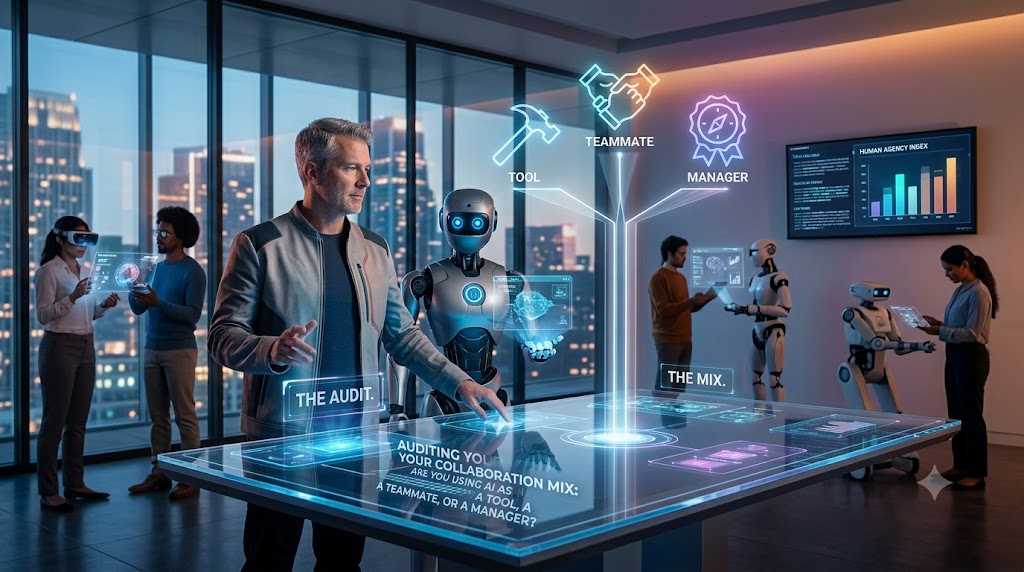
Without intentional design, organizations drift into unexamined technological relationships. By conducting an audit of your human-AI collaboration mix across three distinct operational modes—Tool, Teammate, and Manager—you can ensure automation amplifies human agency, creativity, and strategic foresight rather than eroding them.
Most enterprise AI implementations begin with a straightforward mandate: eliminate friction and boost productivity. Yet software is no longer a passive medium waiting for explicit commands. Generative models and agentic workflows possess variable levels of autonomy, synthetic reasoning, and directive capability.
Without a deliberate strategy, teams frequently experience a strange paradox:
- They attempt to use advanced AI merely as a fast copy-pasting tool, missing its potential for collaborative problem-solving.
- Simultaneously, they unconsciously surrender delegation, evaluation, and prioritization choices to algorithms, turning AI into an unvetted manager.
Sustainable, human-centered innovation requires us to pause and audit these dynamics. Building a high-performing, resilient organization means consciously designing where human judgment is preserved, where machine intelligence acts as a partner, and where algorithmic systems are strictly constrained.
II. Mode 1: AI as a Tool (Efficiency & Execution)
When used as a Tool, AI operates in a classic transactional mode. Human actors retain full directive control, defining inputs and evaluating outputs against strict boundaries.
[ Human Directive ] ──> [ AI Execution ] ──> [ Human Review & Action ]
- Key Characteristics: Task-bound, reactive, and execution-focused (e.g., reformatting unstructured data, summarizing lengthy transcripts, generating initial code blocks, basic research synthesis).
- Strategic Value: Eliminates cognitive friction, reduces routine operational toil, and accelerates delivery cycle times.
- The Strategic Pitfall: Treating dynamic intelligence solely as a static utility limits its value. If your organization only uses AI to do yesterday’s work slightly faster, you run the risk of accelerating outdated processes rather than innovating new ones.
III. Mode 2: AI as a Teammate (Co-Creation & Thought Partnership)
When elevated to a Teammate, AI transitions from execution to interaction. The relationship shifts to an iterative dialogue where human and artificial capabilities challenge, refine, and expand upon one another.
[ Human Perspective ] <── Iterative Dialogue & Friction ──> [ AI Synthesis ]
                                   │
                                   ▼
                      [ Expanded Solution Space ]
- Key Characteristics: Scenario planning, rapid prototyping, perspective-shifting exercises (“What customer blind spots are we missing?”), and joint problem-solving.
- Strategic Value: Unlocks productive friction, expands the initial search space for innovations, and enables rapid experience design testing before committing real-world resources.
- The Strategic Pitfall: Diffused accountability and false empathy. Synthetic intelligence lacks lived human context, emotional resonance, and ethical accountability. A machine can simulate strategic alternatives, but humans must retain ownership of the choice and its consequences.
IV. Mode 3: AI as a Manager (Direction & Governance)
When AI assumes the role of a Manager, it gains agency over direction, resource allocation, performance assessment, or process gating.
[ System Rules & Data ] ──> [ Algorithmic Decision ] ──> [ Human Workforce ]
- Key Characteristics: Dynamic resource scheduling, automated ticket routing, algorithmic performance scoring, and automated compliance gatekeeping.
- Strategic Value: High-speed pattern matching and logistical optimization across complex systems that exceed human processing bandwidth.
- The Strategic Pitfall: “Ghost Management.” When algorithmic rules dictate daily priorities without transparent human oversight or empathy, psychological safety declines, organizational trust breaks down, and frontline autonomy gets stripped away.
V. The Organizational Audit Framework: Mapping Your Mix
To align your technology strategy with human-centered principles, run your current AI implementations through a three-part organizational audit:
1. Agency & Authority Mapping
Identify where systems act strictly upon human instruction (Tool), where they shape thinking iteratively (Teammate), and where they dictate outcomes or workflows (Manager).
| Operational Focus | Tool Mode | Teammate Mode | Manager Mode |
|---|---|---|---|
| Primary Function | Task execution & automation | Ideation & counterpoint | Workflow routing & governance |
| Locus of Control | 100% Human-driven | Shared / Conversational | System-driven / Algorithmic |
| Success Metric | Time saved / Error reduction | Solution breadth & depth | Operational throughput |
2. Experience Impact Assessment
Evaluate how your current mix impacts worker agency and customer experiences:
- Are team members feeling empowered by thought-partnership, or micromanaged by opaque metrics?
- Is technological adoption giving employees time to focus on strategic work, or simply increasing task volume?
3. Accountability Alignment
Establish clear rules of ownership:
- The Non-Delegable Rule: Strategic intent, moral responsibility, and relationship building must remain 100% human functions.
- The Audit Rule: Any system operating in Manager mode must feature clear human-in-the-loop escalation paths and transparent, challengeable decision logic.
VI. Conclusion: Designing Intended Collaboration Futures
The future of work is not about replacing human talent with technology; it is about designing intentional, high-trust environments where human creativity, wisdom, and strategic foresight remain central.
When you audit and balance your collaboration mix, you transition your organization from passive software adoption to deliberate experience design. Treat AI as a precision tool to strip away toil, leverage it as an agile teammate to expand your creative horizons, and keep it firmly on a tight leash whenever it touches management. Innovation flourishes when technology serves as a lever for human potential, not a substitute for human perspective.
Frequently Asked Questions
What is the difference between using AI as a tool, a teammate, and a manager?
Using AI as a Tool involves transactional, task-bound execution where humans maintain complete control (e.g., summarizing text). Using AI as a Teammate creates an iterative dialogue for co-creation, scenario planning, and thought partnership. Using AI as a Manager delegates operational agency to algorithms for resource allocation, workflow routing, or performance gating.
Why is it dangerous to let AI act as an unmonitored manager?
When AI assumes manager-level authority without transparent human oversight—a phenomenon known as “ghost management”—it can erode psychological safety, destroy organizational trust, and strip autonomy from frontline employees by prioritizing algorithmic efficiency over human context and empathy.
How can organizations audit their current human-AI collaboration mix?
Organizations can audit their collaboration mix by mapping agency and authority across workflows, assessing the impact of AI on employee experience and agency, and enforcing accountability rules ensuring strategic and ethical decisions remain non-delegable human responsibilities.
Bottom line: Futurology is not fortune telling. Futurists use a scientific approach to create their deliverables, but a methodology and tools like those in FutureHacking™ can empower anyone to engage in futurology themselves.
Image credit: Gemini
 Sign up here to get Human-Centered Change & Innovation Weekly delivered to your inbox every week.