LAST UPDATED: December 4, 2025 at 4:48 PM
GUEST POST from Chateau G Pato
The innovation landscape is shifting, and the tremors are strongest in the artificial intelligence (AI) sector. For a moment, OpenAI felt like an impenetrable fortress, the company that cracked the code and opened the floodgates of generative AI to the world. But now, as a thought leader focused on Human-Centered Innovation, I see the classic signs of disruption: a growing competitive field, a relentless cash burn, and a core product advantage that is rapidly eroding. The question of whether OpenAI is on the brink of bankruptcy isn’t just about sensational headlines — it’s about the fundamental sustainability of a business model built on unprecedented scale and staggering cost.
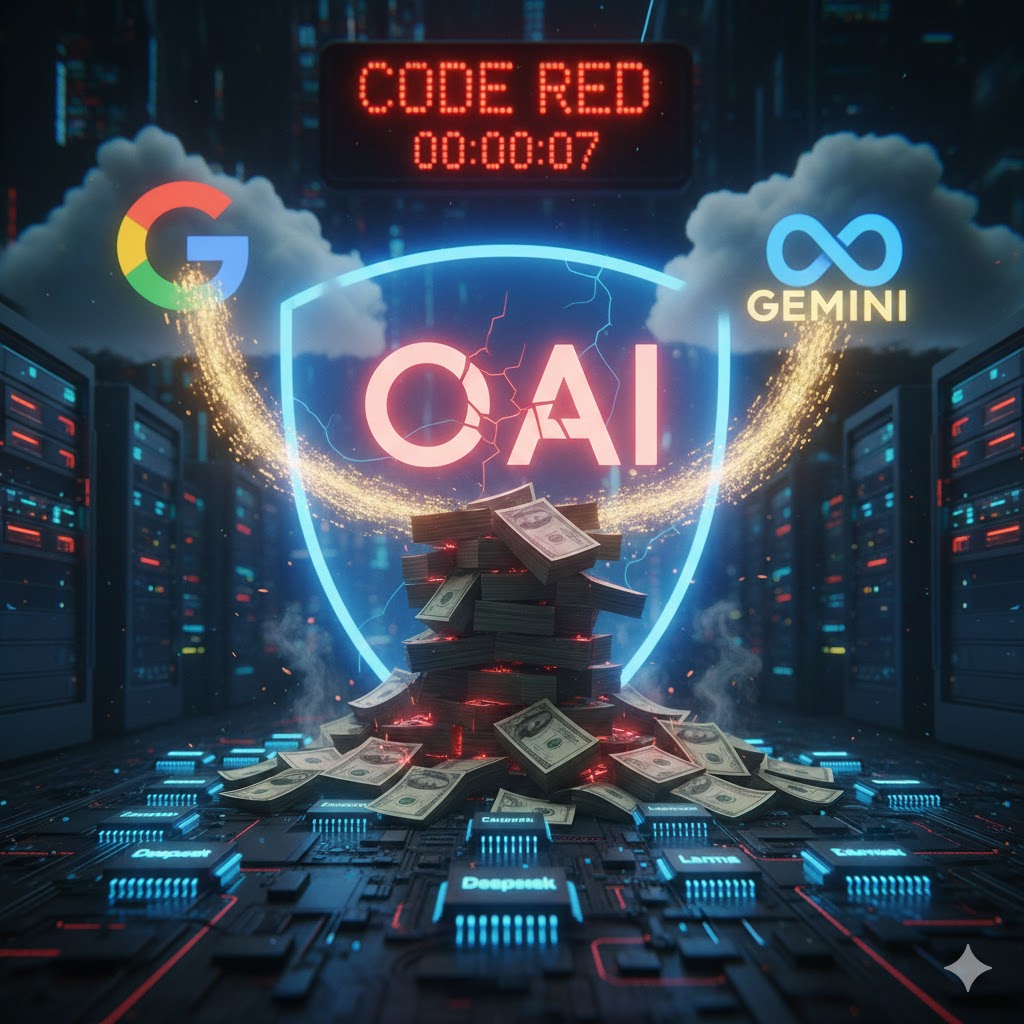
The “Code Red” announcement from OpenAI, ostensibly about maintaining product quality, was a subtle but profound concession. It was an acknowledgment that the days of unchallenged superiority are over. This came as competitors like Google’s Gemini and Anthropic’s Claude are not just keeping pace, but in many key performance metrics, they are reportedly surpassing OpenAI’s flagship models. Performance parity, or even outperformance, is a killer in the technology adoption curve. When the superior tool is also dramatically cheaper, the choice for enterprises and developers — the folks who pay the real money — becomes obvious.
The Inevitable Crunch: Performance and Price
The competitive pressure is coming from two key vectors: performance and cost-efficiency. While the public often focuses on benchmark scores like MMLU or coding abilities — where models like Gemini and Claude are now trading blows or pulling ahead — the real differentiator for business users is price. New models, including the China-based Deepseek, are entering the market with reported capabilities approaching the frontier models but at a fraction of the development and inference cost. Deepseek’s reportedly low development cost highlights that the efficiency of model creation is also improving outside of OpenAI’s immediate sphere.
Crucially, the open-source movement, championed by models like Meta’s Llama family, introduces a zero-cost baseline that fundamentally caps the premium OpenAI can charge. Llama, and the rapidly improving ecosystem around it, means that a good-enough, customizable, and completely free model is always an option for businesses. This open-source competition bypasses the high-cost API revenue model entirely, forcing closed-source providers to offer a quantum leap in utility to justify the expenditure. This dynamic accelerates the commoditization of foundational model technology, turning OpenAI’s once-unique selling proposition into a mere feature.
OpenAI’s models, for all their power, have been famously expensive to run — a cost that gets passed on through their API. The rise of sophisticated, cheaper alternatives — many of which employ highly efficient architectures like Mixture-of-Experts (MoE) — means the competitive edge of sheer scale is being neutralized by engineering breakthroughs in efficiency. If the next step in AI on its way to artificial general intelligence (AGI) is a choice between a 10% performance increase and a 10x cost reduction for 90% of the performance, the market will inevitably choose the latter. This is a structural pricing challenge that erodes one of OpenAI’s core revenue streams: API usage.
The Financial Chasm: Burn Rate vs. Reserves
The financial situation is where the “bankruptcy” narrative gains traction. Developing and running frontier AI models is perhaps the most capital-intensive venture in corporate history. Reports — which are often conflicting and subject to interpretation — paint a picture of a company with an astronomical cash burn rate. Estimates for annual operational and development expenses are in the billions of dollars, resulting in a net loss measured in the billions.
This reality must be contrasted with the position of their main rivals. While OpenAI is heavily reliant on Microsoft’s monumental investment — a complex deal involving cash and Azure cloud compute credits — Microsoft’s exposure is structured as a strategic infrastructure play. The real financial behemoth is Alphabet (Google), which can afford to aggressively subsidize its Gemini division almost indefinitely. Alphabet’s near-monopoly on global search engine advertising generates profits in the tens of billions of dollars every quarter. This virtually limitless reservoir of cash allows Google to cross-subsidize Gemini’s massive research, development, and inference costs, effectively enabling them to engage in a high-stakes price war that smaller, loss-making entities like OpenAI cannot truly win on a level playing field. Alphabet’s strategy is to capture market share first, using the profit engine of search to buy time and scale, a luxury OpenAI simply does not have without a continuous cash injection from a partner.
The question is not whether OpenAI has money now, but whether their revenue growth can finally eclipse their accelerating costs before their massive reserve is depleted. Their long-term financial projections, which foresee profitability and revenues in the hundreds of billions by the end of the decade, require not just growth, but a sustained, near-monopolistic capture of the new AI-driven knowledge economy. That becomes increasingly difficult when competitors are faster, cheaper, and arguably better, and have access to deeper, more sustainable profit engines for cross-subsidization.
The Future Outlook: Change or Consequence
OpenAI’s future is not doomed, but the company must initiate a rapid, human-centered transformation. The current trajectory — relying on unprecedented capital expenditure to maintain a shrinking lead in model performance — is structurally unsustainable in the face of faster, cheaper, and increasingly open-source models like Meta’s Llama. The next frontier isn’t just AGI; it’s AGI at scale, delivered efficiently and affordably.
OpenAI must pivot from a model of monolithic, expensive black-box development to one that prioritizes efficiency, modularity, and a true ecosystem approach. This means a rapid shift to MoE architectures, aggressive cost-cutting in inference, and a clear, compelling value proposition beyond just “we were first.” Human-Centered Innovation principles dictate that a company must listen to the market — and the market is shouting for price, performance, and flexibility. If OpenAI fails to execute this transformation and remains an expensive, marginal performer, its incredible cash reserves will serve only as a countdown timer to a necessary and painful restructuring.
Frequently Asked Questions (FAQ)
- Is OpenAI currently profitable?
OpenAI is currently operating at a significant net loss. Its annual cash burn rate, driven by high R&D and inference costs, reportedly exceeds its annual revenue, meaning it relies heavily on its massive cash reserves and the strategic investment from Microsoft to sustain operations. - How are Gemini and Claude competing against OpenAI on cost and performance?
Competitors like Google’s Gemini and Anthropic’s Claude are achieving performance parity or superiority on key benchmarks. Furthermore, they are often cheaper to use (lower inference cost) due to more efficient architectures (like MoE) and the ability of their parent companies (Alphabet and Google) to cross-subsidize their AI divisions with enormous profits from other revenue streams, such as search engine advertising. - What was the purpose of OpenAI’s “Code Red” announcement?
The “Code Red” was an internal or public acknowledgment by OpenAI that its models were facing performance and reliability degradation in the face of intense, high-quality competition from rivals. It signaled a necessary, urgent, company-wide focus on addressing these issues to restore and maintain a technological lead.
UPDATE: Just found on X that HSBC has said that OpenAI is going to have nearly a half trillion in operating losses until 2030, per Financial Times (FT). Here is the chart of their $100 Billion in projected losses in 2029. With the success of Gemini, Claude, Deep Seek, Llama and competitors yet to emerge, the revenue piece may be overstated:
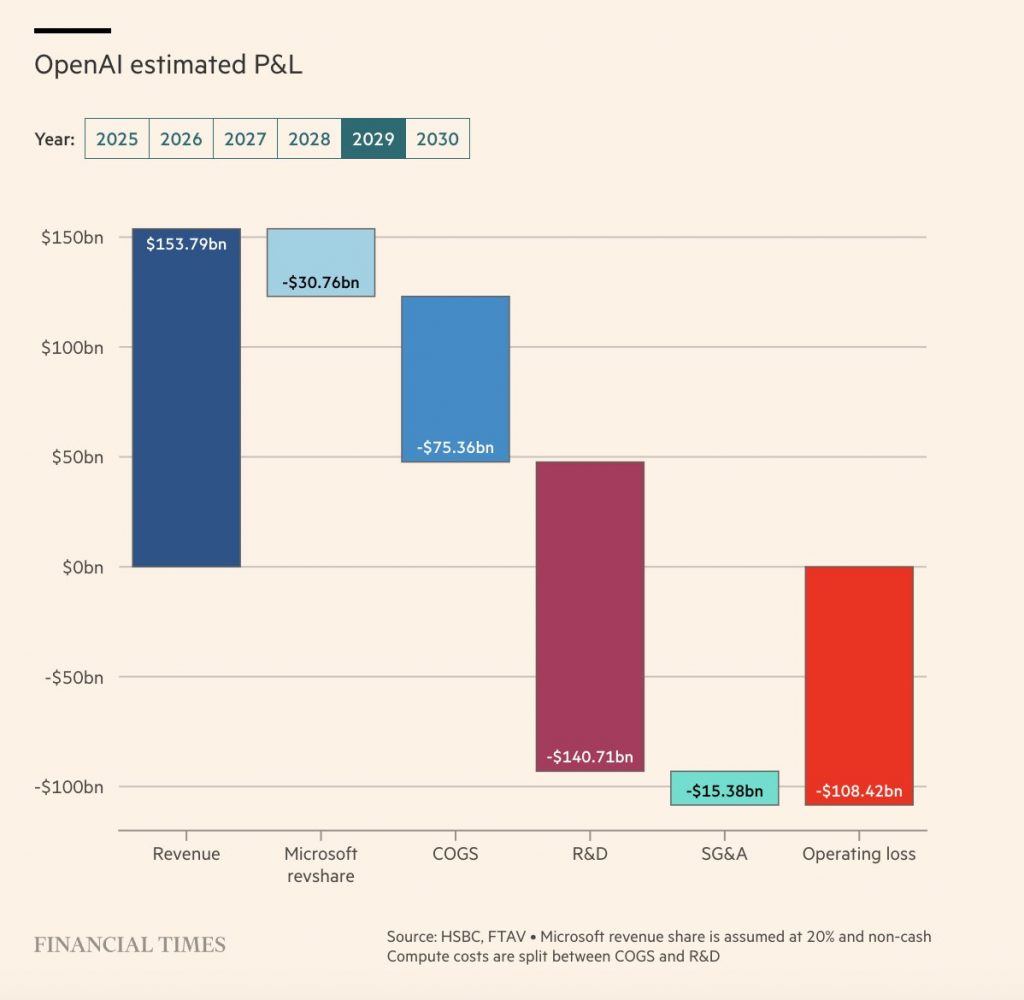
Image credits: Google Gemini, Financial Times
 Sign up here to get Human-Centered Change & Innovation Weekly delivered to your inbox every week.
Pingback: Top 10 Human-Centered Change & Innovation Articles of December 2025 | Human-Centered Change and Innovation
Pingback: Top 10 Human-Centered Change & Innovation Articles of January 2026 | Human-Centered Change and Innovation