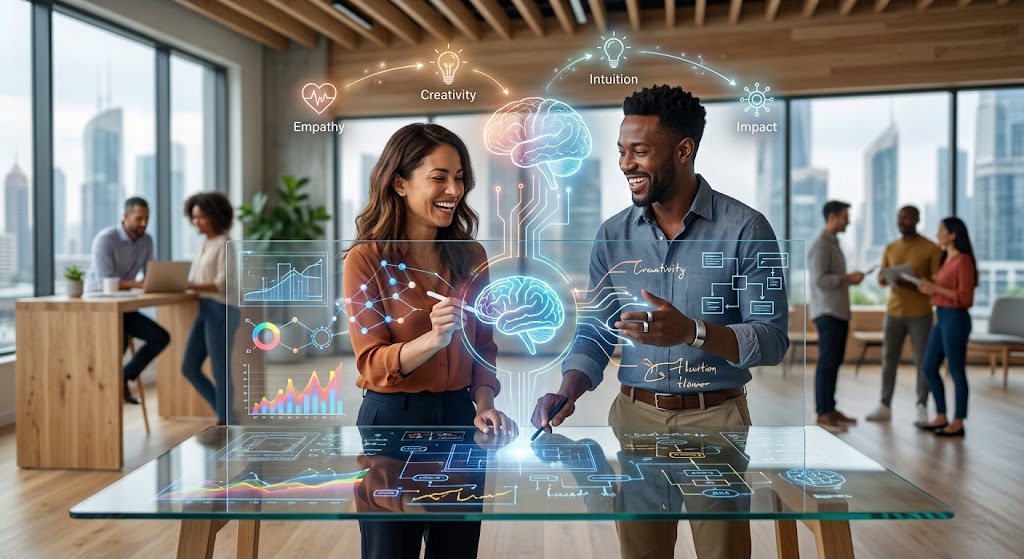
GUEST POST from Chateau G Pato
I. The Paradigm Shift: From Automation to Augmentation
Artificial Intelligence is not coming to replace humanity; it is accelerating the urgent need to double down on what makes us uniquely human. For decades, organizations have chased operational efficiency—standardizing tasks, cutting friction, and streamlining processes. In an AI-driven world, however, raw efficiency is no longer a competitive moat—it is merely the cost of entry.
The Efficiency Trap
When every organization has access to the same generative tools and algorithmic optimizations, competing solely on speed and output leads to commoditization. True differentiation requires moving beyond doing the same things faster, toward designing entirely new value streams grounded in human connection and strategic vision.
The Co-Intelligence Imperative
We must reframe the narrative from a zero-sum game of human substitution to one of continuous augmentation. The future belongs to co-intelligent organizations that leverage machine capability to supercharge human creativity, strategic reasoning, and relationship-building.
Directing Technology with Purpose
Technology provides the leverage, but human-centered sight, vision, and empathy determine the direction. AI can generate options, process datasets, and predict outcomes, but only human judgment can assign true value, uphold ethics, and define a meaningful future worth building.
II. Unpacking “The Human Advantage” (What AI Can’t Replicate)
While artificial intelligence excels at pattern recognition, predictive processing, and vast scale synthesis, it remains an engine of probabilities—not possibilities. The true engine of innovation remains distinctively human. To build resilient organizations in an AI-saturated world, leaders must cultivate and protect the capabilities that algorithms simply cannot replicate.
Empathy & Experience Design
AI can analyze touchpoints, but it cannot feel human emotion. Experience design relies on deep empathy—the capacity to uncover unarticulated needs, sense friction points, and understand the messy, non-linear realities of the human experience. Delivering meaningful customer and employee experiences requires emotional intelligence, nuance, and genuine connection.
Contextual Intuition & Moral Judgment
Algorithms operate on historical data, which means they excel at standard environments but struggle with novel context, ambiguity, and ethical gray areas. Human leaders possess contextual intuition—the ability to read between the lines, consider organizational culture, weigh ethical trade-offs, and make high-stakes judgment calls when data is incomplete or conflicting.
Creative Friction & Interdisciplinary Innovation
Generative AI reorganizes existing information; humans create original paradigms. Breakthrough innovation often emerges from creative friction—combining radically different fields, challenging entrenched assumptions, and embracing dynamic debate. Navigating the spark between differing human perspectives drives true category-defining breakthroughs.
III. Human-Centered Change™ in the Age of AI
Technology transitions are rarely defeated by technical limitations; they fail because of human friction. As artificial intelligence fundamentally reshapes how work gets done, leaders must move past top-down technology rollouts and apply structured, human-centered approaches to organizational change.
Getting Everyone on the Same Page
When organizations introduce complex AI tools without shared clarity, anxiety and confusion naturally follow. Utilizing visual, collaborative frameworks enables cross-functional teams to align on goals, identify risks early, and co-create workflows. Shared visual clarity transforms silent resistance into active, collective ownership.
Overcoming Human Adoption Friction
The majority of digital transformation initiatives falter because they treat change as an IT project rather than a human transition. Fear of displacement, skill obsolescence, and loss of agency are real human concerns. Successfully navigating this shift requires empathy, psychological safety, transparent communication, and clear pathways for upskilling.
Redesigning Work for Human Strengths
Succeeding with AI requires more than superimposing tools onto legacy processes. Organizations must intentionally redesign team roles and operating models around core human capabilities—focusing effort on strategic orchestration, complex problem-solving, curiosity, and relationship management while offloading transactional tasks to machine intelligence.
IV. Practical Principles for Innovation Leaders
Navigating the AI transformation requires more than strategic intent; it demands concrete leadership behaviors that bridge technological capability with human potential. Leaders must actively shape an environment where human ingenuity and algorithmic speed reinforce one another.
Lead with the ‘Why’, Enable with the ‘How’
Technology initiatives fail when tools are deployed in search of a problem. Leadership begins by clearly defining the human and business outcomes—solving real customer pain points or removing employee friction—before selecting technical solutions. When teams understand the core purpose, technology becomes a meaningful catalyst rather than a forced mandate.
Cultivate Continuous Adaptability
Static five-year roadmaps cannot keep pace with exponential technology. Innovation leaders must foster an experimental culture built on rapid hypothesis testing, continuous feedback loops, and high psychological safety. Encouraging smart experimentation turns organizational anxiety into active learning and adaptability.
Orchestrate Human-AI Synergies
Peak performance occurs at the intersection of machine efficiency and human judgment. Leaders must deliberately architect cross-functional workflows that pair algorithmic speed and data processing with human discernment, ethical oversight, and contextual understanding. Structuring these collaborative dynamics ensures AI serves as an multiplier for human ambition.
V. Conclusion: The Future is Intentionally Human
As artificial intelligence continues to reshape industries and redefine productivity standards, the defining characteristic of successful organizations will not be their technical infrastructure alone. The true differentiator will be how effectively they harness technology to unleash human capability, creativity, and connection.
Reframing the Transformation Agenda
The core leadership question of our era must shift. Instead of asking only “What tasks can we automate with AI?” leaders must consistently ask, “How can AI eliminate friction so our people can focus on higher-value, uniquely human impact?” This subtle pivot transforms AI from a cost-reduction lever into a growth engine powered by human ingenuity.
Elevating Experience and Connection
The ultimate goal of human-centered innovation is to design experiences that resonate deeply—for both customers and employees. In an increasingly automated marketplace, authentic human empathy, thoughtful experience design, and strong organizational purpose become the highest-value currencies available to any brand.
The Path Forward
The future of work is neither purely automated nor strictly legacy; it is intentionally co-intelligent. By anchoring AI initiatives in empathy, visual collaborative planning, and continuous adaptability, organizations can navigate technological disruption while building a workplace—and a market presence—that is resilient, impactful, and undeniably human.
Frequently Asked Questions
What is the core difference between AI automation and human augmentation?
Automation focuses on replacing human effort to optimize for raw speed, efficiency, and cost reduction. Augmentation uses AI to handle repetitive tasks and data synthesis so humans can focus on high-value capabilities like empathy, creative problem-solving, strategic judgment, and experience design.
Why do most AI transformation initiatives fail to deliver expected ROI?
Most AI transformations fail because organizations treat them as technology rollouts rather than human transitions. Technical adoption founders on human friction, fear of displacement, and lack of visual alignment. Success requires addressing culture, psychology, and organizational design alongside technology.
How can organizations foster “The Human Advantage” alongside AI adoption?
Organizations foster the Human Advantage by redesigning workflows around uniquely human strengths—such as contextual intuition, relationship building, and continuous innovation—while leveraging visual, collaborative frameworks to align teams around a shared, human-centered vision.
Bottom line: Futurology is not fortune telling. Futurists use a scientific approach to create their deliverables, but a methodology and tools like those in FutureHacking™ can empower anyone to engage in futurology themselves.
Image credit: misterinnovation.com
 Sign up here to get Human-Centered Change & Innovation Weekly delivered to your inbox every week.