Helping Employees Transition Through Professional Evolution
GUEST POST from Chateau G Pato
I. Understanding the Anatomy of Identity Loss
When organizations undergo significant transformations, leaders often spend millions optimizing systems and workflows while ignoring the fundamental human architecture beneath them. True change rarely fails because the strategy was flawed; it fails because people are asked to abandon who they are before they understand who they are becoming.
The “Who Am I Now?” Dilemma
Professional identity is built on years of accumulated expertise, earned status, and predictable mastery. When a transformation upends those foundations, employees experience a profound psychological shift:
- The Fall from Expert to Novice: Moving subject-matter experts into unfamiliar digital paradigms strip them of their primary source of workplace confidence. The anxiety of feeling incompetent often manifests as active resistance.
- Loss of Agency and Status: Reorganizations and process shifts can erase legacy accomplishments overnight, leaving individuals feeling disempowered and invisible.
- The Professional Grief Cycle: Denial, defensiveness, and bargaining are not signs of stubbornness—they are natural human responses to losing a meaningful professional identity.
Futurology & Technological Displacement
As artificial intelligence and automated systems rapidly integrate into daily operations, the nature of workplace friction has fundamentally changed. The threat is no longer just operational; it is existential.
- Redefining Human Value: Technology doesn’t just alter what employees do—it challenges who they feel they are. When an algorithm performs in seconds what took a specialist years to master, it creates a crisis of purpose.
- The Role Evolution Mandate: Workers must shift from tactical execution to strategic curation, prompt orchestration, and high-empathy problem solving. This transition requires active guidance, psychological safety, and intentional experience design.
II. Framing the Transition: Experience Design for Identity Shifts
To navigate profound identity disruption, organizations must look beyond traditional change management. Traditional methods treat people as assets to be moved across a spreadsheet. Human-centered experience design, by contrast, recognizes that transitioning professional identity is an emotional and psychological journey that requires intentional architecture.
From Change Management to Experience Architecture
Systemic transformation succeeds only when we design the transition experience with the same rigor and empathy we apply to customer experience:
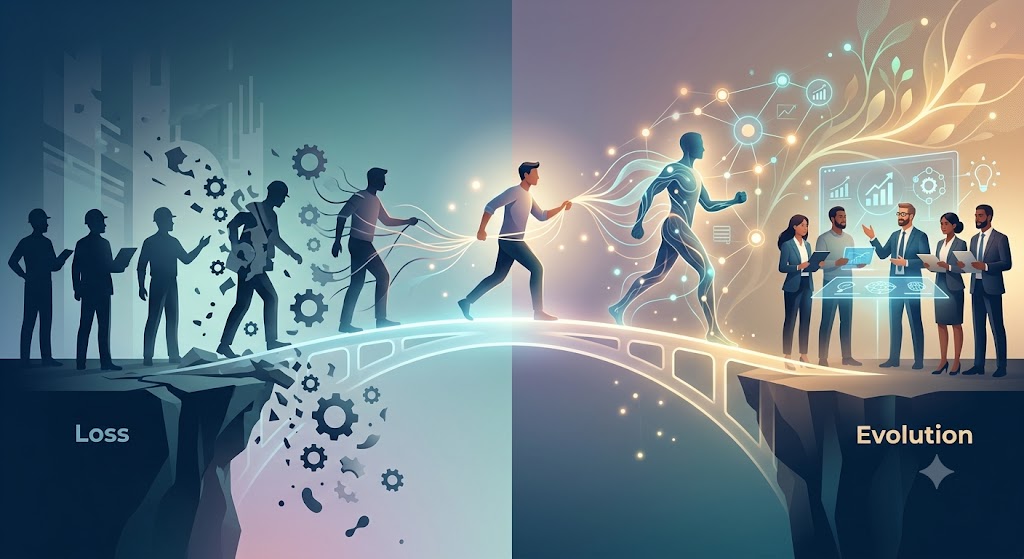
- Building Psychological Bridges: Mandating a new future state overnight creates panic and withdrawal. Experience architecture builds intentional stepping stones—scaffolding new behaviors while helping employees safely sunset legacy routines.
- Designing for Emotional Touchpoints: Mapping the employee journey means identifying key moments of friction, uncertainty, and self-doubt, then embedding explicit support structures directly into those touchpoints.
- Co-Creating the Future State: People rarely resist changes they help design. Involving employees in shaping their evolved roles transforms identity loss into identity ownership.
The Change Planning Framework
Integrating identity considerations directly into the early strategy phase prevents blind spots that derail execution:
- Mapping Identity Loss Early: Before launching new initiatives, assess who loses status, mastery, or visibility. Identifying where identity shock will hit hardest allows leaders to proactively design mitigations.
- Visualizing the Shift: Utilizing collaborative visual frameworks and toolkits enables teams to map out their evolving responsibilities together, making abstract organizational shifts tangible and actionable.
- Aligning Purpose with Capability: Help individuals connect their foundational expertise to the new vision, ensuring they see a clear, valued place for themselves in the organization’s future state.
III. Actionable Strategies for Leaders: Preserving Dignity while Driving Evolution
Navigating identity transition requires more than empathetic rhetoric; it demands structured, practical interventions. Leaders must act as architects of transition—creating environments where employees can let go of old paradigms without feeling that their past contributions were meaningless.
1. Honor the Past to Unlock the Future
Abruptly discarding legacy systems or methodologies often signals to long-tenured employees that their past work no longer has value. To unlock momentum for the future, leaders must intentionally honor past achievements:
- Acknowledge the Legacy: Celebrate the expertise, dedication, and historical wins that brought the organization to its current point before demanding adoption of the new direction.
- Create Formal Sunsetting Rituals: Mark the retirement of legacy tools or processes with intentional milestones, giving teams a sense of closure rather than a silent erasure.
2. Reframing Core Capabilities
When tasks become automated or obsolete, an employee’s sense of competence is threatened. Leaders must help individuals decouple their professional worth from specific tools and anchor it to enduring human capabilities:
- Translate Tactical Skills into Strategic Value: Help a manual process expert see that their true value lies in domain context, critical thinking, and quality orchestration, not just mechanical execution.
- Highlight Transferable Strengths: Conduct skill-mapping exercises that explicitly connect an individual’s foundational strengths—such as empathy, problem-solving, or stakeholder management—to newly emerging roles.
3. Designing Psychological Safety Networks
Identity transition forces experienced professionals back onto a learning curve, introducing the fear of failure. Without psychological safety, individuals protect their identity through resistance:
- Establish Safe Sandbox Environments: Create low-stakes experimentation zones where employees can practice using new tools, platforms, or workflows without fear of performance penalties.
- Build Identity Support & Peer Networks: Pair transitioning employees with mentors or peers who have successfully navigated similar role evolutions to offer practical guidance and reassurance.
4. Redefining Success Metrics
Continuing to measure performance against legacy key performance indicators (KPIs) while expecting new behaviors creates conflicting signals and heightens identity anxiety:
- Reward Adaptability and Learning Velocity: Shift evaluation frameworks to value curiosity, experimentation, and speed of skill acquisition alongside traditional output metrics.
- Recognize Value Orchestration: Measure how effectively individuals leverage new capabilities, AI tools, or cross-functional collaborations to drive broader organizational outcomes.
IV. The Leader’s Role as an Identity Catalyst
Transformation cannot be delegated solely to HR or change management offices. True organizational agility requires leaders at every level to step up as identity catalysts—guiding their teams through the vulnerability of evolution with authenticity, narrative clarity, and deliberate experience design.
Empathy as a Strategic Metric
Leading through identity disruption requires moving beyond top-down mandates toward genuine, human-centered engagement:
- Radical Candor and Transparency: Acknowledge the discomfort and ambiguity of change directly. Pretending a transition is seamless undermines trust and dismisses real employee anxieties.
- Active Listening and Validation: Create deliberate feedback loops to hear employee concerns without immediately jumping to defend the change strategy. Validating their experience builds the psychological safety needed to move forward.
Storytelling and Narrative Building
Data drives decisions, but stories drive commitment. Leaders must help employees connect their personal career arcs to the organization’s macro journey:
- Crafting the Evolution Story: Help individuals frame their career trajectory not as a sharp rupture, but as a logical, empowering next chapter built on the foundation of their past contributions.
- Illuminating Role Models: Highlight stories of peers who have successfully reinvented their roles, providing tangible proof concepts for what success looks like in the new paradigm.
Designing the New Employee Experience (EX)
A successful transition culminates in an employee experience that feels intentional, empowering, and aligned with long-term growth:
- Restoring Autonomy and Agency: Re-establish a sense of control by giving employees room to shape how they execute their new responsibilities and define their daily workflows.
- Cultivating Renewed Purpose: Ensure new roles are clearly tied to meaningful business and customer outcomes, helping individuals regain pride and fulfillment in their evolving professional identity.
Conclusion: Building Resilient, Evolution-Ready Cultures
In an era defined by continuous technological advancement and market shifts, change is no longer a discrete event with a clear beginning and end—it is a perpetual operating condition. Organizations that succeed in this environment will not be those with the sleekest software or the most rigid plans, but those that master the human dimension of transition.
By shifting our focus from enforcing compliance to designing human-centered transition experiences, we address the root cause of organizational friction: the fear of losing identity, status, and purpose. When leaders honor past contributions, create safe spaces for experimentation, and help employees reframe their core value, identity loss transforms from a point of resistance into a catalyst for profound personal and collective growth.
Ultimately, helping people navigate professional evolution builds hyper-adaptable, deeply loyal cultures. When employees know their dignity and growth are prioritized amidst disruption, they don’t just survive change—they actively drive the innovation required to shape the future.
Frequently Asked Questions
- What is professional identity loss in the workplace?
- Professional identity loss occurs when organizational restructuring, automation, or role shifts strip employees of the legacy expertise, status, and routine tasks that previously defined their professional value and sense of purpose.
- How does experience design differ from traditional change management?
- Traditional change management focuses primarily on processes, tools, and compliance. Experience design takes a human-centered approach, focusing on the psychological journey, emotional friction points, and co-creating transition pathways so employees maintain agency and dignity during evolution.
- How can leaders support employees experiencing identity loss due to AI and automation?
- Leaders can support employees by honoring past contributions, decoupling personal worth from obsolete mechanical tasks, providing safe sandbox environments for risk-free upskilling, and redefining success metrics to reward adaptability and high-empathy value orchestration.
Bottom line: Futurology is not fortune telling. Futurists use a scientific approach to create their deliverables, but a methodology and tools like those in FutureHacking™ can empower anyone to engage in futurology themselves.
Image credit: Gemini
 Sign up here to get Human-Centered Change & Innovation Weekly delivered to your inbox every week.