Merging Digital Intelligence with Material Reality
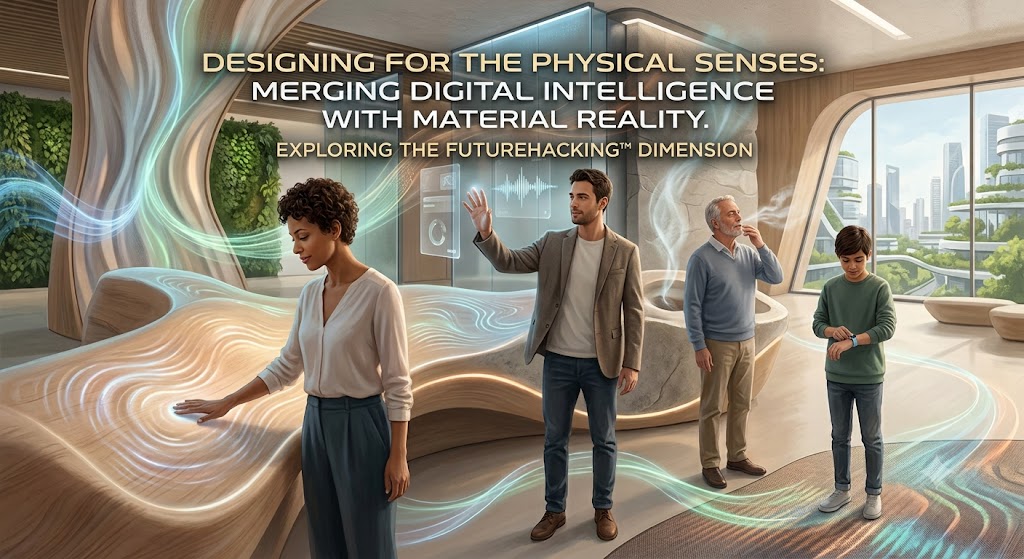
GUEST POST from Art Inteligencia
The Digital Flatland and the Sensory Deficit
For more than two decades, digital transformation and screen-first design paradigms have methodically flattened human experience. We have traded the rich, tactile complexity of the physical world for two-dimensional glass interfaces, smooth pixels, and uniform glass taps. In our rush to optimize for efficiency, scalability, and instant connectivity, we inadvertently backed ourselves into a design corner — one where our interaction with world-changing intelligence is reduced to a swipe, a click, or a passive stare.
Yet human beings did not evolve in a vacuum of illuminated pixels. We are intrinsically multi-sensory creatures engineered to navigate a rich material reality. We decode our surroundings through the subtle friction of a textured surface, the spatial acoustic resonance of a room, changes in ambient temperature, and the deep emotional triggers embedded in scent and weight. When customer experience (CX) and product design initiatives treat the human body as nothing more than a set of eyes and a index finger, they hit a hard value ceiling. They build experiences that are functional, yet emotionally sterile and cognitively exhausting.
The next true horizon of experience design will not be won by making screens brighter, algorithms faster, or digital interfaces more pervasive. The breakthrough lies in merging digital intelligence directly with material reality — creating responsive, ambient environments and physical touchpoints that engage the full spectrum of human perception. By grounding advanced digital capabilities in our physical senses, we can move past screen fatigue and design experiences that feel genuinely human, deeply intuitive, and profoundly meaningful.
Section I: The Physics of Experience — Moving Beyond Sight and Sound
To design truly meaningful hybrid experiences, we must first break free from the sight-and-sound bias that dominates modern product and interaction design. Sight and hearing are undeniably powerful, but they represent only a fraction of how human beings process context, evaluate safety, form memories, and build trust with their environment. When we expand our aperture to include the full spectrum of physical sensation, we unlock entirely new dimensions for innovation and emotional connection.
An Audit of the Physical Senses in Design
Haptics & Tactile Intelligence
Touch is our primary sense of verification; we touch things to confirm what our eyes tell us. In material experience design, tactile feedback goes far beyond simple device vibrations. It encompasses surface texture, compliance, temperature conductivity, and weight distribution. Intelligent design leverages force feedback and material resistance as high-bandwidth communication channels — communicating state changes, physical precision, or brand quality without requiring a single visual pixel.
Olfactory & Gustatory Architecture
Scent bypassed logical routing in the brain and connects directly to the limbic system, the seat of emotion and memory. Despite this direct line to human psychology, olfactory design remains criminally underutilized in commercial and digital-physical integration. Ambient scenting, when deployed with precision, can instantly reduce anxiety, anchor spatial memory, and signal environmental transition. Paired thoughtfully with gustatory elements in hospitality, retail, or healthcare, scent creates visceral, irreproducible brand recall that software alone can never replicate.
Proprioception & Spatial Awareness
Proprioception — our body’s subconscious awareness of its position and movement in space — defines how we navigate physical environments. When environments are digitally augmented without respecting human scale and kinetic movement, the result is spatial disorientation and cognitive fatigue. Designing for spatial intelligence means creating environments that recognize human biomechanics, accommodating how people naturally reach, turn, lean, and move through physical architecture alongside ambient systems.
Sensory Friction vs. Sensory Harmony
Expanding the sensory canvas carries inherent risk. The goal is not to flood the human nervous system with a chaotic symphony of inputs, but rather to orchestrate them into seamless alignment. We must carefully distinguish between two critical states:
- Sensory Friction: The chaotic overlap of competing visual, acoustic, and tactile noise — often created when digital signage, broadcast audio, and intrusive physical displays fight for consumer attention. Sensory friction induces cognitive overload, heightens stress, and drives users to seek exit routes.
- Sensory Harmony: The subtle, synchronized tuning of environmental inputs to support a specific human objective. In a harmonious system, ambient light softens as acoustics adjust, material textures guide intuitive navigation, and subtle cues signal state changes effortlessly.
True mastery in sensory design lies in restraint. By aligning material feedback with digital intelligence, we create environments that feel effortless, restorative, and remarkably intuitive to navigate.
Section II: Bridging the Digital and Material (The Hybrid Experience Framework)
Connecting digital intelligence with the material world requires moving past the idea that technology must always present itself through a screen. The challenge for modern innovators is to weave intelligence directly into physical substrates, transforming passive physical environments into responsive, living ecosystems that adapt to human presence and intent.
Contextual Intelligence: The Perceptual Environment
For an environment to respond meaningfully to human senses, it must first be capable of perceiving them. By combining spatial computing, ambient Internet of Things (IoT) sensors, and edge AI, physical spaces transition from static backdrops to active participants in the human experience.
A contextually intelligent environment does not wait for explicit commands or screen inputs. Instead, it reads subtle environmental and physiological signals — foot traffic flow, ambient noise levels, lighting changes, and spatial proximity — to anticipate needs dynamically. It transforms the physical room or product into an intuitive interface that adjusts lighting, acoustic absorption, temperature, and airflow in real time, matching the physiological rhythm of the people within it.
The Power of Digital Invisibility
The highest achievement in hybrid experience design is often the complete disappearance of the interface. When technology works in harmony with human biology, explicit user interfaces (UI) become redundant. We shift from demanding high-cognitive-load screen interactions to leveraging natural, low-friction physical behaviors:
- Physical Gestures: Replacing tap-and-swipe menus with natural body language, micro-gestures, and directional movement that physical spaces interpret effortlessly.
- Ambient Lighting & Cues: Utilizing subtle shifts in color temperature, light intensity, or edge-lighting along architectural features to direct attention, signal status, or guide movement without a single text-based prompt.
- Acoustic Damping & Directional Sound: Structuring soundscapes that deliver localized information directly where needed, preserving quiet zones elsewhere and reducing overall cognitive clutter.
- Thermal & Tactile Transitions: Employing material surface temperature and physical texture changes to communicate boundaries, safety limits, or operational readiness.
The Sensory Value Creation Equation
Deploying sensory technology without a grounded strategic framework risks creating expensive gimmicks. To ensure hybrid physical-digital experiences deliver tangible business and human value, leaders must evaluate every touchpoint across three core vectors:
$$\text{Sensory Value} = \frac{\text{Value Creation} \times \text{Value Access}}{\text{Value Translation Friction}}$$
- Value Creation: Does the sensory enhancement solve a real human problem, improve safety, reduce anxiety, or heighten emotional engagement?
- Value Access: Can every individual — regardless of physical ability or neurodiversity — intuitively access and benefit from the sensory interaction without specialized training?
- Value Translation: How seamlessly does the underlying digital data translate into a meaningful physical sensation? If the translation requires cognitive effort or introduces operational friction, the hybrid experience fails.
When digital intelligence operates invisibly in service of human senses, technology ceases to be a distraction and becomes an organic extension of physical reality.
Section III: Sector Applications and Future Case Studies
The convergence of digital intelligence and sensory material design is not a theoretical exercise — it is actively reshaping how forward-thinking organizations build value across industries. By moving from purely screen-based digital strategies to integrated sensory environments, leaders can unlock new levels of customer loyalty, operational performance, and human well-being.
Retail & Commerce: Reclaiming the Physical Advantage
E-commerce won on convenience and algorithmic personalization, but it stripped away the tactile discovery that makes shopping human. To stay relevant, physical retail must lean into what screens can never replicate: high-fidelity sensory engagement.
The future of retail experience design lies in “touch-and-feel” environments powered by invisible digital backbones:
- Dynamic Material Interactivity: Smart display surfaces embedded with RFID and computer vision that alter localized ambient lighting, surface warmth, or subtle scent cues the moment a customer picks up a product — enriching story-telling without forcing the customer to scan a QR code.
- Adaptive Acoustic Environments: Directional audio zones that deliver tailored brand narratives or contextual music to individual shoppers while maintaining an overall tranquil acoustic floor throughout the store.
- Sensory Personalization: Utilizing ambient sensors to adapt store lighting and atmosphere based on real-time foot traffic density, reducing sensory overload during peak hours and maintaining an inviting, high-touch environment.
Workplace & Organizational Design: Cultivating Cognitive Performance
Modern workplaces are suffering from a quiet crisis of screen fatigue, open-plan acoustic distraction, and environmental monotony. Applying human-centered sensory design to physical work environments offers a powerful lever for change management, employee retention, and collaborative energy.
- Circadian and Thermal Adaptation: Smart architectural systems that subtly shift color temperature, light intensity, and micro-climate airflow throughout the workday to align with natural human circadian rhythms, mitigating afternoon cognitive drops.
- Tactile and Spatial Psychological Safety: Incorporating biophilic materials, acoustic-damping textures, and flexible spatial geometry that allow teams to switch effortlessly between high-focus individual work and dynamic group ideation.
- Ambient Status Signals: Replacing intrusive desktop notifications with subtle, non-disruptive spatial lighting or physical movement cues that communicate room availability, focus times, or organizational milestones without breaking deep work flow.
Healthcare & Wellness: Healing Through Environment Design
Healthcare environments are notoriously sterile, noisy, and stress-inducing — factors that actively impede recovery and heighten patient anxiety. Bridging digital diagnostic intelligence with calming material reality transforms hospitals and wellness centers from clinical processing facilities into therapeutic sanctuaries.
- Bio-Responsive Patient Rooms: Ambient sensor arrays that continuously read biometric stress markers and automatically soften room lighting, project calming visual textures onto architectural surfaces, and release evidence-based therapeutic scents.
- Tactile Stress-Reduction Tools: Medical interfaces and rehabilitation devices built with warm, soft-touch biomaterials and haptic feedback, reducing patient apprehension during diagnostics or physical therapy.
- Acoustic Isolation & Soundscapes: Active noise-canceling architectural materials and generative ambient soundscapes engineered to mask alarming equipment alarms while keeping care teams fully informed.
Smart Cities & Public Spaces: Human-Scale Urban Innovation
Urban technology initiatives often fall into the trap of over-instrumentation — filling public squares with screens, kiosks, and cameras while ignoring the human experience of navigating physical space. The next generation of urban design prioritizes intuitive, sensory-first physical infrastructure.
- Sensory Navigation & Wayfinding: Public transit hubs and walkways equipped with tactile paving that subtly communicates directional flow or upcoming hazards through subtle texture shifts and embedded haptic guidance.
- Responsive Urban Micro-Climates: Bus shelters and public plazas that dynamically deploy radiant heating, misting, or wind-blocking barriers in response to localized micro-climate sensors and crowd movement.
- Non-Intrusive Public Cues: Utilizing warm architectural illumination and natural materials to intuitively guide night-time pedestrian traffic and signal safe transit pathways without relying on invasive signage or surveillance displays.
Section IV: The FutureHacking™ Perspective — Designing for Horizon 2 & 3
To prepare for the next decade of experience innovation, we must look beyond current mobile devices and smart displays. As we push into Horizon 2 and Horizon 3, breakthroughs in material science, edge computing, and biological sensing will converge, allowing us to interact with physical reality in ways that feel almost telepathic. Forward-thinking leaders must begin building organizational capabilities for these emerging technologies today.
Emerging Technologies to Watch
The convergence of material science and digital intelligence is giving rise to a new toolkit for experience architects:
- Biomimetic & Dynamic Materials: Physical substrates engineered with shape-memory polymers and electro-reactive textures that physically alter their surface structure, warmth, or grip in response to digital inputs, human touch, or biometric stress cues.
- Micro-Climate Regulation & Directional Acoustics: Advanced environmental control systems capable of delivering hyper-localized acoustic beams and tailored micro-thermal zones to specific individuals without bleeding sound or temperature into surrounding physical spaces.
- Spatial AI & Micro-Gesture Recognition: Low-power computer vision and radar-based spatial intelligence that decode subtle human body language, micro-gestures, and posture shifts — enabling environments to sense intent and adapt without requiring explicit voice or touch commands.
The Ethics of Sensory Experience Design
As environments become increasingly responsive, perceptual, and immersive, the line between helpful anticipation and psychological manipulation becomes dangerously thin. Experience design leaders have an urgent responsibility to establish ethical guardrails before these capabilities become ubiquitous.
Designing for physical senses requires addressing three critical ethical imperatives:
- Protecting Cognitive Autonomy: Multi-sensory inputs operate below our conscious filter, reaching directly into emotional and biological processing centers. Designers must strictly reject “sensory dark patterns” — such as engineered scent triggers or acoustic pressure designed to induce impulse buying or manipulate dwell time without consent.
- Mitigating Hyper-Surveilled Environments: Creating perceptual spaces requires gathering real-time spatial and physical data. Organizations must prioritize edge computing — processing sensory inputs locally without harvesting or storing sensitive biological, behavioral, or physical tracking data.
- Sensory Inclusivity & Neurodiversity: Physical environments must account for sensory processing differences. Designs must offer clear control mechanisms, low-stimulation zones, and adaptable sensory modes so that neurodivergent individuals are never overwhelmed or excluded.
By pairing technological foresight with an unwavering commitment to ethics, we can ensure that sensory innovation elevates human agency rather than exploiting it.
Conclusion: Bringing Humanity Back to the Center
We stand at a pivotal crossroads in the evolution of experience design. For decades, our industry’s relentless pursuit of digital transformation has forced human beings to adapt to the constraints of machines — channeling our rich, multi-sensory lives through flat glass, glowing pixels, and rigid digital menus. In doing so, we built a hyper-connected world that is all too often sensory-deprived, emotionally flat, and cognitively exhausting.
The true promise of the next innovation curve is not to replace physical reality with virtual worlds, but to enrich material reality with invisible digital intelligence. When we design for the full spectrum of human perception — harnessing texture, sound, warmth, spatial movement, and ambient light — technology recedes into the background. It ceases to be a distraction competing for our attention and becomes a natural, restorative extension of our physical environment.
The Multi-Sensory Imperative
For business leaders, product strategists, and experience architects, the competitive imperative is clear. Algorithmic efficiency and screen-based features are rapidly becoming table stakes. The organizations that win in the next decade will be those that master the seamless interplay between digital capabilities and physical touchpoints, creating irreproducible, deeply human connections that build lasting brand loyalty and operational excellence.
It is time to look up from our screens. Stop designing exclusively for eyes and thumbs. Start designing for human beings operating in rich, 360-degree sensory environments. By bringing humanity back to the center of experience design, we can build a physical-digital future that feels profoundly meaningful, effortlessly intuitive, and unmistakably alive.
Frequently Asked Questions
Why is experience design moving away from screens and toward physical senses?
After decades of digital-first design, users are experiencing severe screen fatigue and cognitive overload from 2D interfaces. Human beings naturally perceive and process context through 360-degree sensory feedback — such as texture, spatial acoustics, ambient light, and scent. Grounding digital intelligence in material reality creates more intuitive, emotionally resonant, and accessible experiences.
What is the Hybrid Experience Framework?
The Hybrid Experience Framework is a methodology for merging digital capabilities (such as IoT, edge AI, and spatial computing) into physical environments without relying on explicit screens or traditional UIs. It focuses on contextual intelligence, digital invisibility, and balancing value creation against sensory translation friction.
How do ethics apply to sensory and material experience design?
Sensory design directly touches biological and emotional processing centers (e.g., using scent to affect mood). Ethical sensory design requires respecting cognitive autonomy by avoiding “sensory dark patterns” (manipulative environmental triggers), protecting user privacy via local edge computing, and ensuring neuroinclusive spaces that allow users to tune or opt out of stimulation.
Bring This Thinking to Your Next Event
Braden Kelley is a LinkedIn Top Voice, bestselling author, and innovation keynote speaker who helps organizations get to the future first and build sustainable innovation cultures.
Image credit: Gemini
 Sign up here to get Human-Centered Change & Innovation Weekly delivered to your inbox every week.