A Practitioner’s Guide to the Most Important Models

by Braden Kelley and Art Inteligencia
Every organization wants to innovate. Few do it consistently. The difference is almost never creativity — most organizations have more ideas than they can act on. The difference is structure: a repeatable way of thinking about innovation that aligns effort with strategy, channels creative energy toward real opportunities, and builds the organizational capability to innovate continuously rather than occasionally.
That’s what an innovation framework provides. And after two decades of working with organizations on innovation and change — and developing my own frameworks including the Eight I’s of Infinite Innovation, the Value Innovation Framework, and the Human-Centered Innovation Toolkit™ — I’ve developed strong views on which frameworks work, which ones fall short, and how to choose the right one for your situation.
This guide covers the most important innovation frameworks in use today, what each one does well, where each one is limited, and how to choose the right framework for your organization’s specific innovation challenge.
What is an Innovation Framework?
An innovation framework is a structured approach that helps organizations systematically identify opportunities, generate and evaluate ideas, and move from concept to implemented value. A good innovation framework does three things: it provides a common language that aligns leaders, teams, and stakeholders around what innovation means and how it works in your context; it sequences the activities of innovation so that effort is directed toward the highest-value opportunities; and it builds repeatable capability — so that innovation becomes a way of working rather than a periodic event.
The most important thing to understand about innovation frameworks is that no single framework covers all types of innovation equally well. Frameworks that excel at incremental product improvement are not designed for disruptive business model innovation. Frameworks built for startup environments don’t always transfer to large, complex organizations. The first step in choosing a framework is understanding what type of innovation challenge you are actually facing.
The Most Important Innovation Frameworks
McKinsey’s Three Horizons Framework
Developed at McKinsey and popularized in the book The Alchemy of Growth, the Three Horizons Framework helps organizations balance their innovation portfolio across three time horizons:
- Horizon 1 — Extending and defending the core business. Incremental improvements to existing products, services, and business models. Typically 70% of innovation investment.
- Horizon 2 — Building emerging businesses. Adjacent opportunities that leverage existing capabilities in new markets or segments. Typically 20% of innovation investment.
- Horizon 3 — Creating genuinely new options. Transformative innovations that may cannibalize the core business or create entirely new markets. Typically 10% of innovation investment.
Strengths: The most useful framework for having conversations about innovation investment allocation at the executive level. Forces organizations to acknowledge that they need different innovation approaches for different time horizons, and that Horizon 3 work requires protection from the short-term pressures that dominate Horizon 1 management.
Limitations: The 70-20-10 split is a guideline, not a rule — and organizations in different competitive situations need different allocations. The framework also doesn’t tell you how to innovate within each horizon, just how to allocate investment across them. And the original framework assumed horizons of roughly 0-2, 2-5, and 5+ years — in fast-moving industries today, those timeframes may be compressed significantly.
Best for: Portfolio strategy, investment allocation conversations, and helping leadership teams understand why protecting Horizon 3 work from Horizon 1 pressures is essential.
Jobs to Be Done (JTBD)
Developed by Clayton Christensen and refined by Tony Ulwick and Bob Moesta, Jobs to Be Done reframes the innovation question from “what product should we build?” to “what job are customers hiring this product to do?” The insight is that customers don’t buy products — they hire them to make progress in specific circumstances, and understanding the underlying job opens innovation opportunities that product-focused thinking misses entirely.
Strengths: The most powerful framework available for identifying genuinely unmet customer needs and generating breakthrough product and service concepts. The “milkshake marketing” insight — that people hired McDonald’s milkshakes for a morning commute job, not a dessert job — is one of the most cited examples in innovation literature because it illustrates how different JTBD thinking is from conventional market research. JTBD consistently surfaces opportunities that product roadmaps and voice-of-customer surveys miss.
Limitations: Requires significant qualitative research skill to apply well. The interviews and observation needed to surface real jobs-to-be-done are more demanding than standard customer research. JTBD also doesn’t provide a framework for the full innovation process — it’s an insight methodology, not an end-to-end innovation system.
Best for: Product and service innovation, identifying white space opportunities, and challenging assumptions about why customers actually use your products.
Lean Startup
Developed by Eric Ries and drawing on Toyota’s lean manufacturing principles, the Lean Startup framework centers on the Build-Measure-Learn loop: build a minimum viable product (MVP), measure how real customers respond, and learn whether to persevere with the current direction or pivot to a different approach. The core insight is that the biggest risk in innovation is building something nobody wants — and that risk is best mitigated through rapid, cheap experimentation rather than elaborate upfront planning.
Strengths: The most influential innovation framework of the past two decades in the startup world, and increasingly in corporate innovation. The MVP concept has genuinely changed how organizations think about early-stage development. Lean Startup’s emphasis on validated learning — testing assumptions with real customers before significant investment — reduces the waste that kills most innovation programs.
Limitations: Developed for startup environments and doesn’t fully account for the complexity of large organization constraints — governance requirements, brand risk, organizational politics, and the need to coordinate across functions. “Move fast and break things” works differently when you are breaking an established brand or regulatory relationship. Also focuses primarily on product and technology innovation rather than business model or organizational innovation.
Best for: New product development, digital product and service innovation, and any context where rapid experimentation and validated learning are possible.
Disruptive Innovation Framework
Clayton Christensen’s theory of disruptive innovation describes how new entrants typically begin by serving overlooked, over-served, or non-consuming segments with simpler, cheaper solutions — and then move upmarket over time, eventually displacing established players who were focused on serving their most profitable customers. The framework provides a lens for understanding competitive threats that conventional competitive analysis misses.
Strengths: The most powerful framework for understanding how industries are disrupted and for identifying both threats and opportunities from disruptive dynamics. Helps established organizations avoid the innovator’s dilemma — the tendency to dismiss disruptive threats as irrelevant to their core market until it is too late.
Limitations: Better as a diagnostic and strategic lens than as a practical innovation process. The framework tells you where disruption is likely to come from and why, but doesn’t tell you what to do about it. Also, the theory has been misapplied so frequently — with “disruptive” used as a synonym for any significant innovation — that it has lost some of its precision.
Best for: Competitive analysis, strategic planning, and helping leadership teams understand the threats they are systematically underestimating.
Open Innovation
Coined by Henry Chesbrough, open innovation describes a model in which organizations use both internal and external ideas and paths to market to advance their innovation. Rather than relying solely on internal R&D, open innovation deliberately leverages external partners — startups, universities, customers, suppliers, and even competitors — to access capabilities and ideas that would take too long or cost too much to develop internally.
Strengths: Dramatically expands the innovation surface area available to an organization. Companies like Procter & Gamble, whose Connect + Develop program targeted sourcing 50% of innovations from outside the company, demonstrated that open innovation can transform both the scale and velocity of an innovation program. Particularly powerful for organizations that need to access rapidly evolving technology capabilities.
Limitations: Requires significant organizational capability to manage external relationships, evaluate external ideas, and integrate external technologies without destroying their value. The “not invented here” syndrome — the organizational immune system’s tendency to reject external ideas — is a powerful force that many open innovation programs underestimate. Also raises complex IP and partnership issues.
Best for: Technology-intensive industries, organizations seeking to accelerate innovation velocity, and any context where the external innovation ecosystem is moving faster than internal R&D can match.
Design Thinking
Formalized at Stanford’s d.school and popularized by IDEO, design thinking is a human-centered, iterative problem-solving methodology built around five stages: Empathize, Define, Ideate, Prototype, and Test. At its core, design thinking insists that innovation must begin with deep understanding of the people being served — not with technology capabilities or product roadmaps.
Strengths: The best framework available for ensuring that innovation addresses real human needs. Design thinking’s emphasis on empathy and prototyping has genuinely changed how organizations approach product and service development. The methodology transfers well beyond product design to organizational change, service design, and public policy — anywhere that complex human-centered problems need to be solved creatively. For a full treatment, see our guide to the design thinking process.
Limitations: The Empathize and Define stages require significant time investment that organizations under delivery pressure often shortcut — producing the tool’s use without its value. Design thinking also doesn’t address the full innovation pipeline beyond concept validation: scaling, organizational alignment, and change management are outside its scope.
Best for: Product and service innovation, organizational change design, and any context where the problem is not fully understood and human needs are the primary design constraint.
Braden Kelley’s Innovation Frameworks
After applying and observing the frameworks above across hundreds of organizations, I developed my own frameworks to address the gaps I consistently encountered — particularly the absence of frameworks designed for building continuous innovation capability rather than managing individual innovation projects.
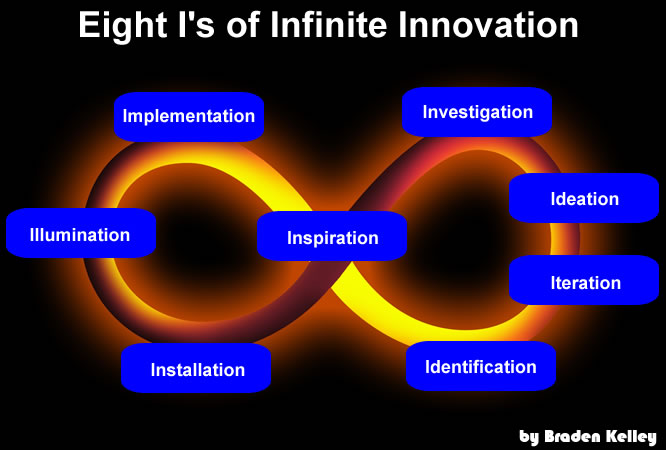
The Eight I’s of Infinite Innovation
The Eight I’s of Infinite Innovation is a continuous innovation framework built around eight interconnected elements: Inspiration, Insight, Ideation, Invention, Implementation, Illumination, Improvements, and Infinity. Unlike project-based innovation frameworks, the Eight I’s is designed to be a perpetual cycle — the outputs of one round become the inputs for the next, creating a self-reinforcing engine of continuous innovation rather than a series of discrete projects.
The framework is particularly suited to organizations transitioning from a product-centered to a customer needs-centered structure — where innovation must be ongoing and adaptive rather than periodic and planned. The Eight I’s is most powerful when combined with the Value Innovation Framework, which provides the strategic lens for determining which opportunities are worth pursuing. Read more about the Eight I’s of Infinite Innovation →
The Value Innovation Framework
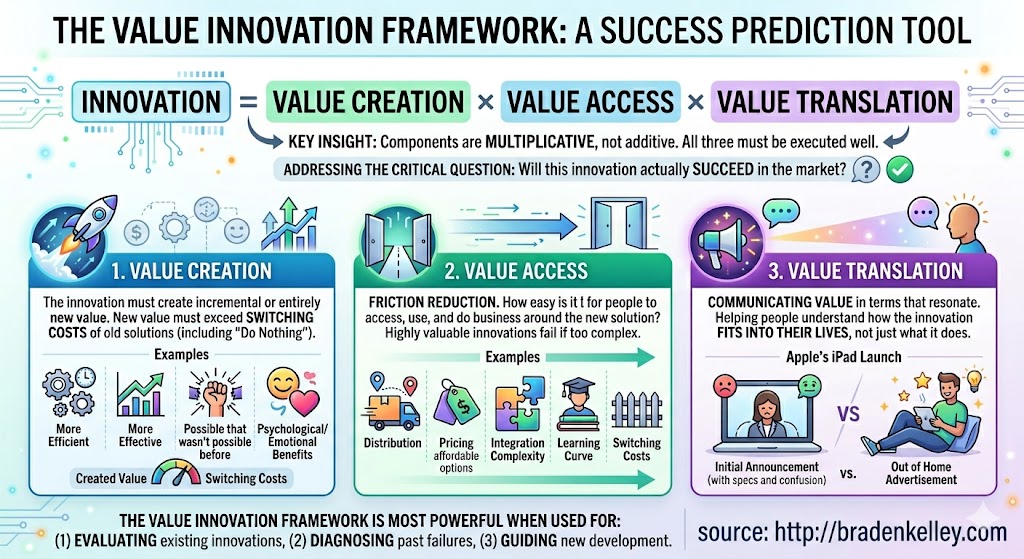
The Value Innovation Framework addresses the question that most innovation frameworks leave unanswered: will this innovation actually succeed in the market? Most frameworks focus on generating and validating ideas, but provide little guidance on predicting whether an innovation will achieve real-world adoption. The Value Innovation Framework fills that gap with a simple but powerful equation:
Innovation = Value Creation × Value Access × Value Translation
The components are multiplicative, not additive — which is the key insight. Do two of the three brilliantly and one poorly, and the innovation can still fail. All three must be executed well for an innovation to succeed:
Value Creation — The innovation must create incremental or entirely new value large enough to overcome the switching costs of moving from the old solution (including the “Do Nothing” option). New value can be created by making something more efficient, more effective, possible that wasn’t possible before, or by creating new psychological or emotional benefits. If the value created doesn’t exceed the friction of switching, adoption won’t happen regardless of how well the other two components are executed.
Value Access — Also thought of as friction reduction. How easy is it for people to access, use, and do business around the new solution? A highly valuable innovation that is difficult to access, purchase, integrate, or use will fail. Value Access covers the full spectrum of friction that stands between a customer and the value an innovation creates — distribution, pricing, integration complexity, learning curve, and switching costs.
Value Translation — How well does the innovation communicate its value in terms that resonate with the people it is designed for? Apple’s iPad launch illustrates this perfectly: the initial announcement failed to translate the value clearly, putting the launch at risk — until a single Out of Home advertisement showing a person relaxing with an iPad on their lap communicated in seconds what no amount of technical specification could. Value Translation is about helping people understand how the innovation fits into their lives, not just what it does.
The Value Innovation Framework is an innovation success prediction tool — it can be applied to evaluate existing innovations, diagnose why past innovations failed, and guide the development of new ones. It is most powerful when combined with the Eight I’s of Infinite Innovation – which can be downloaded as an 11″ x 17″ reference for free here. Read the full treatment in Innovation Is All About Value →
The Human-Centered Innovation Toolkit™
The Human-Centered Innovation Toolkit™ is the most comprehensive of my innovation frameworks — a complete system for building innovation capability inside organizations. It draws on the best of design thinking, jobs to be done, and lean startup while adding the organizational change management dimension that none of those frameworks adequately address.
The central insight driving the toolkit is that innovation programs fail most often not because of insufficient creativity or inadequate process, but because the organizational change required to implement innovations is underestimated and under-managed. The Human-Centered Innovation Toolkit™ integrates the innovation process with the change management process — giving organizations a single system for generating validated concepts and successfully implementing them.
How to Choose the Right Innovation Framework
The right framework depends on your innovation challenge, organizational context, and where you are in the innovation process. Use this guide to match your situation to the most appropriate approach:
| Your situation | Best framework(s) |
|---|---|
| Deciding how to allocate innovation investment across time horizons | Three Horizons Framework |
| Identifying unmet customer needs and white space opportunities | Jobs to Be Done |
| Validating new product concepts quickly and cheaply | Lean Startup |
| Understanding competitive disruption threats | Disruptive Innovation Framework |
| Accessing external innovation capabilities and ideas | Open Innovation |
| Solving complex human-centered problems | Design Thinking |
| Building continuous innovation capability across the organization | Eight I’s of Infinite Innovation + Value Innovation Framework |
| Integrating innovation and change management into a single system | Human-Centered Innovation Toolkit™ |
| Full-spectrum innovation from insight to implementation | Human-Centered Innovation Toolkit™ + Change Planning Toolkit™ |
Most organizations benefit from combining frameworks rather than selecting one exclusively. The Three Horizons gives you the portfolio lens. Jobs to Be Done gives you the customer insight. Design Thinking gives you the problem-solving process. Lean Startup gives you the validation methodology. The Human-Centered Innovation Toolkit™ ties them together with the organizational change capability that determines whether any of them actually produce results at scale.
The Most Common Reasons Innovation Frameworks Fail
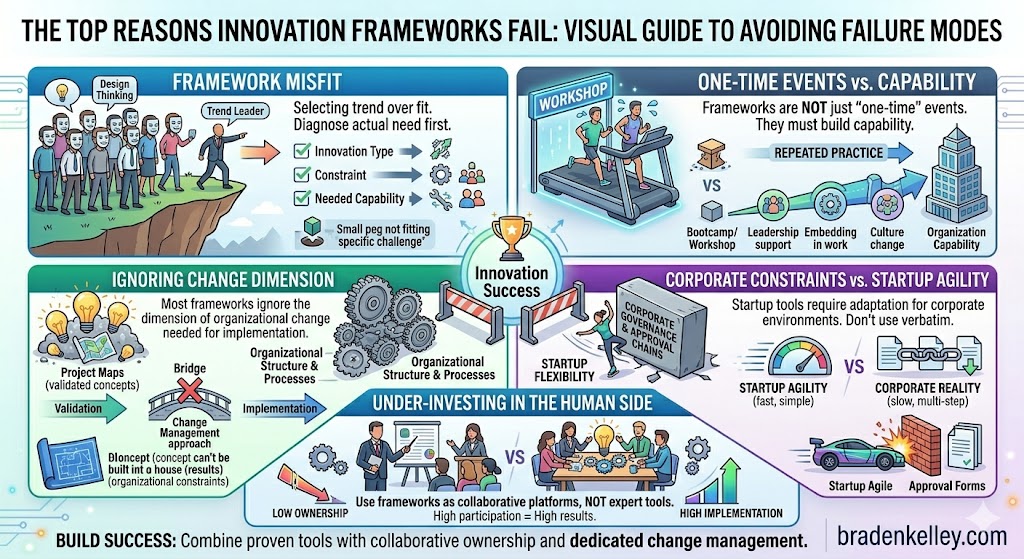
Even the best innovation framework will fail if applied poorly. Here are the most common failure modes I’ve observed across organizations:
Selecting frameworks based on trend rather than fit. Design thinking is enormously popular. That doesn’t mean it’s the right framework for every innovation challenge. Before selecting a framework, diagnose your actual situation — what type of innovation are you pursuing, what is your primary constraint, and what organizational capability do you most need to build?
Treating frameworks as one-time events. A design thinking workshop is not a design thinking capability. A Lean Startup bootcamp is not a Lean Startup organization. Frameworks only build organizational capability when they are practiced repeatedly, supported by leadership, and embedded in how work actually gets done — not when they are run as standalone events.
Ignoring the organizational change dimension. Every significant innovation requires organizational change to implement — changes to processes, structures, skills, culture, and resource allocation. Most innovation frameworks are silent on this dimension, which is why so many validated concepts never get implemented. Building an innovation framework without a corresponding change management approach is the single most common reason innovation programs produce learning but not results.
Applying corporate constraints to startup frameworks. Lean Startup and Design Thinking were developed for environments where speed, flexibility, and risk tolerance are high. Large organizations often apply these frameworks while maintaining governance structures, approval chains, and risk management processes that fundamentally undermine the methodologies’ core principles. The frameworks need to be adapted for corporate environments, not applied verbatim.
Under-investing in the human side. The best innovation frameworks are collaborative, not expert-driven. They are designed to be used with the teams and stakeholders who will implement innovations, not by consultants or innovation functions who deliver conclusions to leadership. Organizations that use frameworks as expert tools rather than collaborative platforms consistently get lower-quality insights, lower ownership, and lower implementation rates.
Frequently Asked Questions About Innovation Frameworks
What is an innovation framework?
An innovation framework is a structured approach that helps organizations systematically identify opportunities, generate and evaluate ideas, and move from concept to implemented value. It provides a common language for talking about innovation, a sequence of activities for managing the innovation process, and a set of principles that reflect how successful innovation actually works. The best innovation frameworks are adapted to the specific type of innovation challenge an organization faces — there is no single framework that is right for all situations.
What are the most widely used innovation frameworks?
The most widely used innovation frameworks include McKinsey’s Three Horizons Framework (for portfolio allocation), Jobs to Be Done (for identifying unmet customer needs), Lean Startup (for rapid concept validation), Disruptive Innovation (for competitive strategy), Open Innovation (for accessing external ideas and capabilities), and Design Thinking (for human-centered problem solving). Most experienced innovation leaders use multiple frameworks in combination rather than relying on any single approach, selecting frameworks based on the specific innovation challenge at hand.
What is the difference between an innovation framework and an innovation process?
An innovation framework is a broader conceptual structure — a set of principles, lenses, and approaches that guide how an organization thinks about and pursues innovation. An innovation process is more specific — a defined sequence of steps, activities, and decision points for managing innovation from idea to implementation. Most innovation frameworks include or imply a process, but the framework encompasses more than the process: it includes the mindsets, organizational capabilities, and strategic logic that determine whether the process produces results.
How do you build an innovation framework for your organization?
Building an innovation framework for your organization involves four steps. First, diagnose your actual innovation challenge — are you trying to improve the core business, explore adjacent opportunities, or develop transformative new capabilities? Different challenges require different frameworks. Second, select the frameworks that best fit your challenge and organizational context. Third, adapt those frameworks to your specific environment — accounting for your governance requirements, risk tolerance, and organizational culture. Fourth, build the organizational capability to use the frameworks consistently over time, not just as one-time events. This requires leadership support, training, embedded practice, and the organizational change management capability to implement what the frameworks reveal.
Why do innovation frameworks fail in large organizations?
Innovation frameworks fail in large organizations most often for four reasons: they are applied as one-time events rather than ongoing practices; they are selected based on trend rather than fit; they ignore the organizational change dimension required to implement innovations; and they are applied by expert consultants rather than collaboratively with the teams who will execute the work. The organizations that get the most value from innovation frameworks are those that adapt them to their specific context, practice them consistently, and invest equally in the change management capability needed to turn innovation concepts into implemented results.
For real-world examples of each framework in action, see our guide to innovation framework examples.
Content Authenticity Statement: The topic area, key elements to focus on, etc. were decisions made by Braden Kelley, with a little help from Claude and Google Gemini to clean up the article, add images and create infographics.
Image credits: Google Gemini
 Sign up here to get Human-Centered Change & Innovation Weekly delivered to your inbox every week.