The Low-Fidelity Advantage
GUEST POST from Chateau G Pato
The Trap of Polished Perfection
Organizations often fall into the “High-Fidelity Delusion”—the mistaken belief that an idea’s maturity is directly proportional to how polished it looks. Teams spend weeks, sometimes months, refining pixel-perfect designs, elaborate slide decks, or fully fleshed-out specifications before showing them to real stakeholders or customers. The result? Escalating sunk-cost fallacy, defensive creators, and delayed feedback loops that stall real progress.
Reframing the Artifact: From Presentation to Co-Creation
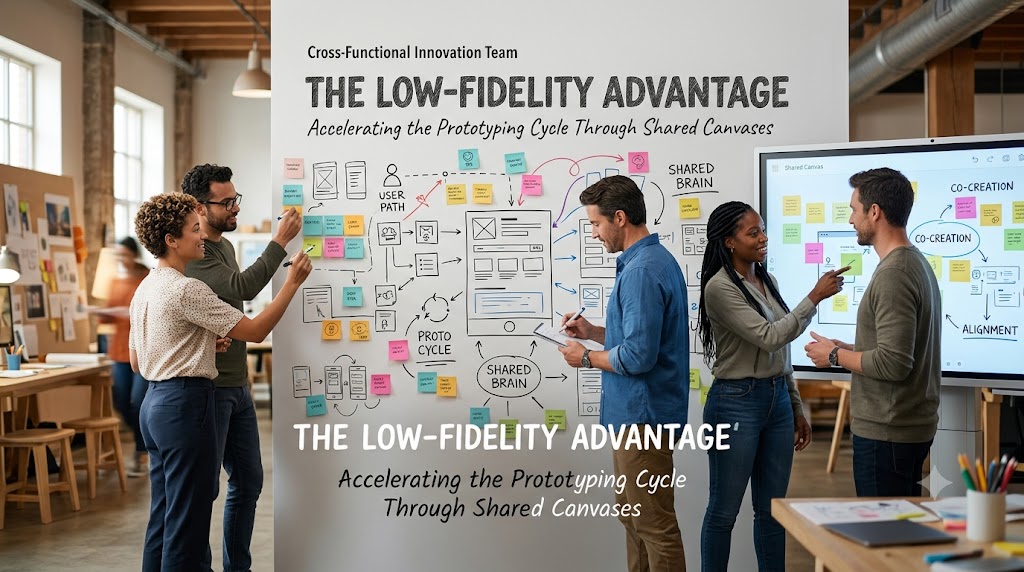
Low-fidelity prototyping combined with shared canvases flips this dynamic entirely. A low-fi approach isn’t a compromise on quality or a shortcut for the lazy; it is a strategic accelerator. When an artifact looks rough, incomplete, and open to interpretation, it transforms the stakeholder interaction from a passive critique of a finished product into an active invitation to co-create.
The Power of Shared Canvases
By shifting from siloed handoffs to visual, shared canvases, cross-functional teams build a unified mental model in real time. Shared canvases lower psychological friction, surface hidden assumptions early, and engage the whole brain—cognitive, conative, and affective. The result is a dramatic acceleration of the prototyping cycle, moving organizations from ambiguous ideas to actionable, human-centered impact faster.
Why Low-Fidelity Wins in the Early Prototyping Cycle
The earliest stage of any innovation effort is defined by uncertainty. Yet, organizations routinely rush to build polished artifacts to create a false sense of certainty. Embracing low-fidelity prototypes early in the lifecycle breaks this cycle by prioritizing rapid learning over premature execution.
Lowering Psychological Friction for True Feedback
When stakeholders review a high-fidelity artifact, they intuitively perceive it as nearly finished. This triggers two negative dynamics: feedback shifts toward superficial aesthetic critique—such as color choices, fonts, or minor UI alignment—and reviewers hesitate to question foundational logic for fear of appearing unsupportive. A rough, hand-drawn sketch or basic block diagram communicates that the core concept is fluid, explicitly inviting critical feedback on value proposition, utility, and basic workflow mechanics.
Fail Fast, Learn Faster: Reducing the Cost of Exploration
Low-fidelity tools make iteration nearly frictionless. When an idea can be prototyped on a shared canvas in minutes using sticky notes, rough sketches, or rapid paper mockups, the cost of discarding an unviable direction approaches zero. This dramatic reduction in risk changes team behavior: people become willing to test bolder, more ambitious concepts because pivoting or discarding an idea doesn’t mean throwing away weeks of labor.
Protecting Emotional Attachment and Fostering Flexibility
The sunk-cost fallacy isn’t just financial—it’s deeply emotional. The more hours a team spends perfecting an artifact, the more attached they become to its specific form. By keeping early prototypes low-fidelity, creators maintain psychological distance from the artifact itself. Defensiveness evaporates, allowing teams to embrace honest critique, pivot gracefully when assumptions fail, and co-design superior solutions alongside their stakeholders.
Operationalizing the Advantage: Canvas-Driven Prototyping Workflows
To move from abstract philosophy to repeatable business capability, teams must integrate low-fidelity practices into structured, visual workflows. By leveraging shared canvases at every stage of development, cross-functional teams transform ambiguous concepts into validated solutions with minimal friction.
Phase 1: Framing and Problem Finding
Before jumping into solution space, teams must construct a shared visual map of the problem landscape. Using single-page visual frameworks, teams systematically surface user pain points, operational constraints, and strategic goals. Mapping the problem space visually exposes hidden dependencies early, ensuring the team solves the right problem before investing resources in building answers.
Phase 2: Rapid Co-Creation with Power Teams
Rather than working in functional isolation and passing deliverables back and forth, cross-functional “Power Teams”—comprising product, design, engineering, and business strategy leads—gather around a shared digital or physical canvas workspace. Working in real time, members sketch workflows, arrange sticky notes, and contribute parallel ideas, compressing days of asynchronous reviews into focused co-creation sessions.
Phase 3: Testing Assumptions and Validating Alignment
A canvas serves as an explicit dashboard for risk. Teams use designated canvas quadrants to categorize core assumptions around desirability, feasibility, and viability. By isolating key uncertainties directly on the visual workspace, teams can quickly design targeted, low-fidelity experiments—such as paper walkthroughs or simple concept tests—to validate or invalidate each premise before scaling.
Phase 4: Bridging to Human-Centered Change
A prototype is only as valuable as the organization’s ability to adopt the ultimate solution. By maintaining low-fidelity, visual representations of the emerging product or experience, teams can seamlessly transition into change planning. Stakeholders across the organization can visualize how the solution impacts workflows, roles, and user experiences, building readiness and organizational pull long before final deployment.
Overcoming Organizational Resistance to Low-Fi Work
Despite the clear efficiency gains, transitioning an enterprise from polished deliverables to low-fidelity artifacts often triggers organizational friction. Corporate cultures built on risk avoidance frequently mistake high-fidelity polish for rigor, viewing rough sketches and sticky-note frameworks as unpolished or unprofessional. Overcoming this mindset requires deliberate leadership and cultural reframing.
Reframing “Scrappy” as Strategic Efficiency
Leaders must reframe how low-fidelity visual work is perceived across the enterprise. Scrappy, canvas-driven prototyping is not a shortcut or a lack of effort; it is a high-return investment in risk mitigation. Frame low-fi practices in terms of return on investment: every hour spent refining a low-fidelity canvas saves dozens of engineering hours, prevents costly late-stage pivots, and accelerates time-to-market by surfacing fatal flaws early in the cycle.
Managing Executive Expectations and Setting Context
Presenting low-fidelity concepts to senior leadership requires setting clear psychological framing beforehand. When executives are handed a polished prototype, their attention naturally drifts toward tactical details—color palettes, micro-copy, or visual aesthetics. Before presenting a low-fidelity canvas, explicitly state the goal of the review: “We are evaluating core logic, value proposition, and strategic alignment—not final visual design.” This boundary guides leadership to contribute high-level strategic direction rather than superficial nitpicks.
Nurturing a Culture of Continuous Experimentation
To make low-fidelity prototyping a permanent organizational muscle rather than an isolated technique, visual tools must be embedded into daily routines. Normalize the use of shared canvases across team retrospectives, strategy sessions, and project kickoffs. When teams routinely see leaders using rough visual canvases to map complex challenges, the psychological barrier drops, creating an environment where experimentation, co-creation, and continuous learning become standard operating procedure.
From Shared Canvases to Shared Futures
At its core, innovation is not merely about generating novel ideas—it is about building the organizational alignment necessary to bring those ideas to life. High-fidelity deliverables often create a false sense of security while isolating collaborators behind functional walls. By embracing low-fidelity prototyping on shared canvases, organizations dismantle these silos, replacing passive reviews with active co-creation.
Keeping the Human Element at the Center
Sustainable transformation relies on engaging people across cognitive, conative, and affective dimensions. When cross-functional teams build shared visual models together, they cultivate psychological safety, foster deep empathy for end users, and develop true collective ownership over the solution. The shared canvas becomes a unifying space where diverse perspectives synthesize into clear, actionable strategy.
The Path Forward: Co-Creating the Future
Accelerating the prototyping cycle does not require expensive tools or lengthy specifications. It requires the willingness to be imperfect in front of one another for the sake of faster learning. Grab a marker, open a digital canvas, keep the fidelity low, and invite your team into the room. The fastest path from breakthrough idea to meaningful impact begins when everyone is literally on the same page.
Frequently Asked Questions
Why use low-fidelity prototyping instead of high-fidelity designs early on?
Low-fidelity prototyping lowers psychological friction and prevents sunk-cost fallacy. When a prototype looks unfinished, stakeholders feel comfortable offering honest feedback on core logic, value proposition, and overall workflow rather than focusing on superficial aesthetic details like fonts or colors.
How do shared canvases improve cross-functional team collaboration?
Shared canvases flatten complex information onto a single visual plane, creating a unified mental model across engineering, product, and business leads. They engage cognitive, conative, and affective dimensions of thinking, replacing lengthy text documents with real-time visual co-creation.
How should teams introduce low-fidelity canvases to executives expecting polished work?
Frame the session explicitly before presenting: state that the objective is to evaluate strategic alignment, value proposition, and core logic rather than final visual execution. Position low-fidelity work as a high-return strategy that saves engineering hours and accelerates time-to-market.
Bottom line: Futurology is not fortune telling. Futurists use a scientific approach to create their deliverables, but a methodology and tools like those in FutureHacking™ can empower anyone to engage in futurology themselves.
Image credit: Gemini
 Sign up here to get Human-Centered Change & Innovation Weekly delivered to your inbox every week.