GUEST POST from Art Inteligencia
The Rigid Contract Trap
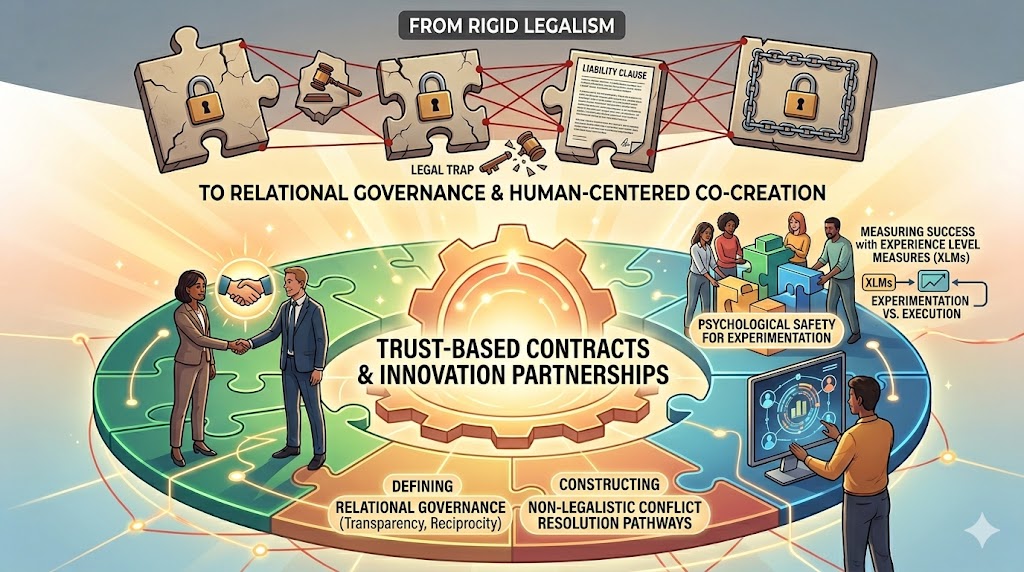
In the traditional corporate landscape, contracts are often drafted as defensive armor — walls of legalese designed to mitigate every conceivable risk and litigate every potential failure. While this “command and control” approach offers a sense of security for steady-state operations, it acts as a suffocating weight on the chest of innovation.
Innovation is, by definition, a journey into the unknown. It requires the freedom to pivot, the permission to fail, and the agility to adapt to emerging signals. When we bind partnerships to rigid, granular deliverables defined at a project’s inception, we prioritize compliance over outcomes. This creates a “Fixed-Mindset Partnership” where both parties are more concerned with avoiding a breach than they are with creating breakthrough value.
To thrive in an era of constant change, we must shift from Transactional Management to Relational Governance. This means evolving the contract from a static “fence” meant to keep people out, into a dynamic “foundation” meant to support shared growth. We must design agreements that mirror the human-centered principles we apply to our products: empathy, flexibility, and a relentless focus on the experience of the partnership itself.
Defining Trust-Based Contracting
Trust-based contracting is not about abandoning legal protections; it is about re-centering the agreement on mutual intent rather than purely punitive constraints. In an innovation context, the “spirit” of the agreement must carry as much weight as the “letter.” When partners trust that both sides are committed to a shared vision, they spend less energy on defensive posturing and more on creative problem-solving.
Prioritizing the Spirit over the Letter
Traditional contracts often fail because they attempt to predict a future that is inherently unpredictable. A trust-based framework acknowledges that the “how” will likely change, but the “why” — the core value proposition — remains the North Star. This shift allows for Relational Governance, where the health of the partnership is the primary metric of success.
The Core Pillars of the Partnership
- Radical Transparency: Moving beyond “need-to-know” basis to shared intellectual roadmaps and open-book accounting. When both parties see the full picture, they can align their efforts more effectively toward shared goals.
- Dynamic Reciprocity: Ensuring that the value exchange remains balanced as the project evolves. As breakthroughs occur or obstacles arise, the partnership must be flexible enough to re-adjust incentives so that win-win outcomes remain the reality.
- Structural Autonomy: Granting partners the “license to explore.” This means defining “safe-to-fail” zones where experimentation is encouraged without the threat of immediate contractual penalties for missed micro-milestones.
“The most effective contracts are those that serve as a platform for co-creation, not a script for execution.”
Designing for Uncertainty (The Human-Centered Lens)
In an era of rapid technological shifts and “Agentic AI,” the traditional three-year fixed roadmap is a relic of a slower age. A human-centered approach to contracting acknowledges that the people involved — and the markets they serve— will learn and adapt during the project lifecycle. We must design agreements that account for this evolution rather than penalizing it.
Empathy as a Contractual Variable
Before the ink dries, we must look beyond the balance sheet. Designing for uncertainty starts with deep empathy for the partner’s “Why.” What are their internal cultural barriers? What are the pressures on their specific industry? When we build agreements that respect the human constraints of both organizations, we create a sturdier, more resilient bond.
The Shift to Rolling Statements of Work
To maintain agility, we must replace static, monolithic deliverables with Rolling Statements of Work (SOWs). By committing to short-term, iterative execution cycles while maintaining a long-term strategic vision, we allow the partnership to pivot based on real-world data and “FutureHacking” signals without requiring a complete legal overhaul every time a change is needed.
Value-Created vs. Effort-Based Rewards
Traditional “Time and Materials” models often incentivize inefficiency. A trust-based, human-centered contract shifts the focus toward Experience Level Measures (XLMs) and outcome-based incentives. By rewarding the impact of the innovation — rather than just the hours logged — we align the partner’s success directly with the organizational value they help create.
This transition requires moving away from rigid Service Level Agreements (SLAs) that often measure the wrong things, and toward measures that capture the qualitative and strategic health of the innovation ecosystem.
Managing Intellectual Property (IP) in Collaborative Ecosystems
One of the greatest friction points in any partnership is the “IP Paradox”: organizations seek to innovate through collaboration, yet they often employ restrictive legal frameworks that prevent the very flow of ideas required for success. To foster a true innovation partnership, we must move beyond defensive hoarding toward a model of Fluid Intellectual Capital.
The IP Paradox: Protection vs. Proliferation
When we over-protect every incremental idea, we inadvertently slow down the “Speed of Learning.” In a trust-based model, the goal is not just to own the idea, but to maximize its utility. High-walls around intellectual property often result in “Zombie Projects” — innovations that are legally secure but commercially stagnant because they couldn’t breathe in a collaborative environment.
Shared Ownership and the “Foreground/Background” Framework
To navigate this, we utilize a clear distinction between existing and emergent knowledge:
- Background IP: This remains the sole property of the originating party. It is the “tools of the trade” each partner brings to the table. Trust-based contracts provide an automatic, friction-free license for the other partner to use this IP strictly within the scope of the project.
- Foreground IP: This is the new value created together. Instead of a winner-take-all scramble, we design shared ownership or “Exclusive Field of Use” agreements. This ensures both parties have a vested interest in the long-term success and scaling of the innovation.
Prioritizing “Freedom to Operate”
In a world of accelerating change, being first to learn is often more valuable than being the sole owner of a patent. Trust-based contracts prioritize the Freedom to Operate. This means focusing on iterative learning and rapid market entry. By ensuring that neither party can “block” the other from pursuing the project’s North Star, we maintain the organizational agility needed to respond to “FutureHacking” signals and market shifts.
Conflict Resolution: The “Living Contract”
In traditional environments, a dispute often signals the beginning of the end for a partnership. In a human-centered innovation ecosystem, however, friction is viewed as a signal — data that the partnership needs to evolve. To handle this, we treat the agreement as a “Living Contract” that scales and adapts through consistent governance rather than static litigation.
Governance Rhythms over Quarterly Reviews
Waiting for a quarterly business review to address a misalignment is a recipe for project decay. Trust-based partnerships implement “Alignment Pulses” — short, frequent touchpoints focused on identifying emerging blockers before they calcify into legal disputes. These rhythms ensure that the “human” element of the partnership stays synchronized with the technical and financial goals.
Non-Legalistic Dispute Pathways
When significant disagreements arise, the first instinct should not be to call the lawyers, but to engage the Innovation Board. By establishing internal peer mediation frameworks, we solve problems through the lens of project success rather than contractual liability. This keeps the focus on “How do we get back on track?” instead of “Who is at fault?”
Pivoting with Grace: The “Fast Fail” Clause
True innovation requires the ability to walk away when the data suggests a path is no longer viable. Trust-based contracts include Graceful Exit strategies that allow for a “Fast Fail” without destroying the professional relationship. By pre-defining how to wind down a project — sharing the learnings and settling costs fairly — we ensure that a failed experiment doesn’t lead to a failed partnership.
“The strength of a partnership isn’t defined by the absence of conflict, but by the speed and empathy with which that conflict is resolved.” — Braden Kelley
Case Studies: Trust in Action
The difference between a rigid contract and a trust-based partnership is most visible when the unexpected occurs. To understand the practical application of these principles, we must look at how “Trust Equity” functions as a lubricant for organizational speed and a buffer against market volatility.
The Rigid Failure vs. The Agile Success
In many traditional aerospace or manufacturing sectors, we often see “Feature Creep” meet “Legal Gridlock.” When a partner identifies a necessary pivot but is bound by a fixed-price, fixed-scope agreement, the project often enters a “stalemate” phase. Progress halts while change orders are debated, leading to missed market windows and demoralized teams.
Conversely, in successful cross-industry R&D collaborations — such as those seen in modern digital transformation initiatives — partners often operate under a “Master Innovation Agreement.” This framework sets the high-level goals but leaves the tactical execution to a Joint Innovation Board. When a pivot is required, the board reallocates resources in real-time, focusing on the Experience Level Measures (XLMs) rather than debating the original line items.
Measuring “Trust Equity”
How do we measure something as intangible as trust? In an innovation ecosystem, we track specific indicators that correlate with partnership health:
- Decision Velocity: The average time it takes to approve a strategic pivot or resource shift.
- Information Flow: The frequency and depth of proactive “signal sharing” between organizations.
- Conflict Resolution Time: How quickly misalignments are moved from “dispute” to “solution” without legal escalation.
By treating trust as a measurable asset, organizations can move beyond the “warm and fuzzy” perception of the word and treat it as a core component of their Innovation Maturity.
Conclusion: The Future of Partnerships
As we navigate the complexities of digital transformation and the “Agentic Paradox,” the nature of how we work together must fundamentally change. The era of the adversarial, “zero-sum” contract is drawing to a close. In its place, we are seeing the rise of the Human-Centered Ecosystem — a network of partners bound not by the fear of litigation, but by the pursuit of shared purpose.
From Gatekeepers to Enablers
For this shift to take hold, leadership must redefine the roles of legal and procurement departments. These teams should no longer function as internal gatekeepers whose sole job is to say “no” to risk. Instead, they must become Innovation Enablers, tasked with designing the flexible frameworks that allow for rapid experimentation and “FutureHacking.” Their success should be measured by the speed and health of the partnerships they help facilitate.
The Ultimate Competitive Advantage
In a world of accelerating change, your most valuable competitive advantage is not your proprietary code or your secret manufacturing process — it is your Relational Agility. Organizations that can form, scale, and pivot partnerships quickly will outperform those trapped in the “Rigid Contract Trap.”
Ultimately, a trust-based contract is a recognition of a simple truth: business is a human endeavor. When we design for trust, empathy, and transparency, we aren’t just making better agreements — we are building the foundation for the breakthroughs that will define the next decade. The most important line in any contract isn’t the one written in ink; it’s the invisible line of trust that connects the people behind the signatures.
“Stop drafting for the end of the relationship; start designing for its success.”
Frequently Asked Questions
How do Trust-Based Contracts handle failure?
Unlike traditional contracts that use penalties to punish failure, trust-based agreements utilize “Graceful Exit” clauses. These allow partners to “Fast Fail” when data shows a project is no longer viable, ensuring that the learning is captured and the relationship remains intact for future collaboration.
Do these agreements replace legal protections?
No. Trust-based contracting shifts the focus from purely punitive measures to relational governance. It layers empathy and flexibility over a legal foundation, ensuring that the “spirit” of the innovation partnership is protected as much as the “letter” of the law.
What are XLMs and why are they used?
Experience Level Measures (XLMs) capture the qualitative and strategic impact of a partnership. While SLAs measure technical uptime or speed, XLMs measure the health of the innovation ecosystem and the actual value created, aligning incentives with human-centered outcomes.
SPECIAL BONUS: Braden Kelley’s Problem Finding Canvas can be a super useful starting point for doing design thinking or human-centered design.
“The Problem Finding Canvas should help you investigate a handful of areas to explore, choose the one most important to you, extract all of the potential challenges and opportunities and choose one to prioritize.”
Image credit: Gemini
 Sign up here to get Human-Centered Change & Innovation Weekly delivered to your inbox every week.