Tag Archives: inflation

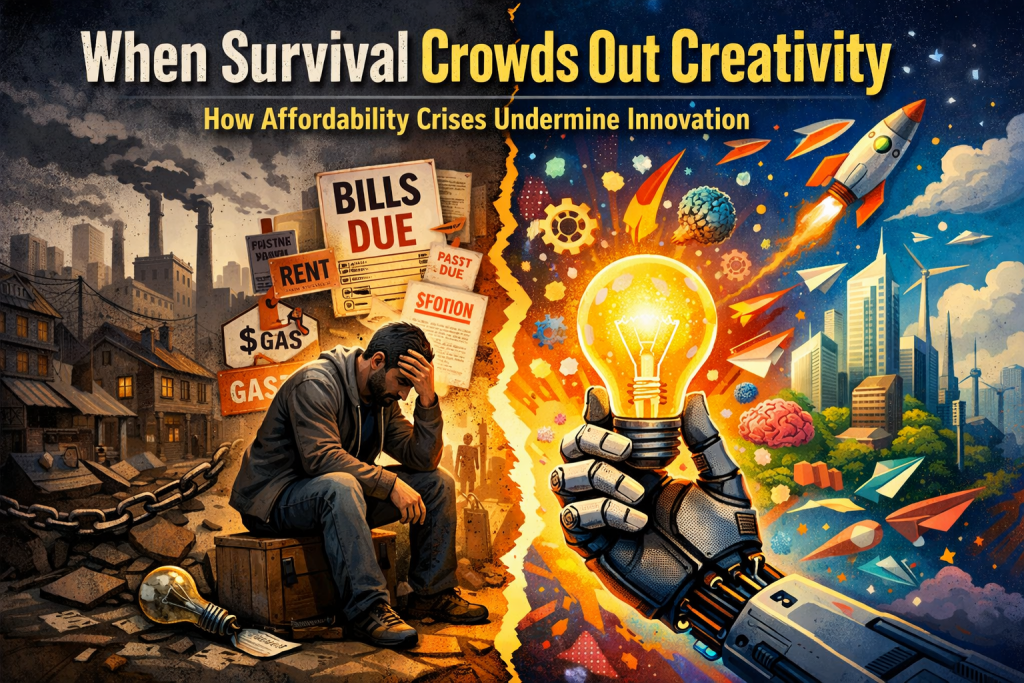
When Survival Crowds Out Creativity: How Affordability Crises Undermine Innovation

An exploration of how rising costs of living reduce cognitive surplus, suppress innovation, and limit organizational and societal progress.

LAST UPDATED: January 19, 2026 at 4:43 PM
When Survival Crowds Out Creativity: How Affordability Crises Undermine Innovation

GUEST POST from Art Inteligencia

I am frequently asked about the ingredients of a successful innovation ecosystem. We talk about venture capital, high-speed internet, patent laws, and university partnerships. But we rarely talk about the most fundamental requirement of all: human physiological and psychological security.

Innovation is not a purely intellectual exercise; it is an emotional and biological one. It requires a specific state of mind — one that is open, curious, and willing to embrace the possibility of failure. However, when a society faces systemic affordability challenges — skyrocketing rents, food insecurity, and the crushing weight of debt — we are effectively taxing the cognitive bandwidth of our greatest resource: people.

“Innovation is not a luxury of the elite, but a byproduct of a society that provides its citizens enough stability to dream. When we price people out of their basic needs, we price ourselves out of our future.” — Braden Kelley


The Cognitive Tax of Scarcity

To understand why affordability kills innovation, we must look at how the human brain functions under stress. Human-centered innovation is rooted in the idea that people solve problems when they have the mental “slack” to do so. When an individual is constantly calculating how to cover a 30% increase in rent or skipping meals to pay for childcare, they are operating in survival mode.

In survival mode, the brain’s prefrontal cortex — the center for higher-order thinking, long-term planning, and creative synthesis — takes a backseat to the amygdala. We become more reactive, more short-term focused, and significantly more risk-averse. You cannot disrupt an industry when you are terrified of an eviction notice.

This “scarcity mindset” creates a hidden drain on productivity and creativity. It is a form of Innovation Debt that we are accruing as a society, where the interest is paid in ideas that were never born because the potential innovators were too exhausted to think of them.

In organizations, this manifests as:

  • Employees avoiding bold ideas for fear of failure
  • Reduced participation in innovation programs
  • Higher burnout and turnover among creative talent
  • A preference for incrementalism over experimentation

“Innovation requires slack — slack in time, money, attention, and emotional safety. When survival becomes the primary occupation, imagination is the first casualty.” — Braden Kelley


Case Study 1: The Silicon Valley “Talent Flight”

The Situation

For decades, Silicon Valley was the undisputed epicenter of global innovation. However, by the early 2020s, the median home price in the region exceeded $1.5 million. While established tech giants could afford to pay engineers high salaries, the support ecosystem — the teachers, the artists, the junior researchers, and the “garage tinkerers” — could not.

The Innovation Impact

Innovation thrives on cross-pollination. When only the wealthy can afford to live in a hub, the diversity of thought collapses. We began to see a “homogenization of innovation,” where new startups focused almost exclusively on problems faced by high-income individuals (e.g., luxury delivery apps) rather than solving systemic human challenges. The high cost of living created a barrier to entry that effectively barred the next generation of “scrappy” innovators who didn’t have a safety net or venture backing.

The Result

Data showed a significant migration of talent to “secondary” hubs like Austin, Denver, and Lisbon. While this decentralization has benefits, the initial friction and lost momentum in the primary hub represented a massive opportunity cost for breakthrough research that requires physical proximity and intense collaboration.


The Death of the “Garage Startup”

The “garage startup” is a cherished myth in innovation circles, but it relies on a very real economic reality: the availability of low-cost, low-risk space. Hewlett-Packard, Apple, and Google all started in spaces that were relatively cheap to rent or own.

In today’s urban environments, that “low-risk space” has vanished. When every square foot of a city is optimized for maximum real estate yield, there is no room for the inefficient, messy work of early-stage experimentation. We are replacing “maker spaces” with luxury condos, and in doing so, we are dismantling the physical infrastructure of the Fail Fast philosophy. If the cost of your “lab” (your garage or basement) is $3,000 a month, you cannot afford to fail. And if you cannot afford to fail, you will never truly innovate.


Case Study 2: Food Insecurity in the Academic Pipeline

The Situation

A 2023 study of graduate students in North America revealed that nearly 30% experienced some form of food insecurity. These are the individuals tasked with the most rigorous scientific and social research — the literal “R” in R&D.

The Innovation Impact

Graduate students are the primary engine of university-led innovation. When these researchers spend their nights worrying about calorie counts instead of quantum counts, the quality of research suffers. The persistence required to push through a failed experiment is diminished when physical health is compromised.

The Result

Universities noted a decline in “high-risk, high-reward” thesis topics. Students began gravitating toward “safe” research areas with guaranteed funding or clear paths to corporate employment to pay off student loans and eat. The “Failure Budget” for these young innovators was effectively zero, leading to a stifling of the very exploratory research that historically leads to major scientific breakthroughs.


Case Study 3: A Manufacturing Firm’s Productivity Paradox

A mid-sized manufacturing company invested heavily in digital transformation and innovation training, yet saw minimal improvement in idea generation or experimentation. Leadership initially blamed culture and skills.

A deeper assessment revealed a different root cause: nearly 40 percent of the workforce was experiencing food or housing insecurity. Employees were working second jobs, skipping medical care, and managing chronic stress.

The company shifted strategy. It introduced wage stabilization, subsidized meals, and emergency financial support. Within twelve months, participation in continuous improvement programs doubled, and frontline innovation proposals increased by over 60 percent.

Innovation did not fail due to lack of tools. It failed due to lack of breathing room.


Why Affordability Shapes Risk Appetite

Innovation requires people to take risks that may not pay off immediately. But when the margin for error is razor-thin, risk becomes reckless rather than courageous.

Employees who fear eviction or medical debt are far less likely to:

  • Challenge entrenched assumptions
  • Experiment with unproven ideas
  • Advocate for long-term investments
  • Speak candidly about systemic flaws

Affordability challenges quietly turn organizations into compliance machines rather than learning systems.


Conclusion: A Call for Human-Centered Policy

If we want to maintain a competitive edge in a rapidly changing world, we must view affordability as an innovation policy. Rent control, affordable housing, student debt relief, and food security are not just “social issues”; they are the foundational layers of a healthy innovation funnel.

We need to create “slack” in our systems. We need to ensure that the next great thinker is not working three gig-economy jobs just to keep the lights on. As leaders, we must advocate for a world where people are free to use their entire brain for the work of change, rather than wasting half of it on the math of survival.

True innovation starts with a simple human truth: A mind preoccupied with where to sleep cannot dream of how to fly.


Frequently Asked Questions

Q: How do high housing costs impact an organization’s innovation potential?

A: High housing costs force talent to relocate or spend a disproportionate amount of cognitive energy on survival. This reduces “cognitive bandwidth,” making employees more risk-averse and less likely to engage in the creative problem-solving or “intrapreneurship” required for organizational growth.

Q: What is the “Cognitive Tax” of affordability challenges?

A: The cognitive tax is the mental drain caused by financial stress. When individuals are worried about basic needs like food and rent, their prefrontal cortex — the area responsible for complex decision-making and creativity — is overwhelmed by the stress of survival, effectively lowering their functional IQ and creative output.

Q: Can innovation survive in an environment of economic scarcity?

A: While scarcity can occasionally breed “frugal innovation,” systemic affordability challenges generally stifle breakthrough innovation. Breakthroughs require “slack” — time, resources, and mental space — to experiment and fail. Without basic economic security, individuals cannot afford the risk of failure.

Disclaimer: This article speculates on the potential future direction of society based on current factors. It is hard to predict whether commercial, political and charitable organizations will respond in ways sufficient to alter the course of history or not.

Image credits: ChatGPT

Subscribe to Human-Centered Change & Innovation WeeklySign up here to get Human-Centered Change & Innovation Weekly delivered to your inbox every week.

Why Greedflation Must End and How Consumers Can Make It So

Why Greedflation Must End and How Consumers Can Make It So

GUEST POST from Art Inteligencia

Greedflation — an insidious blend of greed and inflation — has silently been eroding the purchasing power of consumers, escalating economic inequalities, and tarnishing the trust we place in markets and institutions. This practice, where companies exploit inflationary trends to excessively hike prices, detaches from economic principles and delves into unethical opportunism. While inflation in itself, when moderate, plays a functional role in the economy, greedflation skews the balance, enriching the few at the expense of many. Here’s why this must end and how consumers can play a pivotal role in its demise.

Why Greedflation Must End

  1. Economic Inequity: Greedflation exacerbates economic disparities, widening the gap between the rich and the poor. While executives and shareholders prosper, average citizens struggle more to afford basic commodities. This vicious cycle traps lower-income families in a relentless financial squeeze, robbing them of opportunities for upward mobility.
  2. Erosion of Trust: Trust is the bedrock of a functional economy. When consumers perceive that companies are exploiting inflationary pressures to rake in excess profits, trust in those companies and the broader market erodes. This lack of trust can lead to decreased consumer spending, hampering economic growth and stability.
  3. Reduced Consumer Purchasing Power: As prices soar disproportionately, the real purchasing power of consumers dwindles. Households find themselves paying more for the same goods and services, which can lead to indebtedness and reduced quality of life. This reduction in purchasing power compounds the already significant challenges faced by middle and lower-income families.
  4. Market Distortion: Greedflation distorts market dynamics by creating artificial price structures that don’t accurately reflect demand and supply. This conflation of legitimate inflationary factors with opportunistic price hikes undermines true market efficiency and the ability to allocate resources effectively.
  5. Social Unrest: When people feel unfairly squeezed by relentless price hikes, social tension can build. Such unrest not only affects social harmony but can also lead to broader economic and political consequences. It’s a recipe for instability that we can ill afford in a complex global environment.

Identifying specific companies definitively engaging in “greedflation” can be complex, as it often involves nuanced economic analyses and data that may not always be readily available or clear-cut. However, certain sectors and companies have faced accusations and scrutiny over seemingly disproportionate price hikes, especially during periods of broader economic instability. Here are five examples based on public scrutiny and anecdotal evidence:

  1. Amazon: During the COVID-19 pandemic, Amazon faced criticism for significant price increases on essential items such as hand sanitizers, masks, and other health-related products. While some of these price hikes were attributed to third-party sellers on the platform, the company was scrutinized for not doing enough to regulate prices during a global crisis.
  2. Pharmaceutical Companies (e.g., Martin Shkreli’s Turing Pharmaceuticals): One of the most notorious cases of alleged greedflation in the pharmaceutical industry involved Turing Pharmaceuticals, where the price of Daraprim, a life-saving medication, was increased by over 5,000% overnight under the leadership of Martin Shkreli. This incident highlighted how companies could exploit patent protections and market monopolies to drastically inflate prices unethically.
  3. Oil Companies (e.g., ExxonMobil, Chevron): Oil giants like ExxonMobil and Chevron have been accused of leveraging geopolitical tensions and supply chain disruptions to raise gas prices disproportionately, thereby generating record profits during periods when consumers are already struggling with inflationary pressures.
  4. Grocery Retailers (e.g., Kroger, Albertsons): Major grocery chains like Kroger and Albertsons have faced allegations of increasing food prices beyond what could be justified by supply chain issues and general inflation. With essential goods being a critical part of everyday life, such actions appear particularly exploitative.
  5. Telecom Companies (e.g., Comcast, AT&T): Telecom giants such as Comcast and AT&T have been criticized for raising prices on internet and cable services, despite relatively stable or reduced operational costs due to advancements in technology. Consumers often feel trapped because of limited competition in many areas.

While these examples showcase sectors and companies that have faced scrutiny, it’s important to note that conclusive evidence of greedflation can be difficult to establish due to the complexity of market forces and individual company strategies. This underscores the need for informed consumer activism to hold companies accountable.

How Consumers Can Help End Greedflation

  1. Shop Smarter: Consumers wield significant power through their purchasing decisions. By being more discerning and opting for alternatives when prices seem unjustifiably high, we can signal to corporations that unethical pricing won’t be rewarded. Supporting smaller, local businesses and cooperatives can also help counterbalance big players who may indulge in greedflation.
  2. Promote Transparency: Demand greater transparency from companies about their pricing strategies. When transparency becomes a social norm, it’s harder for businesses to hide behind inflated prices. Use social media and other platforms to press for clarity and accountability.
  3. Support Policies for Market Oversight: Advocate for stronger regulatory frameworks and more stringent oversight bodies that can analyze and address unethical pricing practices. By supporting politicians and policies that prioritize consumer protection and market fairness, individuals can influence systemic change.
  4. Educate and Mobilize: Consumer education is crucial. Share knowledge and resources about how to spot and combat greedflation. Community groups, educational institutions, and social networks can serve as platforms for educating others about prudent consumer practices.
  5. Leverage Collective Bargaining Power: Form or join consumer advocacy groups that can collectively negotiate for fair prices and better market practices. Unified consumer voices can be a powerful force for change, pushing corporations to rethink their pricing strategies.

Conclusion

The end of greedflation is not just an economic imperative but a moral one. It’s about creating a fairer society where prosperity is shared more equitably, trust is maintained, and economic stability is preserved. Consumers hold immense power as the primary drivers of market forces. By making informed, conscious choices and demanding greater accountability, we can collectively put an end to greedflation and forge a more just economic future.

As an independent thinker and human-centered innovation and transformation thought leader, I firmly believe in the power of consumers to act as agents of change. Together, let’s take that necessary step to ensure markets function with integrity, fairness, and a sense of shared prosperity.

#EndGreedflation #ConsumerPower #EconomicJustice

Image credit: Unsplash

Subscribe to Human-Centered Change & Innovation WeeklySign up here to get Human-Centered Change & Innovation Weekly delivered to your inbox every week.
Now is the Time to Design Cost Out of Our Products

Now is the Time to Design Cost Out of Our Products

GUEST POST from Mike Shipulski

With inflation on the rise and sales on the decline, the time to reduce costs is now.

But before you can design out the cost you’ve got to know where it is. And the best way to do that is to create a Pareto chart that defines product cost for each subassembly, with the highest cost subassemblies on the left and the lowest cost on the right. Here’s a pro tip – Ignore the subassemblies on the right.

Use your costed Bill of Materials (BOMs) to create the Paretos. You’ll be told that the BOMs are wrong (and they are), but they are right enough to learn where the cost is.

For each of the highest-cost subassemblies, create a lower-level Pareto chat that sorts the cost of each piece-part from highest to lowest. The pro tip applies here, too – Ignore the parts on the right.

Because the design community designed in the cost, they are the ones who must design it out. And to help them prioritize the work, they should be the ones who create the Pareto charts from the BOMs. They won’t like this idea, but tell them they are the only ones who can secure the company’s future profits and buy them lots of pizza.

And when someone demands you reduce labor costs, don’t fall for it. Labor cost is about 5% of the product cost, so reducing it by half doesn’t get you much. Instead, make a Pareto chart of part count by subassembly. Focus the design effort on reducing the part count of subassemblies on the left. Pro tip – Ignore the subassemblies on the right. The labor time to assemble parts that you design out is zero, so when demand returns, you’ll be able to pump out more products without growing the footprint of the factory. But, more importantly, the cost of the parts you design out is also zero. Designing out the parts is the best way to reduce product costs.

Pro tip – Set a cost reduction goal of 35%. And when they complain, increase it to 40%.

In parallel to the design work to reduce part count and costs, design the test fixtures and test protocols you’ll use to make sure the new, lower-cost design outperforms the existing design. Certainly, with fewer parts, the new one will be more reliable. Pro tip – As soon as you can, test the existing design using the new protocols because the only way to know if the new one is better is to measure it against the test results of the old one.

And here’s the last pro tip – Start now.

Image credit — aisletwentytwo

Subscribe to Human-Centered Change & Innovation WeeklySign up here to get Human-Centered Change & Innovation Weekly delivered to your inbox every week.