Unlocking the Invisible Signals That Shape Innovation and Change
LAST UPDATED: March 20, 2026 at 5:44 PM

GUEST POST from Art Inteligencia
The Invisible Byproduct of Work: What is Digital Exhaust?
Every organization is producing more data than ever before. Dashboards are full, KPIs are tracked, and reports are generated with increasing frequency. And yet, despite this abundance, many leaders still find themselves asking a fundamental question: “What is really happening inside our organization?”
The answer often lies not in the data we intentionally collect, but in the data we unintentionally leave behind. This is what we call digital exhaust—the invisible trail of signals created as people interact with systems, processes, and each other in the course of getting work done.
Digital exhaust includes everything from collaboration patterns in tools like email, Slack, and Teams, to clickstreams in customer journeys, to the subtle workarounds employees create when processes don’t quite fit reality. It is not designed, structured, or curated. It simply exists as a byproduct of activity.
Most organizations focus their attention on intentional data—metrics they define in advance: sales targets, operational efficiency scores, customer satisfaction ratings. These are important, but they are also inherently limited. They reflect what leaders thought would matter ahead of time.
Digital exhaust, by contrast, captures what actually does matter in practice. It reveals:
- Where employees are struggling despite “green” metrics
- How work really flows across teams, not how it is designed to flow
- Where customers encounter friction that was never anticipated
- Which informal behaviors are compensating for broken systems
In this sense, digital exhaust is not just data—it is a form of organizational truth-telling. It exposes the gap between the designed experience and the lived experience.
For leaders focused on human-centered change and innovation, this distinction is critical. Traditional measurement systems tend to reinforce existing assumptions. Digital exhaust challenges them. It brings visibility to the moments of friction, improvisation, and adaptation where real innovation opportunities are hiding.
Perhaps the most powerful way to think about digital exhaust is this: It is a passive, always-on listening system for your organization.
Unlike surveys or interviews, it does not rely on what people say after the fact. It reflects behavior in real time, at scale, and often without the filters that come with formal reporting. It captures the signals people don’t even realize they are sending.
And that is precisely why it is so valuable. Buried in this exhaust are the early indicators of change resistance, subtle signs of employee disengagement, and the unarticulated needs of customers. It is where inefficiencies whisper before they become visible problems, and where innovation opportunities emerge before they are formally recognized.
The challenge is not whether digital exhaust exists—it already does, in massive quantities. The challenge is whether organizations are willing and able to see it for what it is: not noise, but signal.
Organizations that learn to listen to their digital exhaust gain something incredibly powerful: a clearer, more human-centered understanding of how work actually happens. And with that understanding comes the ability to design change and innovation efforts that are grounded in reality, not assumption.
Why Digital Exhaust Matters for Change and Innovation
Most change initiatives don’t fail because of poor strategy. They fail because leaders are operating with an incomplete—or worse, inaccurate—understanding of how their organization actually functions. This is where digital exhaust becomes a game changer.
At its core, digital exhaust provides a continuous, behavior-based view of the organization in motion. It captures the difference between how work is designed and how it is actually performed. And in that gap lies the truth about why change efforts stall and where innovation opportunities emerge.
Traditional change management relies heavily on lagging indicators—survey results, adoption metrics, and post-implementation reviews. By the time these signals appear, the organization has already absorbed the impact, for better or worse. Digital exhaust, on the other hand, offers something far more valuable: early visibility into emerging patterns of behavior.
This early visibility allows leaders to detect and respond to critical dynamics in real time, including:
- Change Resistance: Not through what people say, but through what they do—avoiding new tools, reverting to old processes, or creating parallel workarounds.
- Process Friction: Identifying bottlenecks, repeated handoffs, or excessive rework that signal misaligned or poorly designed workflows.
- Cultural Misalignment: Revealing disconnects between stated values and actual behavior patterns.
- Hidden Work: Surfacing informal, often invisible effort employees expend to compensate for gaps in systems or processes.
For innovation leaders, this is where things get especially interesting. Digital exhaust doesn’t just highlight problems—it illuminates possibilities. Every workaround is a signal of unmet need. Every friction point is a potential innovation opportunity. Every unexpected behavior pattern is a clue about how people are adapting to constraints in ways the organization did not anticipate.
In other words, innovation lives in the gaps between designed experience and lived experience.
When organizations ignore digital exhaust, they effectively blind themselves to these gaps. They continue to invest in solutions based on assumptions, often optimizing for a version of reality that no longer exists. This is how well-intentioned initiatives end up driving “hallucinatory innovation”—building elegant solutions to problems that don’t actually matter.
Conversely, organizations that leverage digital exhaust gain the ability to:
- Continuously validate whether change is working as intended
- Identify emerging needs before they are formally articulated
- Adapt strategies dynamically based on real-world behavior
- Reduce the gap between leadership perception and employee/customer reality
This shifts the role of leadership from one of prediction to one of perception and response. Instead of trying to anticipate every outcome, leaders can sense what is happening and adjust accordingly.
The implications are profound. Change becomes less about large, episodic transformations and more about continuous alignment. Innovation becomes less about isolated breakthroughs and more about systematically uncovering and addressing real human needs.
Ultimately, digital exhaust matters because it reconnects organizations with reality. It grounds strategy in behavior, not intention. And in a world where the pace of change continues to accelerate, that grounding may be the most important competitive advantage of all.
From Data to Meaning: The Practice of Digital Exhaust Analysis
If digital exhaust is the raw signal of how work actually happens, then digital exhaust analysis is the discipline of turning that signal into meaning. This is where many organizations struggle—not because they lack data, but because they lack a systematic way to interpret it in a human-centered way.
The first step is recognizing the breadth of digital exhaust across the enterprise. Every interaction, transaction, and workflow leaves behind traces of behavior. Individually, these signals may seem insignificant. Collectively, they form a dynamic, continuously updating picture of how the organization actually operates.
Common sources of digital exhaust include:
- Collaboration Tools: Email, messaging platforms, and meeting systems that reveal communication flows, decision bottlenecks, and collaboration overload.
- Customer Interactions: Support tickets, chat logs, call transcripts, and clickstream data that expose friction, confusion, and unmet expectations.
- Operational Systems: CRM, ERP, and workflow platforms that capture how processes actually unfold, including delays, rework loops, and exception handling.
- Content and Knowledge Systems: Document creation, editing patterns, and knowledge-sharing behaviors that reflect how information is accessed, reused, or lost.
But volume alone does not create insight. The real shift comes from applying analytical approaches that focus on behavior rather than static metrics. Instead of asking “What happened?”, digital exhaust analysis asks “How and why did it happen this way?”
Effective analysis typically combines multiple techniques:
- Behavioral Pattern Recognition: Identifying recurring actions, deviations, and anomalies that signal friction, adaptation, or emerging habits.
- Process Mining and Journey Reconstruction: Rebuilding actual workflows and customer journeys based on real activity, not designed processes.
- Language and Sentiment Analysis: Examining tone, word choice, and context in communications to uncover emotion, confusion, or resistance.
- Network and Interaction Analysis: Mapping how people and teams connect to reveal informal influence structures and collaboration patterns.
A critical principle in this work is triangulation. No single data source tells the full story. Only by combining multiple signals can organizations distinguish between noise and meaningful patterns.
Equally important is the shift from retrospective reporting to continuous sensing. Traditional analytics looks backward, summarizing what has already occurred. Digital exhaust analysis, when done well, enables organizations to monitor patterns as they emerge and evolve—creating the opportunity to respond in near real time.
This does not mean automating decisions blindly. On the contrary, the goal is to augment human judgment. The role of digital exhaust analysis is to surface signals that prompt better questions, deeper inquiry, and more informed action.
Ultimately, the practice is not about mastering tools—it is about building a new organizational capability: the ability to see clearly, move beyond assumptions, understand behavior in context, and translate that understanding into smarter, more human-centered decisions about change and innovation.
Human-Centered Interpretation: Avoiding the Measurement Trap
One of the most dangerous assumptions organizations make is that data is objective. It isn’t. Data is shaped by what we choose to measure, how we collect it, and the context in which we interpret it. Digital exhaust may feel more “real” because it is behavior-based, but it is still incomplete without thoughtful, human-centered interpretation.
This is where many digital exhaust initiatives go off track. Leaders see a new stream of rich behavioral data and immediately move to optimize against it—reducing time, increasing throughput, or eliminating variance. In doing so, they risk falling into the very trap they were trying to escape: mistaking signals for truth and metrics for meaning.
The reality is that every data point carries ambiguity. A spike in after-hours activity could indicate high engagement—or it could signal burnout. A reduction in collaboration might reflect improved efficiency—or growing silos. Without context, interpretation becomes guesswork dressed up as insight.
This is why digital exhaust analysis must be grounded in a human-centered mindset. The goal is not to monitor people more closely, but to understand their experiences more deeply.
There is also an important ethical dimension to consider. The same data that can illuminate friction and unlock innovation can also feel invasive if misused. Employees who believe they are being surveilled will adapt their behavior—not to improve outcomes, but to protect themselves. When that happens, the integrity of the data itself begins to erode.
Organizations must therefore be intentional about how they approach digital exhaust:
- Transparency: Be clear about what is being analyzed, why it matters, and how it will (and will not) be used.
- Purpose: Focus on improving systems and experiences, not evaluating or policing individuals.
- Context: Combine behavioral data with qualitative insights—interviews, observation, and direct feedback—to understand the “why” behind the patterns.
- Humility: Treat insights as hypotheses to explore, not conclusions to enforce.
At its best, digital exhaust analysis becomes a tool for empathy at scale. It helps leaders see where people are struggling, where systems are failing, and where expectations are misaligned—not in theory, but in lived experience.
This requires a fundamental shift in mindset: from control to curiosity. Instead of asking, “How do we make people comply with the process?” leaders begin asking, “Why does the process not work for people?” That shift is where real transformation begins.
Because the ultimate goal is not to create perfectly optimized systems. It is to design organizations that work with humans, not against them. And that means recognizing that behind every data point is a person making choices, adapting to constraints, and trying to get their work done.
Digital exhaust can show you what is happening. But only a human-centered approach can help you understand why—and what to do about it in a way that builds trust rather than erodes it.
Use Cases That Actually Move the Needle
Digital exhaust analysis only becomes valuable when it drives better decisions and meaningful outcomes. While the concept can feel abstract, its impact becomes very concrete when applied to real organizational challenges. The key is to focus on use cases where behavior-based insight can close the gap between intention and reality.
The following are some of the highest-impact applications of digital exhaust analysis across change, experience, and innovation:
Change Management: Seeing Adoption as It Happens
Traditional change management relies on training completion rates, survey feedback, and delayed adoption metrics. These signals often arrive too late to correct course effectively.
Digital exhaust provides a real-time view of how people are actually engaging with new tools, processes, or ways of working. Leaders can identify:
- Where employees are reverting to legacy systems or behaviors
- Which teams are adopting quickly—and why
- Where informal workarounds are emerging
This enables faster intervention, targeted support, and ultimately a higher likelihood of sustained change.
Employee Experience: Detecting Friction and Burnout Early
Employee experience is often measured through periodic surveys, which provide valuable but infrequent snapshots. Digital exhaust fills in the gaps between those moments.
By analyzing collaboration patterns, workload signals, and communication behaviors, organizations can detect:
- Meeting overload and fragmentation of focus time
- After-hours work patterns that may indicate burnout risk
- Breakdowns in cross-functional collaboration
Instead of reacting to disengagement after it occurs, leaders can proactively redesign work environments to better support how people actually operate.
Customer Experience: Uncovering Hidden Friction
Customer journeys are carefully designed, but rarely experienced exactly as intended. Digital exhaust reveals where those designs break down in practice.
Through analysis of clickstreams, support interactions, and behavioral flows, organizations can identify:
- Points where customers hesitate, abandon, or seek help
- Inconsistencies across channels and touchpoints
- Unmet needs that are not captured in structured feedback
These insights enable more precise, evidence-based improvements to the customer journey—reducing friction and increasing satisfaction in ways that traditional metrics alone cannot achieve.
Innovation Discovery: Finding Opportunity in Workarounds
One of the most overlooked sources of innovation is the set of informal solutions people create to get their work done. These workarounds are not failures—they are signals.
Digital exhaust analysis helps surface:
- Repeated deviations from standard processes
- Shadow systems and tools adopted outside official channels
- Emerging behaviors that indicate shifting needs or expectations
Each of these represents an opportunity to design better solutions that align with how people naturally work, rather than forcing them into rigid structures.
Operational Excellence: Moving Beyond Efficiency to Effectiveness
Many operational improvement efforts focus narrowly on efficiency—reducing time, cost, or variability. Digital exhaust enables a broader view that includes effectiveness and experience.
By reconstructing actual workflows, organizations can identify:
- Hidden loops of rework and redundancy
- Misaligned handoffs between teams or systems
- Disconnects between formal processes and real execution
This allows for redesign efforts that not only streamline operations but also make them more intuitive and resilient.
Across all of these use cases, the common thread is speed of learning. Digital exhaust shortens the feedback loop between action and insight. It allows organizations to move from periodic evaluation to continuous adaptation.
And in an environment where change is constant, that ability—to learn faster than the pace of disruption—is what ultimately separates organizations that struggle from those that thrive.
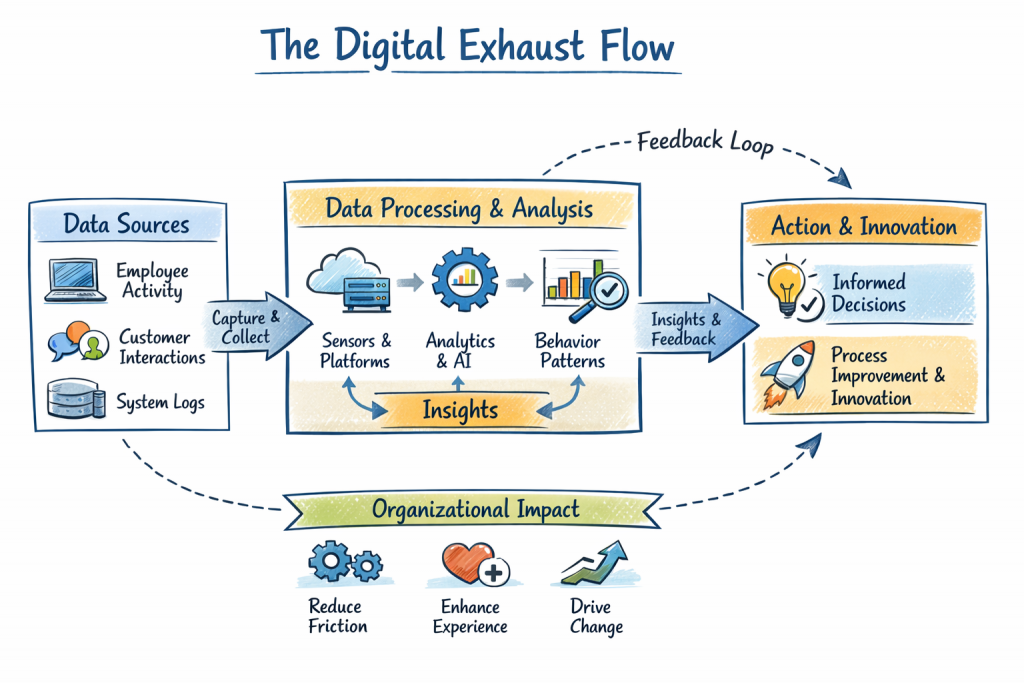
The Technology Ecosystem Powering Digital Exhaust Analysis
While digital exhaust is created naturally through everyday work, unlocking its value requires a rapidly evolving ecosystem of technologies. No single platform owns this space. Instead, it is an emerging convergence of analytics, artificial intelligence, process mining, and digital twin capabilities—each contributing a piece of the broader puzzle.
Understanding this ecosystem is critical, not because organizations need to adopt every tool, but because it reveals where the market is heading: toward a future of organizational observability—the ability to continuously sense, interpret, and respond to how work actually happens.
Enterprise Platforms: Scaling Insight Across Complex Systems
Large enterprise technology providers are embedding digital exhaust analysis into broader platforms that integrate data across operations, customers, and assets. These solutions often combine IoT, analytics, and simulation to create end-to-end visibility.
- Siemens: Leveraging digital twin technology to simulate and optimize complex systems, capturing exhaust signals from both physical and digital environments.
- General Electric: Applying industrial data analytics to monitor performance, predict issues, and improve operational outcomes.
- Dassault Systèmes: Enabling virtual modeling of organizations and ecosystems to better understand how processes and interactions unfold.
- PTC: Integrating IoT and augmented reality to connect frontline activity with enterprise systems, generating rich behavioral data streams.
These platforms are particularly powerful in environments where physical and digital systems intersect, but their broader impact is the normalization of continuous data capture and analysis at scale.
Advanced Analytics and Simulation Engines
A second layer of the ecosystem focuses on making sense of complexity. These tools excel at modeling, simulation, and high-dimensional analysis—turning raw exhaust into predictive and prescriptive insight.
- ANSYS: Known for engineering simulation, increasingly applied to model system behavior and test scenarios before changes are implemented.
- Altair: Combining data analytics, AI, and high-performance computing to uncover patterns and optimize outcomes across complex environments.
These capabilities allow organizations to move beyond hindsight and into foresight—understanding not just what is happening, but what is likely to happen next under different conditions.
Process Mining and Behavioral Analytics Innovators
One of the fastest-growing segments in this space is process mining and behavioral analytics. These solutions reconstruct workflows and interactions from event logs, revealing how processes actually execute across systems and teams.
They provide:
- End-to-end visibility into real process flows
- Identification of bottlenecks, deviations, and rework
- Data-driven opportunities for automation and redesign
By grounding analysis in actual behavior, these tools bring a level of objectivity and clarity that traditional process mapping rarely achieves.
Emerging Startups: Democratizing Insight
Alongside established players, a new generation of startups is pushing the boundaries of what digital exhaust analysis can do. These companies are often more focused, more agile, and more explicitly human-centered in their approach.
They are exploring innovations such as:
- AI-driven pattern detection and anomaly identification
- Natural language processing applied to communication data
- Lightweight tools that make insight accessible beyond data science teams
- Privacy-first architectures that balance insight with trust
Their collective impact is to lower the barrier to entry—making it possible for more organizations to experiment with and benefit from digital exhaust analysis without massive upfront investment.
The Convergence Toward Organizational Observability
What is most important is not any individual tool, but the direction of travel. These technologies are converging toward a shared goal: creating organizations that can continuously observe themselves.
In software engineering, observability transformed how systems are managed—shifting from reactive troubleshooting to proactive monitoring and adaptation. A similar transformation is now underway at the organizational level.
The implication is clear. In the near future, leading organizations will not rely on periodic reports to understand performance. They will operate with a living, breathing view of how work unfolds—powered by digital exhaust and the technologies that bring it to life.
The question is no longer whether these capabilities will exist, but how quickly organizations will learn to use them in a way that is both effective and human-centered.
Building the Capability: From Experiment to Enterprise Muscle
Recognizing the value of digital exhaust is one thing. Building the organizational capability to use it consistently and effectively is another. Many organizations start with enthusiasm, launch a pilot, and then stall—unable to scale insight beyond isolated use cases.
The difference between experimentation and impact lies in treating digital exhaust analysis not as a tool, but as a core organizational muscle—one that must be intentionally developed, embedded, and sustained over time.
Start Small, But Start Where It Matters
The most successful organizations resist the urge to boil the ocean. Instead, they begin with a focused, high-value problem—typically a journey or process where friction is both visible and consequential.
This might include:
- A struggling change initiative with uneven adoption
- A critical customer journey with known pain points
- An internal process plagued by delays or rework
By instrumenting relevant systems and analyzing the resulting digital exhaust, teams can generate early wins that demonstrate both value and feasibility.
Build Cross-Functional Alignment Early
Digital exhaust does not belong to a single function. It spans IT, HR, customer experience, operations, and innovation. As a result, siloed approaches quickly run into limitations.
Leading organizations bring together cross-functional teams that combine:
- Technical expertise (data engineering, analytics, AI)
- Domain knowledge (HR, CX, operations)
- Human-centered design and research capabilities
This combination ensures that insights are not only technically sound, but also contextually meaningful and actionable.
Establish Clear Governance and Ethical Guardrails
As digital exhaust analysis scales, questions of trust, privacy, and appropriate use become unavoidable. Without clear guardrails, even well-intentioned efforts can create resistance or unintended consequences.
Effective governance includes:
- Transparency: Communicating openly about what data is being used and for what purpose
- Boundaries: Defining what will not be measured or inferred, particularly at the individual level
- Accountability: Ensuring that insights are used to improve systems, not penalize people
Trust is not a byproduct of capability—it is a prerequisite for it.
Shift the Mindset: From Reporting to Sensing and Adapting
Perhaps the most important transformation is cultural. Traditional organizations are built around reporting—periodic snapshots of performance against predefined metrics.
Digital exhaust enables something fundamentally different: continuous sensing. But to realize this value, leaders must embrace a new operating model—one that prioritizes learning and adaptation over control and prediction.
This means:
- Acting on directional insight rather than waiting for perfect data
- Testing and iterating in shorter cycles
- Empowering teams to respond to what they observe in real time
Over time, this shift transforms digital exhaust analysis from a specialized capability into an embedded way of working.
Scale What Works, Systematically
Once early use cases demonstrate value, the focus should shift to scaling—not by replicating tools, but by codifying practices. This includes:
- Standardizing data pipelines and integration patterns
- Creating reusable analytical models and frameworks
- Embedding insights into existing decision-making processes
The goal is to make digital exhaust analysis repeatable, reliable, and accessible across the organization.
Ultimately, organizations that succeed in this space do not treat digital exhaust as a one-time initiative. They build it into the fabric of how they operate—continuously listening, learning, and adapting.
And in doing so, they move closer to something every organization aspires to, but few achieve: the ability to evolve as quickly as the world around them.
The Future: From Digital Exhaust to Adaptive Organizations
The journey from collecting digital exhaust to building a fully adaptive organization is both a technological and cultural evolution. It requires more than tools or analytics—it demands a mindset shift where organizations listen continuously, respond intelligently, and innovate in alignment with real human behavior.
Organizations that master digital exhaust will develop capabilities similar to observability in software systems: they will sense emerging issues, anticipate bottlenecks, and detect opportunities before they become urgent. This real-time awareness allows leadership to act proactively rather than reactively.
Key hallmarks of adaptive organizations powered by digital exhaust include:
- Continuous Sensing: Systems and processes generate ongoing behavioral data, providing a real-time view of organizational health and performance.
- Rapid Feedback Loops: Insights flow quickly to decision-makers, enabling faster course corrections and iterative improvements.
- Behavior-Informed Innovation: Emerging patterns reveal unmet needs, workarounds, and latent opportunities, fueling human-centered innovation.
- Trust-Centered Design: Analysis is conducted ethically and transparently, preserving employee and customer confidence.
The implications are profound. Change initiatives no longer rely solely on annual plans or post-implementation reviews. Innovation is no longer limited to isolated labs or ideation workshops. Instead, the organization becomes a living, learning system, continuously adapting based on how people actually work, collaborate, and engage.
Looking forward, the integration of AI and automation with digital exhaust analysis promises even more sophisticated capabilities. Intelligent agents may highlight emerging friction points, suggest targeted interventions, or simulate the potential outcomes of proposed changes before they are executed.
Yet, technology alone is not enough. Adaptive organizations are built on a foundation of human-centered insight, trust, and curiosity. Leaders must listen carefully, interpret thoughtfully, and act with empathy—turning the passive signals of digital exhaust into meaningful transformation.
The ultimate promise of this approach is clear: organizations that learn to sense and respond effectively will not just survive change—they will thrive in it. By transforming digital exhaust from noise into signal, they unlock the ability to innovate continuously, adapt dynamically, and create lasting value for employees, customers, and stakeholders alike.
In a world of accelerating complexity, the question is no longer whether digital exhaust matters. The question is whether your organization is ready to listen—and evolve.
Frequently Asked Questions (FAQ)
What is digital exhaust in an organization?
Digital exhaust is the unintentional trail of data created by employees, customers, and systems as they interact with processes and tools. It includes patterns of behavior, communication flows, process deviations, and other signals that reveal how work actually happens, beyond formal metrics.
How can digital exhaust analysis improve innovation and change initiatives?
Digital exhaust analysis provides real-time insights into actual behavior and process execution. By identifying friction points, informal workarounds, and adoption gaps, organizations can adapt more quickly, design human-centered solutions, and uncover opportunities for innovation that traditional metrics may miss.
What are the ethical considerations when analyzing digital exhaust?
Ethical considerations include ensuring transparency, protecting individual privacy, and using insights to improve systems rather than monitor or penalize people. Organizations should combine quantitative data with qualitative context, communicate clearly about data usage, and maintain trust to preserve the integrity of the analysis.
Disclaimer: This article speculates on the potential future applications of cutting-edge scientific research. While based on current scientific understanding, the practical realization of these concepts may vary in timeline and feasibility and are subject to ongoing research and development.
Image credits: ChatGPT
 Sign up here to get Human-Centered Change & Innovation Weekly delivered to your inbox every week.
 Drum roll please…