Tag Archives: continuous adaptation

From Change Projects to Continuous Adaptation

From Change Projects to Continuous Adaptation

GUEST POST from Art Inteligencia


I. Introduction: The Fallacy of the “Finish Line”

The Hook: The modern corporate myth of the “Transformation Project”—complete with a kickoff town hall, a Gantt chart, a go-live date, and a celebratory cake.

The Reality: In a world of exponential technological shifts, market volatility, and evolving human expectations, the “freeze-unfreeze-refreeze” model is obsolete. By the time a 24-month change project finishes, the context it was designed for no longer exists.

The Human Cost: How back-to-back “projects” create change fatigue, cynicism, and organizational scar tissue.

Thesis Statement: True resilience requires shifting our mindset and operating model from managing finite change projects to cultivating continuous adaptation—a human-centered capability embedded into the daily rhythm of work.

II. Deconstructing the “Change Project” Trap

Change Done To People vs. With People: Why top-down, waterfall change management triggers natural human resistance—rooted in a loss of agency, creeping ambiguity, and a perceived threat to professional identity.

The Silo Problem: Separating “the people who design the future” (strategy and innovation) from “the people who execute the present” (operations), while bringing in change management at the eleventh hour as a communications Band-Aid.

Metric Misalignment: Measuring success by project completion (delivered on time and on budget) rather than human adoption, sustained behavior change, and real-world value realization.

III. The Four Pillars of Continuous Adaptation

To make adaptation an organizational muscle rather than a top-down mandate, leaders must weave together four distinct disciplines into a unified operating capability:

  1. Human-Centered Change (Empathy at Scale)
    • Mapping the emotional and practical journey of employees just as rigorously as we map the customer journey.
    • Designing for psychological safety so people feel empowered to experiment, fail fast, and speak up early when systems break.
  2. Experience Design (EX = CX)
    • Recognizing that you cannot deliver a frictionless, adaptive Customer Experience (CX) on top of a rigid, frustrating Employee Experience (EX).
    • Treating internal processes, tools, and workflows as products that require continuous user research and iterative UX improvements.
  3. Applied Futurology & Strategic Foresight
    • Moving from reactive firefighting to proactive horizon scanning.
    • Democratizing foresight by giving teams at all levels the permission and tools to spot weak signals and run small-scale “future-back” experiments before disruption hits.
  4. Embedded Innovation (The Daily Habit)
    • Shifting innovation out of isolated corporate “labs” and directly into everyday workflows.
    • Empowering frontline teams with micro-budgets and autonomy to continuously refine how work gets done.

IV. The Operating Shift: From Projects to Rhythms

Moving from episodic change to continuous adaptation requires replacing static project milestones with living operational cadences:

Dimension Change Projects (Old Model) Continuous Adaptation (New Model)
Cadence Episodic, with a fixed start and end date Ongoing, operating in continuous learning loops
Ownership Top-down, cascaded from leadership Co-created with the people doing the work
Scope Fixed requirements locked in early Evolving scope shaped by real-time feedback
Primary Driver Compliance and schedule adherence Curiosity, purpose, and human value
Definition of Done “Go-live” and project sign-off Sustained behavior change and adaptability

Building the “Adaptation Cadence”: Replacing massive annual overhauls with quarterly sense-making sessions, monthly co-design sprints, and weekly team retrospectives.

The Role of Leadership: Shifting from “Chief Answer-Giver” to “Chief Context-Setter and Barrier-Remover”—creating the clarity and space teams need to iterate safely.

V. Practical First Steps: Starting Monday Morning

Shifting from rigid transformation projects to continuous adaptation doesn’t require another massive reorganization. You can start building the muscle immediately with three targeted moves:

  • Audit Your Change Portfolio: Review your current roadmap and identify bloated, multi-year initiatives that are already losing relevance. Break at least one down into smaller, testable experiments with 30-day learning loops.
  • Form a Cross-Functional “Adaptation Coalition”: Bring your HR/Change, Strategy/Innovation, and CX/EX leaders to the same table. Stop letting them run separate playbooks—they are solving different sides of the exact same human problem.
  • Co-Create the Next Shift: Pick one upcoming workflow, policy, or tool change and invite a cross-section of skeptical frontline employees to co-design the rollout from day one—turning potential critics into architectural partners.

VI. Conclusion: Designing a Future Worth Inhabiting

Synthesis: Change is no longer a temporary storm we hunker down to weather before returning to “business as usual”—it is the permanent climate we operate in.

Final Thought: When we stop treating humans as obstacles to be “managed” through an isolated project and start treating them as co-designers of an evolving system, adaptation stops feeling like exhaustion—and starts feeling like momentum.

Frequently Asked Questions: From Change Projects to Continuous Adaptation

Why do traditional “change projects” fail in modern organizations?

Traditional change projects rely on an outdated “freeze-unfreeze-refreeze” model with fixed scopes and rigid end dates. In an environment of rapid technological and market shifts, the business context evolves faster than a 12- to 24-month project can execute—resulting in obsolete solutions, change fatigue, and low human adoption.

How is continuous adaptation different from traditional change management?

Traditional change management treats change as an isolated event done to employees, measuring success by on-time, on-budget project delivery. Continuous adaptation embeds human-centered change, experience design, strategic foresight, and innovation directly into daily workflows—co-creating evolution with employees through ongoing learning loops.

What is the first step leaders can take to shift toward continuous adaptation?

Start by auditing your current change portfolio to break at least one bloated, multi-year initiative into smaller 30-day experiments. Simultaneously, bring HR/Change, Strategy/Innovation, and CX/EX leaders together into a unified “Adaptation Coalition” and invite frontline employees to co-design your next workflow shift from day one.

SPECIAL BONUS: Braden Kelley’s Problem Finding Canvas can be a super useful starting point for doing design thinking or human-centered design.

“The Problem Finding Canvas should help you investigate a handful of areas to explore, choose the one most important to you, extract all of the potential challenges and opportunities and choose one to prioritize.”

Image credit: Gemini

Subscribe to Human-Centered Change & Innovation WeeklySign up here to get Human-Centered Change & Innovation Weekly delivered to your inbox every week.
The Human Engine of Continuous Adaptation

Resilience as Innovation

LAST UPDATED: February 5, 2026 at 3:13PM

The Human Engine of Continuous Adaptation

GUEST POST from Chateau G Pato

In the traditional corporate lexicon, resilience is often treated as a defensive trait—the ability to “weather the storm” or “bounce back” to a previous state of stability. But in a world defined by permanent volatility, bouncing back is no longer enough. To thrive in 2026, organizations must redefine resilience not as a recovery mechanism, but as a generative innovation capability.True resilience is the human engine of continuous adaptation. It is the proactive capacity to transform pressure into progress and friction into fuel. As a human-centered change leader, I’ve observed that the most innovative companies don’t just survive disruption; they use the shockwaves of change to crack open legacy thinking and reveal new pathways for value creation.


Moving Beyond Robustness to Anti-fragility

A bridge is robust when it resists a load. An organization is resilient when it learns from the load. When we focus purely on robustness, we build rigid structures that eventually shatter under unprecedented stress. When we focus on human-centered resilience, we empower our people to iterate in real-time.

This shift requires us to address Subjective Time Pressure. When employees feel “bullied by time,” their cognitive bandwidth shrinks, and they default to survival instincts. Innovation requires the opposite: the mental “white space” to see a crisis as a collection of data points rather than a series of threats. By designing conditions that provide temporal agency, leaders allow their teams to process change with curiosity rather than fear.

“The most valuable innovation isn’t a new product; it’s a resilient culture. Products can be copied, and technologies will be disrupted, but a team that has mastered the art of continuous adaptation is an insurmountable competitive advantage.”

— Braden Kelley


Case Studies: Resilience in Action

Case Study 1: The Supply Chain Transformation

A global electronics manufacturer faced a catastrophic disruption when a primary regional hub was taken offline by an environmental crisis. Traditional disaster recovery focused on restoring the status quo. However, the leadership team utilized my Change Planning Toolkit™ to reframe the crisis. Instead of just rebuilding, they empowered cross-functional “Agility Cells” to design a decentralized, AI-driven sourcing model. This wasn’t just recovery; it was a structural innovation. The new system was 15% more cost-effective and reduced lead times by 30%, proving that resilience is the catalyst for the next leap in operational excellence.

Case Study 2: Retail Pivot through Psychological Safety

A national retail chain saw a dramatic shift in consumer behavior that rendered their flagship store model obsolete almost overnight. Rather than implementing top-down layoffs, the CEO fostered psychological safety by launching an internal “Phoenix Initiative.” Store managers—the people closest to the customer—were given the agency to experiment with hyper-local micro-fulfillment and “service-as-an-experience” concepts. By treating their frontline staff as distributed innovators rather than mere executors, the company successfully pivoted 80% of its footprint to a high-growth hybrid model within 12 months.


Tools for Cultivating Adaptive Resilience

To turn resilience into an innovation engine, leaders need a structured approach. It isn’t enough to tell people to “be resilient.” You must provide the scaffolding for it. This involves:

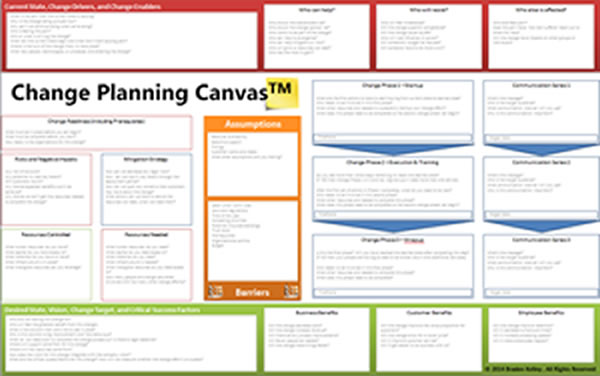
  • The Change Planning Canvas™: Visualizing the transition to ensure everyone understands the why behind the what.
  • Metabolic Alignment: Ensuring the organization’s pace of decision-making matches the pace of market change.
  • Cognitive Slack: Intentionally protecting time for reflection and synthesis during high-stress periods.

Change Planning Canvas

When these tools are in place, resilience stops being an exhausting effort and starts being a natural state of flow. We stop fighting the waves and start learning how to surf them.


Resilience is the ultimate form of innovation because it is the only one that is self-sustaining. As we look toward the future of work, the winners will be those who recognize that their greatest asset isn’t their intellectual property, but the adaptive capacity of their people. By leading with empathy, providing the right visual tools, and reclaiming our agency over time, we can build organizations that are not just built to last, but built to evolve.

For years, innovation has been framed as a forward-looking activity: new ideas, new technologies, new business models. But the most overlooked truth about innovation is that it is not powered by novelty. It is powered by people who can absorb disruption, learn quickly, and adapt continuously.

Resilience is not a soft skill. It is the human engine that makes innovation sustainable over time. Without resilience, innovation becomes episodic—bursts of creativity followed by exhaustion, resistance, or collapse. With it, organizations evolve steadily, even under pressure.

As I often say, “Innovation isn’t about how fast you move when conditions are perfect; it’s about how well you adapt when they aren’t.”

Why Resilience Is the Missing Link in Innovation

Many organizations invest heavily in innovation labs, design thinking workshops, and emerging technologies, yet struggle to translate these efforts into lasting change. The issue is rarely a lack of ideas. It is a lack of human capacity to sustain change.

Resilience enables individuals and teams to stay curious under stress, to reframe setbacks as learning, and to recover quickly when experiments fail. Innovation demands repeated exposure to uncertainty. Resilience determines whether that uncertainty becomes energizing or debilitating.

When resilience is absent, organizations default to risk avoidance, short-term thinking, and defensive behavior. When resilience is present, they experiment, learn, and adapt faster than their competitors.

Case Study 3: Microsoft’s Cultural Reset

When Satya Nadella became CEO of Microsoft, the company faced a familiar innovation challenge: strong legacy products, slowing growth, and an internal culture resistant to change.

Rather than focusing first on new technologies, Nadella emphasized a shift from a “know-it-all” culture to a “learn-it-all” culture. This cultural reframing prioritized psychological safety, growth mindset, and continuous learning.

The result was a more resilient organization. Teams became more open to experimentation and failure. Collaboration improved across silos. Innovation accelerated not because people were pushed harder, but because they felt safer adapting.

Resilience turned cultural humility into a competitive advantage.

Resilience Is Built, Not Declared

Organizations often mistake resilience for grit or endurance. In reality, resilience is about recovery and renewal. It requires intentional design.

Resilient systems balance challenge with support. They create clear priorities, reduce unnecessary friction, and provide space for reflection. Leaders play a critical role by modeling learning, acknowledging uncertainty, and reinforcing progress rather than perfection.

Without these conditions, resilience degrades. Burnout replaces creativity. Innovation becomes performative instead of practical.

Case Study 4: Toyota and Continuous Improvement

Toyota’s long-standing commitment to continuous improvement offers another powerful example of resilience as innovation.

The Toyota Production System encourages employees at all levels to identify problems, stop the line if needed, and propose improvements. Mistakes are treated as signals, not failures.

This approach builds organizational resilience by embedding adaptation into daily work. Small improvements accumulate. Learning compounds. The system remains flexible even as complexity increases.

Toyota’s resilience is not reactive; it is designed into the way work gets done.

The Human Experience of Adaptation

Innovation ultimately happens inside people. Resilience is shaped by how individuals experience change: whether they feel informed or surprised, supported or isolated, empowered or constrained.

Human-centered innovation recognizes that adaptation is emotional as well as cognitive. Anxiety, fatigue, and identity threats can stall even the best ideas.

“You don’t scale innovation by demanding more from people. You scale it by removing what drains them and reinforcing what helps them adapt.”

— Braden Kelley

Resilience as a Strategic Capability

Organizations that treat resilience as a strategic capability outperform those that treat it as a personal responsibility. They invest in leadership development, clarity of purpose, and systems that reinforce learning.

They understand that the pace of change will not slow, and that resilience is the only sustainable response.

Innovation, in this light, becomes less about disruption and more about evolution. Less about heroic breakthroughs and more about consistent progress.

Innovation is often portrayed as a moment—a breakthrough idea, a disruptive product, a bold strategic move. But in reality, innovation is a long game played under conditions of uncertainty, pressure, and constant change. The organizations that win are not simply the most creative. They are the most resilient.

Resilience is the hidden infrastructure of innovation. It is the capacity that allows people, teams, and systems to absorb disruption, learn quickly, and keep moving forward without losing coherence or energy.

As I often say, “Innovation doesn’t start with ideas. It starts with the human capacity to adapt when the old answers stop working.”

Why Innovation Breaks Without Resilience

Most innovation efforts fail not because the idea was wrong, but because the organization could not sustain the journey. Uncertainty creates stress. Stress narrows thinking. Narrow thinking kills experimentation.

Resilience interrupts this cycle. It allows people to stay open when outcomes are unclear and to reframe setbacks as feedback rather than failure.

Without resilience, organizations retreat to what feels safe. With it, they move toward what is necessary.

Case Study 3: Microsoft and the Power of Learning

Microsoft’s resurgence under Satya Nadella is a powerful example of resilience driving innovation.

Nadella recognized that technical excellence alone was not enough. The organization needed to become more adaptable. By emphasizing growth mindset, collaboration, and empathy, Microsoft rebuilt its cultural foundation.

Teams became more willing to experiment, more open to feedback, and less defensive about legacy success. This cultural resilience enabled innovation across cloud computing, AI, and enterprise services.

Innovation followed resilience, not the other way around.

Designing for Human Recovery

Resilience is often misunderstood as toughness. In practice, it is about recovery. Resilient organizations create space to pause, reflect, and learn.

They limit initiative overload. They clarify priorities. They normalize saying “we don’t know yet.” These behaviors reduce cognitive strain and preserve creative energy.

“People don’t resist change because they hate progress. They resist it because they’re exhausted.”

— Braden Kelley

Case Study 4: Toyota and Embedded Adaptation

Toyota’s approach to continuous improvement demonstrates how resilience can be embedded into daily work.

Employees are encouraged to surface problems early, test small improvements, and share learning openly. This creates a system that adapts constantly rather than episodically.

Resilience becomes routine. Innovation becomes cumulative.

The organization does not rely on heroic change initiatives. It evolves continuously.

Resilience as a Leadership Responsibility

Resilience is not an individual burden. It is a leadership responsibility.

Leaders shape resilience through clarity, consistency, and compassion. They influence whether people feel safe experimenting or afraid of being wrong.

When leaders reward learning instead of just outcomes, resilience grows. When they model adaptability, others follow.

The Strategic Payoff

Organizations that invest in resilience outperform those that chase innovation theater. They adapt faster, recover quicker, and sustain momentum longer.

Resilience transforms innovation from a risky bet into a repeatable capability.

In an era defined by volatility, resilience is not optional. It is the price of admission.


Frequently Asked Questions

How does Braden Kelley define resilience in an innovation context?

Braden Kelley defines resilience not as bouncing back to the status quo, but as a generative capability where the organization uses change and disruption as a stimulus for continuous adaptation and new value creation.

Why is psychological safety important for organizational resilience?

Psychological safety allows employees to take the risks necessary for adaptation. Without it, fear of failure leads to rigid thinking and resistance to change, which are the opposites of a resilient, innovative culture.

What role do visual tools play in resilience?

Visual tools like the Change Planning Canvas™ provide clarity and alignment during periods of chaos. They help teams externalize complex problems, reducing cognitive load and allowing for faster, more collaborative decision-making.

To learn more about human-centered innovation and building an adaptive workforce, connect with Braden Kelley for keynotes and workshops.

Image credits: ChatGPT

Subscribe to Human-Centered Change & Innovation WeeklySign up here to get Human-Centered Change & Innovation Weekly delivered to your inbox every week.