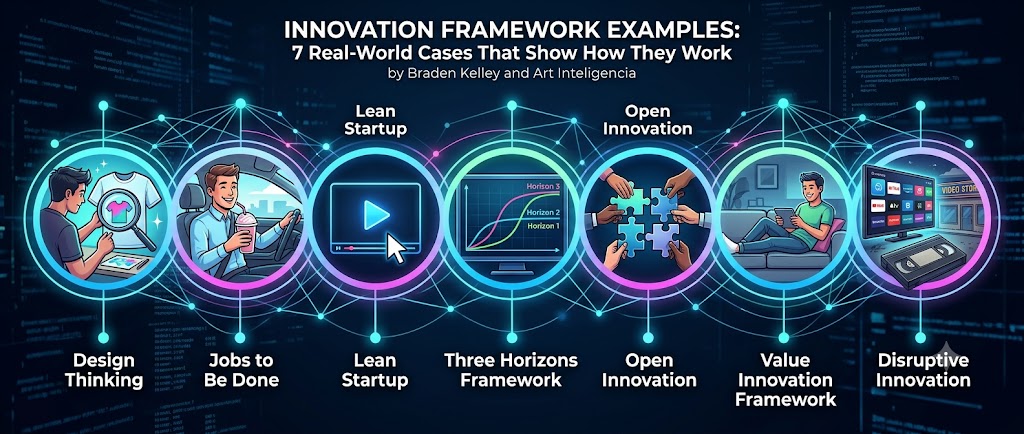
by Braden Kelley and Art Inteligencia
The most common question I get after presenting on innovation frameworks is not “which framework is best?” — it’s “can you show me what this actually looks like inside a real organization?” That question is exactly right. Frameworks are only valuable when you can see how they translate from theory to practice, and the translation is rarely as clean or obvious as the textbook version suggests.
What follows are real examples of organizations applying specific innovation frameworks — what the framework gave them, what it required of them, and what the outcomes looked like. For a complete guide to the major frameworks themselves, see our comprehensive innovation frameworks reference guide.
Design Thinking: IDEO and Bank of America’s “Keep the Change”
Bank of America’s “Keep the Change” savings program is one of the most cited design thinking success stories for good reason — it demonstrates what happens when you apply genuine customer empathy rather than product-feature thinking to a business problem.
The challenge: Bank of America wanted to help customers save more money, but conventional savings products were failing to attract adoption among their target segment of working-age adults. IDEO was brought in to apply design thinking to the problem.
The empathy research revealed something that no amount of market data had surfaced: people found saving difficult not because they lacked discipline, but because saving felt like a deliberate sacrifice that required conscious decision-making every time. The insight was behavioral, not financial.
The solution that emerged from this insight was counterintuitive: make saving automatic and invisible. Every time a customer made a debit card purchase, the amount was rounded up to the nearest dollar, and the difference was automatically transferred to savings. No decision required. No sacrifice felt.
The result: 2.5 million new customers enrolled in the first year, and Bank of America customers saved more than $1 billion through the program in its first year of operation. The program succeeded because the design thinking process surfaced a genuine behavioral insight — that the friction to saving was psychological, not financial — that product-focused thinking had systematically missed.
The framework lesson: Design thinking’s empathy stage is not market research. It surfaces the behavioral and emotional dimensions of a problem that quantitative data can’t see. The “Keep the Change” insight — that automatic saving removes the psychological friction that makes conscious saving feel like sacrifice — was only discoverable through direct human observation.
Jobs to Be Done: McDonald’s Milkshake Story
Clayton Christensen’s milkshake story is the most famous example of Jobs to Be Done thinking in practice — and it’s worth revisiting in detail because it illustrates exactly how differently JTBD reframes a business problem.
McDonald’s wanted to increase milkshake sales. Conventional market research asked customers what they wanted in a milkshake — thicker? sweeter? more flavors? The answers were inconclusive and the improvements they prompted didn’t move the sales needle.
A JTBD researcher took a different approach: instead of asking customers what they wanted in the product, he asked what job they were hiring the milkshake to do. The finding was completely unexpected. The majority of morning milkshake purchasers were buying for the commute — they needed something that would keep them full through a long, boring drive, that they could consume one-handed without making a mess, and that would last long enough to feel like an event rather than a transaction. The milkshake — thick, slow to consume, and easy to hold — was uniquely suited for this job. The alternatives (a banana, a bagel, a coffee) all failed on at least one dimension of the commute job.
The implication was immediately actionable: make the morning commute milkshake even better at its actual job — thicker, available faster at the drive-through, with a thinner straw to make it last longer. Don’t change the flavor. The job, not the product attribute, was the unit of analysis.
The framework lesson: JTBD reframes the competitive set entirely. McDonald’s wasn’t competing with Burger King for milkshake customers — it was competing with bananas and bagels for the morning commute job. That reframe opens completely different improvement directions than conventional competitive analysis would ever produce.
Lean Startup: Dropbox’s Minimum Viable Product
Dropbox’s founding story is the canonical example of Lean Startup’s MVP principle applied to its fullest effect — and what makes it particularly instructive is that the MVP wasn’t even a product. It was a video.
In 2007, Drew Houston had built a working prototype of Dropbox but faced a fundamental challenge: file synchronization is a problem that requires a significant user base to be meaningful, and building that base requires persuading investors and early users that the problem is real and the solution works. The conventional path — build, launch, market, iterate — would require substantial capital for a product whose value proposition was genuinely hard to communicate without experiencing it.
The Lean Startup approach: before investing further in the product, validate that people actually wanted it. Houston created a simple three-minute demo video explaining what Dropbox would do. No working product. No technical demonstration. Just a clear explanation of the problem and how Dropbox would solve it. He posted it on Hacker News.
The waitlist went from 5,000 to 75,000 overnight. The demand signal was unambiguous. The MVP — in this case, a video rather than a product — had validated the core assumption (that people wanted effortless file synchronization across devices) at a cost of hours rather than months of development.
The framework lesson: The point of an MVP is to test the most important assumption at the lowest possible cost, not to build the simplest functional version of the product. In Dropbox’s case, the most important assumption was demand, not technical feasibility — so the MVP was a demand test, not a product prototype.
Three Horizons Framework: Amazon Web Services
Amazon’s development of AWS is the most instructive example of McKinsey’s Three Horizons Framework in practice — partly because Amazon’s leaders almost certainly weren’t thinking about Three Horizons when they built it, but the strategic logic maps perfectly onto the framework.
Amazon’s Horizon 1 business in the early 2000s was e-commerce — the core retail operation that was generating revenue and requiring continuous improvement. The challenge every e-commerce business faces is infrastructure: you need enormous computing capacity to handle peak periods (holiday shopping), but that capacity sits idle for most of the year. Amazon had solved this problem for itself through massive internal infrastructure investment.
The Horizon 2 insight — building an adjacent business from existing capabilities — came from recognizing that the infrastructure Amazon had built to run its own e-commerce operation was itself a valuable product that other companies needed. The capability was already built. The extension was to offer it externally.
The Horizon 3 bet was that computing infrastructure as a service would become a foundational utility — that the long-term market was enormous and that Amazon’s early investment would produce compounding advantages as the market developed. In 2024, AWS generated over $100 billion in annual revenue and represented the majority of Amazon’s operating profit.
The framework lesson: The Three Horizons Framework is most valuable not as a planning tool but as a diagnostic: it forces explicit conversations about whether the organization is investing appropriately across all three time horizons, and whether Horizon 1 pressures are crowding out the Horizon 2 and 3 investments that produce long-term competitive advantage. Amazon’s willingness to invest in and protect Horizon 3 bets — including AWS, Prime, and Alexa — while competitors focused primarily on Horizon 1 optimization is a significant part of why it has compounded value so effectively.
Open Innovation: Procter & Gamble’s Connect + Develop
Procter & Gamble’s Connect + Develop program, launched in 2000 under CEO A.G. Lafley, is the most cited example of open innovation at enterprise scale. Lafley set an ambitious and specific goal: source 50% of P&G’s innovations from outside the company. This was not aspirational language — it was a specific, measurable target that required fundamentally restructuring how P&G approached innovation.
The program built explicit infrastructure for external idea sourcing: a dedicated team for identifying and evaluating external innovations, partnerships with universities and research institutions, a public submission portal for independent inventors, and acquisition strategies that brought external technologies inside P&G’s commercialization machinery.
The results were significant. Spin-off toothbrush innovations, the Swiffer product line, and the Pringles printing technology all came through open innovation channels. By 2006, P&G reported that more than 35% of its new products had elements that originated from outside the company, up from about 15% in 2000. Productivity in R&D improved substantially.
What made Connect + Develop work where most open innovation programs fail was the investment in internal absorption capability — the processes, relationships, and organizational structures that allowed P&G to actually use external ideas rather than just collect them. The “not invented here” syndrome that kills most open innovation programs was addressed through deliberate cultural and process design, not just aspiration.
The framework lesson: Open innovation requires two-sided capability development — not just the ability to attract external ideas, but the organizational capacity to evaluate, integrate, and commercialize them. P&G’s investment in internal absorption capability was as important as its investment in external sourcing.
The Value Innovation Framework: Apple iPad Launch
The Apple iPad launch in 2010 illustrates the Value Innovation Framework’s three components — Value Creation, Value Access, and Value Translation — and specifically demonstrates what happens when Value Translation fails even when the other two are strong.
The iPad’s Value Creation was genuinely significant: a device that made web browsing, email, media consumption, and light content creation dramatically more convenient than a laptop for a large set of use cases. Value Access was strong: the price point was lower than expected, distribution through Apple Stores and carriers was immediate, and the device worked out of the box without configuration.
The initial launch, however, struggled with Value Translation — helping people understand what job the device was actually for. The early marketing positioned it as a larger iPhone or a smaller laptop, both framings that made it seem like a compromise rather than a genuine innovation. Reviews were mixed. The initial sales trajectory was uncertain.
The Value Translation breakthrough came not from a product change but from a single advertising image: a person relaxing on a couch with an iPad in their lap. That image communicated in seconds what no amount of specification comparison could: this is the device for the relaxed, casual computing moment — not the desk, not the commute, but the couch. Sales accelerated dramatically after that visual translation clicked.
The framework lesson: Innovation = Value Creation × Value Access × Value Translation is multiplicative, not additive. The iPad had strong Value Creation and Value Access from day one. The Value Translation gap almost cost Apple the launch. Fixing the translation — not the product — unlocked the market.
Disruptive Innovation: Netflix vs Blockbuster
The Netflix/Blockbuster story has become the defining example of disruptive innovation theory in practice — perhaps because it is unusually clean as a case study, with a visible incumbent, a clear disruption pattern, and a decisive outcome.
Netflix’s initial DVD-by-mail service in 1998 entered the video rental market from exactly the position Christensen’s theory predicts: serving an overlooked segment (frequent renters who resented late fees and found the trip to the store inconvenient) with a simpler, different model that the incumbent (Blockbuster) had no interest in responding to. Blockbuster’s most profitable customers were the casual renters who came into stores and paid late fees — the customers Netflix was serving were not Blockbuster’s priority.
As Netflix improved, it moved upmarket — expanding its library, improving delivery speed, and eventually transitioning to streaming. By the time the threat was obvious to Blockbuster, the incumbent’s response was structurally constrained: its entire business model (physical stores, late fees, walk-in customers) was incompatible with the direction the market was moving. Blockbuster filed for bankruptcy in 2010. Netflix is now a global media company with over 300 million subscribers.
The framework lesson: Disruptive innovation theory’s most valuable practical application is identifying threats that conventional competitive analysis will dismiss. Blockbuster’s leadership could see Netflix’s numbers for years and rationally conclude that the threat was manageable. The framework reveals why that rational conclusion was wrong: the disruption was coming from a direction Blockbuster’s financial incentives prevented it from defending.
Frequently Asked Questions
What are some real-world examples of innovation frameworks in action?
Real-world innovation framework examples include: Bank of America’s “Keep the Change” savings program (design thinking applied to behavioral finance); McDonald’s milkshake insight (Jobs to Be Done reframing the competitive set); Dropbox’s video MVP (Lean Startup demand validation before product development); Amazon Web Services (Three Horizons Framework applied to infrastructure-as-a-service); Procter & Gamble’s Connect + Develop (open innovation at enterprise scale); the Apple iPad launch (Value Innovation Framework showing the importance of Value Translation); and Netflix’s disruption of Blockbuster (Disruptive Innovation theory playing out over a decade). Each example illustrates how frameworks translate from theory to specific, actionable decisions in real organizations.
Which innovation framework is most widely used by large companies?
McKinsey’s Three Horizons Framework and Design Thinking are the most widely adopted innovation frameworks among large organizations. Three Horizons is particularly prevalent in corporate strategy and portfolio management contexts because it provides a common language for conversations about innovation investment allocation. Design Thinking has been widely adopted across industries — from product development to healthcare to public policy — because its human-centered, iterative approach applies to virtually any type of complex problem. In practice, most sophisticated innovation programs use multiple frameworks in combination rather than selecting one exclusively.
How do you choose the right innovation framework for your organization?
Choosing the right innovation framework depends on your primary challenge: if you need to allocate innovation investment across time horizons, use Three Horizons; if you need to identify unmet customer needs, use Jobs to Be Done; if you need to validate a new concept quickly, use Lean Startup; if you need to understand competitive disruption threats, use Disruptive Innovation theory; if you need to access external capabilities, use Open Innovation; if you need to solve a complex human-centered problem, use Design Thinking. Most organizations benefit from using multiple frameworks in combination — each addresses a different dimension of the innovation challenge. For a complete framework selection guide, see our comprehensive innovation frameworks guide.
Want to go deeper on any of these frameworks? Our complete guide to innovation frameworks covers each one in detail — what it does well, where it falls short, and how to choose the right approach for your specific situation.
Bring This Thinking to Your Next Event
Braden Kelley is a LinkedIn Top Voice, bestselling author, and innovation keynote speaker who helps organizations get to the future first and build sustainable innovation cultures.
Image Credit: Gemini
Content Authenticity Statement: The topic area, key elements to focus on, etc. were decisions made by Braden Kelley, with a little help from Claude to clean up the article, add images and create infographics.
 Sign up here to get Human-Centered Change & Innovation Weekly delivered to your inbox every week.