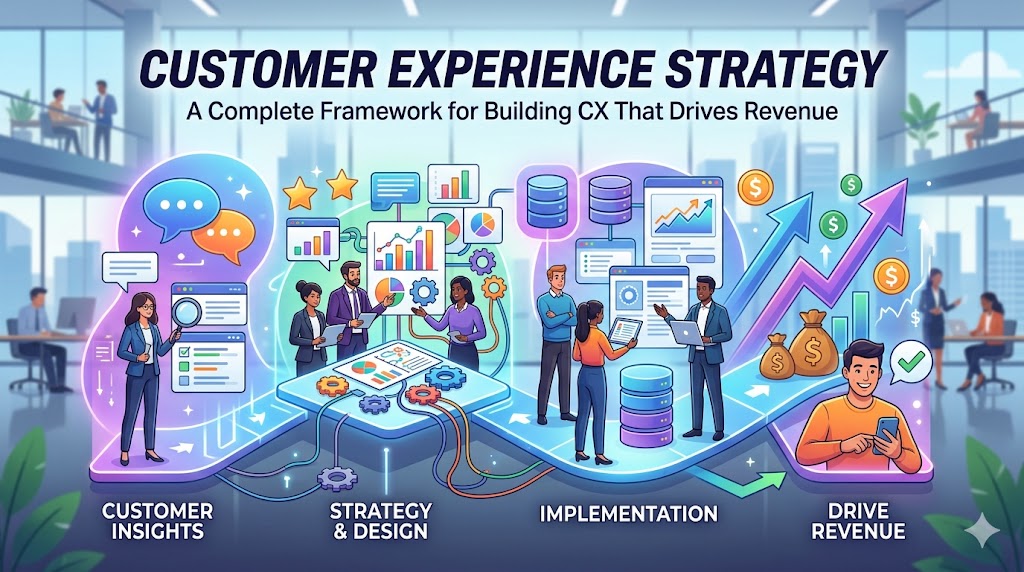
A Complete Framework for Building CX That Drives Revenue
by Braden Kelley and Art Inteligencia
Most organizations have a customer experience strategy in name. Few have one in practice. The evidence is in the numbers: 80% of organizations claim CX is a top priority, yet Forrester’s CX Index has declined for four consecutive years. The gap between organizational intention and customer reality is not a commitment problem — it is a strategy problem. Organizations are investing in the wrong things, measuring the wrong outcomes, and building programs that produce activity without producing experience improvement.
A customer experience strategy that actually works — one that produces measurable improvement in customer loyalty, retention, and revenue — requires more than a CX team, a VoC program, and a dashboard of satisfaction scores. It requires a clear theory of how experience creates competitive advantage, organizational alignment around that theory, and the capability to diagnose and fix experience failures systematically rather than reactively.
This guide provides a practitioner’s framework for building a customer experience strategy that produces those outcomes.
What is a Customer Experience Strategy?
A customer experience strategy is a deliberate, organization-wide plan for designing, delivering, and continuously improving the experiences customers have with your organization — with the explicit goal of building the loyalty, advocacy, and revenue growth that excellent experience generates.
Three components of this definition deserve emphasis:
Deliberate — Customer experience is not managed by default. Every organization has a customer experience, whether it has a strategy for it or not. The question is whether that experience is the result of deliberate design or accumulated accident. Organizations whose experiences are the result of design consistently outperform those whose experiences are the result of organizational inertia.
Organization-wide — Customer experience is not owned by the customer service team, the CX function, or the Chief Customer Officer alone. Every function that touches the customer journey — product, marketing, sales, operations, technology, and service — contributes to the experience. A CX strategy that operates within a single function produces incremental improvement in that function’s touchpoints while leaving the rest of the experience unchanged.
Continuously improving — Customer experience is not a project with an end state. Customer expectations evolve, competitive standards rise, and the experience that was excellent last year becomes merely adequate this year. A CX strategy that treats experience improvement as a one-time initiative rather than an ongoing management discipline will fall behind the organizations that are constantly raising the standard.
The Business Case for Customer Experience Strategy
The financial return on customer experience investment is among the best-documented in business strategy:
- CX leaders generate 6x the revenue growth of bottom-quartile peers, and the typical CX investment returns 3x within 24 months, per Forrester CX Index 2026
- 86% of buyers are willing to pay more for a better customer experience — meaning experience quality directly affects price realization, not just retention
- 41% of customer-obsessed companies achieved at least 10% revenue growth in their last fiscal year, compared to just 10% of less mature companies
- A 5% improvement in retention drives 25–95% profit growth — the retention economics of excellent experience consistently outperform acquisition investment on lifetime ROI
- Brands that align customer experience and brand experience unlock up to 3.5x revenue growth compared to those that manage them separately, per Forrester’s Total Experience Score research
The organizations generating these returns are not doing so through better survey scores. They are doing so by building genuine organizational capability to understand what customers actually experience, identify where that experience is falling short, and fix the specific failures driving churn, suppressing expansion, and preventing advocacy.
The Five Components of an Effective CX Strategy
1. A Clear CX Vision and Promise
An effective CX strategy begins with a clear, specific definition of the experience you are trying to deliver — not the generic “we put customers first” aspiration that appears in every annual report, but a specific commitment that describes what customers should feel, think, and be able to do at the end of every interaction with your organization.
The best CX visions are simultaneously aspirational and actionable. They are aspirational because they describe a standard that the current experience doesn’t fully meet — creating the tension that motivates investment and improvement. They are actionable because they are specific enough to guide decisions: when a product team is debating whether to add a feature or simplify the onboarding flow, the CX vision should make the right answer clear.
A strong CX vision has three characteristics: it is grounded in genuine customer insight (not internal assumptions), it is differentiated from what competitors are promising, and it is achievable within the organization’s strategic and operational capabilities.
2. Deep Customer Understanding
A CX strategy built on assumptions about what customers experience is a strategy built on sand. The organizations with the most effective CX strategies invest continuously in understanding what customers actually experience — not just what they say they experience, but what they do, what they feel, and what they compare you to.
This understanding is built through four complementary sources:
- Voice of Customer programs — systematic collection and analysis of direct, indirect, and inferred customer feedback across the full journey
- Customer journey mapping — visual documentation of the customer experience from the customer’s perspective, validated against real customer research rather than internal assumptions
- Direct experience walking — actually going through your own experience as a customer, and your competitors’ experiences, to build firsthand understanding of the gaps
- Periodic experience audits — systematic, holistic assessment of the full experience landscape that supplements continuous VoC monitoring with deep diagnostic capability
The organizations that consistently outperform on customer experience are those that treat customer understanding as a continuous investment rather than a periodic research project.
3. Cross-Functional Alignment and Governance
The most common reason CX strategies fail to produce results is not insufficient investment — it is insufficient alignment. When product, marketing, sales, operations, and service teams are each optimizing for their own metrics without a shared understanding of the customer journey they are collectively creating, the result is a fragmented experience that frustrates customers and produces avoidable service contacts, churn, and missed expansion opportunities.
Effective CX governance requires three things:
Shared metrics — Every function should have CX-related metrics in their performance management framework, not just the CX team. When only the CX team is measured on customer outcomes, only the CX team is accountable for them.
Cross-functional journey ownership — Each major stage of the customer journey should have a named executive owner who is accountable for the experience at that stage, with the authority to coordinate across functions to improve it.
Regular cross-functional experience reviews — Leadership teams should review the state of the customer experience on a regular cadence — not just quarterly satisfaction scores, but a genuine assessment of where the experience is improving, where it is declining, and what is driving the changes.
4. Prioritized Experience Improvement Roadmap
A CX strategy without a prioritized improvement roadmap is a set of principles without a plan. Experience improvement requires the same discipline as any other organizational investment: clear priorities, defined owners, specific timelines, and success metrics that connect improvements to business outcomes.
Prioritization should be driven by two dimensions: impact on customer loyalty and revenue (which improvements will most move the needle on the outcomes you care about?) and feasibility (which improvements can be made with available resources and within acceptable timeframes?). The highest-value CX investments are almost always the ones that address high-frequency friction points — the experiences that affect large numbers of customers and generate avoidable contacts, churn, and negative word of mouth.
A rigorous prioritization process requires two things that most organizations lack: a complete, evidence-based understanding of where the experience is falling short, and a financial model that connects experience gaps to revenue impact. Without both, prioritization is driven by advocacy and politics rather than customer and business value.
5. Measurement and Accountability Infrastructure
You cannot manage what you cannot measure — but the more important principle for CX strategy is that you cannot improve what you are measuring incorrectly. Most CX measurement infrastructure is designed to report on experience quality rather than to drive improvement. The organizations that generate the strongest financial returns from CX investment have measurement systems designed around a different purpose: connecting experience quality to business outcomes in a way that guides investment decisions.
Effective CX measurement has four layers:
Relationship metrics — NPS, customer lifetime value, churn rate, and share of wallet track the overall health of the customer relationship and connect experience quality to revenue outcomes.
Journey metrics — Experience quality measures at key journey stages (onboarding completion rates, first value realization timelines, renewal conversation sentiment) track whether the experience is building or eroding loyalty at the moments that matter most.
Touchpoint metrics — CSAT, CES, and FCR at specific interactions identify where particular touchpoints are falling below acceptable performance thresholds.
Leading indicators — Behavioral signals (product usage patterns, support contact rates, engagement trends) that predict future loyalty outcomes before they show up in lagging metrics like churn.
Organizations that demonstrate how customer satisfaction is associated with growth, margin, and profitability are 29% more likely to secure more CX budgets — meaning measurement that connects experience to financial outcomes is not just analytically valuable, it is organizationally necessary for sustained CX investment.
Common CX Strategy Mistakes
Starting with technology rather than understanding
The most expensive CX strategy mistake is investing in CX technology — journey analytics platforms, AI-powered personalization engines, omnichannel service infrastructure — before understanding what the customer experience actually is and where the highest-value improvement opportunities lie. Technology amplifies existing experience design; it does not substitute for it. Organizations that deploy sophisticated CX technology on top of a poorly designed experience produce a more sophisticated version of the same bad experience.
Optimizing components rather than journeys
Experience improvement programs that focus on individual touchpoints — improving the support chat experience, redesigning the onboarding email sequence, upgrading the checkout flow — often produce local improvements that don’t translate to loyalty gains. Customers experience your organization as a journey, not a collection of touchpoints. A touchpoint that is individually excellent but that follows a frustrating prior stage in the journey will not produce the loyalty improvement the touchpoint quality alone would suggest.
Treating CX as a department rather than an organizational capability
When “customer experience” is the name of a team rather than a description of organizational behavior, the CX team becomes responsible for improving experiences that other functions are simultaneously degrading. Product decisions that generate avoidable support contacts, sales promises that onboarding cannot fulfill, billing processes that require customers to call to understand their invoices — none of these are the CX team’s problem to fix, and none of them will be fixed as long as the functions causing them have no accountability for the experience they produce.
Measuring satisfaction rather than loyalty drivers
Satisfaction is a lagging indicator of an experience that has already occurred. Loyalty is a forward-looking outcome that determines future revenue. CX strategies that optimize for satisfaction scores may produce organizations that customers find acceptable but don’t actively choose — behaviorally retained but not genuinely loyal. The most important CX measurement question is not “are customers satisfied?” but “are customers building the trust and emotional connection that will make them loyal and advocate for us?”
Treating the experience audit as a one-time project
A customer experience audit conducted once and never repeated produces a snapshot of the experience at a point in time. Customer expectations evolve, competitive standards rise, and new experience failures emerge continuously. Organizations that treat experience diagnosis as a periodic investment — auditing the experience regularly rather than annually at best — consistently outperform those that conduct a one-time audit and consider the diagnostic work done.
Building Your CX Strategy: A Starting Point
If you are starting from scratch or rebuilding a CX strategy that hasn’t been producing results, begin with three foundational activities before investing in any specific improvement initiatives or technology:
1. Audit the actual experience
Before deciding what to improve, understand what the experience actually is. This means walking your own customer journey — from first search to onboarding to service to renewal — with genuinely fresh eyes, and comparing it against the experiences your customers can get from alternatives. The gap between what you think the experience is and what it actually is almost always contains the most important strategic insight.
2. Quantify the revenue impact of experience gaps
Translate the experience gaps you identify into revenue language — churn contribution, expansion revenue foregone, acquisition cost elevated by poor NPS, price premium sacrificed because the experience doesn’t justify it. This translation is what connects CX strategy to business strategy and secures the organizational commitment and investment that experience improvement requires.
3. Build cross-functional alignment before building programs
No CX program produces sustainable results without cross-functional alignment. Before launching improvement initiatives, build a shared understanding of the customer journey across product, marketing, sales, operations, and service — and establish the governance structure that assigns accountability for experience quality at each stage of that journey.
A customer experience audit is the most direct way to accomplish all three simultaneously — providing an accurate picture of the actual experience, a prioritized assessment of where the gaps are most costly, and the shared organizational language needed to align functions around a common understanding of what needs to improve.
CX Strategy in 2026: The Emerging Imperatives
The CX landscape is evolving rapidly, and the strategies that were leading-edge in 2022 are table stakes in 2026. Three imperatives are reshaping what effective CX strategy requires:
Proactive over reactive
By 2026, 40% of customer service organizations will adopt proactive strategies, enabling them to anticipate needs, resolve issues before they escalate, and contribute directly to revenue growth. The organizations capturing the most CX value are not those with the best reactive service — they are those that design experiences to prevent problems from occurring, and intervene proactively at the moments of highest risk before customers need to reach out.
AI-augmented human experience
By 2030, 67% of customer engagements via digital devices will be managed by intelligent machines rather than human agents. The strategic question for every organization is not whether to use AI in the customer experience, but how to use it in ways that enhance rather than degrade the human elements of the experience that drive genuine loyalty. Organizations that deploy AI to reduce cost without considering its impact on trust and emotional connection will save money while eroding the loyalty they have built.
Personalization as foundation, not feature
65% of consumers expect tailored experiences, and 80% are more likely to make purchases from brands that deliver personalized interactions. Personalization has moved from a competitive differentiator to a baseline expectation. Organizations that are not systematically using the data they have about customers to deliver more relevant, contextualized experiences are falling behind the standard customers now expect.
Frequently Asked Questions About Customer Experience Strategy
What is a customer experience strategy?
A customer experience strategy is a deliberate, organization-wide plan for designing, delivering, and continuously improving the experiences customers have with your organization — with the explicit goal of building the loyalty, advocacy, and revenue growth that excellent experience generates. An effective CX strategy has five components: a clear CX vision and promise; deep customer understanding built through VoC programs, journey mapping, and direct experience research; cross-functional alignment and governance; a prioritized experience improvement roadmap; and measurement and accountability infrastructure that connects experience quality to business outcomes.
What is the ROI of a customer experience strategy?
The financial return on customer experience investment is well-documented and substantial. CX leaders generate 6x the revenue growth of bottom-quartile peers, with typical CX investments returning 3x within 24 months. A 5% improvement in retention drives 25–95% profit growth. 86% of buyers are willing to pay more for better experience, meaning CX quality directly affects price realization. 41% of customer-obsessed companies achieved at least 10% revenue growth in their last fiscal year, compared to just 10% of less mature companies. The organizations generating these returns are building genuine organizational capability to understand and improve the actual customer experience — not just reporting on satisfaction scores.
Who owns customer experience strategy in an organization?
Customer experience strategy should be owned at the CEO level and executed cross-functionally — not delegated to a single team. In practice, accountability is typically assigned to a Chief Customer Officer, Chief Experience Officer, or Chief Marketing Officer, with cross-functional governance ensuring that product, operations, technology, and service teams are aligned around shared experience standards. The most common CX strategy failure is treating experience as a department responsibility rather than an organizational capability — holding the CX team accountable for outcomes produced by decisions made across the entire organization.
What is the difference between customer experience strategy and customer service strategy?
Customer experience strategy addresses the full customer relationship across every touchpoint — from first awareness through advocacy — and is owned by the entire organization. Customer service strategy addresses the specific moments when customers seek assistance and is owned primarily by the service or support function. Customer service is one component of customer experience. A customer service strategy that produces excellent support interactions cannot compensate for poor product design, broken onboarding, or friction-laden processes elsewhere in the journey. Organizations that conflate the two consistently underinvest in the upstream experience design that determines whether service is needed at all.
How do you measure the success of a customer experience strategy?
Effective CX strategy measurement operates across four layers: relationship metrics (NPS, customer lifetime value, churn rate, share of wallet) that track the overall health of the customer relationship; journey metrics that measure experience quality at key stages (onboarding, first value realization, renewal); touchpoint metrics (CSAT, CES, FCR) that identify where specific interactions are underperforming; and leading indicators (product usage patterns, support contact rates, engagement trends) that predict future loyalty outcomes before they show up in lagging metrics. The most important principle is connecting experience metrics to business outcomes — organizations that demonstrate how CX improvement drives revenue, retention, and profitability are 29% more likely to secure sustained CX investment.
How does a customer experience audit support CX strategy?
A customer experience audit provides the diagnostic foundation that effective CX strategy requires — an accurate, evidence-based picture of what customers actually experience, where the experience is falling short of competitive standards, and which gaps are generating the most significant revenue impact. Without this foundation, CX strategy investment is driven by assumptions, advocacy, and the loudest recent customer complaints rather than by a systematic understanding of where experience improvement will generate the greatest return. An experience audit is particularly valuable at three moments: when building a new CX strategy from scratch, when an existing strategy isn’t producing the expected results, and when competitive pressure or declining metrics signal that the experience may have fallen behind the market standard found via competitive experience benchmarking.
Ready to build a customer experience strategy on a foundation of genuine understanding? Start with an Experience Audit →
Content Authenticity Statement: The topic area, key elements to focus on, etc. were decisions made by Braden Kelley, with a little help from Claude and Google Gemini to clean up the article, add images and create infographics.
Image credits: Google Gemini
 Sign up here to get Human-Centered Change & Innovation Weekly delivered to your inbox every week.
Sources:
— https://www.digitalapplied.com/blog/customer-experience-statistics-2026-cx-data-points
— https://www.superoffice.com/blog/customer-experience-statistics/
— https://porchgroupmedia.com/blog/how-to-drive-customer-engagement/
— https://searchlab.nl/en/statistics/customer-experience-statistics-2026
— https://www.forrester.com/about-us/forrester-timeline/
— https://cxm.world/customer-experience/perception-is-profit-forresters-total-experience-score-reveals-all/