Why Satisfaction Isn’t Enough and What Actually Builds It
by Braden Kelley and Art Inteligencia
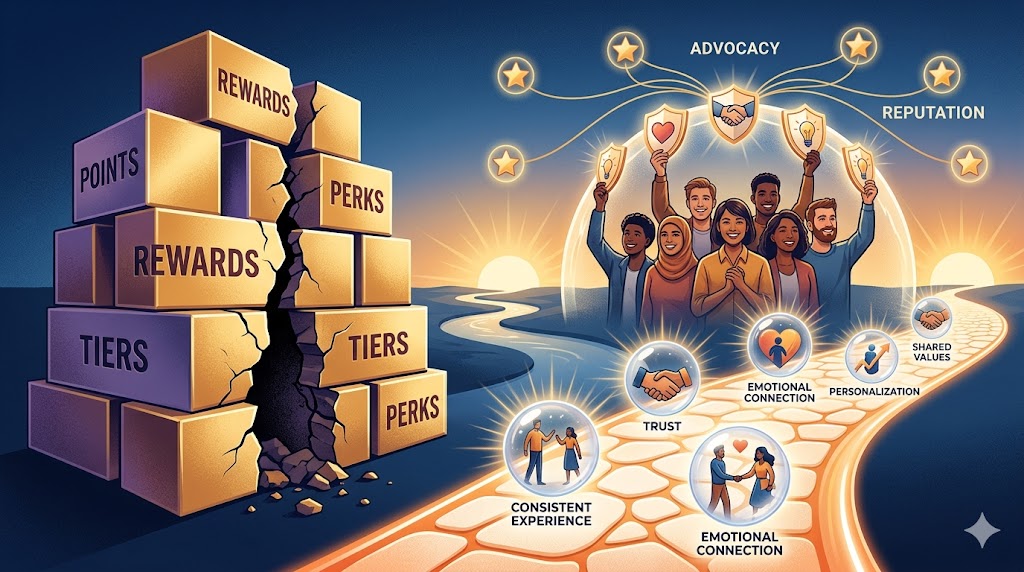
Customer loyalty is the most misunderstood concept in business. Organizations spend billions annually on loyalty programs — points, rewards, tiers, and perks — while the research consistently shows that programs are not what makes customers loyal. Customers are loyal because of how an organization makes them feel, how reliably it delivers on its promises, and how effectively it helps them succeed. The program is the mechanism. The experience is the cause.
This distinction matters enormously in practice. Organizations that invest in loyalty programs without fixing the underlying experience are building an expensive structure on a cracked foundation. Organizations that invest in experience first — and use programs to reinforce the relationship — build the kind of loyalty that is genuinely difficult for competitors to disrupt.
What is Customer Loyalty?
Customer loyalty is the sustained preference a customer shows for an organization — expressed through repeat purchases, resistance to competitive alternatives, willingness to pay a premium, and active advocacy on the organization’s behalf. It is not the same as customer retention (which can be driven by switching costs and inertia), and it is not the same as customer satisfaction (which measures a moment in time, not a sustained behavioral pattern).
True loyalty has three dimensions:
- Behavioral loyalty — customers consistently choose you over alternatives and purchase repeatedly, even when alternatives are available
- Attitudinal loyalty — customers have a genuinely positive disposition toward your organization, feel emotionally connected to it, and trust it
- Advocacy loyalty — customers actively recommend you to others, defend you when criticized, and invest their social capital in your brand
Most loyalty metrics measure only the behavioral dimension — repeat purchase rates, retention rates, and NPS scores as a proxy for advocacy. The attitudinal dimension is harder to measure and receives far less management attention, which is why so many organizations are surprised when behaviorally “loyal” customers defect at the first attractive alternative: they were retained, not loyal.
The Business Case for Customer Loyalty
The financial argument for investing in customer loyalty is among the strongest in business strategy:
- 80% of future profits will come from just 20% of existing customers — making the retention and deepening of existing relationships the highest-ROI investment available to most organizations.
- Customers with an emotional bond to a brand have a 306% higher lifetime value than those who are merely satisfied — the gap between satisfied and loyal is not incremental, it is transformational.
- Acquiring a new customer costs 5x more than retaining an existing one — and loyal customers require less acquisition investment, less service investment, and generate more referral value simultaneously.
- Brands that align customer experience and brand experience unlock up to 3.5x revenue growth compared to those that manage them separately, according to Forrester’s Total Experience Score research.
- Customers who trust a brand are 88% more likely to be repeat buyers — trust is the foundation of loyalty, and trust is built through experience, not programs.
Why Loyalty Programs Alone Don’t Build Loyalty
Loyalty programs are ubiquitous — and their limitations are increasingly well documented. In 2026, roughly 59% of consumers are more likely to join a loyalty program than 12 months ago, and loyalty programs now account for 31.4% of total marketing budgets. Yet the research on whether programs actually build loyalty is sobering.
The fundamental problem with loyalty programs is that they address behavior without addressing attitude. A points program can change what a customer does — encouraging them to concentrate purchases with your organization to maximize rewards — without changing how they feel about you. Behavioral loyalty driven by a program is fragile: it persists only as long as the program’s economics are attractive. The moment a competitor offers a better program, the “loyal” customer transfers their purchases immediately.
This is the difference between loyalty that is earned and loyalty that is purchased. Earned loyalty — built through consistently excellent experience, genuine trust, and emotional connection — is durable. Purchased loyalty — maintained through rewards and discounts — is ephemeral.
Forrester’s 2025 CX Index reached a new low after four consecutive years of decline, with 25% of US brands seeing CX scores decline for a second straight year. This is happening at the same time that loyalty program investment is rising — a clear signal that programs are not compensating for experience failures.
The Real Drivers of Customer Loyalty
The research on what actually drives sustained customer loyalty consistently points to the same factors — and none of them are primarily program-driven:
1. Consistent, reliable experience delivery
80% of customers state that the experience a company provides is just as important as its products and services. Consistency matters as much as peak quality — customers who know what to expect from you, and reliably get it, develop a form of trust that is the foundation of genuine loyalty. Inconsistency, even when punctuated by excellent experiences, creates uncertainty that erodes trust over time.
2. Trust
Trust is both the prerequisite for loyalty and its most fragile component. In PwC’s 2025 CX research, 93% of consumers say a brand will lose their trust if it mishandles personal data. Trust is built slowly through consistent behavior and destroyed quickly through specific failures — particularly failures of honesty, competence, or care at critical moments. Organizations that treat trust as an implicit asset rather than an explicit management priority consistently underinvest in the behaviors that build it.
3. Emotional connection
Customers with an emotional bond to a brand have a 306% higher lifetime value than those who are merely satisfied. Emotional connection is built when customers feel genuinely understood, when the organization demonstrates that it knows and values them as individuals, and when interactions feel human rather than transactional. It is the hardest loyalty driver to manufacture deliberately — and the most durable when it exists.
4. Value realization
Customers are loyal to organizations that reliably help them succeed — that deliver the outcomes they purchased for, consistently and predictably. Value realization is distinct from product quality: a high-quality product that customers can’t fully use, don’t know how to use, or aren’t supported in using does not build loyalty. Organizations that invest in customer success — in helping customers actually achieve the outcomes they bought — build the kind of loyalty that survives competitive disruption.
5. Personalization
91% of consumers now prefer brands that offer personalized content and offers. Personalization signals that you know the customer as an individual — that they are not interchangeable with every other customer you serve. At its best, personalization is not about data and algorithms; it is about demonstrating through every interaction that you understand who this specific customer is, what they value, and what they need.
6. Shared values
89% of consumers prefer brands that share their social or ethical values. Values alignment has become an increasingly important loyalty driver, particularly among younger customers. Organizations whose behavior visibly aligns with values their customers hold — environmental responsibility, social equity, community investment, employee treatment — build a form of loyalty that transcends the transactional relationship entirely.
7. Exceptional service recovery
The service recovery paradox — the well-documented phenomenon where customers who experience a problem that is handled exceptionally well become more loyal than customers who never experienced a problem at all — is one of the most actionable loyalty drivers available. Every service failure is a loyalty opportunity if handled correctly. Organizations that invest in exceptional service recovery — not just adequate resolution but genuinely impressive response — consistently outperform on loyalty metrics.
The Satisfaction-Loyalty Gap: Why Satisfied Customers Aren’t Always Loyal
One of the most important findings in customer loyalty research is the non-linear relationship between satisfaction and loyalty. Satisfaction and loyalty are not the same thing, and the gap between them is where most loyalty investment goes to waste.
Research by Xerox consistently found that customers rating an experience 5 out of 5 were six times more likely to repurchase than customers rating it 4 out of 5. The difference between “satisfied” and “completely satisfied” — between adequate and excellent — is enormous in its loyalty implications. This is why organizations that manage to average satisfaction scores miss the point: the goal is not average satisfaction, it is the consistent delivery of genuinely excellent experience at the moments that matter most.
The practical implication is that loyalty investment should focus on the moments of truth — the high-stakes interactions that define whether customers feel excellent or merely adequate — rather than on incremental improvements to already-acceptable baseline experiences.
How Customer Experience Drives Customer Loyalty
Every loyalty driver identified above is fundamentally an experience outcome. Trust is built through experience. Emotional connection is built through experience. Value realization is built through experience. Personalization is delivered through experience. Service recovery is an experience intervention.
This means that the most direct path to building customer loyalty is investing in customer experience — specifically, in understanding where the current experience is falling short of the standard required to build the trust, emotional connection, and consistent value realization that sustain loyalty over time.
A customer experience audit is the most systematic way to identify the specific experience gaps that are preventing loyalty from forming — or actively eroding loyalty that has been built. An experience audit walks the actual customer journey across all touchpoints to identify:
- The moments of truth being handled adequately when they should be handled exceptionally
- The consistency failures creating uncertainty and undermining trust
- The personalization gaps signaling to customers that they are not truly known
- The service recovery processes that are resolving problems without rebuilding loyalty
- The value realization gaps preventing customers from achieving the outcomes that sustain engagement
The result is not a loyalty strategy — it is a prioritized experience improvement roadmap that addresses the specific gaps preventing loyalty from forming in your specific customer base, which competitive experience benchmarking can help identify.
Building a Loyalty Strategy That Actually Works
A loyalty strategy that produces genuine, durable loyalty — not just behavioral compliance maintained by program economics — is built in this sequence:
Step 1: Understand what loyalty actually looks like in your customer base
Before investing in loyalty, define what loyalty means in your specific context. What does a genuinely loyal customer do that a merely retained customer doesn’t? How do your most loyal customers behave differently from your average customers? This profile becomes the target state for your loyalty investment.
Step 2: Audit the experience that loyalty is built on
Identify the specific experience gaps — the moments of truth handled adequately rather than exceptionally, the consistency failures, the personalization gaps — that are preventing your average customers from becoming your most loyal customers. This is the foundation that programs and campaigns are built on, and it must be solid before those investments will pay off.
Step 3: Fix the experience failures before layering on programs
The most common loyalty investment mistake is launching a program to compensate for experience failures. Programs attract customers who are loyal to the program, not to you — and they attract your competitors’ customers on the same basis. Fix the experience that builds genuine loyalty first, then use programs to reinforce and reward it.
Step 4: Design moments of truth for excellence, not adequacy
Identify the five to ten moments in your customer journey (customer journey mapping helps here) where the quality of the experience has a disproportionate impact on loyalty — typically onboarding, first value realization, first service incident, renewal, and expansion. Invest in making these moments genuinely excellent rather than merely adequate. The gap between adequate and excellent at these specific moments is where most of the loyalty value lives.
Step 5: Build loyalty measurement that captures what matters
NPS is a useful signal but an incomplete loyalty measure. Build a measurement approach that captures all three dimensions of loyalty — behavioral, attitudinal, and advocacy — and tracks them over time. Understand not just whether customers are renewing but whether they feel genuinely connected, whether they trust you, and whether they would actively recommend you unprompted.
Frequently Asked Questions About Customer Loyalty
What is customer loyalty?
Customer loyalty is the sustained preference a customer shows for an organization — expressed through repeat purchases, resistance to competitive alternatives, willingness to pay a premium, and active advocacy. It has three dimensions: behavioral loyalty (consistently choosing you over alternatives), attitudinal loyalty (genuinely positive feelings and trust toward your organization), and advocacy loyalty (actively recommending you to others). Most loyalty metrics measure only behavioral loyalty, missing the attitudinal and advocacy dimensions that determine whether loyalty is genuine and durable or merely habitual and fragile.
What is the difference between customer loyalty and customer retention?
Customer retention measures whether customers continue purchasing — it can be driven by genuine loyalty, switching costs, inertia, or lack of alternatives. Customer loyalty is a more specific condition: customers are retained because they genuinely prefer your organization, trust it, and feel positively connected to it. A retained customer who is not loyal will defect at the first attractive competitive offer; a genuinely loyal customer will resist competitive alternatives even when they are objectively similar or cheaper. The distinction matters because retention-focused strategies and loyalty-focused strategies require different investments — retention can be managed operationally, but loyalty requires experience investment.
Do loyalty programs actually build customer loyalty?
Loyalty programs can reinforce loyalty in customers who are already loyal, but they rarely create loyalty in customers who are not. The fundamental limitation of loyalty programs is that they change behavior without changing attitude — they can encourage customers to concentrate purchases with your organization, but they cannot make customers trust you, feel emotionally connected to you, or advocate for you. Behavioral loyalty driven by program economics is fragile: it persists only as long as the program’s rewards are attractive relative to alternatives. Organizations that invest in loyalty programs without fixing the underlying experience failures limiting genuine loyalty are building on a cracked foundation.
What is the most important driver of customer loyalty?
Research consistently identifies consistent, reliable experience delivery as the foundation of customer loyalty — before emotional connection, personalization, or program incentives. Customers who know what to expect from an organization and reliably get it develop a form of trust that is the prerequisite for all other loyalty dimensions. Trust, once established, is the single most powerful loyalty driver: customers who trust a brand are 88% more likely to be repeat buyers, and customers with emotional bonds to a brand have a 306% higher lifetime value than those who are merely satisfied. Both trust and emotional connection are built through experience — not through programs.
How does customer experience affect customer loyalty?
Customer experience is the primary mechanism through which loyalty is built or destroyed. Every loyalty driver — trust, emotional connection, value realization, personalization, and service recovery — is delivered through experience. Organizations that invest in understanding and improving their customer experience build the genuine loyalty that resists competitive disruption and generates advocacy. Organizations that manage experience to adequacy while investing in loyalty programs are managing the symptom while neglecting the cause. The most direct path to improving customer loyalty is identifying and fixing the specific experience failures that are preventing trust and emotional connection from forming — which is what a customer experience audit is designed to do.
What is the service recovery paradox?
The service recovery paradox is the well-documented phenomenon where customers who experience a service failure that is handled exceptionally well become more loyal than customers who never experienced a problem at all. It occurs because exceptional service recovery demonstrates, in a high-stakes moment, that the organization genuinely cares about the customer — producing a stronger emotional signal than routine good service. The paradox is real but conditional: it requires genuinely exceptional recovery, not just adequate resolution. Organizations that treat service failures as loyalty opportunities and invest in recovery processes that produce genuine customer delight consistently outperform on loyalty metrics.
Ready to identify the experience gaps limiting loyalty in your organization? Learn more about the Experience Audit →
Image credits: Google Gemini
Content Authenticity Statement: The topic area, key elements to focus on, etc. were decisions made by Braden Kelley, with a little help from Google Gemini to clean up the article, add images and create infographics.
 Sign up here to get Human-Centered Change & Innovation Weekly delivered to your inbox every week.
Pingback: Customer Churn: The Experience Failures Driving Customers Away
Pingback: Revenue Leakage: The Experience Failures Draining Your P&L
Pingback: Customer Experience Improvement: A Complete Framework