LAST UPDATED: May 3, 2026 at 10:10 AM
GUEST POST from Chateau G Pato
The Death of the “Black Box” Excuse
For years, we have treated Artificial Intelligence as a sophisticated utility — a faster calculator or a more intuitive search engine. But that era is over. We have crossed the threshold into agentic collaboration, where AI is no longer a silent tool but a functional, active teammate. This shift demands more than just a change in workflow; it requires a fundamental redesign of our ethical and operational foundations.
The Growing Responsibility Gap
As human-AI teams begin to co-create, we encounter the “Responsibility Gap.” Traditional organizational structures are ill-equipped to handle outcomes generated through hybrid intelligence. When a process is obscured by algorithmic complexity, and the human “partner” acts only as a rubber stamp, accountability evaporates. If we cannot trace the logic of a decision, we cannot learn from its failure.
A Human-Centered Thesis for Innovation
To unlock the true potential of this partnership, we must stop viewing accountability as a punitive liability and start designing it as a shared, transparent, and human-centered asset. True innovation thrives on trust, and trust is built on the clarity of who owns the intent, who owns the execution, and how we collectively govern the results. We aren’t just building better tools; we are building a more responsible future for work.
The Architecture of a Modern Accountability Framework
Designing for accountability requires us to move beyond vague notions of “responsibility” and into the granular details of systems design. We must build structures that can withstand the speed of AI while maintaining the integrity of human oversight. This architecture isn’t just about technical constraints; it’s about experience design (XD) for the people who manage these systems.
The RACI Matrix 2.0
The traditional RACI model (Responsible, Accountable, Consulted, Informed) must be re-engineered for the hybrid workforce. In a human-AI team, the AI might be Responsible for the execution of a task, but a human must always remain Accountable for the result. We must clearly define who is “Informed” when an AI drifts from its baseline and who must be “Consulted” when the AI suggests a radical pivot in strategy.
Traceability by Design
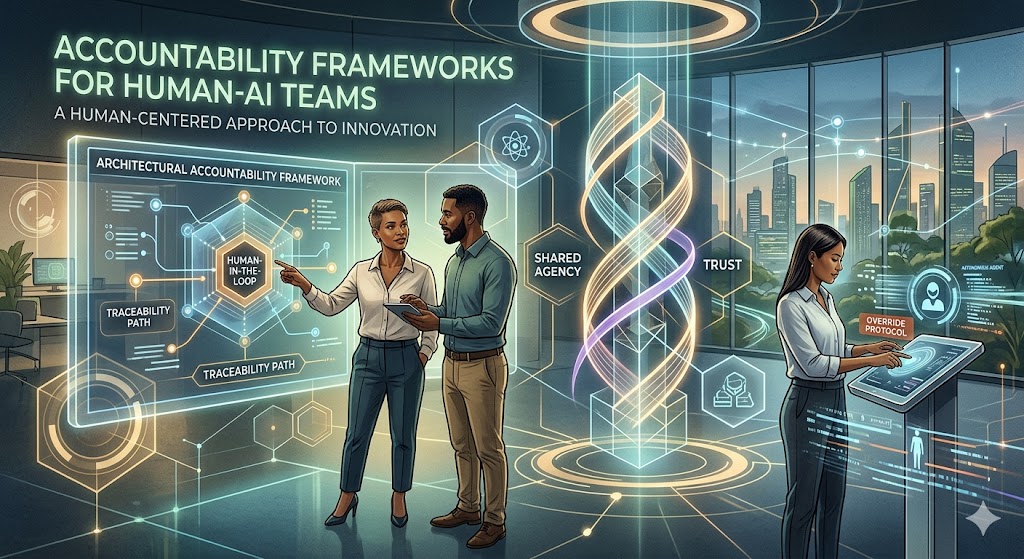
Accountability is impossible without transparency. Every output generated by an AI teammate must have a “provenance trail” — a clear map of the data inputs, prompts, and logic used to arrive at a conclusion. By treating traceability as a core design requirement, we ensure that when a system fails, we aren’t looking at a “black box,” but at a documented path that can be audited, understood, and corrected.
The “Kill Switch” and Override Protocols
True leadership in an AI-integrated world means knowing when to pull the plug. A robust framework establishes clear “Kill Switch” protocols:
- Threshold Alerts: Automated triggers that notify human leads when AI confidence scores drop below a specific percentage.
- Manual Override Authority: Clearly designated roles with the power to bypass AI-driven decisions without bureaucratic delay.
- Emergency Rollbacks: The ability to revert to a “last known good” human-validated state when an autonomous agent produces unexpected outcomes.
By building these safeguards directly into the organizational fabric, we empower our teams to innovate boldly, knowing that the safety nets are both visible and functional.
Designing for Transparency and Trust
Trust is the currency of innovation. In a human-AI partnership, trust cannot be blind; it must be earned through transparency. If a team does not understand how their digital counterpart arrives at a conclusion, they will either follow it off a cliff or ignore it entirely — both of which are disastrous for experience design and organizational growth.
Explainability as a Right
We must move toward a standard where “Explainable AI” (XAI) is not a luxury feature but a fundamental right for every employee. “The AI said so” is an unacceptable defense in any business context. Accountability frameworks must mandate that AI outputs include a plain-language rationale, allowing human teammates to evaluate the logic behind the recommendation rather than just the result.
Real-Time Feedback Loops
Accountability is a two-way street. To prevent algorithmic drift and the entrenchment of bias, we must design mechanisms where humans can correct AI outputs in real-time. This isn’t just about fixing an error; it’s about active mentoring. These feedback loops ensure that the AI learns from the human’s nuanced understanding of culture, ethics, and strategy, creating a virtuous cycle of continuous improvement.
Cultivating Psychological Safety
Innovation dies in an environment of fear. For a human-AI team to function, humans must feel psychologically safe to question, challenge, or reject an AI’s suggestion. A robust framework ensures that:
- Dissent is Valued: Challenging an algorithm is viewed as a form of “quality assurance” rather than an obstacle to efficiency.
- Bias Reporting: There are clear, non-punitive channels for reporting perceived biases or ethical lapses in the AI’s behavior.
- Human Agency: The ultimate decision-making power is visibly vested in people, reinforcing that AI is a partner in the process, not the master of it.
By prioritizing these human-centered elements, we transform the AI from a mysterious “black box” into a transparent, reliable, and accountable colleague.
Change Management: Implementing the Framework
The most sophisticated accountability framework in the world is useless if it exists only as a static document. Integrating AI into the team fabric is a cultural transformation, not a software deployment. To move from theory to practice, we must design the transition with as much intentionality as the technology itself.
From Monitoring to Mentoring
We must shift the organizational mindset. Traditional management often views AI oversight as “monitoring” — a defensive posture designed to catch errors. To drive innovation, we must reframe this as “mentoring.” When a human teammate audits an AI’s output, they are not just checking for mistakes; they are training the system on the nuance of the brand, the ethics of the industry, and the complexities of human experience.
Upskilling for Governance
Accountability requires a new set of competencies. It is no longer enough for employees to be “AI literate”; they must be governance-capable. This includes:
- Critical Prompting: The ability to structure inquiries that minimize bias and maximize transparency.
- Algorithmic Auditing: Basic skills in identifying “hallucinations” or logical inconsistencies in generative outputs.
- Ethical Decision-Making: Strengthening the human capacity to make value-based judgments that an AI, by its very nature, cannot replicate.
Iterative Governance: The Living Document
In the world of futurology, we know that the only constant is acceleration. An accountability framework must be a “living document” that evolves alongside the technology. We recommend Quarterly Governance Sprints, where teams reconvene to assess where the framework held firm and where the speed of agentic AI created new, unforeseen “blind spots.”
By treating the implementation as an ongoing journey of experience design, we ensure that our teams remain agile, empowered, and — above all — accountable for the future they are building.
Conclusion: The Futurist’s Perspective
As we look toward the horizon of the next decade, the organizations that thrive won’t just be those with the fastest processors or the largest datasets. They will be the ones that have mastered the social architecture of Human-AI collaboration. Accountability is not a bureaucratic anchor; it is a competitive advantage that provides the psychological safety necessary for radical experimentation.
Accountability as a Catalyst for Speed
There is a common misconception that guardrails slow us down. In reality, a well-designed accountability framework acts like the brakes on a high-performance racing car — it is precisely because you know you can stop that you have the confidence to go faster. When teams understand exactly where the responsibility lies, they can iterate with a level of boldness that “black box” systems simply don’t allow.
The Architect of Intent
Ultimately, the goal of human-centered innovation is to ensure that technology serves humanity, not the other way around. While we will increasingly share our labor with AI, we must never outsource our intent. The future belongs to the leaders who treat AI as a powerful co-author of the work, while remaining the ultimate architects of the mission.
“We are moving from a world of ‘doing the work’ to a world of ‘designing the outcomes.’ In this shift, our accountability is the only thing that keeps our innovation anchored to our values.” — Braden Kelley
The frameworks we build today are the blueprints for the collaborative culture of tomorrow. Let’s design them to be as intelligent, transparent, and resilient as the future we hope to create.
Frequently Asked Questions
Who is ultimately responsible for an AI’s error?
In a human-centered framework, the human lead remains the Accountable party. While the AI is responsible for the execution (the output), the human is responsible for the outcome and must ensure the result aligns with ethical and strategic standards.
Does an accountability framework slow down innovation?
Quite the opposite. By defining clear guardrails and “Kill Switch” protocols, teams gain the psychological safety needed to move faster. Clear boundaries prevent the “analysis paralysis” that often occurs when ethical or operational risks are ambiguous.
What is “Traceability by Design”?
It is the practice of building AI systems that automatically document their logic and data sources. This ensures that every decision can be audited, allowing human teammates to understand the “why” behind an AI’s suggestion.
Bottom line: Futurology is not fortune telling. Futurists use a scientific approach to create their deliverables, but a methodology and tools like those in FutureHacking™ can empower anyone to engage in futurology themselves.
Image credit: Gemini
 Sign up here to get Human-Centered Change & Innovation Weekly delivered to your inbox every week.