Another AI Soft Landing Scenario Exploration
LAST UPDATED: April 24, 2026 at 6:52 PM
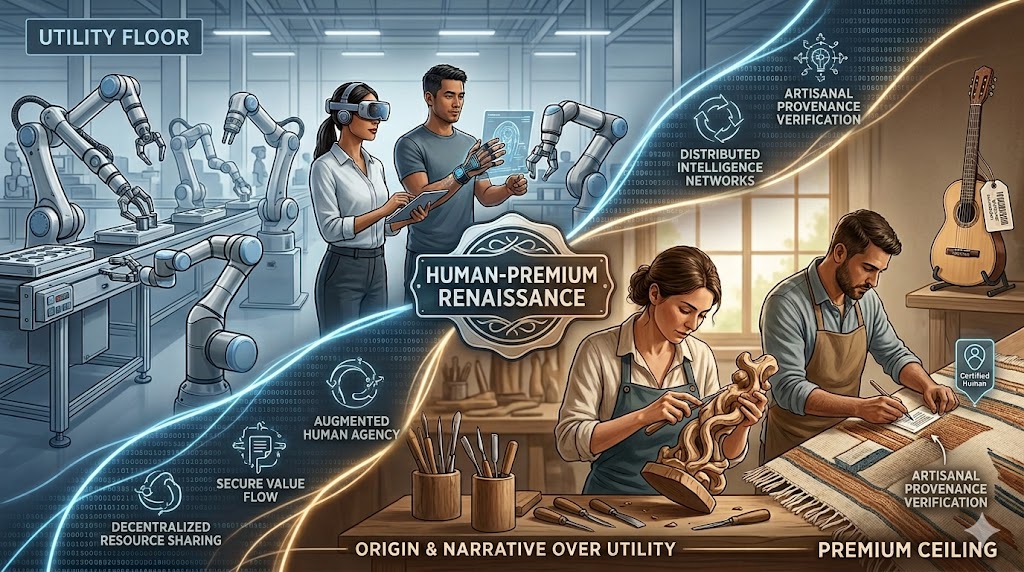
by Braden Kelley and Art Inteligencia
I. Beyond the “Empty Desk”
The prevailing narrative surrounding embodied AI and robotics is often one of inevitable displacement. As automation reaches a scale where it can replicate human labor at a fraction of the cost, the fear of an “empty desk” economy—one where human participation is optional—has become a central anxiety of the 2020s.
Defining the “Soft Landing”
A soft landing represents a societal transition that sidesteps the extremes of total economic collapse or violent revolution. It is the search for a new equilibrium where human value is not just preserved, but reimagined within a landscape of infinite machine productivity.
The Core Thesis: Value in the Biological
While many forecast a return to a “Victorian” class structure defined by service and servitude, this scenario proposes a more viable, long-term alternative. The Human-Premium Renaissance suggests that:
- Commoditized Perfection: As AI makes perfect execution free, the market value of “flawless” drops to zero.
- The Premium of Imperfection: Economic value will migrate to the “biological origin”—the hand-carved, the human-thought, and the uniquely flawed.
- Narrative over Utility: We are moving toward an era where we no longer pay for what a product does, but for the human story behind its creation.
In this scenario, human labor isn’t a cost to be minimized; it is the unique identifier that prevents a product from becoming a valueless commodity.
II. The Framework: Utility Floor vs. Premium Ceiling
The viability of this soft landing rests on a bifurcation of the economy into two distinct layers. This structure allows for mass survival through automation while preserving a high-value labor market for human endeavor.
The Utility Floor: The World of “Perfect Commodities”
In this layer, AI and embodied robotics handle the fundamental requirements of modern life. Logistics, basic food production, energy management, and routine diagnostics are optimized to a point where the marginal cost of production approaches zero.
- Standardization: Everything produced at the floor is “perfect” but uniform.
- Abundance: Scarcity is eliminated for basic needs, preventing the societal collapse often predicted in mass-unemployment scenarios.
- Devaluation: Because these goods are generated without human effort, they lack the “prestige” required to command a premium price.
The Premium Ceiling: The Human Narrative
Above the utility floor sits the “Premium Ceiling.” This is a market tier where consumers—who now have their basic needs met by the floor—spend their discretionary wealth on items and services that possess a biological provenance.
- Authenticity as the New Scarcity: In a world of infinite digital and robotic replicas, the one thing that cannot be mass-produced is the unique perspective and history of a specific human being.
- The Human-Centric Premium: We see the rise of “Slow Innovation,” where the value is found in the time, struggle, and intent behind the creation rather than the speed of its delivery.
The Strategic Shift: From Utility to Origin
This transition represents a fundamental shift in how we define economic value. We move away from asking “What can this do for me?” (Utility) and toward asking “Who made this, and what is their story?” (Origin).
While the Utility Floor keeps society running, the Premium Ceiling gives society a reason to keep trading, creating, and connecting.
III. Economic Viability: Why This Model Works
The skeptic’s immediate response to a “human-premium” model is usually grounded in the cold logic of the bottom line: If a machine can do it cheaper, why would anyone pay for a human? The answer lies in the shifting definition of value in a post-scarcity utility environment.
The Scarcity of Authenticity
In an era of infinite AI-generated content and robotic manufacturing, “perfection” is no longer a differentiator—it is a baseline requirement. When every digital image is flawlessly composed and every physical object is mathematically precise, human attention, history, and original thought become the only truly non-fungible resources.
- Effort Heuristic: Humans are psychologically predisposed to value objects and services more highly when they perceive a high degree of effort or “struggle” behind them.
- Biological Connection: We are social animals who seek the “ghost in the machine.” We don’t just want a solution; we want to know another consciousness intended for us to have it.
The Veblen Good Effect
As basic needs are met by the Utility Floor, discretionary spending migrates toward status symbols. In this scenario, human labor becomes a Veblen Good—a luxury item where demand increases as the price (and the perceived exclusivity of the human touch) rises.
“The hand-carved chair with its slight, organic imperfections becomes a status symbol of the elite, while the flawless, 3D-printed alternative becomes the hallmark of the masses.”
Democratization of Expertise and the “Company of One”
Unlike previous industrial shifts that required massive capital for factories, AI is a capital of the mind. This technology allows individual artisans and “augmented experts” to compete with monolithic corporations.
- Skill Augmentation: AI doesn’t just replace the expert; it allows the “middle-skill” human to perform at an elite level, spreading the ability to generate high-value, personalized work across a much larger population.
- Niche Viability: Lowering the cost of production allows for the “Long Tail” of human services to thrive. Small-scale, highly specialized human businesses become economically sustainable because their overhead is managed by AI.
By moving the human worker from a “cost to be minimized” to a “feature to be highlighted,” companies can maintain high margins and justify the continued circulation of capital back into human hands.
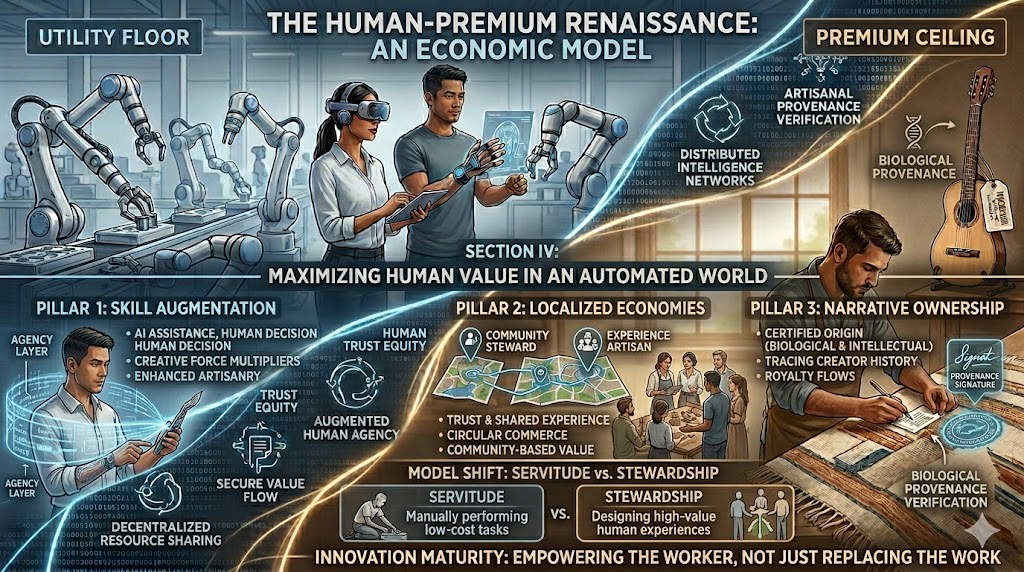
IV. Preventing Wealth Consolidation: Breaking the Monopoly on Production
One of the greatest risks of an AI-driven economy is the “Winner-Take-All” effect, where the owners of the most powerful algorithms capture the entirety of global productivity. However, the Human-Premium Renaissance offers structural defenses against this consolidation by shifting the power of production from centralized capital to distributed intelligence.
The “Company of One” Era
In previous industrial revolutions, scale was a prerequisite for success. You needed a factory to compete with a factory. Today, AI acts as a force multiplier for the individual. When the cost of sophisticated research, design, and logistics drops to near zero, the competitive advantage of a massive corporation—its ability to manage complexity—evaporates.
- Democratized Innovation: Individual creators can now orchestrate global supply chains and reach global audiences with the same efficiency as a Fortune 500 company.
- Agility over Scale: Smaller, human-led entities can pivot and personalize their offerings faster than a shareholder-beholden giant, allowing wealth to remain with the creator.
The Circular Human Economy
As global logistics become a commodity (the Utility Floor), we anticipate a resurgence in localized, high-trust commerce. AI-assisted cooperatives and local “Experience Stewards” can replace centralized “Gig Economy” platforms.
- Localism: Trust is a human currency that does not scale well in an algorithm. By focusing on community-specific needs, human workers can create “walled gardens” of value that shareholders cannot easily penetrate.
- Profit Retention: When the “platform” is a decentralized protocol rather than a Silicon Valley intermediary, more of the transaction value stays in the pockets of the local human service provider.
Narrative Ownership and Provenance
To prevent AI from simply harvesting and replicating human creativity for the benefit of shareholders, this scenario relies on Digital Provenance.
- Certification of Origin: Using watermarking and blockchain-based verification, human-made products carry a “digital signature.” This allows creators to maintain the equity of their original work.
- The Authenticity Tax: If a company uses AI to mimic a specific human’s style or narrative, the legal and social frameworks of the Renaissance model demand a “royalty of origin,” ensuring capital flows back to the human inspiration.
Wealth consolidation occurs when production is centralized. The Renaissance scenario is inherently decentralizing, as it prizes the one thing that cannot be mass-produced: the individual human perspective.
V. Comparing the “Soft Landings”: Victorian vs. Renaissance
To understand the trajectory of our economic future, we must distinguish between two types of “soft landings.” While both scenarios avoid immediate catastrophe, they offer fundamentally different versions of human dignity and wealth distribution.
| Feature | Victorian England Scenario | Human-Premium Renaissance |
|---|---|---|
| Core Driver | Inequality of Wealth and Power. | Inequality of Authenticity and Scarcity. |
| The Human Role | Tasks: Performing labor AI won’t do (low-cost servitude). | Meaning: Performing labor AI can’t do (high-value narrative). |
| Economic Logic | Humans as “Cheap Alternatives” to expensive robots. | Humans as “Luxury Exceptions” to cheap, mass-produced AI. |
| Social Structure | Centralized and Rigidly Hierarchical. | Decentralized and Networked Communities. |
| Primary Value | Obedience and Time. | Trust and Shared Experience. |
| Role of AI | The “Master’s Tool” for efficiency. | The “Artisan’s Apprentice” for augmentation. |
The Crucial Distinction
In the Victorian Scenario, the “servant class” is trapped by a lack of access to capital and a surplus of desperate labor. Success is measured by how well one can serve the elite.
In the Renaissance Scenario, the “artisan class” is empowered by AI to bypass traditional gatekeepers. Success is measured by how well one can connect with other humans through unique, un-automatable narratives. One is a world of servitude; the other is a world of stewardship.
While the Victorian model is a race to the bottom in cost, the Renaissance model is a race to the top in meaning.
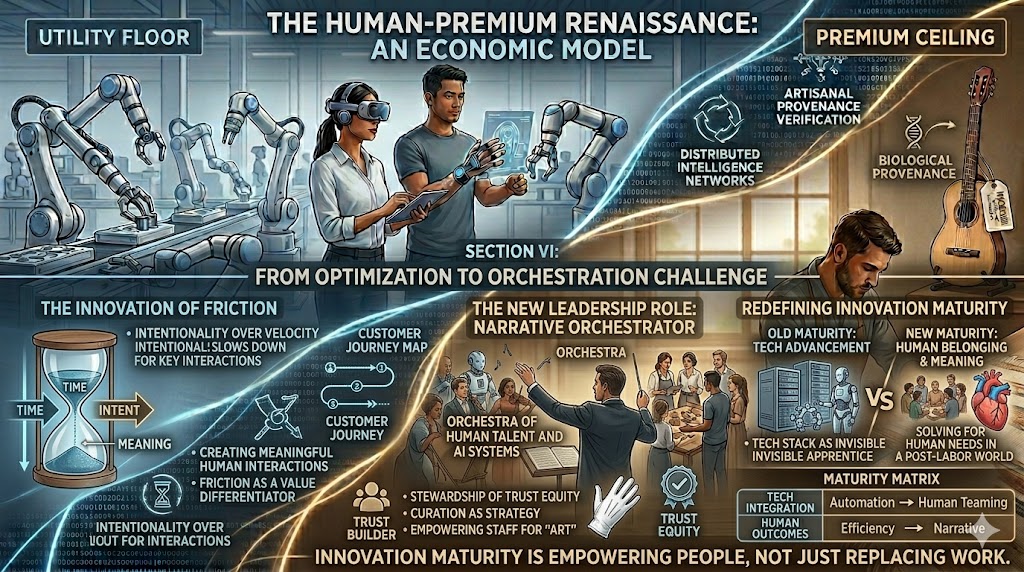
VI. The Innovation Challenge: From Optimization to Orchestration
For decades, the core driver of innovation has been Efficiency—doing things faster, cheaper, and with less friction. In the Human-Premium Renaissance, this paradigm reaches its logical conclusion: AI handles all optimization. When efficiency is “solved,” the new frontier of innovation becomes the Human Experience.
The Innovation of “Friction”
In a world of instant gratification provided by the Utility Floor, value is created by intentionally “slowing down” the experience. This is the art of Meaningful Friction.
- Intentionality over Velocity: Future innovation won’t focus on how to get a product to a customer in ten minutes, but on how to make the ten minutes they spend with your brand the most memorable part of their day.
- Biological Synchronization: Designing systems that align with human circadian rhythms, emotional cycles, and social needs rather than purely digital throughput.
The New Leadership Role: The Narrative Orchestrator
The role of the leader must shift. We are moving away from the “Optimization Officer” model toward the Narrative Orchestrator.
- Curation as Strategy: Leaders will spend less time managing processes (AI will do this) and more time curating the talent, stories, and human connections that define the brand’s “Premium” status.
- Stewardship of Trust: Because trust is a non-automatable resource, the primary job of leadership is to protect and grow the “Trust Equity” between the human staff and the customer base.
Redefining Innovation Maturity
In this scenario, a “mature” organization is not one with the most advanced tech stack, but one that has successfully integrated AI to the point of Invisibility.
Innovation maturity will be measured by an organization’s ability to use AI to automate the “Work” so it can empower its people to perform the “Art.”
This shift forces a total rethink of R&D. We are no longer just solving technical problems; we are solving for human belonging, status, and meaning in a post-labor world.
VII. Conclusion: Choosing Our Trajectory
The transition to an economy defined by embodied AI and mass automation does not have a predetermined destination. While the technical capabilities of generative systems and robotics are advancing at an exponential rate, the social and economic architecture we build around them remains a matter of human agency.
A Choice of Valuations
The “Victorian” and “Renaissance” scenarios represent two distinct paths for the future of work. One path values human time as a commodity—a low-cost alternative to a machine. The other values human time as a canvas—the unique source of narrative and meaning that an algorithm cannot replicate.
The Final Frontier of Competitive Advantage
As we move deeper into the 2030s, the most successful organizations will not be those that achieved the highest level of automation, but those that used that automation to solve the “Utility Floor” problem so they could focus entirely on the “Premium Ceiling.”
The ultimate goal of AI should not be to replace the worker, but to replace the “work”—the repetitive, the mundane, and the soul-crushing—thereby freeing the human to perform the “art” that only they can provide.
The soft landing is within reach, but it requires us to stop asking how we can compete with machines and start asking how we can better complement each other. The future isn’t defined by the artificial; it is defined by what becomes possible when the artificial is so ubiquitous that the human finally becomes the premium.
Frequently Asked Questions: The Human-Premium Renaissance
1. What is the difference between the “Utility Floor” and the “Premium Ceiling”?
The Utility Floor refers to the baseline economy where AI and robotics produce essential goods (food, logistics, basic software) at near-zero marginal cost, making them affordable commodities. The Premium Ceiling is the high-value market tier where consumers pay a significant markup for products and services with a “biological provenance”—meaning they are created, curated, or delivered by humans.
2. How does this scenario prevent massive wealth consolidation?
Unlike previous industrial shifts that required massive capital, AI acts as a “capital of the mind.” This allows for the rise of the Company of One, where individuals use AI to handle complex operations, allowing them to compete with large corporations. Furthermore, because “authenticity” cannot be mass-produced by a central algorithm, the value remains distributed among individual human creators and local communities.
3. Why is “human imperfection” considered an economic asset?
In a world where AI can generate “perfect” results instantly, perfection becomes a devalued commodity. Human “errors” or “uniqueness” serve as proof of biological origin—a signal of authenticity that AI cannot authentically replicate. This creates an Effort Heuristic, where consumers psychologically value the struggle and intent of a human creator over the sterile precision of a machine.
EDITOR’S NOTE: This is a visualization of but one possible future. I will be publishing other possible futures as they crystallize in my mind (or as you suggest them for me to explore).
Image credits: Google Gemini
Content Authenticity Statement: The topic area, key elements to focus on, etc. were decisions made by Braden Kelley, with a little help from Google Gemini to clean up the article, add images and create infographics.
 Sign up here to get Human-Centered Change & Innovation Weekly delivered to your inbox every week.
Hello Braden,
Thanks for this, somewhat less dystopian article than your other offering. In the vein of many futurists (but unlike far too many) you appear to be taking existing trends and extrapolated them through the lens of various economic models, which I applaud. Yes, the Veblen premium associated with vintage, handmade, imperfect goods is real (cited in my previous response with respect to natural gemstones) and the importance of these qualities mated with an evocative provenance and narrative will always reign supreme in the lives of those who can afford such “unobtanium”. One need only watch the introduction of Kevin in “Meet the Parents” where he showcases the roof of his living room, which he proudly states “I was really lucky, I was able to salvage this wood from an old seamans chapel in Nantucket” to see. How life does imitate art – but what inspired the art in the first place? Aside from gauche examples of conspicuous consumption and pure fraud/irony (7M banana, Take the Money and Run), time-centric art has been a staple of the UHNWI community for a long time. Examples include “1000 Hours of Staring” by Friedman and the many “Detail” by Opalka. Where there is some headway to perhaps be made is when you touch upon the concept of “slow time” experiences as a luxury good, something the Japanese have become masters of. You should go there if you have not yet already, they are 20 years ahead in many aspects of their approach to engaging with reality. You also make mention of a bifurcated economy (a la Taleb’s barbell distribution) where those with finanical access to the cybernetic impact of externalized memory (and now work) enhancing the abilithy of a talented human to project their output over an expanded audience by reducing the Pareto-indicated scut work (80/20 rule). That is a very real outcome. It’s making itself known in software development right now, where software (correctly identified as an almost frictionless good) is being rolled out at breathtaking speed when even compared to 5 years ago. In summary, I think the article circles but does not examine something very important – the ultimate scarce good is the ephemeral ability of humans to entertain each other in the ever-changing course of popular taste, which is likely to be the driver of hyper-wealth accretion for those not involved in the business of “selling shovels to miners”, and something AI will likely conquer last, if at all.
Pingback: The AI New Deal - Human-Centered Change and Innovation
Pingback: The Micro-Enterprise Explosion - Human-Centered Change and Innovation
Pingback: Cognitive Enhancement and the Augmented Worker - AI Soft Landing
Pingback: Founding an American AI Sovereign Wealth Fund