by Braden Kelley and Art Inteligencia
I have been writing about innovation long enough to have developed a reflex. When something dazzling shows up, I ask three questions: Is it new? Does it create value for somebody? And will anyone outside the launch event ever actually use it?
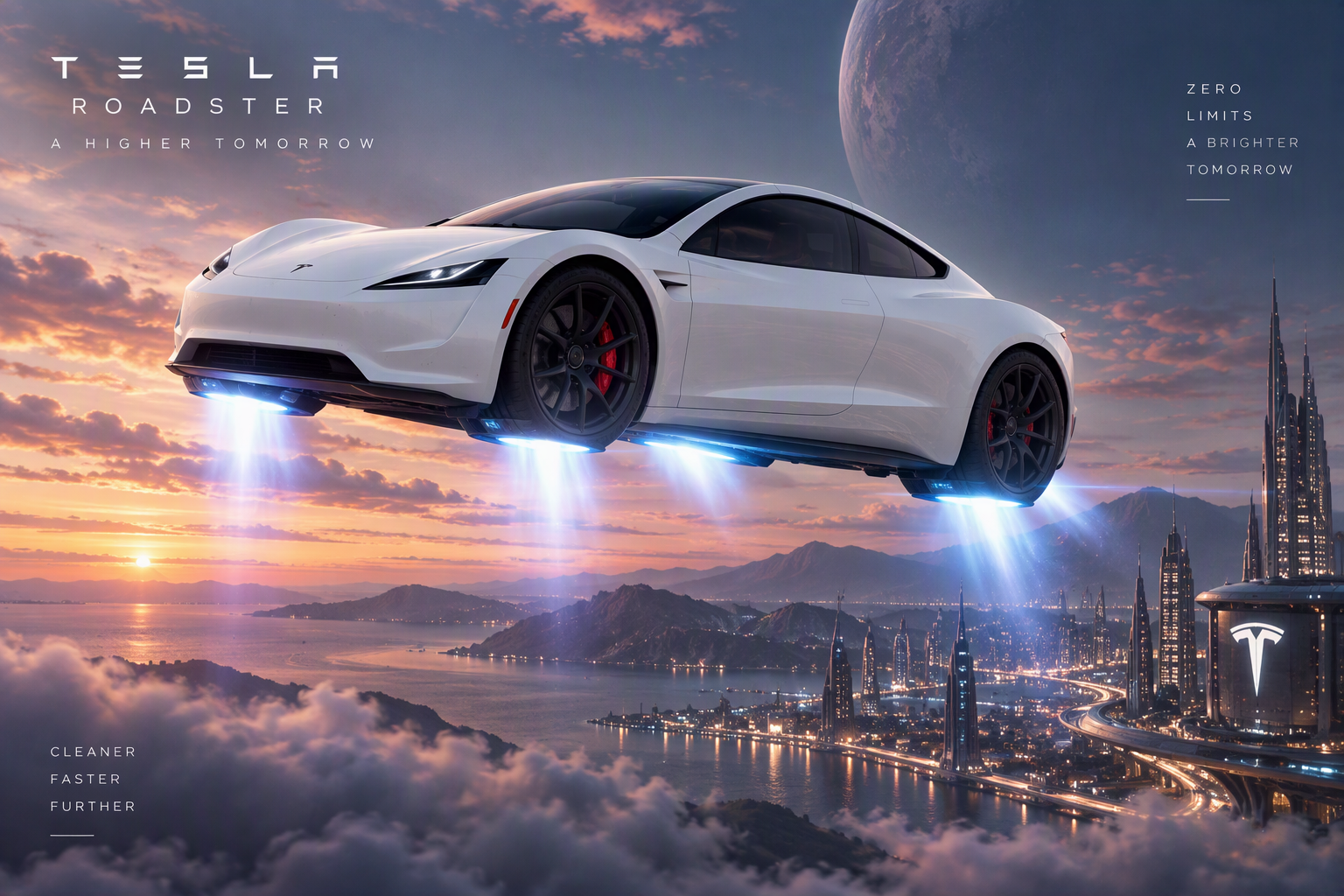
Then, once in a while, something arrives that makes me forget the questions entirely and just stare. The new Tesla Roadster, unveiled in Texas on October 15 with thrusters borrowed from SpaceX, is one of those. A car that hops over other cars. A car that climbs an inverted ramp, spins, and lands. I watched the clip and thought, “Well, that is certainly a thing that now exists.”
Here’s the video. Watch it first, then come back and argue with me.
What Tesla actually showed
The Roadster comes in three versions, and the names are doing a lot of storytelling.
Performance (“road ready”). Two seats. Active aerodynamics and what Tesla calls a multi-mode suction system, which uses fans to pull air from under the car. Tesla says it does 0 to 60 mph in under 1.6 seconds. This is the one you reserve: the reservation is $50,000, and Tesla hasn’t announced a price.
Thrust (“race ready”). Two seats, plus rear-mounted cold-gas thrusters. Under 0.9 seconds to 60 mph, according to Tesla’s figures. It’s a limited release, and reporting puts its reservation at $250,000.
Rocket (“air ready”). One seat. Thrusters around the perimeter of the car give it forward and upward push and the ability to rotate. Under 0.59 seconds to 60 mph. It’s invite-only, no price has been given, and Tesla’s own Roadster page says it isn’t approved for public road use.
Tesla also quotes more than 230 mph and more than 300 miles of range, though reports differ on whether those numbers apply to every version or only the top one. Production, in Musk’s words, is “2028, actually.”
On the hardware: engineering VP Lars Moravy described ten thrusters drawing on 600 liters of compressed air to lift and spin the car. And here’s the detail from the video that I love: the supply isn’t fixed. The car recharges its own air tanks, a bit like regenerative braking. It sucks so it can blow. Tesla says the thrusters produce four to five times the force the tires can handle. In Track Mode, the car lowers itself and deploys active wings, with downforce Tesla describes as approaching F1 levels. Those are Tesla’s claims, and nobody outside the company has measured them yet.
A little arithmetic, because I can’t help myself
Zero to 60 mph is about 27 meters per second. In 0.59 seconds, that works out to an average acceleration of around 4.6 g. Under 0.9 seconds is roughly 3 g. Under 1.6 seconds is a bit over 1.7 g. These are my back-of-the-envelope averages, not Tesla’s figures, but they give you the flavor. A tire on pavement tops out well below the top of that range, which is exactly why the thrusters matter: they push on the air, not the road.
What this could mean for racing
This is where I got genuinely excited, and then immediately got to asking questions, because the interesting part isn’t the stunt. It’s the principle.
For a century, a race car has been limited by the same thing: how much grip four small patches of rubber can deliver. Engineers have spent that century finding ways to get more of it, with wings, ground effects, tire chemistry, and clever suspensions. A thruster that adds force without relying on the tires is a different category of answer to the same problem.
So the questions I’d be asking if I ran a sanctioning body:
- Is it a car or an aircraft that touches the ground sometimes? Racing rulebooks are written around assumptions about what a car is. This quietly breaks several.
- Does thrust help braking and cornering, or only launches? A launch is a spectacle. Lap time is what wins.
- What happens to the tank on lap 20? Because the car can refill its own air supply, the way regenerative braking recovers energy, the question isn’t “how much do you have?” but “how fast can you recover it, and when do you spend it?” That turns race strategy into energy management, a trick that has made other racing formats more interesting, not less.
- – Who gets to use it? The moment a technology like this shows up, either everyone gets it or nobody does, and neither answer is easy.
Don’t hold me to any of this. Tesla showed a demo, not a season. But “what does racing look like when grip isn’t the ceiling?” is a real question now, and it wasn’t last month.
And now, the dismay
I promised you surprise. What I actually feel is closer to dismay, and I want to be honest about why.
It isn’t the engineering. By every account I’ve read, the engineering is real and impressive, and I’d be a hypocrite to say otherwise. My dismay is about what, among all the things this talent and capital could have built, the answer turned out to be.
Consider the details. Tesla says it packed pressure vessels into every usable void in the car, and the same type of vessel has been tied to rocket explosions elsewhere. Musk said “safety is not the main goal,” and that if safety is your top priority, you shouldn’t buy the Roadster. The range is roughly half of what was promised in 2017. The project has slipped repeatedly since then. The top version isn’t road legal. And Musk himself says the car doesn’t move the needle much on revenue, which makes it a halo car, an object whose job is to make you feel something about the brand.
I understand halo cars. They’ve always existed. But there’s a difference between a halo that says “look what we can do” and one that says “safety is optional, and rules are for other people.” In a world where the most pressing transportation problems are affordability, safety and charging, building the most extreme thing imaginable, and then selling reservations for it, feels like a statement about priorities. There’s also a fair amount of speculation, including in CNBC’s coverage, that the event was partly about linking Tesla with SpaceX ahead of a possible merger. If that’s true, the car is as much a story as a vehicle.
So: innovation or not?
Here’s my verdict, and you’re welcome to disagree.
Is it new? Absolutely. Putting cold-gas thrusters on a car, and making them controllable enough to land a spin, is a genuine invention.
Does it create value? For a handful of people, certainly. For everybody else, the value is the attention it earns and the questions it raises.
Will it reach people? The Performance version, maybe, in 2028, if you have $50,000 to reserve. The versions that do the flying, probably not on any road you drive.
My verdict is that it’s a remarkable invention and a so-far unproven innovation. An invention becomes an innovation when it creates and captures value at scale, and nobody can say yet whether that will happen here. But the technology underneath, force that doesn’t depend on tire grip, is worth watching long after the Roadster itself has been forgotten or perfected.
Then again, I said the same thing about every flying car I’ve ever seen. Ask me again in 2028.
What do you think? Innovation or not? Tell me in the comments.
Image Credits: Microsoft 365 CoPilot
Content Authenticity Statement: The topic area, key elements to focus on, etc. were decisions made by Braden Kelley, with a little help from Claude to clean up the article.
 Sign up here to get Human-Centered Change & Innovation Weekly delivered to your inbox every week.