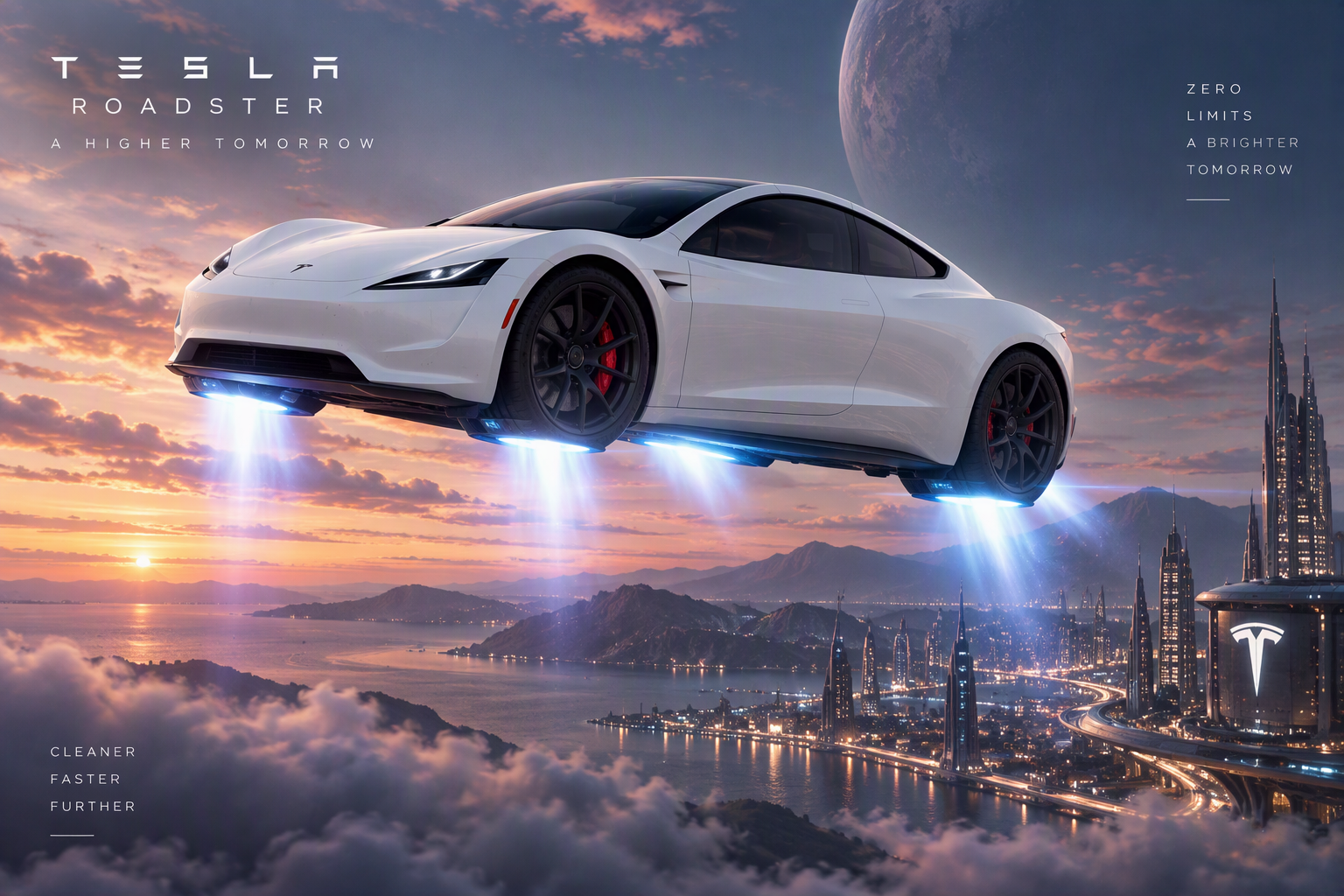
Tag Archives: Tesla Roadster

Innovation or Not? The Tesla Roadster With SpaceX Thrusters

Innovation or Not? The Tesla Roadster With SpaceX Thrusters

by Braden Kelley and Art Inteligencia

I have been writing about innovation long enough to have developed a reflex. When something dazzling shows up, I ask three questions: Is it new? Does it create value for somebody? And will anyone outside the launch event ever actually use it?

Then, once in a while, something arrives that makes me forget the questions entirely and just stare. The new Tesla Roadster, unveiled in Texas on October 15 with thrusters borrowed from SpaceX, is one of those. A car that hops over other cars. A car that climbs an inverted ramp, spins, and lands. I watched the clip and thought, “Well, that is certainly a thing that now exists.”

Here’s the video. Watch it first, then come back and argue with me.

What Tesla actually showed

The Roadster comes in three versions, and the names are doing a lot of storytelling.

Performance (“road ready”). Two seats. Active aerodynamics and what Tesla calls a multi-mode suction system, which uses fans to pull air from under the car. Tesla says it does 0 to 60 mph in under 1.6 seconds. This is the one you reserve: the reservation is $50,000, and Tesla hasn’t announced a price.

Thrust (“race ready”). Two seats, plus rear-mounted cold-gas thrusters. Under 0.9 seconds to 60 mph, according to Tesla’s figures. It’s a limited release, and reporting puts its reservation at $250,000.

Rocket (“air ready”). One seat. Thrusters around the perimeter of the car give it forward and upward push and the ability to rotate. Under 0.59 seconds to 60 mph. It’s invite-only, no price has been given, and Tesla’s own Roadster page says it isn’t approved for public road use.

Tesla also quotes more than 230 mph and more than 300 miles of range, though reports differ on whether those numbers apply to every version or only the top one. Production, in Musk’s words, is “2028, actually.”

On the hardware: engineering VP Lars Moravy described ten thrusters drawing on 600 liters of compressed air to lift and spin the car. And here’s the detail from the video that I love: the supply isn’t fixed. The car recharges its own air tanks, a bit like regenerative braking. It sucks so it can blow. Tesla says the thrusters produce four to five times the force the tires can handle. In Track Mode, the car lowers itself and deploys active wings, with downforce Tesla describes as approaching F1 levels. Those are Tesla’s claims, and nobody outside the company has measured them yet.

A little arithmetic, because I can’t help myself

Zero to 60 mph is about 27 meters per second. In 0.59 seconds, that works out to an average acceleration of around 4.6 g. Under 0.9 seconds is roughly 3 g. Under 1.6 seconds is a bit over 1.7 g. These are my back-of-the-envelope averages, not Tesla’s figures, but they give you the flavor. A tire on pavement tops out well below the top of that range, which is exactly why the thrusters matter: they push on the air, not the road.

What this could mean for racing

This is where I got genuinely excited, and then immediately got to asking questions, because the interesting part isn’t the stunt. It’s the principle.

For a century, a race car has been limited by the same thing: how much grip four small patches of rubber can deliver. Engineers have spent that century finding ways to get more of it, with wings, ground effects, tire chemistry, and clever suspensions. A thruster that adds force without relying on the tires is a different category of answer to the same problem.

So the questions I’d be asking if I ran a sanctioning body:

  • Is it a car or an aircraft that touches the ground sometimes? Racing rulebooks are written around assumptions about what a car is. This quietly breaks several.
  • Does thrust help braking and cornering, or only launches? A launch is a spectacle. Lap time is what wins.
  • What happens to the tank on lap 20? Because the car can refill its own air supply, the way regenerative braking recovers energy, the question isn’t “how much do you have?” but “how fast can you recover it, and when do you spend it?” That turns race strategy into energy management, a trick that has made other racing formats more interesting, not less.
  • – Who gets to use it? The moment a technology like this shows up, either everyone gets it or nobody does, and neither answer is easy.

Don’t hold me to any of this. Tesla showed a demo, not a season. But “what does racing look like when grip isn’t the ceiling?” is a real question now, and it wasn’t last month.

And now, the dismay

I promised you surprise. What I actually feel is closer to dismay, and I want to be honest about why.

It isn’t the engineering. By every account I’ve read, the engineering is real and impressive, and I’d be a hypocrite to say otherwise. My dismay is about what, among all the things this talent and capital could have built, the answer turned out to be.

Consider the details. Tesla says it packed pressure vessels into every usable void in the car, and the same type of vessel has been tied to rocket explosions elsewhere. Musk said “safety is not the main goal,” and that if safety is your top priority, you shouldn’t buy the Roadster. The range is roughly half of what was promised in 2017. The project has slipped repeatedly since then. The top version isn’t road legal. And Musk himself says the car doesn’t move the needle much on revenue, which makes it a halo car, an object whose job is to make you feel something about the brand.

I understand halo cars. They’ve always existed. But there’s a difference between a halo that says “look what we can do” and one that says “safety is optional, and rules are for other people.” In a world where the most pressing transportation problems are affordability, safety and charging, building the most extreme thing imaginable, and then selling reservations for it, feels like a statement about priorities. There’s also a fair amount of speculation, including in CNBC’s coverage, that the event was partly about linking Tesla with SpaceX ahead of a possible merger. If that’s true, the car is as much a story as a vehicle.

So: innovation or not?

Here’s my verdict, and you’re welcome to disagree.

Is it new? Absolutely. Putting cold-gas thrusters on a car, and making them controllable enough to land a spin, is a genuine invention.

Does it create value? For a handful of people, certainly. For everybody else, the value is the attention it earns and the questions it raises.

Will it reach people? The Performance version, maybe, in 2028, if you have $50,000 to reserve. The versions that do the flying, probably not on any road you drive.

My verdict is that it’s a remarkable invention and a so-far unproven innovation. An invention becomes an innovation when it creates and captures value at scale, and nobody can say yet whether that will happen here. But the technology underneath, force that doesn’t depend on tire grip, is worth watching long after the Roadster itself has been forgotten or perfected.

Then again, I said the same thing about every flying car I’ve ever seen. Ask me again in 2028.

What do you think? Innovation or not? Tell me in the comments.

Image Credits: Microsoft 365 CoPilot

Content Authenticity Statement: The topic area, key elements to focus on, etc. were decisions made by Braden Kelley, with a little help from Claude to clean up the article.

Subscribe to Human-Centered Change & Innovation WeeklySign up here to get Human-Centered Change & Innovation Weekly delivered to your inbox every week.

Where People Go Wrong with Minimum Viable Products

Where People Go Wrong with Minimum Viable Products

GUEST POST from Greg Satell

Ever since Eric Reis published his bestselling book, The Lean Startup, the idea of a minimum viable product (MVP) has captured the imagination of entrepreneurs and product developers everywhere. The idea of testing products faster and cheaper has an intuitive logic that simply can’t be denied.

Yet what is often missed is that a minimum viable product isn’t merely a stripped down version of a prototype. It is a method to test assumptions and that’s something very different. A single product often has multiple MVPs, because any product development effort is based on multiple assumptions.

Developing an MVP isn’t just about moving faster and cheaper, but also minimizing risk. In order to test assumptions, you first need to identify them and that’s a soul searching process. You have to take a hard look at what you believe, why you believe it and how those ideas can be evaluated. Essentially, MVP’s work because they force you to do the hard thinking early.

Every Idea Has Assumptions Built In

In 1990, Nick Swinmurn had an idea for a business. He intended to create a website to sell shoes much like Amazon did for books. This was at the height of the dotcom mania, when sites were popping up to sell everything from fashion to pet food to groceries, so the idea itself wasn’t all that original or unusual.

What Swinmurn did next, however, was. Rather than just assuming that people would be willing to buy shoes online or conducting expensive marketing research, he built a very basic site, went to a shoe store and took pictures of shoes, which he placed on the site. When he got an order, he bought the shoes retail and shipped them out. He lost money on every sale.

That’s a terrible way to run a business, but a great — and incredibly cheap — way to to test a business idea. Once he knew that people were willing to buy shoes online, he began to build all the elements of a fully functioning business. Ten years later, the company he created, Zappos was acquired by Amazon for $1.2 billion.

Notice how he didn’t just assume that his business idea was viable. He tested it and validated it. He also learned other things, such as what styles were most popular. Later, Zappos expanded to include handbags, eyewear, clothing, watches, and kids’ merchandise.

The Cautionary Tale Of Google Glass

Now compare how Swinmurn launched his business with Google’s Glass debacle. Instead of starting with an MVP, it announced a full-fledged prototype complete with a snazzy video. Through augmented reality projected onto the lenses, users could seamlessly navigate an urban landscape, send and receive messages and take photos and videos. It generated a lot of excitement and seemed like a revolutionary new way to interact with technology.

Yet criticism quickly erupted. Many were horrified that hordes of wandering techno-hipsters could be surreptitiously recording us. Others had safety concerns about everything from people being distracted while driving to the devices being vulnerable to hacking. Soon there was a brewing revolt against “Google Glassholes.”

Situations like the Google Glass launch are startlingly common. In fact, the vast majority of new product launches fail because there’s no real way to know whether you have the right product-market fit customers actually get a chance to interact with the product. Unfortunately, most product development efforts start by seeking out the largest addressable market. That’s almost always a mistake.

If you are truly creating something new and different, you want to build for the few and not the many. That’s the mistake that Google made with its Glass prototype.

Identifying A Hair On Fire Use Case

The alternative to trying to address the largest addressable market is to identify a hair-on-fire use case. The idea is to find a potential customer that needs to solve a problem so badly that they almost literally have their hair on fire. These customers will be more willing to co-create with you and more likely to put up with the inevitable bugs and glitches that always come up.

For example, Tesla didn’t start out by trying to build an electric car for the masses. Instead, it created a $100,000 status symbol for Silicon Valley millionaires. Because these customers could afford multiple cars, range wasn’t as much of a concern. The high price tag also made a larger battery more feasible. The original Tesla Roadster had a range of 244 miles.

The Silicon Valley set were customers with their hair on fire. They wanted to be seen as stylish and eco-friendly, so were willing to put up with the inevitable limitations of electric cars. They didn’t have to depend on them for their commute or to pick the kids up at soccer practice. As long as the car was cool enough, they would buy it.

Interestingly, Google Glass made a comeback as an industrial product and had a nice run from 2019 to 2023 before they went away for good. For hipsters, an augmented reality product is far from a necessity, but a business that needs to improve productivity can be a true “hair-on-fire” use case. As the product improves and gains traction, it’s entirely possible that it eventually makes its way back to the consumer market in some form.

Using An MVP To Pursue A Grand Challenge

One of the criticisms of minimum viable products is that they are only suited for simple products and tweaks, rather than truly ambitious projects. Nothing could be further from the truth. The reality is that the higher your ambitions, the more important it is for you to start with a minimum viable product.

IBM is one company that has a long history of pursuing grand challenges such as the Deep Blue project which defeated world champion Garry Kasparov at chess and the Blue Gene project which created a new class of “massively parallel” supercomputers. More recently were the Jeopardy grand challenge, which led to the development of its current Watson business and the Debater project.

Notice that none of these were fully featured products. Rather they were attempts to, as IBM’s Chief Innovation Officer, Bernie Meyerson, put it to me, invent something that “even experts in the field, regard as an epiphany and changes assumptions about what’s possible.” That would be hard to do if you were trying to create a full featured product for a demanding customer.

That’s the advantage of creating an MVP. It essentially acts as a research lab where you can safely test hypotheses and eliminate sources of uncertainty. Once you’ve done that, you can get started trying to build a real business.

— Article courtesy of the Digital Tonto blog
— Image credit: Pixabay

Subscribe to Human-Centered Change & Innovation WeeklySign up here to join 17,000+ leaders getting Human-Centered Change & Innovation Weekly delivered to their inbox every week.

The Art of Storytelling

How to Communicate Innovation Effectively

The Art of Storytelling: How to Communicate Innovation Effectively

GUEST POST from Art Inteligencia

Innovation is the lifeblood of progress. But inventing the next big thing is only half the battle; the real challenge lies in communicating these innovations effectively. Enter the art of storytelling. In the world of business, effective storytelling can bridge the gap between abstract ideas and tangible outcomes. Here, we unravel the secrets behind the art of storytelling and how it can be harnessed to communicate innovation.

Why Storytelling?

Storytelling is much more than a marketing strategy; it is a powerful tool that:

  • Engages and captivates the audience.
  • Conveys complex ideas in a simple, relatable way.
  • Builds an emotional connection with the audience.

When used effectively, storytelling can turn an innovative concept from a mere idea into a compelling vision that drives action.

Case Study 1: Apple and the iPhone

When Apple first introduced the iPhone, they did more than just unveil a new product—they told a story. Steve Jobs stood on stage and didn’t just list the features; he narrated a tale of an innovative future. His key strategies included:

  1. Focusing on Benefits: Jobs highlighted how the iPhone would simplify life by combining multiple devices into one compact unit.
  2. Using Visual Aids: Through vivid visuals and demonstrations, he showed practical uses of the iPhone, making the audience visualize its impact on their lives.
  3. Crafting a Narrative: Jobs’ presentation wasn’t just about the “what,” but also the “why” and “how,” crafting a compelling narrative of technological evolution.

The result? The world saw the iPhone not just as a new gadget, but as a revolutionary tool transforming communication and daily life.

Case Study 2: Tesla and the Roadster

Tesla’s journey with the Roadster is another exemplary case of innovation storytelling. Elon Musk and his team focused on more than just the car’s specifications. Their key strategies included:

  • Emphasizing the Vision: Tesla communicated a broader vision of a sustainable future, bottling the imagination of a world less dependent on fossil fuels.
  • Highlighting Impact over Features: Rather than boasting about technical metrics, they highlighted the environmental benefits and long-term savings.
  • Creating Inspirational Content: Through high-impact videos, interviews, and social media, Tesla created a narrative of excitement and urgency around adopting electric vehicles.

This storytelling approach allowed Tesla to overcome skepticism, foster enthusiasm, and galvanize a community of early adopters and brand evangelists.

Key Elements of Effective Innovation Storytelling

To master the art of storytelling in innovation, consider these essential elements:

1. Know Your Audience: Tailor your narrative to resonate with the values, beliefs, and needs of your target audience.

2. Craft a Clear Message: Simplify complex concepts and focus on the overarching benefit or the big “why” behind your innovation.

3. Use Emotional Appeal: Connect with the audience on an emotional level through relatable stories, testimonials, or visions of a better future.

4. Utilize Visuals: Use compelling visuals to demonstrate your innovation’s impact vividly and memorably.

5. Build a Narrative Arc: Structure your story with a clear beginning, middle, and end, bringing the audience along a journey of discovery and transformation.

Conclusion

Innovation without effective communication is like a masterpiece locked in a vault. The art of storytelling is the key to unlocking its potential. By borrowing techniques from great storytellers and focusing on the emotional and practical impacts of your innovations, you can not only communicate effectively but drive meaningful change. After all, the stories we tell today shape the world we innovate for tomorrow.

Bottom line: Futurology is not fortune telling. Futurists use a scientific approach to create their deliverables, but a methodology and tools like those in FutureHacking™ can empower anyone to engage in futurology themselves.

Image credit: Pixabay

Subscribe to Human-Centered Change & Innovation WeeklySign up here to get Human-Centered Change & Innovation Weekly delivered to your inbox every week.