Why You’re Losing More Than You Think — and Don’t Even Know It
LAST UPDATED: March 11, 2026 at 6:27 PM (SPANISH LANGUAGE VERSION)

by Braden Kelley and Art Inteligencia
I. The Invisible Cost of Friction
Most organizations measure revenue. Some measure profit. A growing number measure customer satisfaction. But very few measure revenue at risk — and almost none systematically measure experience-driven revenue leakage.
The hard truth is this: what customers experience today determines what finance reports tomorrow. Friction in the customer journey rarely shows up immediately on a balance sheet. Instead, it accumulates quietly — in hesitation, in doubt, in abandoned transactions, in unresolved issues, and in eroding trust.
Every confusing onboarding flow. Every policy that makes sense internally but frustrates externally. Every moment where a customer has to work harder than they expected. These are not minor inconveniences. They are micro-withdrawals from future growth.
When friction compounds, it becomes invisible leakage:
- Customers buy less than they intended.
- Customers delay decisions.
- Customers quietly explore alternatives.
- Customers leave without complaint.
Because traditional dashboards focus on lagging indicators, leaders often miss the early warning signs. By the time churn rises or margins compress, the experience damage has already been done.
Customer experience is not a “soft” discipline. It is a leading indicator of financial performance. If you are not measuring friction financially, you are tolerating it culturally.
The first step toward sustainable growth is acknowledging a simple but uncomfortable reality: what you cannot see is already costing you.
II. What Is a Customer Experience Risk & Revenue Leakage Diagnostic?
A Customer Experience Risk & Revenue Leakage Diagnostic is a structured, cross-functional assessment designed to uncover where your organization is unintentionally creating friction, eroding trust, and putting future revenue at risk.
It is not a satisfaction survey. It is not a brand perception study. And it is not a one-time journey mapping workshop.
It is a strategic instrument that connects customer experience directly to financial performance.
At its core, the diagnostic is designed to:
- Identify friction across the end-to-end customer journey
From awareness and onboarding to service and renewal, it reveals where customers hesitate, struggle, or disengage. - Quantify the financial impact of experience breakdowns
It translates moments of frustration into measurable revenue exposure, cost-to-serve distortion, and lifetime value erosion. - Prioritize improvements based on risk and recovery potential
It enables leadership to focus on interventions that reduce risk, restore trust, and unlock trapped growth.
Unlike traditional CX metrics that tell you what happened, this diagnostic helps you understand why it happened — and what it is costing you.
By integrating operational data, customer feedback, employee insight, and financial modeling, the organization gains a clear view of:
- Where revenue is quietly leaking
- Where trust is weakening
- Where internal complexity is surfacing as external pain
- Where competitors are gaining advantage through simplicity
In short, a Customer Experience Risk & Revenue Leakage Diagnostic reframes customer experience from a qualitative aspiration into a measurable performance and risk management discipline.
III. Why Traditional Metrics Fail
Most organizations believe they are measuring customer experience effectively. They track Net Promoter Score (NPS), Customer Satisfaction (CSAT), conversion rates, churn rates, and average handle time. These metrics are familiar. They are benchmarked. They are reported to leadership regularly.
The problem is not that these metrics are wrong. The problem is that they are incomplete — and mostly lagging indicators.
They tell you what happened. They rarely tell you why it happened. And almost never do they tell you what it is costing you before it shows up in revenue.
The Three Core Limitations
- They Measure Sentiment, Not Exposure
A customer can report being “satisfied” while still experiencing friction that reduces purchase frequency, basket size, or long-term loyalty. - They Are Aggregated and Diluted
Journey-level breakdowns are often hidden inside company-wide averages. A single high-friction touchpoint can erode trust even if the overall score appears stable. - They Are Backward-Looking
By the time churn rises or referrals fall, the experience damage has already compounded. Leadership is reacting to symptoms, not preventing causes.
Most importantly, traditional metrics rarely connect experience breakdowns directly to financial risk. Without that connection, friction becomes normalized.
Measurement shapes behavior. If you do not measure friction in financial terms, you unintentionally signal that it is tolerable.
A Customer Experience Risk & Revenue Leakage Diagnostic shifts the focus from “How are we scoring?” to a far more strategic question:
“Where are we unintentionally putting future revenue at risk?”
That reframing changes the conversation — from reporting outcomes to preventing loss and unlocking growth.
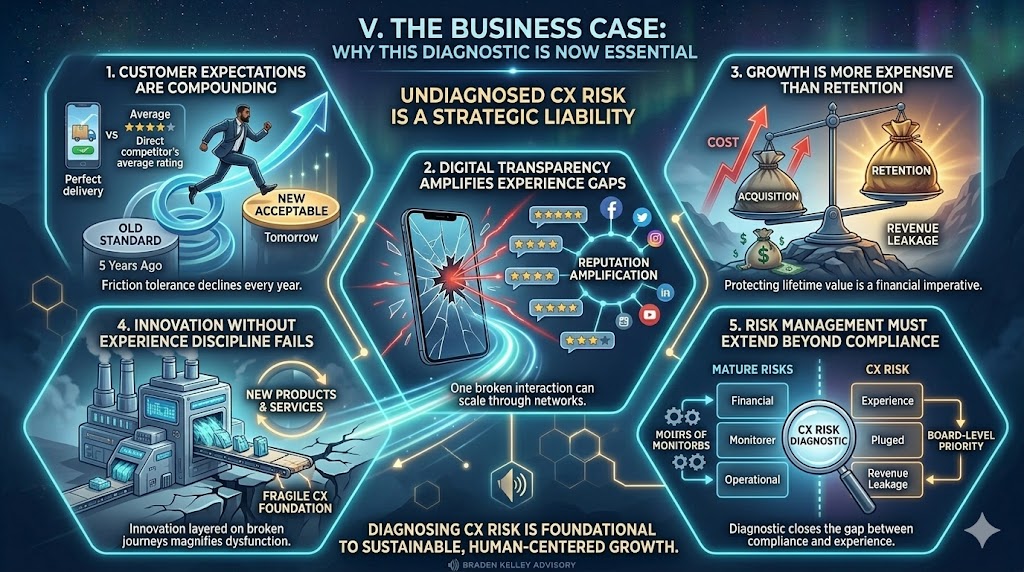
V. The Business Case: Why This Diagnostic Is Now Essential
The question is no longer whether customer experience matters. The question is whether you can afford to leave it undiagnosed.
Market dynamics have shifted. Expectations have accelerated. Transparency has increased. Acquisition costs continue to rise. In this environment, unmanaged experience risk is a strategic liability.
1. Customer Expectations Are Compounding
Customers do not compare you only to direct competitors. They compare you to the best experience they have had anywhere. Friction tolerance declines every year.
What felt “acceptable” five years ago now feels outdated. What feels slightly inconvenient today becomes unacceptable tomorrow.
2. Digital Transparency Amplifies Experience Gaps
One broken interaction can scale rapidly through reviews, social platforms, and peer networks.
Experience inconsistency is no longer contained. Reputation moves at the speed of visibility.
3. Growth Is More Expensive Than Retention
Customer acquisition costs continue to climb across industries. When revenue leaks through preventable friction, organizations are forced to spend more just to stand still.
Protecting and expanding lifetime value is now a financial imperative — not a marketing aspiration.
4. Innovation Without Experience Discipline Fails
Organizations invest heavily in new products, services, and technologies. But innovation layered on top of broken journeys simply magnifies dysfunction.
Scale amplifies whatever system you have — good or bad. If the experience foundation is fragile, growth initiatives will expose the cracks.
5. Risk Management Must Extend Beyond Compliance
Most enterprises have mature financial and operational risk frameworks. Few have equivalent rigor applied to customer experience risk.
A Customer Experience Risk & Revenue Leakage Diagnostic closes that gap, elevating experience from a functional concern to a board-level performance and risk management priority.
In today’s environment, diagnosing experience risk is not optional. It is foundational to sustainable, human-centered growth.
VI. What a High-Impact Diagnostic Actually Measures
If you are going to treat customer experience as a growth and risk discipline, you must measure it with the same rigor you apply to financial performance. A high-impact Customer Experience Risk & Revenue Leakage Diagnostic goes far beyond sentiment scores.
It evaluates exposure, root causes, and financial implications — across the entire customer lifecycle.
A. Journey-Level Risk Exposure
The diagnostic identifies where customers hesitate, struggle, or disengage across key stages of the journey.
- Drop-off and abandonment patterns
- Cycle time delays
- Escalation and repeat contact rates
- Inconsistent cross-channel transitions
Rather than looking at averages, it isolates specific high-risk touchpoints where friction compounds and revenue becomes vulnerable.
B. Emotional Friction Points
Not all risk is operational. Some of the most expensive leakage begins at the emotional level.
- Moments of uncertainty or confusion
- Moments of perceived unfairness
- Moments where trust is tested
- Moments where customers feel unheard
Emotional friction reduces confidence — and reduced confidence lowers commitment, expansion, and advocacy.
C. Operational Root Causes
High-impact diagnostics do not stop at symptoms. They trace friction back to systemic drivers.
- Policy-driven constraints
- Technology integration gaps
- Siloed data and decision rights
- Misaligned incentives and performance metrics
Internal complexity inevitably surfaces as external customer pain. Sustainable solutions require structural insight.
D. Financial Impact Modeling
The most critical component is quantification. Friction must be translated into financial terms.
- Revenue at risk by journey stage
- Lifetime value erosion
- Cost-to-serve inflation
- Margin compression driven by service recovery
When experience breakdowns are expressed in dollars, prioritization becomes clearer and alignment accelerates.
A high-impact diagnostic makes the invisible visible — not just emotionally, but economically.
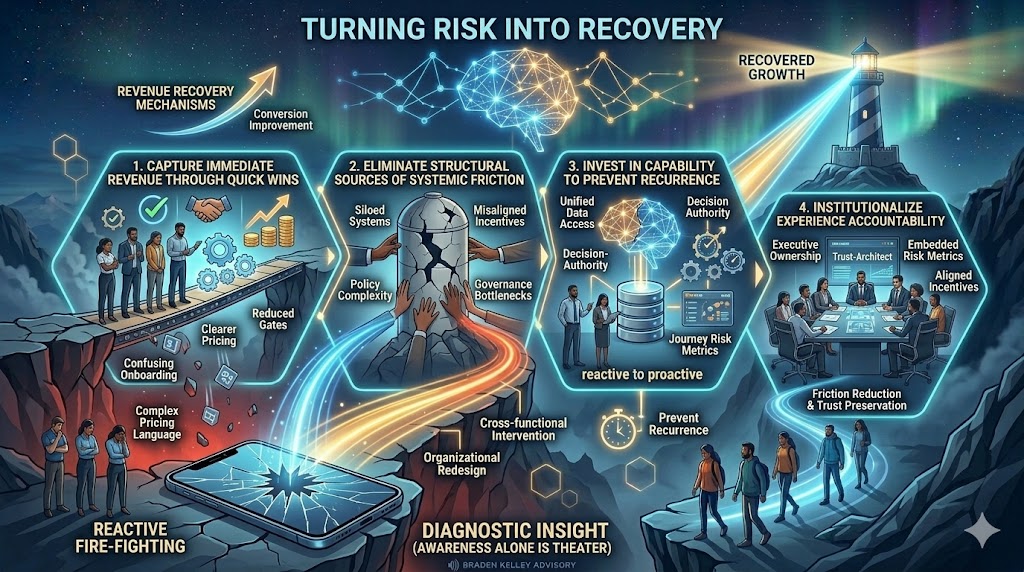
VII. From Insight to Action: Turning Risk into Recovery
A diagnostic without activation is theater.
Insight alone does not recover revenue. Awareness alone does not restore trust. If the findings from a Customer Experience Risk & Revenue Leakage Diagnostic do not change behavior, structure, and investment decisions, then the organization has simply produced a more sophisticated report.
The goal is not understanding. The goal is recovery.
1. Capture Immediate Revenue Through Quick Wins
Every diagnostic surfaces friction points that can be resolved quickly:
- Simplifying confusing onboarding steps
- Clarifying pricing language
- Reducing redundant approval gates
- Fixing high-volume support failure points
These are not cosmetic improvements. They are revenue recovery mechanisms. When friction decreases, conversion improves. When clarity increases, hesitation declines. Early wins build organizational momentum and prove that experience discipline drives financial results.
2. Eliminate Structural Sources of Systemic Friction
Some leakage is not tactical. It is architectural.
Siloed systems. Misaligned incentives. Policy-driven complexity. Governance bottlenecks.
These require cross-functional intervention. This is where leadership courage matters. Because structural friction is usually owned by no one — and tolerated by everyone.
True recovery demands redesigning how the organization works, not just how the customer journey looks.
3. Invest in Capability to Prevent Recurrence
Experience breakdowns often trace back to capability gaps:
- Frontline employees without decision authority
- Teams without access to unified customer data
- Leaders without visibility into journey-level risk metrics
If the organization cannot detect friction early, it will continue to leak revenue quietly. Capability investment turns reactive firefighting into proactive orchestration.
4. Institutionalize Experience Accountability
Lasting change requires governance.
That means:
- Assigning executive ownership for journey health
- Embedding experience risk metrics into performance dashboards
- Aligning incentives with friction reduction and trust preservation
Measurement shapes behavior. When experience risk is measured financially, it stops being a “soft” concern and becomes a board-level priority.
The Shift
When organizations move from insight to action, the narrative changes.
We are not improving customer satisfaction.
We are recovering growth.
We are protecting margin.
We are strengthening trust.
A Customer Experience Risk & Revenue Leakage Diagnostic is not the finish line. It is the ignition point. What matters is what the organization does next — how quickly it acts, how boldly it redesigns, and how deeply it commits to human-centered accountability.
Because friction compounds.
But so does disciplined recovery.
VIII. The Cultural Impact
Conducting a Customer Experience Risk & Revenue Leakage Diagnostic is not just about numbers and dashboards. It is a catalyst for cultural transformation.
When an organization quantifies experience risk, it sends a clear signal: customer outcomes are inseparable from business performance.
Key Cultural Shifts
- Finance Pays Attention: Revenue leakage is now measurable and visible, making it a board-level concern rather than an abstract notion.
- Operations Engage: Front-line teams see how their actions directly influence financial outcomes, motivating proactive problem-solving.
- Leadership Prioritizes: Strategic planning incorporates experience risk as a key dimension alongside cost, efficiency, and growth targets.
- Employees Gain Clarity: Everyone understands how day-to-day decisions impact customer trust, loyalty, and revenue.
The conversation shifts from:
“How satisfied are our customers?”
To a more strategic and actionable question:
“How much growth are we leaving on the table?”
This cultural shift embeds accountability for experience across all levels of the organization. It moves customer experience from a departmental initiative to an enterprise-wide performance discipline.
Ultimately, organizations that embrace this mindset are more agile, more resilient, and more capable of sustaining profitable growth.
IX. The Leadership Imperative
Human-centered change begins with leaders who are willing to see reality clearly. A Customer Experience Risk & Revenue Leakage Diagnostic provides the lens to identify hidden friction, quantify its impact, and prioritize action.
Leadership cannot afford to rely on assumptions, anecdotal feedback, or lagging metrics. The future of growth is determined by how well the organization prevents leakage before it appears on the balance sheet.
Core Principles for Leaders
- See Reality Clearly: Recognize that friction and trust erosion are real, measurable threats to revenue and loyalty.
- Measure What Truly Matters: Go beyond NPS, CSAT, and churn metrics. Quantify revenue at risk and the financial impact of experience breakdowns.
- Act Proactively: Use diagnostic insights to guide immediate interventions, structural improvements, and capability development.
- Embed Accountability: Make experience risk a shared responsibility across functions, not a siloed initiative.
A diagnostic without leadership activation is just a report. True impact comes when insights are operationalized, turning risk into recovery and friction into opportunity.
Ultimately, leaders who embrace this approach shift the organizational conversation from:
“Are we delivering good experiences?”
To a more strategic and urgent question:
“Where are we unintentionally putting future revenue at risk, and how do we fix it?”
This is the leadership imperative: see, measure, act, and embed a culture where customer experience drives sustainable growth.
X. Closing Thought
Innovation does not fail because ideas are weak. It fails because the experience system cannot support them. A brilliant product, service, or solution cannot thrive if friction, trust gaps, or operational constraints block its path to the customer.
If you want sustainable growth, three imperatives are clear:
- Stop guessing: Uncover hidden friction and revenue leakage before it escalates.
- Stop relying on lagging indicators: Traditional metrics alone will not reveal the silent risks undermining growth.
- Diagnose, quantify, and act: Translate insights into immediate interventions, structural fixes, and capability investments.
Because what you cannot see will eventually show up — in churn, in margin compression, and in lost relevance. Waiting until it appears on financial statements is too late.
A Customer Experience Risk & Revenue Leakage Diagnostic gives organizations the clarity, rigor, and foresight needed to protect revenue, strengthen trust, and enable innovation to scale successfully.
In the end, the diagnostic is not just a tool. It is a strategic mindset: measure what matters, see reality, and act decisively. Those who embrace it will not just survive disruption — they will thrive in it.
Reserve your Customer Experience Risk & Revenue Leakage Diagnostic with Braden Kelley today
FAQ: Customer Experience Risk & Revenue Leakage Diagnostic
1. What exactly is a Customer Experience Risk & Revenue Leakage Diagnostic?
It is a structured assessment that identifies friction points across the customer journey, measures the financial impact of experience breakdowns, and prioritizes actions to reduce risk and recover lost revenue. Unlike traditional surveys, it connects customer experience directly to measurable business outcomes.
2. How does this diagnostic differ from traditional CX metrics like NPS or CSAT?
Traditional metrics are lagging indicators that report what has already happened. A diagnostic goes deeper by uncovering hidden sources of friction and trust erosion, quantifying revenue at risk, and linking operational and emotional touchpoints to tangible financial consequences. It transforms CX from a qualitative measure into a strategic risk and growth tool.
3. Who in the organization benefits from this diagnostic?
Everyone from leadership to front-line employees benefits. Leaders gain visibility into financial risk and opportunity, operations teams understand where to focus improvements, and employees see how daily actions impact customer trust and revenue. It aligns the entire organization around measurable experience outcomes.
Reserve your Customer Experience Risk & Revenue Leakage Diagnostic with Braden Kelley today
Image credits: ChatGPT, Google Gemini
Content Authenticity Statement: The topic area, key elements to focus on, etc. were decisions made by Braden Kelley, with a little help from ChatGPT to clean up the article and add citations.
 Sign up here to get Human-Centered Change & Innovation Weekly delivered to your inbox every week.
Pingback: Necesita un Diagnóstico de Riesgo de Experiencia del Cliente y Fuga de Ingresos | Human-Centered Change and Innovation
Pingback: Is Your Customer Experience a Lie? | Human-Centered Change and Innovation
Pingback: Why It Matters WHO Conducts Your Customer Experience Audit | Human-Centered Change and Innovation
Pingback: Why a Customer Experience Audit is Non-Negotiable in 2026 | Human-Centered Change and Innovation
Pingback: Customer Experience Audit 101 | Human-Centered Change and Innovation
Pingback: Trends That Change Culture Without Warning | Human-Centered Change and Innovation
Pingback: Mapping Customer Experience Risk to the P&L | Human-Centered Change and Innovation
Pingback: Metrics That Matter in Distributed Innovation Teams | Human-Centered Change and Innovation