GUEST POST from Art Inteligencia
1. The Cult of Frictionless (And Why We’re Hitting Peak Saturation)
For over two decades, experience design and digital product innovation treated friction as an enemy to be eradicated at every turn. When generative and agentic AI promise to collapse effort across thinking, making, and choosing, we have to ask what disappears alongside the resistance.
The Silicon Valley Dogma
- How “eliminating friction” became the default metric for digital innovation, conversion funnels, and user experience (UX) design.
- Why shaving seconds off every interaction often treats human attention as a bottleneck rather than a source of value.
The AI Acceleration Trap
- How generative and agentic AI automate drafting, synthesis, and decision-making at scale.
- The risk of a future filled with effortless, homogenized output—a “sea of sameness” where speed outpaces originality.
The Law of Unintended Consequences
- What happens to human agency, critical judgment, and cognitive muscle when answers and artifacts arrive pre-chewed.
- How removing struggle can also remove emotional investment, pride, and lasting memory.
2. Historical Precedents: When Speed Triggered a Slow Revolution
History shows that whenever an industrial or technological leap threatens to flatten human experience into pure efficiency, a deliberate counter-movement emerges. People consistently push back when speed begins to erase provenance, ritual, and craft.
Lessons from the Slow Food Movement
- How Carlo Petrini’s rebellion against fast food in the 1980s was never anti-technology—it was pro-provenance, pro-craft, and pro-savoring.
- What the shift from “fueling up” to “dining” teaches us about preserving meaning in an era of instant AI generation.
Analog Resurgences in a Digital World
- Why vinyl records, mechanical watches, film photography, and physical books continue to thrive alongside instant digital alternatives.
- How tactile rituals turn passive consumption into active participation—people choose them because of the friction, not in spite of it.
The Pattern of Human Pushback
- The recurring cycle of innovation: mass automation creates abundance, abundance breeds commoditization, and commoditization sparks a hunger for authenticity.
- Why society repeatedly re-anchors itself in deliberate, human-paced experiences whenever algorithms threaten to homogenize culture.
3. Redefining Experience Design: Designing For Good Friction
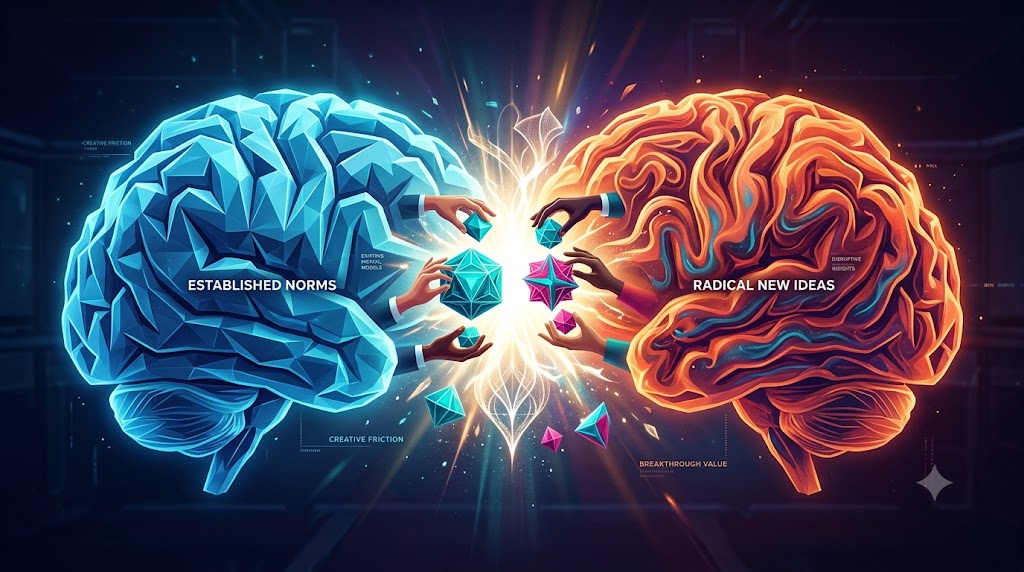
Not all resistance is created equal. As experience designers and innovation leaders, our challenge isn’t to champion clunky interfaces or wasted time—it’s to distinguish between friction that frustrates and friction that fulfills.
Bad Friction vs. Good Friction
- Separating bureaucratic, broken obstacles (bad friction) from intentional, skill-building, and memory-making resistance (good friction).
- How eliminating bad friction clears the path, while preserving good friction deepens engagement, comprehension, and trust.
The IKEA Effect & Effort Justification
- Why humans attach disproportionately higher value to things they struggle to create, assemble, or solve themselves.
- How AI-generated “instant mastery” can inadvertently rob people of ownership, pride, and genuine learning.
Serendipity Requires Detours
- Why algorithmic efficiency optimizes for the predictable, narrowing our field of vision to what we already like or expect.
- How human innovation thrives in the messy, unoptimized margins where unexpected connections and happy accidents occur.
4. Five Pillars of the “Slow AI” Movement
If society deliberately chooses friction, it won’t mean abandoning artificial intelligence—it will mean establishing clear cultural and design boundaries around where and how we use it. Five emerging pillars define what a human-centered “Slow AI” movement looks like in practice.
1. Provenance & Human-in-the-Loop Certification
- The rise of “100% Human-Crafted” labels and transparent AI-assistance disclosures, mirroring the organic food labeling movement.
- Giving audiences, readers, and buyers clear visibility into the human sweat, judgment, and story behind a piece of work.
2. Intentional Latency
- Designing interfaces and workflows that build in deliberate pauses for reflection rather than instant gratification.
- Shifting our success metrics from speed-to-answer to depth-of-thought and decision quality.
3. AI-Free Sanctuaries
- The growth of “analog zones” in education, hospitality, live entertainment, and creative workspaces.
- Spaces where unscripted human imperfection, face-to-face dialogue, and presence are the main attraction.
4. Co-Creation Over Delegation
- Using AI as a Socratic sparring partner that challenges assumptions and adds constructive cognitive friction.
- Resisting the urge to treat AI like a butler that silently completes the work while our own critical thinking atrophies.
5. Craftsmanship as a Luxury Tier
- In an economy flooded with cheap, instant synthetic content, human time, attention, and deliberate struggle become the ultimate status symbols.
- Why organizations and creators who invest in visible human mastery will command enduring trust and premium value.
6. Conclusion: Choosing the Speed of Meaning
As artificial intelligence makes speed abundant, human intention becomes our scarcest and most valuable resource. Choosing friction is not a step backward—it is an active assertion of what we refuse to outsource.
The Ultimate Futurist Question
- Technology naturally asks: What can we automate?
- Human-centered innovation must always ask: What should we preserve?
A Call to Deliberate Design
- Why the future is not an inevitable destination dictated solely by the speed of compute.
- How leaders, designers, and everyday creators shape a meaningful future—one intentional point of friction at a time.
Frequently Asked Questions: The Slow AI Future
A quick guide to what “Slow AI” means for human agency, experience design, and innovation—structured cleanly for both human readers and answer engines.
What is the “Slow AI” future?
The “Slow AI” future is a deliberate approach to technology and experience design in which society chooses intentional friction, human craft, and reflective pacing over instant automation. Rather than treating every pause or effort as a flaw to eliminate, it preserves space for human judgment, learning, and meaning.
How is “good friction” different from “bad friction” in experience design?
Bad friction comes from broken workflows, confusing interfaces, or pointless bureaucracy that wastes time and creates frustration. Good friction is intentional resistance—such as a thoughtful pause, a creative challenge, or a tactile step—that builds skill, deepens memory, and sparks genuine insight.
Why would organizations or people choose slower AI workflows when instant speed is available?
Speed alone commoditizes output and can erode critical thinking, trust, and emotional connection. By pairing AI with human-in-the-loop accountability, intentional latency, and spaces for co-creation, leaders and creators protect originality and differentiate on depth rather than volume.
Bottom line: Futurology is not fortune telling. Futurists use a scientific approach to create their deliverables, but a methodology and tools like those in FutureHacking™ can empower anyone to engage in futurology themselves.
Image credit: Gemini
 Sign up here to get Human-Centered Change & Innovation Weekly delivered to your inbox every week.