
GUEST POST from Chateau G Pato
I. Hook & Thesis: The Illusion of Progress
Generative artificial intelligence has flattened the physical, financial, and temporal barriers to creation. What once required weeks of coding, visual asset production, or technical drafting can now be spun up in seconds at near-zero marginal cost. Yet, as leaders across every industry are discovering, lowering the cost of creating is not the same as expanding your capacity to innovate.
The Paradox of Abundance
Frictionless output creates the illusion of speed. When teams can generate dozens of concepts, codebases, or campaign drafts in an afternoon, leadership often mistakes high activity for strategic progress. But creation is simply the act of producing artifacts, assets, or options; innovation is the successful execution of novel value creation that meaningfully transforms human behaviors, workflows, and outcomes.
The Core Question
When the cost of generating output approaches zero, does your organization’s actual impact increase proportionately—or are you simply choking your innovation pipelines with frictionless, incremental noise?
II. The Misalignment: Friction Has Shifted, Not Disappeared
The fundamental flaw in treating AI purely as a productivity engine is assuming that creation was the primary bottleneck to innovation. It was not. Creation was merely the most visible and time-consuming stage. By removing the mechanical friction of drafting, coding, and sketching, generative AI has not eliminated organizational friction—it has simply pushed it downstream.
The Bottleneck Migration
In the traditional innovation lifecycle, scarcity existed at the front end. Generating viable prototypes, producing design mockups, or building early code bases took substantial time, effort, and capital. Today, that front-end friction has vanished, causing the bottleneck to migrate rapidly to the back end of the innovation pipeline:
- From Generation to Sensemaking: The challenge is no longer coming up with fifty potential solutions, but synthesising, evaluating, and determining which two actually address a genuine human need.
- From Production to Curation: When anyone can generate plausible artifacts in seconds, the ability to discern high-value signals from statistical noise becomes the primary scarce asset.
- From Creation to Absorption: The ultimate constraint on innovation has never been how fast an organization can generate new ideas; it is how fast the organization—and its market—can absorb, adopt, and integrate change.
The Cost of Frictionless Noise
When the cost of creation drops to zero without a corresponding increase in strategic discipline, organizations experience exponential volume inflation. Frictionless creation leads directly to systemic bloat: overcrowded backlogs, fragmented strategic focus, decision fatigue, and organizational cognitive overload.
Unfiltered abundance does not accelerate innovation—it paralyzes it. To build true innovation capacity in an age of cheap creation, leaders must re-architect their processes to focus on what happens after the asset is generated.
III. The Human-Centered Innovation Architecture
To convert low-cost asset creation into true organizational innovation capacity, leadership must upgrade four systemic pillars. Without these structural foundations, cheap creation merely accelerates the production of irrelevance.
1. Experience & Empathy (Human Insights over Automated Consensus)
Generative AI models excel at synthesizing average historical patterns. Relying on AI-generated buyer personas or automated customer research risks creating products tailored to a statistical mean that exists nowhere in reality.
- The Trap: Substituting synthetic persona generation for authentic human immersion.
- The Strategic Shift: Deploy AI to aggregate quantitative data and surface non-obvious behavioral shifts, while doubling down on deep ethnographic research, direct field observation, and unstructured human dialogue to uncover hidden emotional friction points.
2. Organizational Capacity & Change Readiness
An organization’s ultimate limit on innovation is never its ability to generate ideas—it is its capacity to absorb change. Accelerating output without expanding change readiness creates operational friction, frontline burn-out, and initiative fatigue.
- The Trap: Flooding teams with rapid prototypes faster than operational workflows and culture can evolve to support them.
- The Strategic Shift: Measure success not by how quickly AI generates artifacts, but by how effectively leadership equips teams to adapt mental models, realign incentives, and adopt new ways of working.
3. Validation & Experimentation Frameworks
Low-cost prototypes have no strategic value if the team lacks the discipline to test critical assumptions. Generating ten variations of a solution is useless if none of them validate whether the underlying problem is worth solving.
- The Trap: Mistaking high-speed prototyping for effective validation.
- The Strategic Shift: Shift from asking “How fast can we build this prototype with AI?” to “How rapidly and cheaply can we design an experiment to test our riskiest value assumptions?”
4. Strategic Curation & Intentional Foresight
AI algorithms operate on probability based on past training sets. True innovation, however, relies on deliberate counter-trend bets and strategic foresight—moving where the market is going, not where it has already been.
- The Trap: Delegating direction-setting and strategic choice to probabilistic tools.
- The Strategic Shift: Leaders must step into the role of strategic curators, establishing clear boundaries, values, and vision that focus the infinite stream of AI outputs toward meaningful, sustainable outcomes.
IV. The Leader’s Diagnostic: Are You Scaling Innovation or Just Noise?
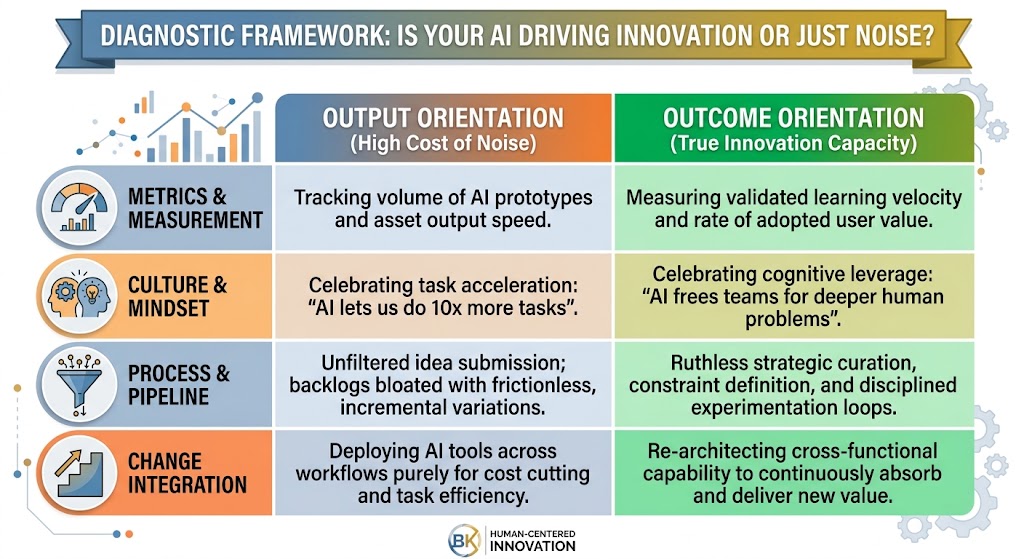
To determine whether your organization is building true innovation capacity or simply accelerating the production of digital noise, leadership teams must evaluate their operational focus. The transition from an output-centric mindset to an outcome-centric architecture requires shifting core organizational habits across four critical dimensions:
| Focus Area | Output Orientation (High Cost of Noise) | Outcome Orientation (True Innovation Capacity) |
|---|---|---|
| Metrics & Measurement | Tracking the volume of AI-generated prototypes, speed of initial draft creation, and raw asset output per employee. | Measuring the velocity of validated learning, reduction in cycle time for assumption testing, and rate of adopted human value. |
| Culture & Mindset | Celebrating task acceleration: “AI enables us to produce 10x more deliverables in the same timeframe.” | Celebrating cognitive leverage: “AI frees our teams to investigate deeper, higher-leverage human and strategic problems.” |
| Process & Pipeline | Unfiltered idea submission leading to backlogs bloated with frictionless, incremental variations and concept sprawl. | Ruthless strategic curation, clear constraint definition, and disciplined, rapid experimentation loops. |
| Change Integration | Deploying generative AI tools across workflows purely to cut costs and mandate incremental task efficiency. | Re-architecting cross-functional organizational capability to continuously absorb, adapt to, and deliver new value. |
Diagnostic Questions for Leadership
Before allocating further capital toward AI-driven creation tools, challenge your executive team with three fundamental questions:
- Has our time spent evaluating, curating, and validating concepts scaled alongside our increased speed of asset generation?
- Are we using AI to uncover non-obvious human needs, or are we using it to generate faster answers to the wrong questions?
- Does our organization possess the operational and cultural capacity to absorb the volume of change our teams are currently drafting?
V. Conclusion: Reclaiming Human-Centered Leadership
Lowering the cost of creation is a monumental technological achievement, but raising an organization’s capacity to innovate remains an exclusively human discipline. As generative tools continue to reduce the friction of producing code, content, and design to near zero, the competitive moat shifts entirely away from what you can create and toward why and how you choose to create it.
When output becomes infinite, meaning becomes the ultimate currency. Organizations that win in this next era will not be those that simply generate the highest volume of cheap artifacts or automate away every creative step. The winners will be the organizations that pair AI-driven leverage with deep human empathy, rigorous experimentation, bold strategic foresight, and the change readiness required to convert raw possibilities into lasting value.
The Path Forward for Leaders
Stop evaluating your AI initiatives by how much faster your teams complete routine deliverables or how many ideas populate your backlog. Instead, hold your leadership team accountable to higher-leverage benchmarks:
- Clarity of Strategic Intent: Is AI helping you sharpen your vision and focus on high-stakes opportunities, or is it distracting you with low-cost incrementalism?
- Depth of Human Insight: Are you using saved cognitive capacity to get closer to your customers, employees, and ecosystem stakeholders to solve their real friction points?
- Velocity of Adopted Value: How quickly can your organization turn validated learning into systemic adoption that changes behavior and drives sustainable growth?
Technology can accelerate your engine, but only human-centered leadership provides the steering. It is time to move past the novelty of frictionless creation and focus on building the organizational capacity to truly innovate.
Frequently Asked Questions
How does generative AI impact organizational innovation capacity?
Generative AI lowers the cost and time required to create prototypes, code, and content, but creation is not innovation. True innovation capacity depends on an organization’s ability to curate ideas, run rigorous validation experiments, and absorb change, rather than merely producing a higher volume of artifacts.
What is the primary bottleneck in the innovation process when creation costs approach zero?
When creation costs decrease, the bottleneck shifts downstream from initial asset production to sensemaking, strategic curation, assumption testing, and organizational change readiness. Without disciplined filters, teams experience decision fatigue and backlog bloat from frictionless noise.
How can leaders ensure AI adoption drives meaningful innovation rather than incremental noise?
Leaders must balance AI automation with deep human empathy and ethnographic research, establish clear strategic boundaries to curate outputs, focus on testing riskiest value assumptions, and build organizational capacity to adopt and integrate real operational change.
Bottom line: Futurology is not fortune telling. Futurists use a scientific approach to create their deliverables, but a methodology and tools like those in FutureHacking™ can empower anyone to engage in futurology themselves.
Image credit: Gemini
 Sign up here to get Human-Centered Change & Innovation Weekly delivered to your inbox every week.