The Disappearing Middle
GUEST POST from Chateau G Pato
Today, the rapid evolution of artificial intelligence and agentic workflows is quietly dismantling this traditional structure. As AI systems increasingly absorb data synthesis, operational coordination, and routine decision-making, the middle of the enterprise is being hollowed out. Yet, viewing this shift purely through the narrow lens of cost efficiency or headcount reduction misses the broader picture. The true challenge—and opportunity—lies in experience design, human-centered capability building, and continuous innovation.
If the middle rungs of the ladder disappear, how do organizations cultivate the senior leaders of tomorrow? While unmanaged AI integration threatens to fracture career progression and create critical skill gaps, forward-thinking organizations can turn this disruption into an advantage. By intentionally redesigning workforce experiences and skill pathways, leaders can move beyond rigid hierarchies to build dynamic, resilient ecosystems where human capability and machine intelligence elevate one another.
The Anatomy of the Disappearing Middle
To navigate the evolution of the workplace, we must first dissect why the middle layer of the corporate structure is uniquely vulnerable to AI disruption. The traditional mid-level tier has historically operated as the functional bridge between vision and execution. As generative tools, intelligent agents, and automated orchestration layers become more sophisticated, the mechanics of this bridge are fundamentally altering.
1. The Execution Gap and Strategy Acceleration
Mid-level roles have long been anchored in information routing, process monitoring, and tactical translation. Project managers, operational coordinators, and mid-tier analysts spent significant effort converting broad executive intent into actionable deliverables for front-line teams.
AI workflows are rapidly compressing this process. Modern autonomous platforms can convert strategic directives directly into functional workflows, draft project schedules, allocate digital resources, and generate real-time progress analytics. When software bridges strategy to tactical execution in seconds, the traditional management layer focused purely on administrative oversight loses its primary value proposition. Without intentional redesign, this shift leaves an operational vacuum between C-suite visionaries and entry-level operators.
2. The Expertise Dilemma and Skill Atrophy
Beyond process management, mid-level roles served an essential developmental purpose: they were the experiential laboratory where junior staff converted theoretical knowledge into practical wisdom. By solving operational problems and navigating real-world trade-offs, rising professionals developed intuition, nuance, and strategic judgment.
As entry-level execution and intermediate analysis are delegated to intelligent tools, organizations face a critical structural dilemma:
- Loss of Ground-Level Learning: If algorithms perform the foundational drafting, coding, and analysis, early-career professionals miss out on the repetitive, hands-on practice that builds deep domain expertise.
- The Senior Gap: Without intermediate rungs on the ladder to test and refine judgment, companies risk creating a drought of qualified senior leaders capable of evaluating AI output, managing risk, and steering organizational vision.
- Institutional Knowledge Erosion: When mid-level operational contexts are subsumed by algorithms, tacit organizational knowledge and cultural memory become fragmented, making the organization less adaptable to unexpected disruptions.
Human-Centered Experience Design for the Workforce
Replacing the corporate ladder isn’t merely an operational challenge—it is an end-to-end employee experience (EX) innovation challenge. When technology disrupts familiar career pathways, organizations cannot rely on passive adaptation. Leaders must actively apply human-centered design principles to build new organizational structures that prioritize human agency, psychological safety, and continuous growth.
1. From Linear Ladders to Dynamic Webs
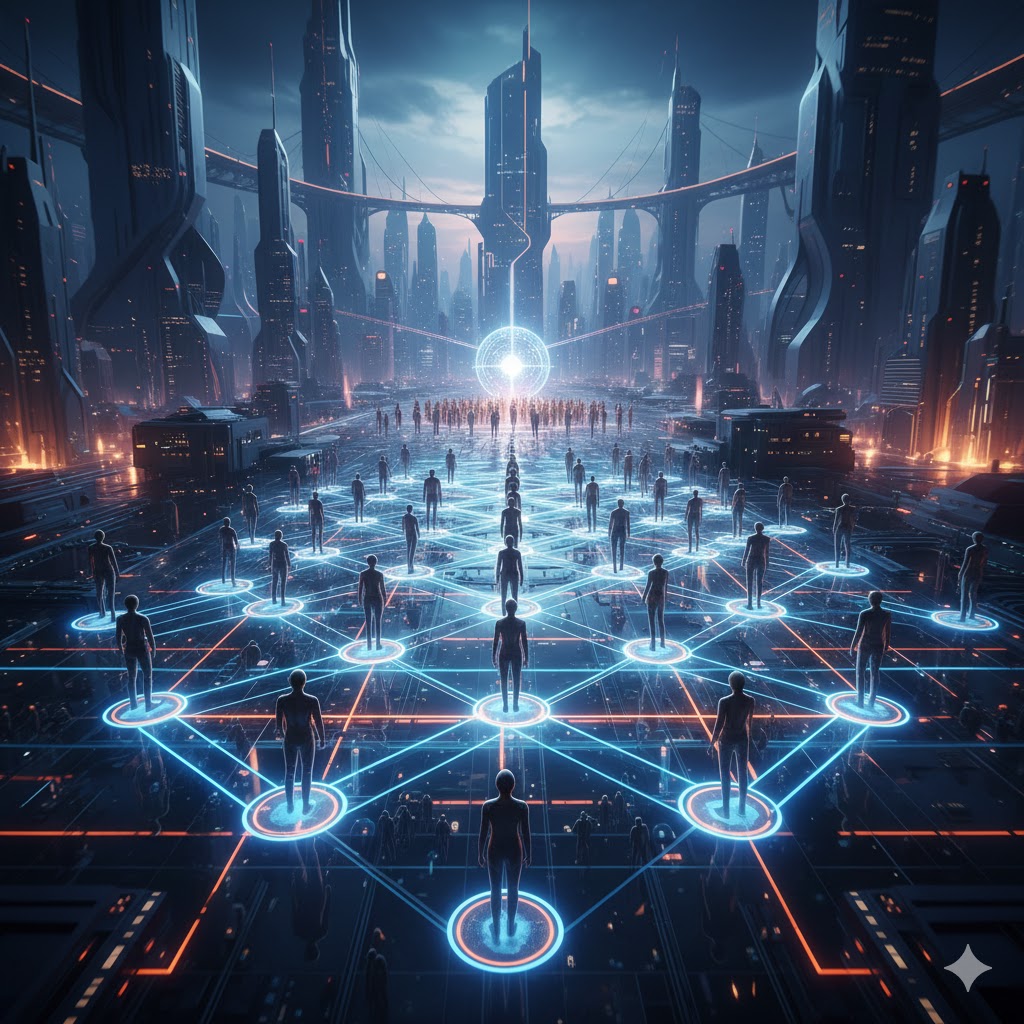
The traditional ladder assumed a singular, vertical direction of success: moving up from individual execution into people management. As AI handles routine execution and administrative overhead, career progression must shift toward a dynamic lattice or web model.
In a dynamic workforce ecosystem, growth is defined by capability expansion, cross-functional mastery, and adaptive problem-solving rather than management headcount. Employees move fluidly across projects, domain areas, and innovation initiatives—building broad, multi-disciplinary mental models that prepare them for high-level strategic stewardship.
2. Designing AI-Augmented Work Experiences
Integrating intelligent technology into daily workflows requires designing experiences that augment human potential rather than marginalize it. Friction occurs when AI tools are deployed simply to maximize volume or speed without considering the worker’s cognitive and emotional engagement.
A human-centered approach to workforce design focuses on three core pillars:
- Autonomy: Empowering employees to direct AI capabilities as creative and analytical partners, keeping the human firmly in the decision-making loop.
- Mastery: Structuring work so that employees continuously refine higher-order human skills—such as critical synthesis, ethical reasoning, and creative problem-framing—alongside technical proficiency.
- Purpose: Ensuring workers clearly understand how their augmented contributions drive tangible value for customers and the broader organization.
Re-imagining Innovation and Change Capability
The erosion of traditional management layers creates a powerful opportunity to redefine how organizations innovate, adapt, and build change capability. Rather than viewing the shrinkage of middle management as a loss, forward-thinking organizations can pivot these pivotal roles toward driving continuous innovation, cultural resilience, and human-centered transformation.
1. The New Role of Middle Management
Middle managers have historically spent vast energy serving as operational gatekeepers, monitoring compliance, and managing status updates. As automation and AI platforms streamline routine administrative oversight, these leaders must transition into active Innovation Facilitators and Change Champions.
In an AI-augmented enterprise, the primary value of mid-tier leadership shifts from task management to human alignment:
- Empathy and Cultural Stewardship: Fostering high-trust environments and psychological safety where teams feel secure experimenting, failing forward, and challenging legacy assumptions.
- Ethical Alignment: Serving as the human conscience in technology deployment, ensuring AI tools operate within ethical, fair, and human-centered boundaries.
- Creative Synthesis: Bridging disparate ideas across functional silos to identify new value pools, business models, and experience enhancements that algorithms cannot foresee.
2. Building Agile, Change-Ready Cultures
Traditional change management often treats organizational transformation as a discrete event with a defined start and end point. In a climate shaped by continuous technological disruption, change is no longer an event—it is an ongoing organizational muscle.
Building a resilient, change-ready culture requires embedding continuous learning loops directly into everyday work processes:
- Micro-Experimentation: Encouraging teams to run small-scale trials with AI tools, testing new workflows in low-risk environments to iterate rapidly.
- Continuous Upskilling Loops: Replacing periodic, static training sessions with real-time, context-aware learning integrated directly into daily employee workflows.
- Incentivizing Curiosity: Rewarding employees not just for output speed, but for exploring novel applications of technology that solve meaningful customer and employee pain points.
Strategic Blueprint for Leaders
Transitioning from rigid corporate hierarchies to an augmented, flexible talent model requires deliberate strategic stewardship. Leaders cannot wait for career pathways to break down under the pressure of technology adoption—they must actively redesign them. The following blueprint provides a structured approach for executives, human resources leaders, and innovation managers to reconstruct career progression and build resilient organizational capabilities.
1. Audit and Map Vulnerable Capability Pathways
Begin by identifying where the traditional learning ladder is most susceptible to disruption. Conduct a comprehensive inventory of mid-level roles to map where skill progression historically occurred.
- Pinpoint Shadow Learning: Isolate the routine, execution-focused tasks that junior staff previously used to master foundational principles.
- Assess Disruption Risk: Determine which intermediate roles are being automated or compressed by AI workflows.
- Identify Knowledge Bottlenecks: Highlight potential gaps where senior-level decision-making capability risks losing its developmental feeder system.
2. Prototype New Learning Pathways
Replace broken rungs on the ladder with deliberate, experiential learning mechanisms that simulate the developmental benefits of traditional mid-level roles.
- AI-Assisted Mentorship: Use intelligent diagnostic tools to pair early-career talent with senior mentors for real-time coaching, project reviews, and strategic decision-making analysis.
- Immersive Simulations: Implement interactive scenarios and sandbox environments where rising professionals can practice complex problem-solving, ethical evaluations, and strategic trade-offs in safe settings.
- Cross-Functional Rotations: Create temporary shadow assignments and rotational programs across innovation, customer experience, and operational units to build broad strategic perspective quickly.
3. Redefine Success and Performance Metrics
Traditional performance metrics tied to execution volume, throughput, and hours spent are obsolete when AI can generate output instantaneously. Performance models must adapt to reward distinctively human contributions.
- Value Creation over Volume: Measure how effectively employees leverage technology to deliver innovative solutions and tangible outcomes rather than raw activity.
- Collaborative Problem-Solving: Evaluate an individual’s ability to orchestrate cross-functional teams, facilitate consensus, and integrate multi-disciplinary perspectives.
- Adaptive Thinking and Curiosity: Reward continuous learning, experiment design, and the ability to ask better questions to frame complex organizational challenges.
4. Co-Create the Future of Work with Employees
Top-down mandates often trigger anxiety, disengagement, and resistance to technology. A human-centered transformation requires involving the workforce directly in designing their own augmented roles.
- Involve End-Users Early: Engage employees across all tiers in hackathons, design sprints, and feedback loops to test and shape new AI-augmented workflows.
- Cultivate Psychological Safety: Ensure team members feel comfortable flagging process friction, ethical concerns, or tool limitations without fear of obsolescence.
- Align Growth with Agency: Transparently communicate how new career lattices operate, giving workers ownership over their skill development trajectories and career direction.
Conclusion: Designing a Flourishing Future of Work
The hollowing out of traditional mid-level corporate roles is not an inevitable decline into organizational displacement; it is a profound invitation to innovate. As artificial intelligence takes over predictable execution, data routing, and administrative synthesis, the structural glue holding the traditional enterprise together must evolve. The linear ladder—a artifact of twentieth-century industrial models—is giving way to a more dynamic, interconnected ecosystem of work.
In this new landscape, the true human advantage becomes unmistakable. AI excels at processing the known, optimizing the existing, and scaling the predictable. Humans drive the novel, the compassionate, and the visionary. When organizations free their workforce from routine execution, they create the space to cultivate essential human capabilities: empathy, ethical judgment, creative synthesis, and strategic foresight.
Navigating this transition successfully requires deliberate leadership and a commitment to human-centered experience design. Leaders cannot afford to treat AI integration as a passive cost-cutting exercise. The choice before us is clear: allow technology to break career pathways and fragment institutional capability, or proactively redesign workforce experiences, learning systems, and organizational structures to elevate human potential.
By transforming middle management into champions of innovation and change, building dynamic career lattices, and co-creating augmented roles directly with employees, we can shape a future of work where technology and human creativity reinforce one another. The middle rungs of the ladder may be disappearing, but the ceiling for what human-centered organizations can achieve together has never been higher.
Frequently Asked Questions
- What is “The Disappearing Middle” in the context of AI and career ladders?
- It refers to the hollowing out of traditional mid-level corporate roles as AI automation absorbs routine administrative oversight, data synthesis, and operational coordination, compressing the gap between strategic leadership and entry-level execution.
- How can junior professionals build expertise if entry-level and mid-level tasks are automated?
- Organizations must replace linear task progression with experiential learning pathways—such as AI-assisted mentorship, immersive simulations, and cross-functional rotations—to build decision-making, critical thinking, and strategic judgment early on.
- How does middle management evolve in an AI-augmented enterprise?
- Middle management transitions from administrative gatekeeping and status reporting to active innovation facilitation, change stewardship, ethical oversight, and fostering psychological safety within teams.
Bottom line: Futurology is not fortune telling. Futurists use a scientific approach to create their deliverables, but a methodology and tools like those in FutureHacking™ can empower anyone to engage in futurology themselves.
Image credit: Gemini
 Sign up here to get Human-Centered Change & Innovation Weekly delivered to your inbox every week.