The Metrics of Agility
GUEST POST from Chateau G Pato
I. Introduction: The Flaw in Legacy Agility Metrics
Most organizations measure agility by output—velocity, burn-down charts, and release frequencies. True organizational agility isn’t about running faster on a treadmill; it is about building a human-centered ecosystem capable of continuous adaptation, learning, and value creation. Measuring evolution requires shifting focus from activity to impact, and aligning incentives with the behaviors that drive sustainable change.
- The Illusion of Speed: Why measuring output (code lines, completed tasks, project completion rates) creates efficiency traps rather than strategic adaptability. When teams focus solely on task volume, they optimize for execution efficiency at the direct expense of strategic responsiveness.
- Agility as an Evolutionary Capability: Defining organizational agility through a human-centered lens—measuring an organization’s capacity to sense change, learn, and pivot smoothly without inflicting organizational trauma or burnout.
- The Core Thesis: You get what you measure and reward. Traditional financial and operational KPIs actively penalize the experimentation, risk-taking, and cross-functional collaboration required for continuous transformation.
II. The Human-Centered Metric Architecture
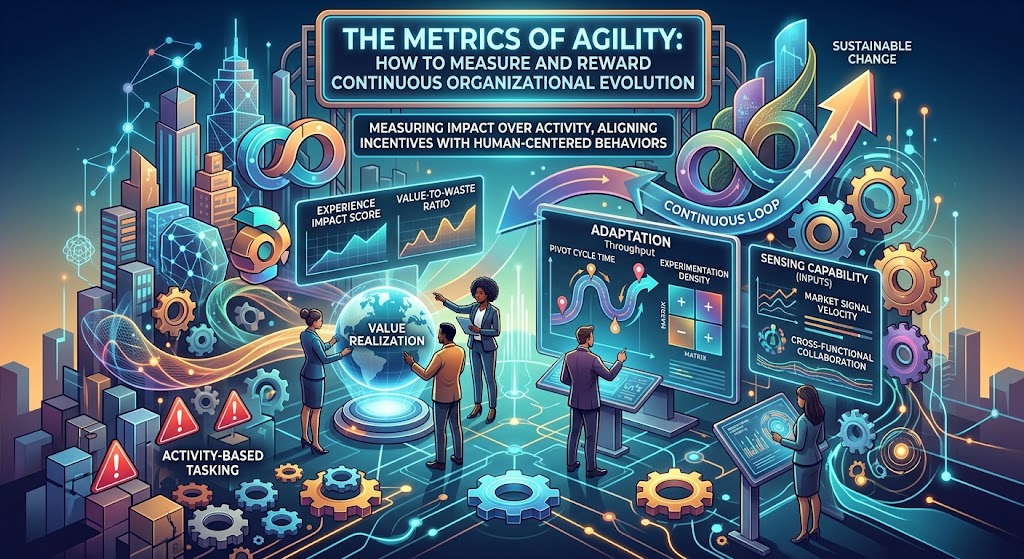
To measure true evolutionary capability, organizations must look beyond superficial operational velocity. Moving from activity-based tracking to an impact-driven framework requires establishing metrics across three distinct, interconnected operational layers.
1. Sensing Capability (Inputs)
Before an organization can adapt, it must have the sensory network required to detect shifts in its internal and external environment.
- Market Signal Velocity: Tracks the elapsed time required for customer insights, emerging market trends, and front-line employee observations to travel from discovery to executive review. Faster flow reduces strategic latency.
- Cross-Functional Collaboration Index: Measures the frequency, quality, and friction levels of inter-departmental knowledge sharing, identifying organizational silos before they stall transformation efforts.
2. Adaptation Capability (Throughput)
Sensing change is meaningless without the structural flexibility to reallocate capital and effort dynamically.
- Pivot Cycle Time: Measures the exact time elapsed between recognizing a necessary strategic pivot and the operational reallocation of talent, budget, and resources.
- Experimentation Density: Tracks the volume of structured, low-risk hypothesis tests and small-scale experiments executed across teams per quarter. Higher density correlates directly with learning velocity.
3. Value Realization (Outputs)
Ultimately, evolutionary metrics must validate that strategic shifts generate sustainable, human-centric outcomes.
- Experience Impact Score: Quantifies measurable improvements in both Employee Experience (EX) and Customer Experience (CX) directly tied to continuous organizational adjustments.
- Value-to-Waste Ratio: The percentage of initiated ideas that are successfully validated and scaled versus those identified as non-viable and sunset early to preserve bandwidth.
III. Aligning Incentives: Rewarding the Right Evolutionary Behaviors
Measuring evolution is pointless if your reward systems reinforce status-quo stability. If performance management penalizes missed predictions while rewarding rigid adherence to outdated plans, people will protect the plan over the business. To build true organizational agility, compensation, recognition, and advancement models must systematically encourage adaptative behaviors.
1. Rewarding “Smart Failures” and Early Sunsetting
The highest-ROI move a team can make is often killing a project before it consumes massive capital. Most corporate structures, however, punish early termination while continuing to fund zombie initiatives that hit arbitrary task deadlines.
- Pivot Bonuses & Innovation Sunset Awards: Celebrate and financially reward teams that validate a negative hypothesis quickly and voluntarily decommission non-viable projects early.
- Capital Recirculation Metrics: Track and reward leaders based on how effectively they return unused bandwidth and budget back to the central innovation pool for reallocation.
2. Recognition for Adaptability over Adherence
Traditional annual reviews evaluate performance against static objectives set 12 months prior. This creates a psychological barrier to pivots, driving employees to execute dead ideas simply because they were written into their annual goals.
- Dynamic Contribution Reviews: Evaluate individuals not on “Did you stick to the plan?” but on “How effectively did you sense market shifts, pivot when presented with data, and support peer-led change?”
- Adaptability Multipliers: Tie performance tiers to the speed and grace with which teams adopt new tools, pivot workflows, and continuously refine customer experiences.
3. Crowdsourced & Peer-Driven Recognition
Leadership rarely sees the day-to-day micro-adaptations that keep an organization agile. Peer-driven systems shine a light on the unsung connectors who break down silos and enable change across boundaries.
- Silo-Busting Micro-Grants: Allow team members to distribute peer recognition funds directly to colleagues in other departments who actively reduce friction and share vital knowledge.
- Cross-Functional Equity: Evaluate senior leaders on joint performance goals shared across functional silos rather than departmental micro-kingdoms.
IV. Leadership’s Role in Sustaining the Feedback Loop
Transformation cannot survive in an ecosystem where leadership acts as a bottleneck rather than an accelerator. Sustaining continuous organizational evolution requires executive leaders to shift from traditional command-and-control oversight to active systemic enablement—using evolutionary metrics to uncover structural blockers and remove friction in real time.
1. From Command-and-Control to Friction Removal
In a truly agile organization, an executive’s primary responsibility is not prescribing rigid tactics, but clearing the runway for cross-functional teams to execute and adapt autonomously.
- Architecting the Frictionless Workplace: Leaders must actively monitor organizational metrics—such as decision latency and approval gate delays—to identify bureaucratic red tape and streamline governance models.
- Protecting Psychological Safety: Creating a culture where front-line employees feel safe signaling bad news early, challenging outdated assumptions, and proposing bold experiments without fear of executive retribution.
2. Continuous Measurement over Annual Targets
Static annual planning cycles belong to a slow-moving past. Sustaining agility demands real-time operational feedback loops that adapt to market dynamics as they happen.
- Rolling, Dynamic OKRs: Replacing rigid annual goal-setting with flexible quarterly objectives and key results that prioritize learning velocity, strategic flexibility, and rapid value delivery.
- Transparent Metric Dashboards: Democratizing access to performance data across all levels of the enterprise, ensuring that every team understands how their daily adaptations contribute to broader strategic goals.
V. Conclusion: The Agile Organization as a Living System
True organizational agility is not a destination, nor is it a set of rigid frameworks to be rigidly imposed upon teams. It is an evolutionary capability—a living system that continuously senses market dynamics, learns from experiments, and adapts its resources without inflicting organizational trauma. Moving beyond legacy output metrics to measure sensing velocity, adaptation throughput, and human-centered value realization is the only way to build a resilient, future-ready enterprise.
The Strategic Shift in Summary
- From Activity to Impact: Measure the capacity to evolve, learn, and reallocate capital rather than tracking sheer task output or burn-down charts.
- From Rigid Plans to Continuous Alignment: Reward smart failures, early project sunsetting, and peer-driven collaboration over strict adherence to outdated annual targets.
- From Control to Enablement: Position leadership as friction removers who cultivate psychological safety and sustain real-time feedback loops.
By aligning what you measure and reward with human-centered behaviors, you transform change from a periodic disruption into a core organizational rhythm—ensuring your enterprise doesn’t just survive change, but thrives because of it.
Frequently Asked Questions
1. What is the fundamental difference between legacy agility metrics and evolutionary agility metrics?
Legacy agility metrics focus primarily on output volume and execution speed—such as task velocity, release frequency, and burn-down charts. Evolutionary agility metrics evaluate an organization’s systemic capability to sense market shifts, execute low-risk experiments, reallocate capital dynamically, and deliver sustainable value without causing employee burnout.
2. How can organizations reward teams for pivoting away from non-viable initiatives?
Organizations can realign incentives by establishing “Pivot Bonuses” and “Innovation Sunset Awards” that financially and culturally celebrate teams for validating negative hypotheses early. Additionally, tracking capital recirculation—how quickly unused bandwidth and budget are returned to the central innovation pool—ensures leaders are recognized for preserving organizational resources.
3. What role does leadership play in sustaining continuous feedback loops?
Leadership must shift from command-and-control oversight to active friction removal. Rather than dictating rigid tactical plans, executive leaders focus on measuring decision latency, eliminating bureaucratic red tape, protecting psychological safety for experimentation, and replacing annual KPI planning with dynamic, rolling OKRs.
EDITOR’S NOTE: Braden Kelley’s Problem Finding Canvas can be a super useful starting point for doing design thinking or human-centered design.
“The Problem Finding Canvas should help you investigate a handful of areas to explore, choose the one most important to you, extract all of the potential challenges and opportunities and choose one to prioritize.”
Image credit: misterinnovation.com
 Sign up here to get Human-Centered Change & Innovation Weekly delivered to your inbox every week.