Equitable Outcomes vs. Equal Inputs
GUEST POST from Chateau G Pato
The Illusion of the Level Playing Field
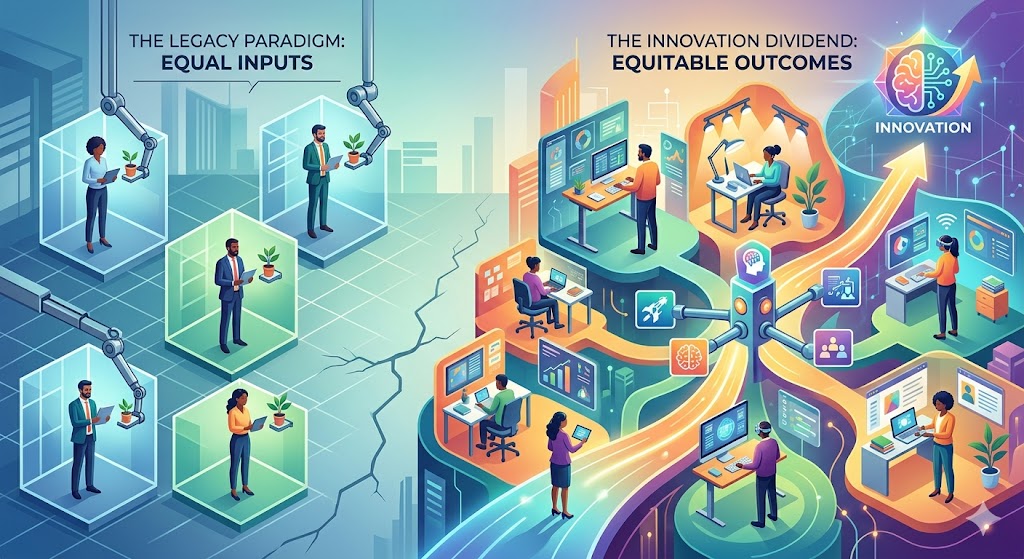
For decades, the corporate playbook has relied on a comforting, mathematically clean definition of fairness: equal inputs. The logic seemed bulletproof—give every employee the exact same tools, the same standardized training, and the same rigid compliance mandates, and the corporate race would inherently be fair. This assembly-line mentality assumed that by standardizing the starting line, we had successfully leveled the playing field.
But in the modern, distributed, and rapidly evolving enterprise, this legacy paradigm is fracturing. Equal inputs assume a reality that simply does not exist: that every individual starts from the same baseline, possesses the same lived experiences, and navigates the same workspace friction. When we design experiences for a mythical “average” employee, we inadvertently design for no one. Standardized inputs frequently mask deep systemic gaps, leaving brilliant talent struggling not from a lack of effort or capability, but from a lack of appropriate, contextual support.
True organizational fairness is not about treating everyone the same; it is about meeting people where they are to unlock their unique potential.
As we navigate an era disrupted by automation and generative technologies, the primary drivers of enterprise value are shifting entirely toward deeply human capabilities—creativity, empathy, strategic foresight, and collaborative innovation. These assets cannot be cultivated on an organizational conveyor belt. To build a resilient, future-ready culture, leadership must boldly shift its focus from equal inputs to equitable outcomes. True fairness means designing systems and experiences that provide the specific, adaptive resources individuals need to thrive, ensuring everyone has an authentic opportunity to achieve excellence.
I. The Anatomy of the Inputs vs. Outcomes Dynamic
To redefine fairness in the modern enterprise, we must first dissect the fundamental mechanics of how organizations distribute resources and evaluate success. For generations, corporate design has conflated equality with equity, treating them as interchangeable concepts when they are, in fact, structurally opposed.
Defining the Boundaries
- Equal Inputs: This is the homogeneous, flat distribution of resources. It manifests as standardizing a one-size-fits-all training program, deploying identical hardware setups without regard for accessibility, or enforcing blanket hybrid-work mandates. It is the practice of measuring fairness purely by what the organization hands out.
- Equitable Outcomes: This is the intentional customization of the support structure. It recognizes that different people require different tools, environments, or cadences to achieve the same level of performance. It shifts the definition of fairness to what the individual is actually empowered to achieve.
The Experience Design Flaw
When organizations default to equal inputs, they fall into a dangerous experience design trap: treating human beings as uniform components in a corporate machine. Human experience is non-linear and deeply contextual. A standardized digital workspace that feels seamless to one employee might present invisible cognitive or accessibility barriers to another. By failing to account for these variances, a system built on “equal inputs” unintentionally penalizes individuals who do not fit the historical archetype of the standard worker, resulting in massive, unmeasured experience revenue leakage.
The Futurist Perspective
This dynamic becomes critical as we advance deeper into the era of continuous technological disruption. As artificial intelligence, advanced automation, and intent orchestration systems rapidly absorb routine, task-based execution, the premium on human labor shifts entirely. The enterprise value of tomorrow is generated through high-cognitive, human-centric skills—complex problem solving, diverse creative thinking, and cross-functional empathy.
These capabilities cannot be optimized through rigid, industrialized standardization. You cannot mandate a creative breakthrough with a standardized input. Cultivating these high-value human assets requires highly adaptive, human-centered environments that recognize individual friction points and actively dissolve them, shifting the focus permanently toward the ultimate outcome.
II. Barriers to Transitioning: The Standardization Trap
If the argument for equitable outcomes is so compelling, why do so many legacy organizations remain fiercely tethered to equal inputs? The reality is that shifting an enterprise mindset requires dismantling decades of industrial-era conditioning. Organizations routinely fall into a series of cultural and operational traps that stall progress and reinforce the status quo.
The Comfort of Equality
The primary reason leadership defaults to equal inputs is simple: it is comfortable, predictable, and remarkably easy to measure. In a traditional corporate hierarchy, inputs fit neatly into spreadsheets. It requires very little organizational effort to verify that every employee received the same 40-hour training block, the same budget allocation, or the same laptop model. This approach creates a powerful illusion of objective neutrality and provides a convenient shield for risk-averse compliance and human resource departments. Under the banner of “treating everyone exactly the same,” organizations can bypass the complex, nuanced work of understanding individual human needs.
The Fear of “Special Treatment”
When enterprises begin discussing equity, an immediate wave of organizational anxiety often ripples through leadership and the rank-and-file alike. Skeptics frequently misinterpret equity as favoritism, special treatment, or worse—a lowering of the performance bar. There is a deeply ingrained fear that tailoring resources to individual circumstances creates an unfair playing field for those who require less structural support.
Equity is not about lowering the bar; it is about providing the right scaffolding so that everyone has a genuine shot at clearing it.
Overcoming this barrier requires a rigorous cultural reframing. Leaders must clearly communicate that equity does not compromise standards; rather, it maximizes the collective capability of the workforce by removing the artificial friction that keeps high-potential talent from performing at their peak.
The Cost of Inertia
Maintaining an inputs-only mindset under the guise of organizational simplicity carries a steep, often hidden financial and cultural price tag. When brilliant individuals realize that their unique challenges are invisible to the organization—and that the enterprise values rigid adherence to process over their actual ability to contribute—they don’t just underperform; they check out.
This inertia drives widespread disengagement, quietly stifles the diverse viewpoints necessary for true corporate agility, and ultimately accelerates expensive talent churn. In a world where the cognitive divide is widening, the organizations that refuse to evolve past standardized inputs will find themselves starved of the very human ingenuity they need to survive.
III. The Innovation Dividend: Why Equity Powers Growth
Shifting from equal inputs to equitable outcomes is not a mere exercise in corporate compliance or philanthropy—it is a cold, hard strategic imperative. In a hyper-competitive global market, the organizations that unlock the highest levels of human ingenuity win. Embracing equity directly impacts the bottom line by transforming the modern enterprise into an adaptive powerhouse designed for continuous growth.
Psychological Safety as Infrastructure
When an enterprise intentionally designs experiences around individual needs, it sends a powerful cultural signal: we see you, and we value your unique contribution. This deliberate systemic care builds profound organizational trust, which serves as the bedrock for psychological safety. In an equitable environment, employees are no longer wasting cognitive energy masks-wearing, navigating invisible friction, or worrying that their unique circumstances make them an outlier. When people feel secure and structurally supported, they are far more willing to take calculated creative risks, challenge legacy assumptions, and pitch the disruptive ideas that fuel the corporate innovation pipeline.
Unlocking Cognitive Diversity
True innovation is born at the chaotic intersections of differing perspectives, lived experiences, and distinct mental models. However, when an enterprise forces a highly diverse workforce through the homogenizing pipeline of identical inputs, it actively flattens that diversity. Standardized tools and rigid frameworks yield standardized thinking. By tailoring resources, communication cadences, and collaboration models to meet individuals where they are, we empower distinct minds to articulate their insights in their most potent form. Equity ensures that cognitive diversity isn’t just a metric on a hiring report, but an active, uninhibited engine of corporate value creation.
The Ecosystem View
The industrial-era enterprise was modeled after the assembly line—a brittle, linear machine where every part was expected to be uniform. The modern enterprise, by contrast, is a complex, living ecosystem. In nature, resilient ecosystems do not survive by distributing sunlight, water, and nutrients perfectly evenly across every square inch of soil. Instead, resources are dynamically channeled where they are needed most to optimize the health of the entire system.
Forward-thinking organizations must adopt this exact ecosystem mentality. By abandoning flat homogenization and treating resource distribution as a dynamic, adaptive capability, the enterprise builds deep structural resilience, ensuring that every node in the organizational network is optimized to drive collective growth and weather market disruption.
IV. A Framework for Designing Equitable Outcomes
Transitioning an entire enterprise from a legacy mindset of rigid standardization to a fluid model of equitable outcomes requires more than inspiring rhetoric—it demands a deliberate architectural framework. We must re-engineer our organizational systems, changing how we listen to our people, how we deploy our resources, and how we measure corporate success.
Empathy-Driven Auditing
The journey toward equity cannot rely on standard, superficial annual engagement surveys, which frequently flatten data and obscure the real challenges within an organization. Instead, enterprises must deploy deep ethnography, qualitative experience mapping, and comprehensive experience audits. This means actively listening to employees across diverse segments to uncover invisible friction points and identify where experience revenue leakage is occurring. By mapping the actual day-to-day employee journey, leadership can pinpoint the exact structural bottlenecks that prevent high-potential talent from fully contributing.
Adaptive Resource Allocation
Once the organizational friction points are clearly mapped, the enterprise must replace its rigid, one-size-fits-all infrastructure with dynamic, adaptive systems. Rather than forcing employees to adapt to inflexible corporate structures, the environment must adapt to them. This involves implementing personalized learning and development pathways that cater to different cognitive styles, designing asynchronous collaboration models that respect diverse regional or personal realities, and offering highly customizable wellness and workspace architectures. Providing flexible scaffolding ensures that every individual has access to the precise environment they need to maximize their focus and impact.
Outcome-Based Accountability
The final and most critical pillar of the framework requires rewriting the managerial playbook. For decades, management has been addicted to tracking easily quantifiable inputs—hours logged at a desk, badges earned in a training module, or physical presence in an office. In a human-centered enterprise, these metrics are obsolete. Leaders must transition to rigorous outcome-based accountability.
Managers must be trained and incentivized to evaluate teams based on the quality of their outputs, their collaborative impact, and the systemic health of their team ecosystems. When we shift performance indicators to focus entirely on the value generated rather than the uniform path taken to get there, we grant employees the autonomy to work in the ways they are most effective, naturally unlocking a higher standard of enterprise performance.
Conclusion: The Future of the Enterprise is Human-Centric
The choice facing the modern enterprise is no longer between efficiency and empathy; it is a choice between rigid stagnation and adaptive survival. Clinging to the industrial-era illusion of equal inputs might offer a fleeting sense of operational comfort and regulatory simplicity, but it does so at the direct expense of human ingenuity. In an increasingly complex and automated marketplace, treating a diverse, highly capable workforce as a uniform mass is a recipe for institutional irrelevance.
Leadership in the modern era requires a profound shift in perspective. The mandate of the forward-thinking executive is no longer to enforce compliance and manage uniformity, but to orchestrate harmony among remarkably diverse talents. This requires moving beyond standard metrics and actively engineering an organizational ecosystem where the support structures are as dynamic and nuanced as the people within them.
True fairness isn’t about giving everyone the exact same pair of shoes; it’s about making sure everyone has a pair that actually fits them so they can run the race to the best of their ability. By boldly shifting the corporate paradigm from equal inputs to equitable outcomes, enterprises do more than just build a fairer workplace—they unlock the full spectrum of human potential, driving the sustained innovation, deep resilience, and human-centered growth necessary to dominate the future.
Frequently Asked Questions
What is the core difference between equal inputs and equitable outcomes?
Equal inputs focus on distributing resources identically across the entire workforce, assuming everyone starts from the same baseline. Equitable outcomes focus on customizing the support structure and resources to meet individuals where they are, ensuring everyone has an equivalent opportunity to succeed and innovate.
Does shifting to an equitable outcomes model lower performance standards?
No. Equity does not mean lowering the bar or offering favoritism. Instead, it involves providing the precise scaffolding, tools, and environments individuals need to eliminate artificial friction, allowing everyone to meet and exceed high-performance standards.
How can managers transition from input tracking to outcome-based accountability?
Managers must shift their focus from easily quantifiable metrics like hours logged or physical desk presence to qualitative impact. This involves defining clear, strategic goals and giving employees the autonomy to determine how they achieve them, while measuring success based on output quality and collaborative value.
Image credit: Gemini
 Sign up here to get Human-Centered Change & Innovation Weekly delivered to your inbox every week.