How Psychological Safety Boosts Organizational Recovery
LAST UPDATED: March 25, 2026 at 12:27 PM
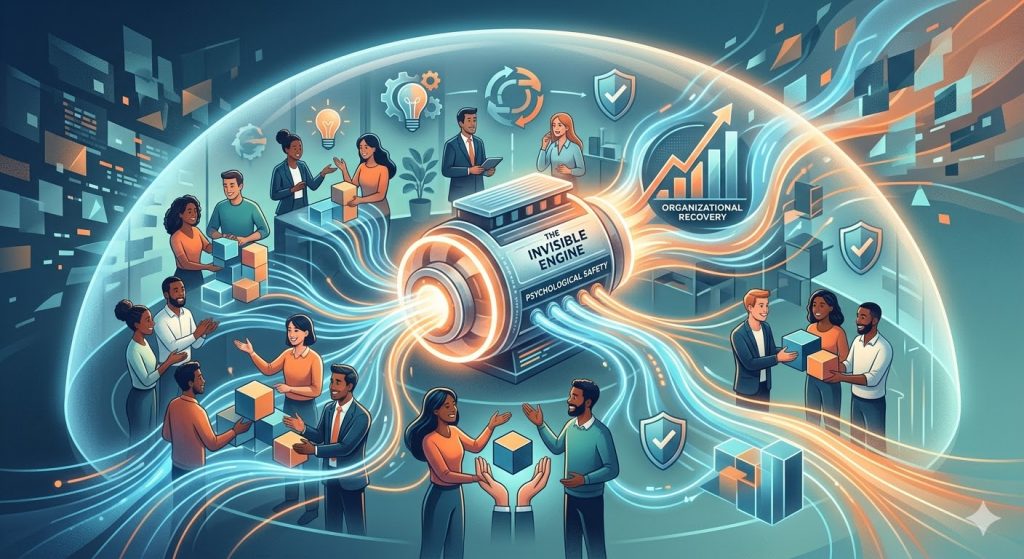
GUEST POST from Art Inteligencia
Beyond the Balance Sheet: The Human Core of Recovery
When an organization faces a crisis — whether it’s a market shift, a digital disruption, or a global event — the instinctive reaction of leadership is to tighten the reins. We look at liquidity ratios, supply chain redundancies, and technological “fixes.” However, this traditional recovery model suffers from a Recovery Fallacy: the belief that you can repair a broken system by only fixing the “hard” infrastructure while ignoring the “soft” human infrastructure that actually drives performance.
The Hidden Infrastructure of Resilience
True organizational resilience isn’t just about the ability to bounce back to a previous state; it’s about the ability to leapfrog forward into a new reality. This requires a high-performance environment where psychological safety acts as the primary lubricant for change. Psychological safety is often misunderstood as “being nice” or lowering standards. In reality, it is the exact opposite. It is a rigorous cultural standard where interpersonal risk-taking is not just permitted, but expected.
“Organizational recovery is a collaborative sport. If your team is afraid to point out where the new plan is failing, you aren’t leading a recovery — you’re managing a decline.” — Braden Kelley
The High Cost of Silence
In the wake of a setback, employees naturally move into a “threat” state. Without a deliberate effort to establish safety, the following occurs:
- Idea Hoarding: People keep “crazy” but potentially transformative ideas to themselves to avoid looking foolish.
- Error Masking: Small failures are hidden until they become systemic disasters because the cost of admission is too high.
- Groupthink: Teams align with the leader’s recovery plan — even when they see fatal flaws — simply to maintain a sense of security.
To boost recovery, leaders must shift their focus. We aren’t just balancing books; we are re-engaging the collective intelligence of the workforce. When people feel safe to be vulnerable, they become the most powerful innovation engine an organization possesses.
The Anatomy of a Post-Crisis Organization
In the aftermath of a major organizational setback, the atmosphere is rarely one of immediate renewal. Instead, most companies enter a state of “cultural stasis.” To lead a successful recovery, we must first diagnose the invisible barriers that prevent people from leaning into the future. It’s not a lack of talent that stalls recovery; it’s a lack of certainty in the face of failure.
The ‘Hunker Down’ Instinct
Human biology is hardwired for survival. When an organization experiences trauma — be it a massive market loss, a failed product launch, or a restructuring — the workforce enters a state of defensive silence. This “hunker down” instinct manifests as:
- Risk Aversion: Choosing the “safe” path even when it leads to stagnation.
- Silo Protection: Guarding resources and information to ensure individual or departmental survival at the expense of the enterprise.
- Cognitive Dissonance: Ignoring evidence that a recovery strategy is failing to avoid the emotional weight of another setback.
The Innovation Gap: Silence is a Signal
The most dangerous byproduct of a crisis is the “Innovation Gap.” This occurs when the feedback loop between the front lines and the C-suite is severed by fear. If an employee sees a way to streamline a process but fears that pointing out the current inefficiency will be seen as an attack on leadership, they will remain silent. In a recovery phase, silence is a cost. Every unshared idea is a lost opportunity to accelerate the return to growth.
The Role of Vulnerability in Leadership
Recovery cannot be mandated; it must be modeled. To bridge this gap, leaders must transition from being “the person with all the answers” to “the person with all the questions.” This requires a strategic display of vulnerability:
- Admitting Uncertainty: Signaling that the path forward is a hypothesis to be tested, not a directive to be followed blindly.
- Redefining Failure: Distinguishing between “preventable failure” (deviating from known processes) and “intelligent failure” (the inevitable result of experimenting in a new market).
- The ‘Safe-to-Fail’ Signal: Publicly celebrating a pilot project that didn’t work but provided critical data for the next iteration.
By addressing these anatomical realities, we move from a culture of blame to a culture of inquiry. This shift is the foundational work required before any tactical recovery plan can take root.
Three Pillars of Safety-Driven Recovery
To move beyond theoretical safety and into measurable organizational recovery, we must embed specific structural pillars into the change management process. These pillars ensure that psychological safety isn’t just a “feeling,” but a functional asset that accelerates the speed of learning and adaptation.
1. Open Feedback Loops: From Command to Listen
In a recovery phase, the most valuable data often sits at the edges of the organization — with the customer-facing teams and the individual contributors who see the friction points first. Traditional “Command and Control” structures stifle this data. To boost recovery, we must implement:
- Blame-Free Retrospectives: Shifting the focus from “Who failed?” to “What happened and how do we prevent it?” This turns every setback into a free masterclass in optimization.
- The ‘Red-Flag’ Protocol: A formal, protected mechanism for any employee to pause a process if they identify a risk that contradicts the recovery goals.
2. Cognitive Diversity: Crowdsourcing the Cure
Recovery strategies built in a vacuum of executive agreement are prone to blind spots. True resilience requires a mosaic of perspectives. By fostering an environment where dissent is seen as a contribution, we unlock:
- The Outsider Advantage: Inviting team members from unrelated departments to “audit” a recovery plan. Their lack of “sunk cost” in the current process allows them to see obvious flaws.
- Inclusive Ideation: Ensuring that the recovery roadmap isn’t just top-down, but reflects the diverse lived experiences of the entire workforce, leading to higher buy-in and smoother implementation.
3. The Permission to Experiment: Safe-to-Fail Zones
Innovation is the only sustainable path out of a crisis, yet innovation requires the possibility of failure. During recovery, the stakes feel too high to miss. We solve this by creating Safe-to-Fail Zones:
- Micro-Pilots: Breaking large recovery initiatives into small, low-cost experiments. If a micro-pilot fails, the organization learns cheaply and quickly.
- Iterative Funding: Moving away from massive annual budgets toward “metered funding” based on the evidence generated by these safe experiments.
- Rewarding the Pivot: Specifically recognizing teams that had the courage to stop a failing project early to redirect resources toward a more promising path.
When these three pillars are in place, psychological safety stops being a HR initiative and starts being the operational backbone of the new, recovered organization.
Measuring What Matters: Safety Metrics for the Boardroom
The greatest challenge in scaling psychological safety is the perception that it is “unmeasurable.” To a Board of Directors or a CFO focused on recovery, if it isn’t on a dashboard, it doesn’t exist. To bridge the gap between culture and capital, we must translate the human experience into Experience Level Measures (XLMs) — qualitative indicators that predict quantitative success.
The ‘Silence’ Metric: Identifying Dangerous Quiet
In a healthy recovery, the volume of constructive dissent should increase, not decrease. We can track the “health of the conversation” by observing:
- Meeting Participation Variance: Tracking the ratio of speaking time between leadership and individual contributors. A recovery plan dominated by a single voice is a plan at risk.
- Uninterrupted Dissent: Measuring how often a “contrarian” view is raised in a steering committee and, more importantly, how long that idea is explored before being dismissed or adopted.
Idea Velocity: From Insight to Execution
Recovery is a race against time. The speed at which a front-line observation (e.g., “The customer hates the new portal”) reaches a decision-maker is a direct reflection of psychological safety. We measure this through:
- The Feedback Lag: The time elapsed between a detected friction point and the initiation of a formal pivot.
- Cross-Silo Contribution: The percentage of recovery ideas that originate from outside the “official” innovation or strategy departments.
Employee Agency and Cognitive Load
Traditional metrics look at “uptime” or “output.” In a recovery context, we must look at Cognitive Load — the mental effort required for an employee to do their job while navigating organizational fear. High-safety environments reduce this load, freeing up “innovation bandwidth.” We track this via:
- The ‘Mistake Transparency’ Index: The frequency of self-reported errors versus those discovered by audits. A high rate of self-reporting indicates a high-safety, low-risk environment for the company’s long-term health.
- Agency Pulse: Regular, micro-surveys asking: “Do you feel you have the authority to change a process that is hindering our recovery?”
By bringing these metrics into the boardroom, we move psychological safety from the “perks and culture” column to the “risk management and growth” column. It becomes an early-warning system for the organization’s most valuable asset: its ability to adapt.
Practical Steps for Today’s Leader: Shifting the Culture
Theory and metrics provide the foundation, but psychological safety is built in the micro-moments of daily interaction. For a leader driving organizational recovery, the goal is to lower the perceived cost of speaking up while raising the perceived cost of silence. This requires a deliberate shift in both behavior and the very language used within the “war room.”
The ‘Check-In’ over the ‘Check-Up’
During a crisis, management tends to obsess over the “Check-Up” — status reports, deadlines, and KPIs. While necessary, these can feel like interrogations. To foster safety, prioritize the “Check-In”:
- Human-First Inquiry: Start meetings by asking, “What is one thing making your work difficult right now?” rather than “What is the status of project X?”
- Active Listening: Practice “Level 3” listening — not just hearing the words, but picking up on the emotional subtext and cognitive load your team is carrying.
Rewarding the ‘Early Warning’
In many organizations, the person who brings bad news is treated as a “blocker.” In a recovery context, that person is actually your most valuable asset. Leaders must pivot to:
- Publicly Celebrating Dissention: When someone identifies a flaw in the recovery roadmap, thank them publicly for “protecting the organization from a blind spot.”
- The ‘Fail-Forward’ Award: Create a recurring recognition for the team that shared the most impactful lesson learned from a failed experiment. This signals that learning is valued as much as winning.
Language Shifts: From Blame to Inquiry
The words a leader chooses can either open or close the “safety valves” of an organization. Small linguistic tweaks have outsized impacts on cultural trust:
| Traditional Language (Blame) | Safety-Driven Language (Inquiry) |
|---|---|
| “Who is responsible for this delay?” | “What is the system bottleneck we need to clear together?” |
| “We need to stick to the plan.” | “What is the data telling us about our current hypothesis?” |
| “Why didn’t you see this coming?” | “How can we improve our early-warning signals for next time?” |
By implementing these language shifts, you transform the “boss” into a “facilitator of progress.” This reduces the friction of change and allows the organization to move at the speed of trust rather than the speed of permission.
Conclusion: Building the Future-Proof Organization
Organizational recovery is often treated as a finite bridge — a temporary structure to get from a point of crisis back to “business as usual.” However, in a world defined by accelerating digital disruption and shifting human expectations, there is no “usual” to return to. The goal of safety-driven recovery is not just to survive the current storm, but to upgrade the vessel for the oceans ahead. We aren’t just fixing what broke; we are building an Anti-fragile organization that grows stronger through stress.
Recovery as a Catalyst for Transformation
When psychological safety is the foundation of your recovery, the crisis itself becomes a catalyst. It forces the organization to shed legacy behaviors that were already slowing it down. By prioritizing human-centered change during a downturn, you achieve two things simultaneously:
- Accelerated Problem-Solving: You tap into the collective intelligence of your people, identifying pivots months before your “command-and-control” competitors.
- Cultural Re-imagination: You move from a culture of “hiring for fit” to “hiring for contribution,” where every voice is a sensor for future opportunities.
The Innovation Mandate
Innovation is not a department or a line item in a recovery budget; it is a direct byproduct of a safe culture. If your people are afraid to fail, they are afraid to innovate. And if they are afraid to innovate, your recovery will be shallow and temporary. The organizations that dominate the next decade will be those that realize that empathy is a strategic advantage and that vulnerability is the precursor to breakthrough value creation.
A Call to Action for Leaders
As you move forward with your recovery roadmap, remember that your primary job is to be the Chief Empathy Officer. Start by making it safe to speak up. Create the “Safe-to-Fail” zones today that will become your growth engines tomorrow. The metrics may live in the spreadsheet, but the recovery lives in the hallway, the Zoom call, and the Slack channel.
“The most resilient organizations don’t just have a plan for the future; they have a culture that is safe enough to invent it.” — Braden Kelley
By embedding psychological safety into the very DNA of your organizational recovery, you don’t just restore what was lost — you create something entirely new, infinitely more capable, and authentically human.
Frequently Asked Questions
Is psychological safety just about being “nice” to employees during a crisis?
No. Psychological safety is about performance, not politeness. It is a cultural rigorousness that allows for candid feedback, the admission of mistakes, and the challenging of the status quo without fear of retribution. In a recovery phase, “being nice” can actually be dangerous if it leads to withholding critical truths that the organization needs to survive.
How does psychological safety specifically accelerate financial recovery?
It reduces the “Information Lag.” When employees feel safe, they report market shifts, customer friction, and internal inefficiencies immediately. This allows leadership to pivot resources toward high-value activities months faster than a fear-based organization, directly impacting the bottom line through reduced waste and faster innovation cycles.
Can psychological safety be measured alongside traditional KPIs?
Absolutely. We use Experience Level Measures (XLMs) to track the health of the human system. By measuring metrics like ‘Idea Velocity’ (how fast an idea moves from front-line to decision-maker) and ‘Mistake Transparency,’ boards can gain a predictive view of organizational resilience that traditional lagging financial indicators miss.
Image credit: Google Gemini
 Sign up here to get Human-Centered Change & Innovation Weekly delivered to your inbox every week.