The New Skill of Prompting
LAST UPDATED: December 9, 2025 at 3:34PM

GUEST POST from Chateau G Pato
In the landscape of Human-Centered Innovation, the tools we use are constantly evolving. For decades, our focus has been on understanding human behavior, market dynamics, and organizational psychology. While these remain critical, a new, rapidly ascending skill is redefining innovation: prompting. This isn’t about esoteric coding; it’s the art and science of communicating effectively with artificial intelligence to unlock unprecedented levels of creativity, efficiency, and insight.
The rise of generative AI means that our ability to articulate needs, define constraints, and guide machine cognition will directly determine our innovation output. Those who master this skill will not merely automate tasks; they will augment human ingenuity, turning vague concepts into tangible prototypes, complex data into actionable strategies, and bold visions into executable plans. We must unlearn the idea that machines only follow rigid commands and instead embrace them as intelligent collaborators, whose effectiveness is a direct reflection of our communication clarity and intent. This is the essence of human-machine co-creation.
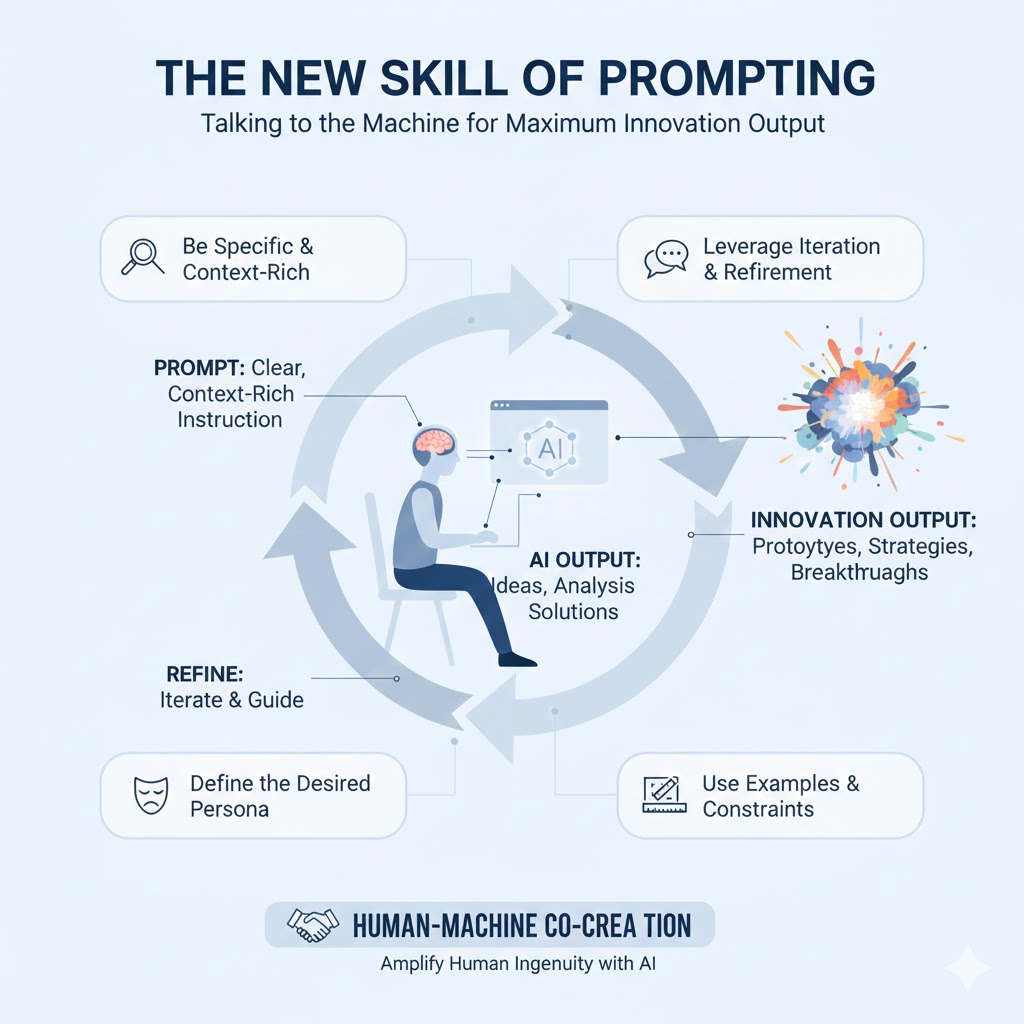
Visual representation: A diagram showing a human figure interacting with an AI interface, with arrows depicting iterative communication between prompt and output, leading to an innovative product or solution.
The Four Principles of Effective Prompting for Innovation
Effective prompting isn’t about magic words; it’s about structured thinking and iterative refinement. Here are four core principles:
1. Be Specific and Context-Rich (The “Who, What, When, Where, Why, How” for AI)
Vague prompts yield vague results. To get innovative outputs, you must provide the AI with a rich tapestry of context, constraints, and desired outcomes. Think of it as briefing an exceptionally intelligent, but context-blind, junior consultant. Define the role of the AI (e.g., “Act as a seasoned product manager”), the target audience (e.g., “for busy small business owners”), the problem you’re solving, the format of the output, and any limitations (e.g., “no more than 3 bullet points”). The more specific you are, the less the AI has to guess, and the more relevant its innovative suggestions become.
2. Leverage Iteration and Refinement (The “Dialogue-Driven” Discovery)
Innovation is rarely a one-shot process, and neither is prompting. Treat your interaction with the AI as a dialogue. Start with a broad prompt, analyze the output, and then refine your request based on what you’ve learned. This iterative process, often called “prompt chaining” or “conversation loops,” allows you to progressively narrow down solutions, explore adjacent ideas, and course-correct in real-time. Don’t expect perfection on the first try; expect a powerful co-creative journey.
3. Define the Desired Persona (Injecting Intent and Tone)
AI models can adopt various personas, which dramatically influences the style, tone, and even the creativity of their responses. Specifying a persona—”Act as a disruptive startup founder,” “Write like a meticulous scientific researcher,” or “Brainstorm like an unconstrained artist”—can unlock entirely different modes of thinking within the AI. This is where you inject the human element of intent into the machine’s generation, ensuring the output aligns not just with the facts, but with the spirit of your innovation challenge.
4. Use Examples and Constraints (Guiding Creativity, Not Limiting It)
While AI can generate novel ideas, it excels when given examples of the type of output you’re looking for, or clear boundaries. Providing “few-shot” examples (e.g., “Here are three examples of innovative headlines; generate five more in a similar style”) can significantly improve the quality and relevance of the output. Similarly, setting negative constraints (e.g., “Do not use jargon,” “Avoid cliché solutions”) focuses the AI’s creative energy towards truly original and effective solutions. These aren’t limitations; they are scaffolding for breakthrough thinking.
Case Study 1: Accelerating New Product Ideation
Challenge: Stagnant Idea Pipeline for a Consumer Electronics Company
A leading consumer electronics firm (“InnovateTech”) struggled with generating truly novel product ideas. Traditional brainstorming sessions often reverted to incremental improvements on existing products, and market research provided limited forward-looking insights. The ideation process was slow and often led to groupthink.
Prompting Intervention: AI-Augmented Brainstorming
InnovateTech integrated a generative AI into its early-stage ideation. Product managers were trained in advanced prompting techniques:
- Specific Context: Prompts included detailed customer personas, unmet needs, existing market gaps, and even desired technological components (e.g., “Act as a futurist product designer. Brainstorm 10 disruptive smart home devices for busy urban professionals, focusing on sustainability and ease of integration, avoiding voice assistants as the primary interface.”).
- Iteration: Initial AI outputs were then used as a basis for further prompts: “Refine these three ideas, focusing on how they could be gamified for user engagement,” or “Generate potential risks for these ideas, along with mitigation strategies.”
The Innovation Impact:
The AI-augmented ideation dramatically increased the volume and diversity of novel product concepts. The team reported a 200% increase in “truly unique” ideas, with the AI serving as an impartial, tireless brainstorming partner, challenging assumptions and suggesting unconventional combinations. The time from concept to validated idea was reduced by 30%, demonstrating how effective prompting transformed a bottleneck into a catalyst for innovation.
Case Study 2: Rapid Market Entry Strategy Development
Challenge: Slow and Costly Market Research for a SaaS Startup
A B2B SaaS startup (“GrowthEngine”) needed to quickly identify the most promising new international markets for its niche analytics platform but lacked the resources for extensive traditional market research. The founders faced a high-stakes decision with limited data.
Prompting Intervention: Strategic AI Analysis
GrowthEngine’s strategy team, using advanced prompting, leveraged an AI model for rapid market analysis:
- Persona & Specificity: The prompt was framed as: “Act as a global market expansion consultant for a B2B SaaS company specializing in real-time data analytics for supply chain optimization. Evaluate the top five emerging markets (outside North America/Europe) for product-market fit, considering regulatory hurdles, competitive landscape, and potential customer segments. Present a SWOT analysis for each, and rank them with justification. Focus on markets with high digital transformation potential but underserved analytics needs.”
- Constraints & Examples: They provided examples of previous successful market entry strategies for similar companies to guide the AI’s analysis and requested the output in a structured table format for easy comparison.
The Innovation Impact:
What would have taken weeks or months of dedicated analyst time was compressed into a few hours of iterative prompting. The AI provided detailed, actionable insights that identified two unexpected, high-potential markets that traditional research might have overlooked. This accelerated GrowthEngine’s market entry decision by 75%, allowing them to seize a first-mover advantage and proving that intelligent prompting is a strategic competitive differentiator.
Conclusion: Prompting as a Core Innovation Competency
The ability to effectively “talk to the machine” through prompting is no longer an optional skill; it is a core competency for the modern innovator. Organizations dedicated to Human-Centered Innovation must invest in training their teams in these principles. It’s about empowering humans to ask better questions, to think more expansively, and to leverage AI not as a replacement, but as an indispensable partner in the journey of discovery and creation. The future of innovation belongs to those who master the dialogue with their intelligent tools. Start prompting, start innovating.
“The future of work isn’t about replacing humans with AI; it’s about amplifying human potential with AI, and prompting is the key.” — Braden Kelley
Frequently Asked Questions About Prompting for Innovation
1. What is “prompting” in the context of AI and innovation?
Prompting is the skill of formulating clear, specific, and context-rich instructions or questions for an artificial intelligence model to generate desired outputs. In innovation, it’s about guiding AI to brainstorm ideas, analyze data, create content, or simulate scenarios to accelerate problem-solving and creative development.
2. Is prompting a technical skill, or more about communication?
Prompting is primarily a communication skill, deeply rooted in critical thinking and understanding intent, rather than pure technical coding. While some technical nuances can optimize results, the core competency lies in the ability to clearly articulate a problem, provide relevant context and constraints, and iterate effectively with the AI.
3. How can organizations encourage prompting skills among their teams?
Organizations can encourage prompting skills by providing dedicated training on effective prompting principles, creating shared “prompt libraries” of successful examples, integrating AI tools into daily workflows, and fostering a culture of experimentation and iterative dialogue with AI. Leadership should actively demonstrate and reward effective AI collaboration.
Your first step toward mastering prompting: The next time you face a creative block or a complex problem, instead of staring at a blank screen, open your favorite generative AI tool. Start with a very simple prompt describing your need, then spend 15 minutes iteratively refining it based on the AI’s responses. Treat it as a rapid-fire brainstorming partner, and watch your initial idea transform.
Extra Extra: Because innovation is all about change, Braden Kelley’s human-centered change methodology and tools are the best way to plan and execute the changes necessary to support your innovation and transformation efforts — all while literally getting everyone all on the same page for change. Find out more about the methodology and tools, including the book Charting Change by following the link. Be sure and download the TEN FREE TOOLS while you’re here.
Image credit: Pexels
 Sign up here to get Human-Centered Change & Innovation Weekly delivered to your inbox every week.