Democratizing Strategic Frameworks for Grassroots Growth
GUEST POST from Chateau G Pato
I. The Strategic Bottleneck: Why Proprietary Growth Fails
Organizations rarely suffer from a scarcity of great ideas. The true bottleneck is structural: a systemic failure to translate high-level ambition into frontline action. For decades, traditional management paradigms have treated strategic innovation as a proprietary black box—conceived behind closed doors, polished in executive suites, and guarded by specialized committees or high-priced consulting firms. This closed-source model creates a severe disconnect between strategy and execution, stranding valuable insights at the top while leaving the rest of the workforce disempowered.
When strategic frameworks remain proprietary, friction builds at every level of the enterprise:
- The “Strategy in a Silo” Trap: Strategic intent formulated without ground-level reality leads to rigid, top-down rollouts. Employees experience transformation as something done to them rather than designed with them, sparking passive resistance and change fatigue.
- The Literacy Divide: Complex corporate jargon creates artificial barriers. Without a universal, visual language for innovation and change, cross-functional alignment breaks down, and local teams lack the clarity needed to execute autonomously.
- Knowledge Hoarding vs. Knowledge Flow: Gatekeeping strategic tools restricts problem-solving to a select few. In a rapidly evolving market, an organization cannot afford to wait for executive permission to adapt.
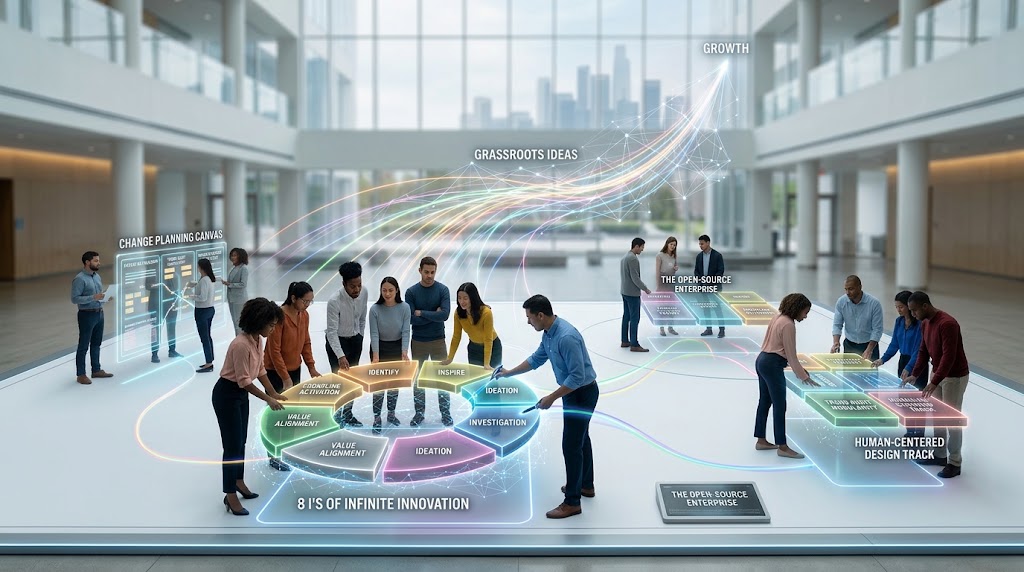
To build a resilient, future-ready enterprise, we must challenge the assumption that strategy belongs solely to leadership. High-performing organizations scale by turning strategic tools into open-source shared assets. Democratizing these frameworks equips every employee to see the big picture, spot weak market signals, and drive meaningful growth from the ground up.
II. The Anatomy of an Open-Source Enterprise
Transitioning from a closed, top-down hierarchy to an open-source enterprise requires a fundamental shift in how strategic capability is distributed across the organization. Democratization is not about abandoning executive leadership or introducing chaotic, unstructured decision-making; it is about providing every team member with the scaffolding needed to think, plan, and innovate strategically. An open-source enterprise treats strategy as an active operating system rather than a passive annual document.
Building this open ecosystem relies on three core structural pillars:
- Democratizing the Toolkit: Strategic tools must be visual, accessible, and intuitive for non-specialists. Replacing 80-slide decks with single-page visual canvases lowers the barrier to entry, enabling multidisciplinary teams to rapidly align, map out complex dependencies, and co-create solutions on a single shared surface.
- Human-Centered Architecture: True organizational agility places human experience—of customers, employees, and broader stakeholders—at the core of growth. By embedding human-centered design principles into daily strategic workflows, teams make decisions rooted in empathetic insight rather than abstract metrics.
- Iterative Co-Creation: Shifting the culture from “change to people” to “change with people” transforms passive observers into active co-architects of the future. Co-creation builds psychological ownership early, drastically accelerating execution speed while reducing organizational friction.
When strategic frameworks are open-source, the enterprise stops relying on isolated bursts of top-down disruption. Instead, strategic capacity becomes continuous, collaborative, and deeply embedded within the frontline culture.
III. Operating Principles: Modularizing Growth Frameworks
Democratizing strategy does not mean handing over unguided freedom; it requires robust, repeatable structure. To scale grassroots innovation without creating operational chaos, organizations must modularize their growth frameworks. Modular strategic architecture provides clear boundaries while allowing teams the flexibility to adapt tools to their local operational realities. This balance transforms isolated R&D efforts into a systematic, enterprise-wide capability.
To successfully operationalize open-source strategy, enterprises should ground their execution in three core operating principles:
- The Continuous Innovation Engine: Innovation must move away from episodic, event-driven workshops and become an ongoing operational muscle. Utilizing perpetual frameworks—such as the Eight I’s of Infinite Innovation™—allows teams to continuously move ideas through identification, inspiration, investigation, creation, and implementation without hitting strategic dead ends.
- Value Alignment Diagnostics: Open-source strategic initiatives must stay anchored to business realities. Ideas must be rigorously evaluated across three core dimensions of value: Value Creation (solving a meaningful customer problem), Value Access (ensuring the organization can deliver and reach the market), and Value Translation (capturing sustainable financial and strategic returns).
- Visual Change Infrastructure: Complex strategic plans fail when they hide behind jargon. By standardizing on intuitive, single-page visual planning canvases—like the Visual Project Charter™ and Change Planning Canvas™—teams establish line-of-sight clarity, expose hidden risks, surfaced dependencies early, and maintain shared accountability across cross-functional silos.
By embedding modular, visual frameworks into daily team rhythms, the enterprise creates a common strategic language. Frontline teams gain the structure needed to move fast and solve complex problems, while leadership retains full alignment on strategic direction.
IV. Activating Grassroots Innovation from the Frontline Up
Providing access to open-source frameworks is only the catalyst; real organizational momentum requires activating frontline teams to actively use them. Frontline employees are closest to customer friction points, operational inefficiencies, and emerging market shifts. When equipped with democratic strategic tools, these teams evolve from passive executors into proactive sensors and drivers of growth.
To successfully activate sustainable, bottom-up innovation across the enterprise, leaders must focus on three core operational enablers:
- Empowering Frontline “Future Hackers”: Organizations thrive when employees are trained to scan for weak market signals, challenge legacy assumptions, and prototype micro-solutions locally. By democratizing trend audit methods and signal-picker tools, teams can anticipate disruption and adapt workflows before minor friction turns into major enterprise risk.
- Balancing the Nine Innovation Roles: Strategic execution fails when teams are homogenous. Utilizing frameworks like the Nine Innovation Roles™ ensures project groups intentionally balance distinct behavioral archetypes—combining Revolutionaries and Conductors with Customer Champions and Evangelists—to move ideas seamlessly from inspiration to market delivery.
- Psychological Safety as Scaffolding: Grassroots innovation cannot survive in a culture of fear. Leadership must construct a safe environment where intelligent experimentation is encouraged, failure is treated as data, and teams have clear authority to run low-risk, localized trials without navigating endless permission loops.
When frontline employees are given both the visual tools and the cultural permission to innovate, strategy becomes a collective, dynamic discipline—unlocking massive hidden potential across every tier of the organization.
V. The Futurist’s Horizon: Scaling Sustainable Culture
The transition to an open-source enterprise is ultimately not a temporary initiative or a quick-fix management trend—it is a perpetual cultural evolution. As market cycles accelerate and technological disruption becomes constant, the organizations that thrive will be those that institutionalize strategic capability into every tier of their workforce. The goal is to build an adaptable organizational organism where strategic adaptation happens organically and continuously.
To sustain this transformation and scale an open strategic culture for the long term, leaders must navigate three critical imperatives:
- Preventing Strategic Fatigue: Tool democratization should simplify work, not compound it. Organizations must avoid “framework overload” by seamlessly weaving visual planning tools into existing rhythms and software workflows rather than positioning them as extra operational overhead.
- Measuring True Adoption Metrics: Success cannot be measured solely by traditional output metrics or completed project lists. Leaders must track change velocity, cross-functional collaboration rates, employee empowerment scores, and the speed at which frontline market insights are translated into active business experiments.
- The Ultimate Competitive Advantage: In a hyper-connected global economy, products, features, and business models are easily copied. Strategic capability, shared visual literacy, and a high-velocity innovation culture cannot be cloned. An open-source strategic architecture turns the enterprise into a self-adapting system built to out-innovate perpetual disruption.
Democratizing strategic frameworks bridges the historical gap between executive vision and ground-level execution. By opening the toolbox, empowering frontline talent, and embedding human-centered frameworks into daily operations, we unleash the full creative and strategic potential of the enterprise.
Frequently Asked Questions
- What is an Open-Source Enterprise?
- An Open-Source Enterprise is an organizational model where strategic innovation and change management frameworks are democratized, made visual, and made accessible to all employees rather than restricted to executive suites or external consultants.
- How do open-source frameworks prevent strategic chaos?
- By pairing shared visual architecture and standardized diagnostic tools (such as visual planning canvases) with clear operating guidelines, organizations ensure frontline teams innovate within aligned strategic boundaries rather than acting in isolation.
- How do you measure the success of strategic democratization?
- Success is measured through change velocity, frontline tool adoption, the speed of translating market signals into local business experiments, and cross-functional alignment, rather than traditional top-down compliance metrics alone.
EDITOR’S NOTE: Braden Kelley’s Problem Finding Canvas can be a super useful starting point for doing design thinking or human-centered design.
“The Problem Finding Canvas should help you investigate a handful of areas to explore, choose the one most important to you, extract all of the potential challenges and opportunities and choose one to prioritize.”
Image credit: Gemini
 Sign up here to get Human-Centered Change & Innovation Weekly delivered to your inbox every week.