by Braden Kelley and Art Inteligencia
Let me tell you about the moment the town of Lone Pine, California, looked up at a pitch-black desert sky and saw two enormous beams of light where there should have been none.
No, it wasn’t aliens. It wasn’t the military. It wasn’t even a particularly ambitious Halloween display. It was a startup rehearsing how it plans to sell sunlight after dark, and the residents hadn’t been invited to the rehearsal.
Welcome to this edition of Innovation or Not.
Press Play First
Two videos to set the scene. Watch them, then come back and argue with me. (The titles below come from search results, so give both a quick play-test before publishing.)
The idea, in one sentence
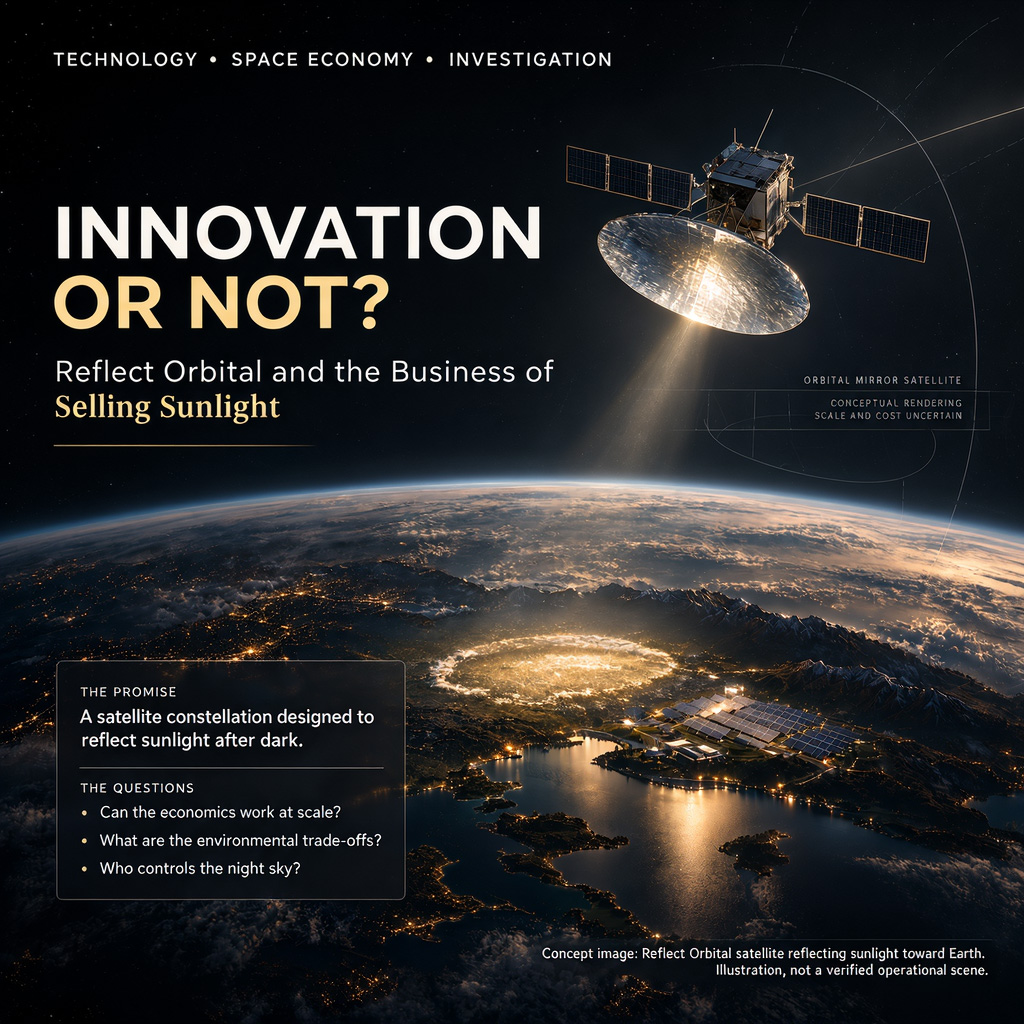
Reflect Orbital wants to put big mirrors in orbit and aim sunlight at spots on the ground that the sun has left. Light on demand, from space. Its tagline is that it makes clean, abundant energy available on demand, and it calls itself “The Sunlight Company.” I admire a company that knows what it sells.
The first spacecraft, Eärendil-1 (named, charmingly, after a character from Tolkien), carries a mirror roughly 18 meters, or about 60 feet, on a side, folded origami-style and made of Mylar. It would orbit a few hundred miles up and sweep a patch of light across the ground for about five minutes before moving on. The company’s own description of that first beam is “comparable to a full moon.” An independent astronomer quoted in coverage of the FCC approval put it at about four times brighter than a full moon. Same mirror, two descriptions, which tells you something about how early this is.
The FCC has approved that demonstration satellite. It has not approved the grand plan.
The Pitch
Here’s the company’s published roadmap, and I’ll let you judge the ambition:
- 2026: two satellites, moonlight-level light for a few minutes
- 2027: around three dozen satellites, with light comparable to street lighting for a couple of hours
- 2028: more than a thousand, with light comparable to an indoor work area
- 2030: more than five thousand, with light approaching daylight for minutes at a time
- 2035: more than fifty thousand, with daylight-level light for hours
Who is it for? The company lists lighting for search and rescue and disaster response, construction and industrial work, agriculture, events, and, the part that gave this article its second half, boosting solar power after the sun goes down.
Does it help solar cells?
This is the claim that deserves the most scrutiny, because it’s where the economics live.
The idea is elegant. A solar farm sits idle at night, so beam light onto it just before dawn and just after dusk and watch the output rise. The company’s own published projection is more modest than the pitch, though. For 2030, it estimates roughly a 1% capacity-factor gain, and its footnote puts the production increase at 0.75% for Southern California and 1.4% for Germany. A 20% gain doesn’t appear until 2035, which is the fifty-thousand-satellite stage.
Now the arithmetic, which is mine, not the company’s, so treat it as a back-of-the-envelope estimate. An 18-meter square mirror has about 324 square meters of surface. Full sunlight delivers about a kilowatt per square meter, so the mirror intercepts roughly 324 kilowatts. Spread that over a beam about five kilometers across, around 20 square kilometers, and you get something like 16 watts per square meter added to the ground, before any losses. Direct sun at noon is around 1,000. In other words, one mirror gives a solar panel about a sixty-fifth of a sunny day’s light.
You can see why the company’s early marketing leaned on lighting. A dim, wide pool of light is perfect for helping rescuers see. It’s a lot less useful for generating megawatts.
Do clouds and fog get in the way?
Short answer: almost certainly, and nobody seems to be talking about it.
I went looking for the company’s answer and found a pretty glaring gap. Its website doesn’t address weather. Neither do the major write-ups I read. The one place the question did come up was an engineering blog that noticed the studies and marketing “never seem to mention clouds, fog or other weather events,” and pointed out that the Russian Znamya 2 space mirror test back in 1993 took place under cloud, and observers barely saw the light.
Here’s my own reasoning, flagged as reasoning. The light from a space mirror has to travel through the same atmosphere as ordinary sunlight to reach the ground. Whatever thick cloud or fog does to the sun, it presumably does to a reflection of the sun. And the atmosphere scatters light even on a clear night, which spreads the beam out and is one reason critics worry about spillover well beyond the intended spot. So a cloudy night would likely bring a very dim result, at the very time people might want the light most.
If Reflect Orbital has data on this, I’d love to see it. Until then, I’d file weather under “important questions without published answers.”
Is it cost-effective?
Not on the evidence available. Michael Brown, an astronomer at Monash University, ran numbers reported by ABC News: matching 20% of midday sunlight would take roughly 3,000 satellites with 54-meter mirrors, and since each satellite can light a given spot for only a few minutes, an hour of daylight at one location would require tens of thousands of satellites, at a cost he put in the tens of millions of dollars. His verdict: “It doesn’t stack up.” He also noted that grid battery costs have fallen by more than 20 percent since Reflect Orbital was founded in 2021, which makes the competition for storing daytime solar energy tougher every year.
A fair counterpoint: the company has raised about $35 million, has a real engineering team and has won an Air Force-related research contract, so this isn’t a napkin sketch. And lighting a disaster zone or a construction site for a few hours might be worth paying for even if lighting a solar farm isn’t. But the energy case, specifically, has more skeptics than believers right now, and the company’s own projections are modest until the very large constellation stages.
When could this be widely available?
If “widely” means a lot of people can buy light from space, not for years, and maybe never at the scale on the roadmap.
As of the most recent reporting I could find, only the single demonstration satellite has FCC approval, and the agency’s review covers radio spectrum, not environmental or ecological effects. Each larger stage needs more approvals. One recent report said the main remaining hurdle for the first spacecraft is simply obtaining a rocket. Earlier reporting named SpaceX as the launch provider, and other coverage says the company is looking at launches from India, so I wouldn’t treat the launch plans as settled.
My read: a handful of test satellites and limited customers, such as event or emergency lighting, are plausible in the next few years. Anything resembling the 2030 or 2035 rows of that roadmap depends on a long chain of approvals, launches and public acceptance that hasn’t happened yet.
What happened in Lone Pine?
Now for the mystery. Earlier this month, Reflect Orbital set up powerful mobile spotlights on Horseshoe Meadows Road, near the peak of Mount Whitney, outside Lone Pine. According to local reporting, the goal was to simulate the light spot its mirror satellites would eventually deliver, so that China Lake Mountain Rescue and other volunteers could practice grid searches, stretcher carries and equipment rigging in realistic conditions.
Here’s the part I want to underline: there was no satellite involved. Those two blinding beams were ground-based spotlights standing in for a technology that hasn’t launched yet. A rehearsal for a performance that hasn’t been cast.
The locals, who looked up from their dinners to see the dark desert sky light up, were baffled, and they weren’t the only ones surprised. According to reports, astronomers weren’t notified, and it’s unclear whether county officials were told in advance. Gaspar Bakos, a Princeton astrophysicist, called it a serious threat to ground-based astronomy. DarkSky International’s CEO, Ruskin Hartley, called the broader plan “clearly an unprecedented assault on the nighttime environment.”
And the rescuers? Phillip Cash, operations leader for the rescue group, said the light was slightly brighter than a full moon and let searchers see about three miles in every direction. But he also noted that his team already works well at night, so the system wouldn’t fundamentally change routine rescues. A useful reality check. The company’s spokesman, for his part, said the test was meant to give responders a precise, realistic simulation.
The Concerns
(briefly)
Fairness requires including the other side of the ledger. Scientists and dark-sky advocates worry about effects on astronomy, on migrating birds and nocturnal animals, on sleep and circadian rhythms, and on pilots. Astronomers have also warned that amateurs looking at the satellites through telescopes could be at risk of eye damage. The company says the light is not bright enough to start fires or harm eyes, that the beams can be dimmed, and that it avoids sensitive areas such as observatories. Some experts dispute those assurances. Whichever side proves right, you can see why a surprise test in a small town didn’t help the case.
So: innovation or not?
Is it new? Yes. Selling reflected sunlight from orbit as a service, with a roadmap and an FCC license, is a genuinely novel business, even if the idea of a space mirror is as old as science fiction.
Does it create value? For specific uses like disaster response, event lighting and temporary construction work, plausibly. For solar power at scale, the case is thin and the company’s own numbers are modest until the huge constellation stages.
Will it reach people? Slowly, and probably in a much smaller form than the roadmap suggests.
Does it have costs it hasn’t priced in? That’s the one I’d watch. If an innovation’s side effects fall on people who weren’t asked, it isn’t done being evaluated.
My verdict: an impressive invention, not yet an innovation. It earns real credit for imagination, and I’d honestly like to see the first mirror fly. But I’d want clearer answers on clouds, cost and consent before I’d call it a breakthrough instead of a very bright experiment.
Then again, a town full of people looked up at the dark and wondered what was going on. As attention-getting goes, you can’t argue with the results.
Sources:
- Reflect Orbital: company website
- Reflect Orbital: Wikipedia
- TIME: A Space Mirror Will Test Turning Night Into Day. What To Know About the Controversial Project
- Space.com: The FCC just gave Reflect Orbital permission to launch its 1st space mirror to orbit
- ABC News (Australia): Reflect Orbital wants to turn night into day with mirrors in space
- Futurism: Unannounced Test by Controversial “Sunlight-as-a-Service” Space Startup Shocks Astronomers
- World Today Journal: Reflect Orbital Tests Spotlights to Simulate Space Mirrors
- Hackaday: Space Mirrors Dreams of Turning the Night Into Day Around the Clock
Image Credits: Microsoft AI
Content Authenticity Statement: The topic area, key elements to focus on, etc. were decisions made by Braden Kelley, with a little help from Claude to clean up the article.
 Sign up here to get Human-Centered Change & Innovation Weekly delivered to your inbox every week.