
by Braden Kelley and Art Inteligencia
Every organization rushing to deploy AI agents is making the same mistake: they are treating this as a technology rollout. It isn’t. It is a change management event — possibly the strangest one most of your employees will ever live through — and almost nobody is managing it as one.
I have spent two decades helping organizations navigate change. New systems, new structures, new leadership, new strategy — I have seen the patterns, and I have built frameworks to help people through them. What’s happening right now with AI agents doesn’t fit neatly into any of those patterns, because for the first time, the “new hire” your team has to adjust to isn’t a person. It has no face to read, no body language to interpret, no shared lunch break to build rapport over. And yet your people are being asked to trust it, collaborate with it, and in some cases defer to its output — all without the social mechanisms humans have relied on for millennia to build trust with someone new.
If you are rolling out AI agents into your teams this year — and if you aren’t already, you will be soon — you need a change management approach built for this specific situation. Here is what that requires.
This Is Not a Software Rollout
When organizations introduce new software, the change management playbook is well understood: communicate the why, train people on the how, support them through the learning curve, and reinforce the new behavior until it sticks. That playbook assumes the new thing is a tool. You pick it up, you put it down, you use it when it’s useful.
An AI agent is not a tool in that sense. It takes initiative. It makes judgment calls. It shows up in meetings, in workflows, in decisions — sometimes proactively, without being asked. The closest analog isn’t a new piece of software. It’s a new colleague. And we already have decades of organizational psychology telling us how disruptive a new colleague can be to team dynamics, let alone one that doesn’t operate like any colleague your team has ever had.
This distinction matters because it changes which change management tools actually apply. ADKAR’s emphasis on individual awareness and desire is still relevant. But the resistance you’ll encounter isn’t really about learning a new interface. It’s about something closer to what happens when any new team member joins: uncertainty about role boundaries, anxiety about being replaced or overshadowed, and an unconscious assessment of whether this new “person” can be trusted.
Why People Resist AI Coworkers Differently Than They Resist New Software
I wrote recently about the neuroscience of creativity and the role the amygdala plays in detecting social threat. The same mechanism is firing right now in your organization, and most leaders have no idea it’s happening.
When a new piece of software arrives, the brain files it under “tool” and moves on. When something that behaves like a colleague arrives — something that talks, decides, and acts with a kind of agency — the brain files it under “social actor” and starts running the same threat assessments it runs on any new person: is this safe? Is this going to take something from me? Can I trust what it tells me?
The catch is that an AI agent gives almost none of the signals humans use to answer those questions. There’s no tone of voice to read for sincerity. No facial expression to gauge intent. No shared history to draw on. Your people are being asked to extend trust to something that offers none of the usual evidence trust is normally built on — and then we’re surprised when adoption stalls or quiet resistance shows up as workarounds, double-checking everything the agent produces, or simply not using it at all.
This is not a training problem. You cannot train your way past a threat response. It has to be addressed the way any well-designed change effort addresses resistance: by understanding what’s actually driving it and designing for that, not for the resistance you assumed you’d see.
Applying the Change Management Process to AI Agent Adoption
I’ve written before about the five process groups that make up a disciplined change management process. Here’s how they apply when the change you’re managing is the introduction of an AI teammate:
Evaluate impact and readiness honestly. Most organizations evaluate AI agent impact in terms of tasks automated and hours saved. Few evaluate it in terms of role identity — what happens to how someone sees their own value when a piece of their job is now done by something that isn’t them? Skipping this assessment is how you end up with technically successful deployments and quietly disengaged teams.
Build a strategy that names the relationship, not just the rollout. Is the agent a tool the team directs, a collaborator the team works alongside, or something closer to a delegate that acts with some independence? Most organizations never decide this explicitly, and the ambiguity is exactly what breeds distrust. Decide it, and say it out loud.
Plan for trust-building, not just training. Traditional training plans teach people how to use something. What you actually need here is closer to onboarding a new team member: transparency about what the agent can and can’t do, visible track record before high-stakes use, and early opportunities for people to verify its output before they’re asked to rely on it.
Execute with visible human oversight, especially early. The fastest way to build trust in a new colleague — human or otherwise — is watching them perform well in front of you, not being told they performed well somewhere else. Early AI agent deployments need visible checkpoints where people can see the agent’s work and verify it, not a black box they’re asked to trust on faith.
Close the loop by naming what changed. Once an AI agent has been integrated into a workflow, say so explicitly, and say what it means for the people whose roles shifted around it. Changes that are never formally acknowledged have a way of generating resentment that outlasts the technical transition by years.
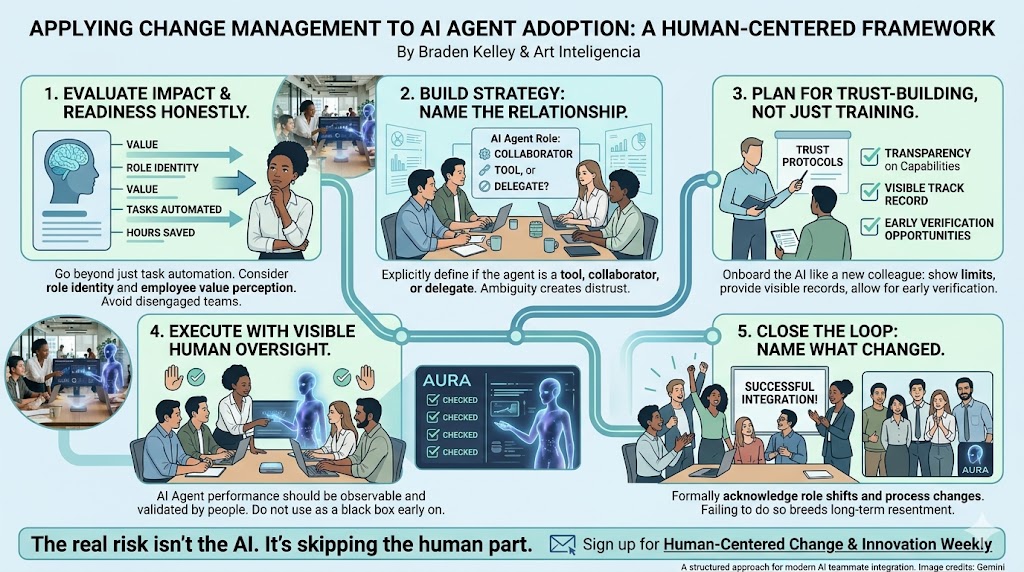
The Real Risk Isn’t the AI. It’s Skipping the Human Part.
I’ll say what I’ve said about AI in customer experience: the key isn’t choosing between AI and humans, it’s knowing when and how to bring each one in well. The organizations that get AI agent adoption right in 2026 will not be the ones with the most advanced agents. They’ll be the ones that treated the human side of this transition with the same discipline they’d apply to any major organizational change — because that is exactly what this is.
Skip that discipline, and you won’t get a failed technology rollout. You’ll get a team that technically has access to an AI agent and quietly refuses to use it, or uses it just enough to look compliant while doing the real work the old way. That is the most expensive kind of failure there is: the one that looks like success on a dashboard somewhere while nothing has actually changed.
Image credits: Gemini
Content Authenticity Statement: The topic area, key elements to focus on, and the change management framing were decisions made by Braden Kelley, with a little help from Claude to research current trends and clean up the article, and Gemini for images/infographics.
 Sign up here to get Human-Centered Change & Innovation Weekly delivered to your inbox every week.