Tag Archives: GenAI

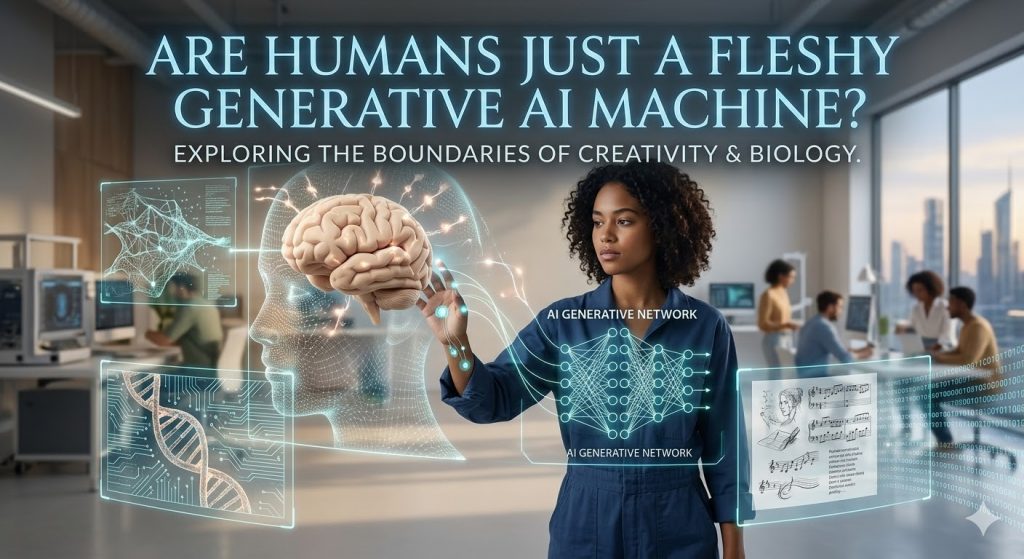
Humans Are Not as Different from AI as We Think

Humans Are Not as Different from AI as We Think

GUEST POST from Geoffrey A. Moore

By now you have heard that GenAI’s natural language conversational abilities are anchored in what one wag has termed “auto-correct on steroids.” That is, by ingesting as much text as it can possibly hoover up, and by calculating the probability that any given sequence of words will be followed by a specific next word, it mimics human speech in a truly remarkable way. But, do you know why that is so?

The answer is, because that is exactly what we humans do as well.

Think about how you converse. Where do your words come from? Oh, when you are being deliberate, you can indeed choose your words, but most of the time that is not what you are doing. Instead, you are riding a conversational impulse and just going with the flow. If you had to inspect every word before you said it, you could not possibly converse. Indeed, you spout entire paragraphs that are largely pre-constructed, something like the shticks that comedians perform.

Of course, sometimes you really are being more deliberate, especially when you are working out an idea and choosing your words carefully. But have you ever wondered where those candidate words you are choosing come from? They come from your very own LLM (Large Language Model) even though, compared to ChatGPT’s, it probably should be called a TWLM (Teeny Weeny Language Model).

The point is, for most of our conversational time, we are in the realm of rhetoric, not logic. We are using words to express our feelings and to influence our listeners. We’re not arguing before the Supreme Court (although even there we would be drawing on many of the same skills). Rhetoric is more like an athletic performance than a logical analysis would be. You stay in the moment, read and react, and rely heavily on instinct—there just isn’t time for anything else.

So, if all this is the case, then how are we not like GenAI? The answer here is pretty straightforward as well. We use concepts. It doesn’t.

Concepts are a, well, a pretty abstract concept, so what are we really talking about here? Concepts start with nouns. Every noun we use represents a body of forces that in some way is relevant to life in this world. Water makes us wet. It helps us clean things. It relieves thirst. It will drown a mammal but keep a fish alive. We know a lot about water. Same thing with rock, paper, and scissors. Same thing with cars, clothes, and cash. Same thing with love, languor, and loneliness.

All of our knowledge of the world aggregates around nouns and noun-like phrases. To these, we attach verbs and verb-like phrases that show how these forces act out in the world and what changes they create. And we add modifiers to tease out the nuances and differences among similar forces acting in similar ways. Altogether, we are creating ideas—concepts—which we can link up in increasingly complex structures through the fourth and final word type, conjunctions.

Now, from the time you were an infant, your brain has been working out all the permutations you could imagine that arise from combining two or more forces. It might have begun with you discovering what happens when you put your finger in your eye, or when you burp, or when your mother smiles at you. Anyway, over the years you have developed a remarkable inventory of what is usually called common sense, as in be careful not to touch a hot stove, or chew with your mouth closed, or don’t accept rides from strangers.

The point is you have the ability to take any two nouns at random and imagine how they might interact with one another, and from that effort, you can draw practical conclusions about experiences you have never actually undergone. You can imagine exception conditions—you can touch a hot stove if you are wearing an oven mitt, you can chew bubble gum at a baseball game with your mouth open, and you can use Uber.

You may not think this is amazing, but I assure you that every AI scientist does. That’s because none of them have come close (as yet) to duplicating what you do automatically. GenAI doesn’t even try. Indeed, its crowning success is due directly to the fact that it doesn’t even try. By contrast, all the work that has gone into GOFAI (Good Old-Fashioned AI) has been devoted precisely to the task of conceptualizing, typically as a prelude to planning and then acting, and to date, it has come up painfully short.

So, yes GenAI is amazing. But so are you.

That’s what I think. What do you think?

Image Credit: Pixabay

Subscribe to Human-Centered Change & Innovation WeeklySign up here to join 17,000+ leaders getting Human-Centered Change & Innovation Weekly delivered to their inbox every week.


Using Generative AI to Break Creative Deadlocks

The Algorithmic Muse

Using Generative AI to Break Creative Deadlocks

GUEST POST from Chateau G Pato
LAST UPDATED: January 28, 2026 at 4:43PM

Innovation is rarely a lightning bolt from the blue; it is more often a sustained fire built through the collision of diverse perspectives and the relentless pursuit of “the next.” However, even the most seasoned innovation teams hit the inevitable wall—the creative deadlock. This is where the friction of organizational inertia meets the exhaustion of the ideation cycle.

In my work centered around human-centric innovation, I have always advocated for tools that empower the individual to see beyond their own cognitive biases. Today, we find ourselves at a fascinating crossroads where Generative AI (GenAI) acts not as a replacement for human ingenuity, but as an Algorithmic Muse—a partner capable of shattering the glass ceilings of our own imagination.

The Friction of the Blank Page

The greatest enemy of innovation is often the blank page. We suffer from “functional fixedness,” a cognitive bias that limits us to using objects or concepts only in the way they are traditionally used. When we are stuck, we tend to dig the same hole deeper rather than digging a new one elsewhere.

Generative AI serves as a lateral thinking engine. It doesn’t “know” things in the human sense, but it excels at pattern recognition and improbable synthesis. By feeding the AI our constraints, we aren’t asking it for the final answer; we are asking it to provide the clutter—the raw, unpolished associations that trigger a human “Aha!” moment.

“True innovation occurs when we stop looking at AI as a magic wand and start treating it as a mirror that reflects possibilities we were too tired or too biased to see.”

Braden Kelley

Case Study I: Rethinking Urban Mobility

A mid-sized architectural firm was tasked with designing a “multi-modal transit hub” for a city with extreme weather fluctuations. The team was deadlocked between traditional Brutalist designs (for durability) and glass-heavy modernism (for aesthetics). They were stuck in a binary choice.

By using GenAI to “hallucinate” structures that blended biomimicry with 1920s Art Deco, the team was presented with a series of visual prompts that used “scales” similar to a pangolin. This wasn’t the final design, but it broke the deadlock. It led the humans to develop a kinetic facade system that opens and closes based on thermal load. The AI provided the metaphoric leap the team couldn’t find in their data sets.

Case Study II: The Stagnant Product Roadmap

A consumer goods company found their flagship skincare line losing relevance. Internal workshops yielded the same “safer, faster, cheaper” ideas. They used an LLM (Large Language Model) to simulate “extreme personas”—such as a Martian colonist or a deep-sea diver—and asked how these personas would solve for “skin hydration.”

The AI suggested “encapsulated atmospheric harvesting.” While scientifically adventurous, it pushed the R&D team to move away from topical creams and toward transdermal patches that react to local humidity levels. The deadlock was broken not by a better version of the old idea, but by a provocation generated by the Muse.

The Human-Centric Guardrail

We must be careful. If we rely on the Muse to do the thinking, we lose the humanity that makes innovation resonate. The “Braden Kelley approach” to AI is simple: Human-in-the-loop is not enough; it must be Human-in-command. Use AI to expand the top of the funnel, but use human empathy, ethics, and strategic intuition to narrow the bottom.

“AI doesn’t replace creativity. It destabilizes certainty just enough for imagination to re-enter the room.”

Braden Kelley

The Anatomy of Creative Stagnation

Most creative deadlocks emerge from premature alignment. Teams converge too early around what feels reasonable, affordable, or politically safe. Over time, this creates a narrowing funnel where bold ideas are filtered out before they can mature.

Generative AI widens that funnel. It introduces alternative framings at scale, surfaces edge cases, and allows teams to explore ideas without ownership or defensiveness.

The Leadership Imperative

Leaders play a critical role in determining whether AI becomes a creativity accelerator or a conformity engine. Used poorly, AI speeds up existing thinking. Used well, it challenges it.

Effective leaders:

  • Position AI as a challenger, not an authority
  • Create space for reaction, not just evaluation
  • Reward learning over polish

“The future belongs to leaders who know when to trust the algorithm—and when to ignore it.”

Braden Kelley

Frequently Asked Questions

How does Generative AI help in breaking creative blocks?GenAI acts as a lateral thinking partner by providing improbable associations and diverse perspectives that challenge human cognitive biases like functional fixedness.

Should AI replace the human innovator?No. AI should be used as a “Muse” to generate raw ideas and provocations, while humans provide the empathy, strategic context, and final decision-making.

What is the best way to start using AI for innovation?Start by using AI to simulate extreme personas or to apply metaphors from unrelated industries to your current problem statement.

Looking for an innovation speaker to inspire your team? Braden Kelley is a world-renowned expert in human-centered change and sustainable innovation.


Extra Extra: Because innovation is all about change, Braden Kelley’s human-centered change methodology and tools are the best way to plan and execute the changes necessary to support your innovation and transformation efforts — all while literally getting everyone all on the same page for change. Find out more about the methodology and tools, including the book Charting Change by following the link. Be sure and download the TEN FREE TOOLS while you’re here.

Image credits: Google Gemini

Subscribe to Human-Centered Change & Innovation WeeklySign up here to get Human-Centered Change & Innovation Weekly delivered to your inbox every week.
