GUEST POST from Chateau G Pato
I. Introduction: The Death of Linear Strategy
For decades, traditional strategic planning has relied on a comfortable, yet increasingly dangerous, illusion: the assumption of linear extrapolation. Leaders have routinely built three-to-five-year static plans operating under the premise that tomorrow will look remarkably like yesterday, just slightly faster or more expensive. However, in an era defined by converging disruptions—the blistering velocity of artificial intelligence, rapid climate shifts, economic volatility, and complex geopolitical realignments—linear strategy is dead.
The Reality of Volatility
We no longer live in a world of predictable business cycles; we operate within an exponential age where change compounds daily. When organizations treat volatility as a temporary inconvenience rather than a permanent operating environment, they design strategies that are brittle rather than resilient. A static plan is essentially a map of a world that no longer exists.
The Human Blindspot
Why do smart, capable organizations continue to stumble when disruption hits? The answer is rarely a lack of intelligence or data; it is our collective human blindspot. Cognitive biases—such as anchoring bias, the normalization of drift, and the innate fear of the unknown—consistently pull leaders back toward “business as usual.” We naturally overweight what is comfortable and familiar, dismissing the weak signals at the margins until market shifts force our hand.
The Premise
This is where true strategic foresight changes the game. Scenario planning is not about predicting a single, correct future; it is a powerful discipline for expanding our strategic imagination, dismantling cognitive blindspots, and designing human-centric resilience. By learning to rehearse multiple plausible futures today, organizations build the agility required to thrive no matter what tomorrow brings.
II. Redefining the Foundations of Scenario Planning
To navigate an era of compounding disruption, organizations must fundamentally rethink what scenario planning is and what it aims to achieve. Misinterpreting this discipline as a predictive exercise leads to fragile strategies and missed opportunities; understanding it as an engine for continuous adaptation turns uncertainty into a strategic advantage.
From Forecasting to Foresight
Traditional forecasting relies heavily on historical data to draw smooth trendlines into the future. While extrapolation works well in stable, low-variance environments, it creates a dangerous sense of false security during times of structural change. Strategic foresight, by contrast, shifts the focus from asking “What will happen?” to asking “What might happen, and how will we respond if it does?” It moves organizations away from passive expectation toward active readiness.
The Exponential Curve Problem
Human cognition evolved to process linear change—we naturally expect steady, step-by-step progressions. Yet technological adoption, market dynamics, and societal shifts increasingly operate along exponential curves. In the early stages, exponential change appears deceptive and slow, often leading leaders to understate its potential impact. By the time the curve bends upward, linear organizations are left scrambling to adapt to realities that seemed unimaginable just quarters prior.
Focusing on the Unknown Unknowns
Effective scenario planning requires a clear distinction between two key elements:
- Driving Forces: Megatrends and structural realities already in motion (such as demographic shifts or established technological trajectories) that provide the backdrop for the future.
- Critical Uncertainties: High-impact, highly unpredictable variables (such as policy shifts, sudden consumer behavior reversals, or breakthrough discoveries) whose outcomes will determine which plausible world actually emerges.
By shifting focus toward critical uncertainties, leaders can stress-test assumptions against the “unknown unknowns”—preparing their organizations to remain resilient regardless of which direction the wind blows.
III. The 5-Stage Framework for Navigating Exponential Uncertainty
Building organizational resilience in an era of rapid disruption requires a structured, repeatable methodology. Rather than treating foresight as an abstract intellectual exercise, this 5-stage framework translates raw uncertainty into actionable strategic clarity, helping leaders continuously stress-test assumptions and adapt before market shifts force their hand.
1. Scope & Anchor (Context Setting)
Every effective scenario planning process begins with clear boundaries. Without a well-defined focal issue or time horizon—whether looking 5, 10, or 20 years ahead—explorations become too diffuse to drive meaningful decision-making.
- Core Strategic Dilemma: Define the critical question the organization needs to answer (e.g., “How must our core business model evolve over the next decade as energy systems transition?”).
- Ecosystem Mapping: Identify vital stakeholders, value chain dependencies, regulatory landscapes, and core organizational values that must be anchored throughout the journey.
2. Scan & Identify (Signals of Change)
To avoid being blindsided by disruption, teams must broaden their peripheral vision by looking beyond industry headlines to the subtle indicators emerging at the fringes of technology, policy, and society.
- Weak Signals Scanning: Systematically track early-stage behaviors, emerging business models, and unconventional technologies across diverse ecosystems.
- Sorting Trends from Uncertainties: Separate predictable driving forces (demographic shifts, known tech trajectories) from high-impact, highly unpredictable variables (geopolitical developments, sudden regulatory changes).
3. Build & Archetype (Drafting Plausible Worlds)
Scenarios are not mere predictions; they are vivid, immersive narrative landscapes designed to challenge assumptions and stretch strategic imagination.
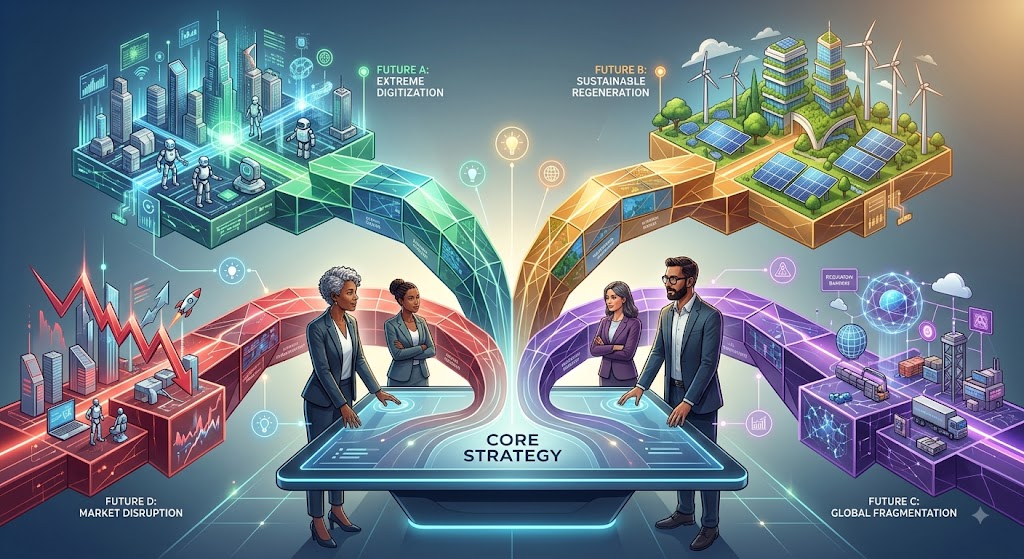
- Matrix Development: Select the two most critical, high-impact uncertainties and cross their polar spectrums to form a 2×2 grid representing four distinct potential futures.
- Vivid World-Building: Develop rich, multi-dimensional narratives for each quadrant, complete with memorable titles that capture the essence of each reality.
- Human Experience Mapping: Detail what daily life, work, culture, customer expectations, and leadership look like within each plausible world.
4. Stress-Test & Strategize (Wind-Tunneling)
Once the plausible futures are established, current capabilities and proposed strategic plans are “wind-tunneled” against each distinct world to evaluate their viability and resilience.
- Robust Strategies: Identify core actions, capabilities, and investments that create value across all four potential scenarios.
- Hedging & Option Strategies: Design flexible, low-regret initiatives and strategic options that enable quick pivots if a specific scenario begins to materialize.
5. Monitor & Trigger (Signposts to Action)
Scenario planning is an ongoing strategic discipline, not a static static binder on a shelf. Organizations must build sensory mechanisms to track which future is actively unfolding.
- Indicator Metrics: Establish clear, quantifiable leading indicators and signposts for each scenario path.
- Action Triggers: Define explicit decision thresholds that signal when to scale up specific strategic options, pivot investments, or gracefully exit legacy initiatives.
IV. Human-Centered Change & Culture: The Missing Link
The most brilliant strategic framework will fail if it ignores the human element. Scenario planning is often treated as an analytical exercise reserved for corporate strategy teams, but strategic foresight only translates into strategic agility when it engages the hearts and minds of the people tasked with executing it.
Strategy Is Human
At its core, strategic adaptation is a human challenge. When organizations face unprecedented uncertainty, the default psychological reaction is self-preservation and risk aversion. Without high levels of psychological safety and an organizational culture rooted in curiosity, employees naturally retreat into familiar routines. Leaders must create environments where questioning existing assumptions, pointing out weak signals, and acknowledging potential threats are welcomed rather than penalized.
Overcoming Resistance Through Storytelling
Data and analytical charts rarely change mindsets; stories do. Human beings process change emotionally long before they execute it rationally. By using rich, narrative-driven world-building in scenario planning, organizations allow teams to step into plausible futures and experience them safely. Immersive storytelling helps leaders and employees process the uncomfortable reality of disruption ahead of time, building emotional resilience and dismantling institutional denial before crisis strikes.
Democratizing Foresight
Future-shaping cannot remain locked inside executive boardrooms or strategy retreats. Frontline employees, customer success teams, and operational staff are often the first to encounter weak signals of market change long before they register on executive dashboards. Democratizing scenario planning means equipping teams across all levels of the organization to recognize emerging trends, challenge status-quo thinking, and adapt locally within a shared strategic intent.
V. Experience Design in Unpredictable Futures
In an environment defined by continuous disruption, static products, rigid service models, and inflexible organizational structures quickly become liabilities. To thrive across multiple potential realities, leaders must view strategic foresight through the lens of experience design—building adaptable, human-centered systems capable of pivoting without breaking.
Designing Flexible Experiences
Customer Experience (CX) and Employee Experience (EX) can no longer be designed around a single, ideal-state assumption. Experience architects must intentionally design for modularity and elasticity. Whether economic conditions shift rapidly, technology paradigms transform customer expectations overnight, or working models evolve, an organization’s core experiences must be capable of adapting seamlessly without losing their structural integrity or value proposition.
Values as the North Star
When external market realities, technology platforms, and operational playbooks are in flux, what keeps an organization grounded? The answer lies in its core values and human-centered purpose. While strategies, product offerings, and tactics must remain fluid across different scenarios, an organization’s underlying commitment to its people, customers, and core mission serves as the immovable compass navigating through the fog of uncertainty.
VI. Conclusion: Embracing the Horizon
Navigating an era of exponential uncertainty is no longer about striving for perfect foresight or clinging to rigid five-year master plans. The goal of scenario planning is not to accurately predict what will happen next, but to ensure your organization is prepared, agile, and aligned—no matter which plausible future emerges.
The Agility Advantage
In a volatile landscape, the ultimate competitive advantage isn’t certainty—it’s adaptability. By embedding strategic foresight, human-centered change management, and flexible experience design into the DNA of your organization, you transform ambiguity from an overwhelming threat into a rich landscape of opportunity. Organizations that cultivate peripheral vision and practice rehearsing the future today will consistently outmaneuver those caught off guard by the unexpected.
A Call to Action for Leaders
The transition from reactive crisis management to proactive future-shaping requires courage, curiosity, and intentional leadership. It demands moving past comfortable linear assumptions, empowering teams across every level to scan for weak signals, and anchoring strategy in core human values. The horizon will always bring unexpected shifts; the leaders and organizations that thrive will be those who actively design for change rather than wait to be changed by it.
Frequently Asked Questions
What is scenario planning, and how does it differ from traditional forecasting?
Traditional forecasting uses past historical data to predict a single, linear trajectory into the future. Scenario planning, by contrast, is a strategic foresight practice that builds multiple plausible future worlds to help organizations stress-test strategies, identify blindspots, and build agility across different potential outcomes.
Why does linear strategy fail during periods of exponential disruption?
Linear strategy assumes steady, step-by-step change over time. Exponential disruption—driven by rapid advancements in AI, economic volatility, and societal shifts—compounds quickly. Organizations relying on static 3-to-5-year plans misjudge early signals of change and become brittle when unexpected market shifts occur.
How does human-centered change make scenario planning more effective?
Scenario planning fails if it remains a purely analytical exercise reserved for executive boardrooms. Incorporating human-centered change principles, psychological safety, and storytelling helps employees process uncertainty emotionally, overcomes institutional resistance, and empowers teams across all levels to spot weak signals and adapt quickly.
Bottom line: Futurology is not fortune telling. Futurists use a scientific approach to create their deliverables, but a methodology and tools like those in FutureHacking™ can empower anyone to engage in futurology themselves.
Image credit: Gemini
 Sign up here to get Human-Centered Change & Innovation Weekly delivered to your inbox every week.