A Complete Framework for Getting It Right

by Braden Kelley and Art Inteligencia
Customer experience improvement is the most consequential and most frequently mismanaged investment in modern business. Organizations spend billions annually on CX improvement programs — new technology platforms, journey redesign initiatives, service training programs, personalization engines — and yet Forrester’s CX Index has declined for four consecutive years. The investment is going up. The experience is going down.
The problem is not that organizations don’t care about improving the customer experience. It is that they are improving the wrong things, in the wrong order, without a clear understanding of what is actually driving the outcomes they are trying to change.
This guide provides a practitioner’s framework for customer experience improvement that works — one grounded in accurate diagnosis, disciplined prioritization, and the cross-functional execution discipline that turns insight into measurable change.
What is Customer Experience Improvement?
Customer experience improvement is the systematic process of identifying where the current customer experience is falling short of customer expectations and competitive standards, and making targeted changes that measurably improve loyalty, retention, and revenue outcomes.
Three elements of this definition are frequently absent in practice:
Systematic — Most CX improvement is reactive rather than systematic. Organizations respond to the most recent customer complaint, the current quarter’s NPS dip, or the loudest internal advocate rather than working from a comprehensive, prioritized understanding of where improvement will generate the greatest return. Reactive improvement produces activity without consistently producing the right outcomes.
Falling short of customer expectations and competitive standards — Improvement is relative, not absolute. An experience that was excellent three years ago may be merely adequate today as customer expectations have risen and competitors have invested. CX improvement that measures itself only against internal benchmarks will fall behind organizations that measure themselves against the best available alternatives.
Measurably improve loyalty, retention, and revenue — The purpose of CX improvement is business outcomes, not better scores. Organizations that improve NPS while churn remains flat, or increase CSAT while expansion revenue stagnates, are improving metrics without improving the underlying customer relationship dynamics that drive financial performance.
Why Most CX Improvement Programs Fall Short
The failure modes of CX improvement programs are consistent and well-documented:
Improving what is easy to measure rather than what matters most
Organizations systematically over-invest in improving the touchpoints they are measuring — post-service CSAT, NPS at renewal, purchase satisfaction — and under-invest in the unmeasured journey stages that often drive the most important loyalty outcomes. 38% of customers feel they have had negative experiences with brands much more than brands think they do — a gap that exists precisely because the experiences customers find most frustrating are often the ones organizations aren’t measuring.
Technology before diagnosis
83% of companies working with CX consultants see positive ROI within 12 months — but the organizations that don’t are typically those that invested in CX technology without first understanding what the actual experience failures are. A personalization engine deployed on top of a broken onboarding experience produces a more personalized version of the same bad experience. Technology amplifies existing experience design; it does not substitute for diagnosis.
Touchpoint optimization without journey thinking
Improving individual touchpoints in isolation — better support chat, faster checkout, cleaner onboarding emails — often produces local improvements that don’t translate to loyalty gains. On average, customers utilize nine different contact points to interact with businesses, and their loyalty is determined by the cumulative journey experience, not the quality of any single interaction. Touchpoint improvement disconnected from journey context is the most common form of CX investment waste.
Improvement without ownership
In 2026, the differentiator is not bigger dashboards — it is faster fixes, clearer ownership, and visible follow-through. If experience data doesn’t drive visible change within 30 days, it’s not insight. CX improvement programs that produce reports without producing owners consistently fail to close the gap between diagnosis and action.
One-time initiatives rather than ongoing capability
Customer experience improvement is not a project — it is a management discipline. Organizations that treat experience improvement as a periodic initiative rather than an ongoing operational capability fall behind organizations that are continuously diagnosing and fixing experience failures. Customer expectations rise continuously. Competitive experience standards rise continuously. A CX improvement program that produces a one-time lift and then stops is not a CX improvement program — it is a CX event.
The Customer Experience Improvement Framework
Effective customer experience improvement follows a consistent framework regardless of industry, organization size, or the specific experience challenges being addressed:
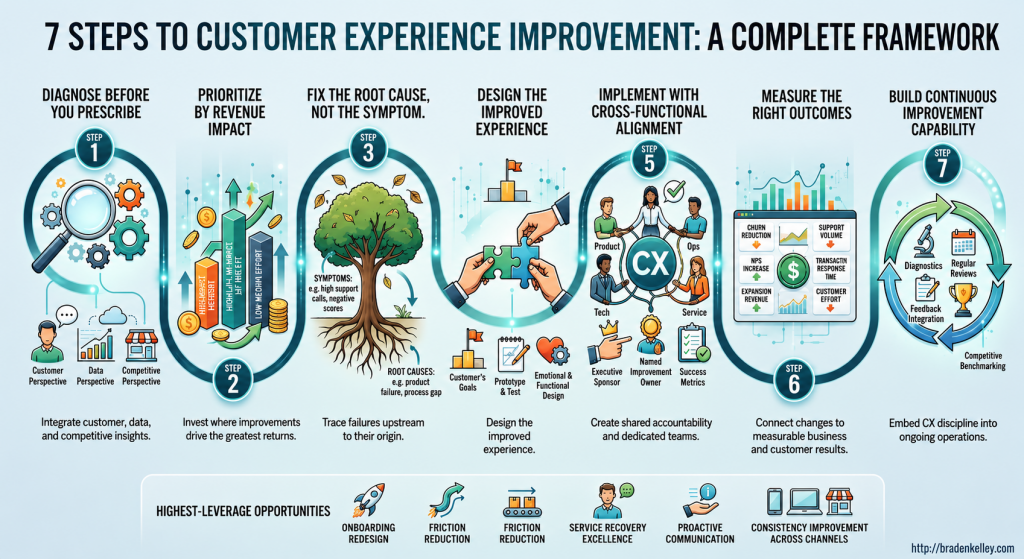
Step 1: Diagnose Before You Prescribe
The foundation of every effective CX improvement program is an accurate, evidence-based understanding of where the experience is falling short — not what internal teams assume is falling short, but what customers are actually experiencing. This diagnosis requires three complementary perspectives:
The customer’s perspective — What do customers actually experience across the full journey? Where is friction accumulating? Which moments of truth are being handled adequately when they should be handled exceptionally? What are customers experiencing with competitors that they are not experiencing with you? This perspective requires direct customer research — interviews, journey walking, and observation — not just survey data.
The data perspective — What does the behavioral and operational data reveal? Where are the highest-contact touchpoints (indicating friction or failure)? Where are churn rates elevated by segment, channel, or cohort? Where is the gap between intended and actual experience visible in usage patterns, support volumes, and retention curves?
The competitive perspective — How does the experience compare to the best available alternatives? Where are you losing customers not on price but on experience quality? What are competitors doing better that your customers are now expecting from you? This perspective requires actually walking competitive experiences, not just monitoring competitive review scores.
A customer experience audit integrates all three perspectives into a single, comprehensive diagnostic — providing the accurate, evidence-based foundation that effective CX improvement requires.
Step 2: Prioritize by Revenue Impact
Not all experience failures are equally worth fixing. Effective CX improvement prioritizes investments by their estimated impact on the outcomes that matter most — customer loyalty, retention, and revenue — rather than by which failures are most visible, most recently complained about, or easiest to fix.
A rigorous prioritization framework evaluates each identified experience gap across three dimensions:
- Frequency — How many customers encounter this experience failure? High-frequency failures affecting large portions of the customer base have proportionally higher revenue impact than low-frequency failures, regardless of individual severity
- Loyalty impact — How significantly does this failure affect customer trust, satisfaction, and likelihood to stay and expand? Failures at moments of truth — onboarding, first service incident, renewal — typically have higher loyalty impact than equivalent failures at lower-stakes touchpoints
- Competitive gap — Is this a failure where competitors are performing significantly better? Competitive gaps are more urgent than absolute failures — customers will tolerate imperfect experiences more readily when alternatives are equally imperfect
The highest-priority CX improvements are those that address high-frequency failures at high-loyalty-impact touchpoints where competitive alternatives are meaningfully better. These are the investments that produce the largest, most durable improvements in the outcomes organizations are trying to move.
Step 3: Fix the Root Cause, Not the Symptom
The most common and expensive CX improvement mistake is fixing symptoms rather than causes. High support contact volumes are a symptom — the root causes are the product failures, process gaps, and communication failures generating the contacts. Negative service satisfaction scores are a symptom — the root causes are the empowerment failures, system limitations, and escalation friction that prevent agents from resolving issues effectively.
Effective CX improvement traces every significant experience failure to its root cause — the upstream decision, design gap, or organizational misalignment that is producing the downstream customer impact — and invests in fixing the cause rather than managing the symptom. This approach is harder and slower than symptom management, but it is the only approach that produces durable improvement rather than temporary score recovery.
Root cause analysis for CX failures requires the same disciplines applied in operational contexts: asking “why” repeatedly until the underlying cause is identified, mapping the causal chain from customer experience to organizational behavior to structural decisions, and resisting the pressure to stop at the first plausible explanation.
Step 4: Design the Improved Experience
With root causes identified and prioritized, CX improvement requires deliberate experience design — not just removing what is broken, but designing the experience you intend to deliver in its place. This means applying the principles of human-centered design to the specific touchpoints and journey stages being improved:
Start with the customer’s goal — What is the customer trying to accomplish at this touchpoint? What would success look and feel like from their perspective? The improved experience should be designed from the customer’s goal outward, not from the organization’s process inward.
Prototype and test before implementing — The most effective CX improvements are tested with real customers before full implementation. Rapid prototyping — paper mockups, role plays, service simulations — surfaces problems and opportunities that design teams cannot anticipate from internal planning alone. A case study in the financial services sector highlights the measurable benefits of a CX-focused approach — by prioritizing customer satisfaction and aligning teams on CX responsibilities, one company reduced defections by 16% through targeted improvements.
Design for the emotional as well as the functional — The most durable CX improvements address both what customers can do (functional design) and how they feel doing it (emotional design). Functional improvements make the experience easier and more effective. Emotional improvements make customers feel more valued, more understood, and more confident. Both are necessary for the kind of loyalty that resists competitive alternatives.
Step 5: Implement with Cross-Functional Alignment
Most experience failures have cross-functional root causes — they exist at the intersections of product, operations, technology, and service rather than within a single function’s control. Fixing them requires cross-functional alignment and shared accountability that most organizations struggle to sustain.
The organizational prerequisites for effective CX improvement implementation are:
- Executive sponsorship — CX improvements that require cross-functional coordination consistently stall without executive support that transcends functional boundaries
- Named improvement owners — Every improvement initiative needs a specific owner with the authority and resources to execute it, not a committee with shared responsibility and no clear accountability
- Cross-functional working groups — Improvement initiatives that touch multiple functions need a dedicated cross-functional team with representatives from each affected function and a clear mandate to solve the customer problem rather than protect functional turf
- Clear success metrics — Every improvement initiative should have defined success metrics that connect the specific change to measurable customer and business outcomes
Step 6: Measure the Right Outcomes
The measure of CX improvement success is not better satisfaction scores — it is measurable improvement in the customer and business outcomes that satisfaction scores are supposed to predict. Effective CX improvement measurement connects each improvement initiative to its expected impact on:
- Churn reduction in the affected customer segment
- Support contact volume reduction at the improved touchpoint
- NPS improvement among customers who have experienced the changed journey
- Expansion revenue increase in the cohort most affected by the improvement
- Customer effort reduction at the specific touchpoints redesigned
73% of CX leaders outperform competitors financially, generating 5.7x more revenue from superior experiences. The organizations generating these returns are not those with the best measurement frameworks — they are those whose measurements are connected to decisions and actions that actually change the experience.
Step 7: Build Continuous Improvement Capability
The final and most important step in customer experience improvement is building the organizational capability to improve continuously — not just executing a one-time improvement program, but embedding the diagnosis, prioritization, design, and measurement disciplines into how the organization operates on an ongoing basis.
88% of customers say that good service will likely make them purchase again — but the standard of “good” rises continuously as competitive experience quality improves. Organizations that build continuous improvement capability — regular journey reviews, systematic feedback integration, periodic experience audits, and ongoing competitive benchmarking — consistently outperform those that treat experience improvement as a periodic initiative.
The Highest-Leverage CX Improvement Opportunities
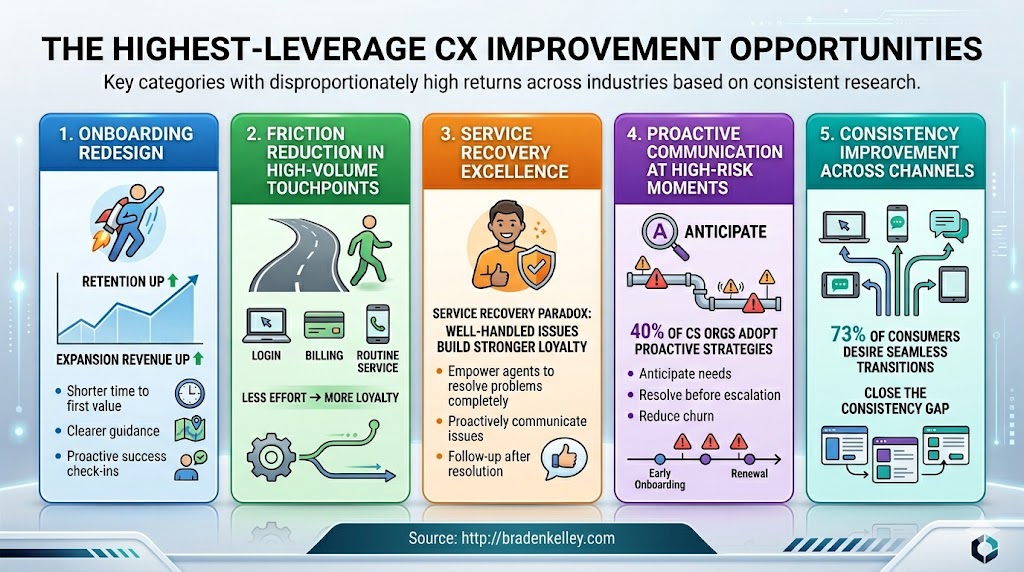
While every organization’s specific improvement priorities will differ based on their experience audit findings, research consistently identifies several categories of improvement that generate disproportionately high returns across most industries:
Onboarding redesign
Onboarding is the highest-risk stage of the customer journey for experience failure — and one of the most consistently underinvested. Customers arrive with expectations shaped by the sales process and encounter the reality of implementation. Organizations that invest in onboarding redesign — shorter time to first value, clearer guidance, proactive success check-ins — consistently see significant improvements in 90-day retention and long-term expansion revenue.
Friction reduction in high-volume touchpoints
The touchpoints customers encounter most frequently — login, billing, routine service requests, account management — accumulate the most friction tax over the lifetime of a customer relationship. Small friction reductions at high-volume touchpoints produce large cumulative improvements in customer effort scores and loyalty metrics.
Service recovery excellence
The service recovery paradox — that customers who experience a well-handled issue become more loyal than customers who never had an issue — remains well-documented in 2026. Organizations that invest in transforming their service recovery from adequate to genuinely excellent — empowering agents to resolve problems completely, proactively communicating when things go wrong, and following up after resolution — consistently generate significant loyalty improvements from a relatively targeted investment.
Proactive communication at high-risk moments
By 2026, 40% of customer service organizations will adopt proactive strategies, enabling them to anticipate needs, resolve issues before they escalate, and contribute directly to revenue growth. Proactive outreach at the moments customers are most likely to struggle — early in onboarding, during known product issues, at renewal — prevents the passive experience failures that accumulate into churn decisions without ever generating a complaint.
Consistency improvement across channels
73% of consumers desire the ability to seamlessly transition between different communication channels. Customers who have excellent experiences in some channels and poor experiences in others develop uncertainty that suppresses engagement and loyalty. Closing the consistency gap — bringing lower-performing channels up to the standard of higher-performing ones — produces broad-based loyalty improvements across the affected customer base.
How a Customer Experience Audit Accelerates CX Improvement
The single most common reason CX improvement programs underperform is that they are built on an incomplete or inaccurate picture of what the experience actually is and where the highest-value improvement opportunities lie. Internal knowledge, survey data, and VoC programs all provide useful signals — but they systematically miss the silent majority of customers who have poor experiences without complaining, the competitive gaps that customers experience without articulating, and the journey stage failures that drive churn without generating a negative survey response.
A customer experience audit provides the complete, accurate diagnostic foundation that CX improvement requires — walking the actual customer journey across all touchpoints, comparing it against competitive alternatives, quantifying the revenue impact of identified gaps, and producing a prioritized improvement roadmap that connects experience investment to business outcomes.
Organizations that invest in an experience audit before building their CX improvement program consistently achieve better outcomes than those that build on internal assumptions alone — because they are fixing the right things rather than the most visible things, in the right order rather than the most convenient order, with a clear understanding of the competitive and financial stakes of each improvement decision.
Frequently Asked Questions About Customer Experience Improvement
What is customer experience improvement?
Customer experience improvement is the systematic process of identifying where the current customer experience is falling short of customer expectations and competitive standards, and making targeted changes that measurably improve loyalty, retention, and revenue outcomes. Effective CX improvement is grounded in accurate diagnosis of actual experience failures — not internal assumptions — prioritizes investments by their revenue impact rather than their visibility or ease, fixes root causes rather than symptoms, and measures success by business outcomes rather than satisfaction scores.
How do you improve customer experience?
Improving customer experience effectively requires seven steps: accurately diagnose where the experience is falling short through customer research, journey walking, and competitive benchmarking; prioritize improvements by their revenue impact rather than their visibility; trace failures to root causes rather than symptoms; design the improved experience from the customer’s goal outward using human-centered design principles; implement with cross-functional alignment and named improvement owners; measure success by business outcomes (churn reduction, expansion revenue, NPS improvement) rather than activity metrics; and build continuous improvement capability so that experience quality rises consistently rather than only after a one-time initiative.
What are the most effective ways to improve customer experience?
The highest-leverage CX improvements across most industries are: onboarding redesign (reducing time to first value and improving early success rates); friction reduction at high-volume touchpoints (where small improvements produce large cumulative loyalty gains); service recovery excellence (transforming adequate resolution into genuinely impressive recovery that builds rather than merely repairs trust); proactive communication at high-risk moments (preventing the passive failures that accumulate into churn decisions without generating a complaint); and consistency improvement across channels (closing the gap between high-performing and low-performing touchpoints to reduce the uncertainty that suppresses engagement and loyalty).
Why do customer experience improvement programs fail?
CX improvement programs most commonly fail for five reasons: improving what is easy to measure rather than what matters most; investing in technology before diagnosing what the actual experience failures are; optimizing individual touchpoints without considering the journey context they exist within; producing insights without assigning clear improvement ownership and timelines; and treating improvement as a one-time initiative rather than an ongoing management discipline. The organizations that generate the strongest financial returns from CX investment are those that address all five failure modes — building systematic, owned, continuously improving programs grounded in accurate experience diagnosis.
How do you measure customer experience improvement?
The most important principle in measuring CX improvement is connecting improvements to business outcomes rather than just satisfaction scores. Effective measurement tracks churn reduction in the affected customer segment, support contact volume reduction at improved touchpoints, NPS improvement among customers who experienced the changed journey, expansion revenue increase in the most affected cohort, and customer effort reduction at redesigned touchpoints. Organizations that demonstrate how CX improvement drives revenue, retention, and profitability are 29% more likely to secure sustained CX investment — making business-outcome measurement not just analytically valuable but organizationally necessary.
How does a customer experience audit support CX improvement?
A customer experience audit provides the complete, accurate diagnostic foundation that CX improvement requires — walking the actual customer journey across all touchpoints, comparing it against competitive alternatives, and quantifying the revenue impact of identified gaps. Without this foundation, CX improvement programs are built on internal assumptions that systematically miss the experience failures customers have without complaining, the competitive gaps they experience without articulating, and the journey stage failures that drive churn without generating a negative survey response. Organizations that invest in an experience audit before building their improvement program consistently fix the right things in the right order, producing better outcomes than those that improve based on the most visible or most recently complained-about failures.
Ready to build a CX improvement program on a foundation of accurate diagnosis? Start with an Experience Audit →
Content Authenticity Statement: The topic area, key elements to focus on, etc. were decisions made by Braden Kelley, with a little help from Claude and Google Gemini to clean up the article, add images and create infographics.
Image credits: Google Gemini
 Sign up here to get Human-Centered Change & Innovation Weekly delivered to your inbox every week.