Category Archives: Design

Book Review and Innovation Summary – “The Design of Business”

The Design of BusinessA few weeks ago I received “The Design of Business” by Roger Martin in the mail. “The Design of Business” is a relatively short, easy, and pleasant read.

The main premise of the book is that our organizations, and the business schools that fill out their top leadership ranks, are too focused on analytical thinking at the expense of intuitive thinking. This focus creates too much emphasis on reliability at the expense of validity.

“The most successful businesses in the years to come will balance analytical mastery and intuitive originality in a dynamic interplay that I call design thinking.” – Roger Martin

One of the key concepts of the book is the introduction of the Knowledge Funnel – a visual element that shows how knowledge progresses from mysteries to heuristics to algorithms. It all begins with a question at the top of the funnel, and at each stage transition, knowledge and execution can typically be transferred to lower cost labor (and possibly handled by a computer when they reach the algorithm level).
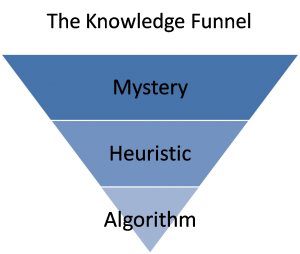
The Knowledge FunnelAt the same time, there are other tensions in our organizations that managers in the era of the creative economy will have to become attuned to, and these include managing an appropriate balance between exploitation and exploration and not falling victim to the false certainty of the past when making business development decisions.

Ultimately, the exploration of the mysteries at the top of the knowledge funnel and exploitation of the algrithms at the bottom of the funnel are equally important. Companies that focus too much on one, at the expense of the other, risk their very future.

Creating a design thinking organization is not easy, and several pages are devoted to describing the struggles of A.G. Lafley and Claudia Kotchka in transforming P&G;’s organizational culture to be more design-centric.

In addition to other examples of organizations pushing themselves more towards design thinking, there is also a great deal of focus in the book on the transformation of mysteries into heuristics and heuristics into algorithms.

Overall, the book is another way of looking at the challenge facing innovators everywhere who are looking to embed design or innovation (or both) into their organization.

So, are you ready to tackle the challenge of achieving a balance of analytical thinking with intuitive thinking in your organization?

My interview with “The Design of Business” author Roger Martin can be found here.

Subscribe to Human-Centered Change & Innovation WeeklySign up here to get Human-Centered Change & Innovation Weekly delivered to your inbox every week.

Balancing Intuition with Analysis

Interview – Roger Martin of “The Design of Business”

Balancing Intuition with Analysis - Roger MartinI had the opportunity to interview Roger Martin, the author of “The Design of Business” about the challenges companies face when they fail to balance analytical thinking with intuitive thinking. We also discuss a variety of other innovation topics including: barriers to innovation, education, and risk taking.

Roger Martin has served as Dean of the Rotman School of Management since 1998. He is an advisor on strategy to the CEO’s of several major global corporations. He writes extensively on design and is a regular columnist for BusinessWeek.com’s Innovation and Design Channel. He is also a regular contributor to Washington Post’s On Leadership blog and to Financial Times’ Judgment Call column. He has published several books, including: “The Design of Business” and “The Opposable Mind”.

Here is the text from the interview:

1. When it comes to innovation, what is the biggest challenge that you see organizations facing?

It is the dominance of analytical thinking which holds that unless something can be proven by way of deductive or inductive logic, it is not worthy of consideration or investment. No new idea in the world has been proven before being tried. So as long as analytical thinking is allowed to dominate, innovation is deeply and profoundly challenged.

2. Why is it so important that organizations teach their leaders to be design thinkers?

Design thinkers are capable of balancing the inductive and deductive logic of analytical thinking with the abductive logic of intuitive thinking. So they are capable of both honing and refining the past and inventing the future. Thus they can overcome the innovation challenge. Without design thinking leaders, an organization is likely to slowly but surely stultify – like most large corporations over time.

3. Why is it so hard for hard for managers to take valid risks?

Two main reasons. First, they live in cultures that value only analytical thinking. And second, they get Stockholm syndrome and begin to believe that is right. First they get dissuaded from innovating by others, then they dissuade themselves.

4. What most impedes the risk-taking necessary for innovation?

The problem is processes that imbed requirements for proof through inductive or deductive logic. And then the culture that this breeds.

5. Since the book was published, have you come across other leaders that have transformed their organizations to take more of a design approach?

Leaders from two of the world’s largest companies read the book and both have asked me to help them transform their organizations to take a design thinking approach. So far, so good. They are very committed.

6. People often talk about not having time to innovate. How can people find the time for themselves or their employees?

That is a lame argument. People have time to do anything for which they are passionate. People blame lack of time for every single thing that they think they would like to do but lack the sufficient passion for. Innovators innovate regardless of their environment. Some get fired for it and go somewhere else and start over again. A leader can make it harder or easier for employees to innovate. But the innovators innovate regardless and the non-innovators complain about the difficulty finding the time to innovate – regardless.

7. What skills do you believe that managers need to acquire to succeed in an innovation-led organization?

They need to nurture their originality. Very few people in life are good at anything without practice. If you practice mastery all your life, you will be masterful. If you practice originality, you will get good at innovation. Most managers spend their time deepening their mastery and not nurturing their originality. Over time, they become fearful of innovation.

8. If you were to change one thing about our educational system to better prepare students to contribute in the innovation workforce of tomorrow, what would it be?

Make art a required subject for as long as we make math a required subject. We send a powerful signal to students that analytics are important and artistry is not. Artistry is the foundation of innovation. Most technologists will never innovate a single thing because their training drove out any artistry from them.

My book review of “The Design of Business” can be found here.

Subscribe to Human-Centered Change & Innovation WeeklySign up here to get Human-Centered Change & Innovation Weekly delivered to your inbox every week.

Simple Innovation

GUEST POST from Stephen Shapiro

Antoine de Saint-Exupery, author of “The Little Prince”, once said:

“Perfection is finally attained not when there is no longer anything to add but when there is no longer anything to take away.”

This is a brilliant quote because it describes the challenge many innovators face. Too often, new products are overly complex and end up ‘over-serving’ their customers.

My new computer with Vista and Office 2007 is a perfect example of that. 99% of the software’s functionality goes unused, yet these complexities slow down my computer and reduce ease of use. Being able to do everything for everyone is not perfection.

Next time you are designing a process, a product, or a service, ask yourself, “What can I remove?” For most consumers, simplicity is more important than comprehensiveness (and complexity).

The concept of ‘taking away’ is also a great time management technique. In addition to your to do list, be sure to create a ‘don’t do’ list. Become masterful at killing products, eliminating non-value adding tasks, and removing old/pointless habits.

Or, as Michelangelo once said:

“In every block of marble I see a statue as plain as though it stood before me, shaped and perfect in attitude and action. I have only to hew away the rough walls that imprison the lovely apparition to reveal it to the other eyes as mine see it.”

What are you doing that is imprisoning your perfection?

Subscribe to Human-Centered Change & Innovation WeeklySign up here to join 17,000+ leaders getting Human-Centered Change & Innovation Weekly delivered to their inbox every week.

Innovation Through Design Thinking

Here is another video from Tim Brown of IDEO, this one is “Innovation Through Design Thinking” from a visit to MIT (skip ahead three minutes if you’re pressed for time):

According to IDEO, Design Thinking is a human-centered approach to innovation.

This video highlights how companies use design thinking in their businesses, from Motorola thinking about strategy to P&G thinking about moving into new markets to Microsoft thinking about the application of new technology.

I’ve always believed that:

Innovation = Invention + Insights

It was good to see Tim reinforce this core belief when he says “Insights are the fuel for innovation.”

Some of the key things to consider when looking to use design thinking as an approach to innovation:

  1. Analogous situations (example: hospital operating teams versus pit crews)
  2. Insights come from the extreme users (example: working with kids on cooking tool project)
  3. Getting out there to look, listen, try
  4. Building to think – prototyping for thinking and learning not as an outcome of what you’ve done
  5. Using storytelling to develop and express ideas
  6. Design thinking is not just about methodology, it is just as much about culture

Finally I’d like to leave you with one thought from the video:

“Many great ideas fail not because they were not great ideas, but because they could not navigate the politics and processes of the organization.”

What do you think?

Braden Kelley (@innovate on Twitter)

How Small is Too Small?

When it comes to a hotel room, how small is too small. There are several new entrants into the hotel market that are promising to shrink not only the price of a room, but the size of it as well. At first it sounds a lot like New York’s tiny hotel rooms, but the comparison stops there because those digs have sky high prices.

In contrast, easyHotel offers hotel rooms in central London from 25gbp.

Another recent creation from Philips and CitizenM utilizes pre-fabricated modules that only require four cables to be connected to have the room up and running.

Small rooms aren’t so bad if the prices are small, and looking at photos they don’t look like they are quite as small as Tokyo’s pod hotels.

Would you stay in one of these new small hotel rooms if the price was right?

Subscribe to Human-Centered Change & Innovation WeeklySign up here to get Human-Centered Change & Innovation Weekly delivered to your inbox every week.