Breaking the Dual Barriers of Machine Olfaction to Unlock the Next Era of Multi-Sensory Innovation
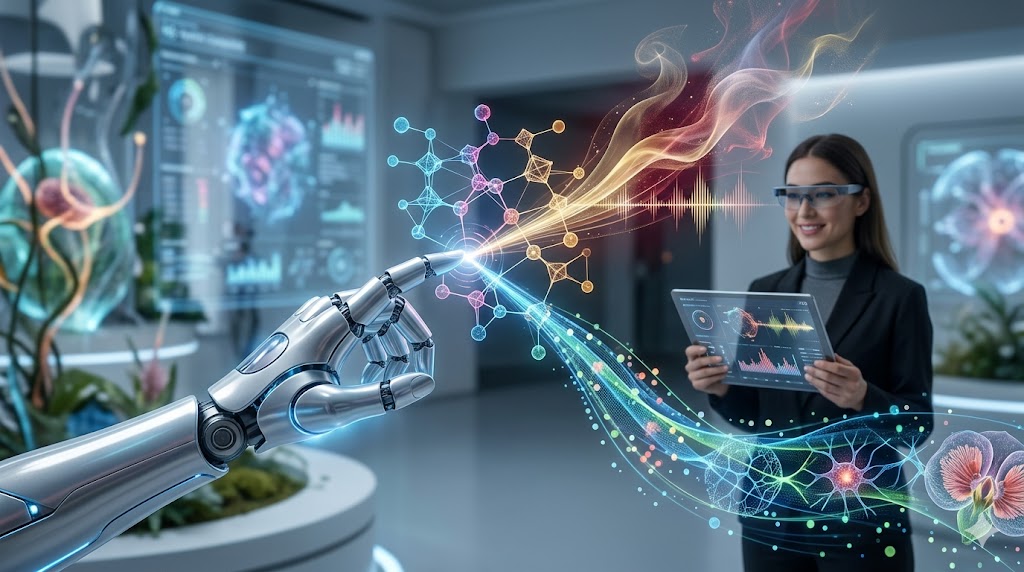
GUEST POST from Chateau G Pato
I. Introduction: The Flatness of the Digital World
Breaking the Dual Barriers of Machine Olfaction to Unlock the Next Era of Multi-Sensory Innovation
For decades, human-centered design has mastered the pixels, micro-interactions, and spatial acoustics of the digital landscape. We have engineered an era of unprecedented visual and auditory fidelity, yet our interactions remain trapped behind cold glass. From a futurist perspective, the modern digital experience suffers from an artificial flatness — a sensory deficit that strips away the visceral, chemical essence of how humans natively navigate reality. By designing exclusively for the eyes and ears, we have sanitized technology, separating it from our most primal cognitive pathways.
Olfaction represents the ultimate untapped frontier for experience design. Unlike sight or sound, which are processed through the thalamus, scent has an unmediated, direct line to the limbic system — the evolutionary core of human memory, emotion, and behavior. A single volatile organic compound can instantly trigger vivid nostalgia or alter physiological arousal before the conscious mind even registers its identity. To build experiences that truly resonate on a deeply human level, innovation leaders must evolve beyond the binary constraints of audiovisual media and embrace the intricate syntax of smell.
The Strategic Innovation Paradox: The obstacle to this multi-sensory future is not a lack of imagination, but a profound dual technical constraint. To bridge the digital-chemical divide, human-centered change frameworks must simultaneously dismantle two systemic barriers: The Ingestion Wall (the challenge of artificial chemical perception) and The Projection Wall (the challenge of safe, dynamic, and contextually aware synthesis back to the human user).
Dismantling these barriers requires an alchemical blend of emerging technologies and design discipline. On the perception side, we must capture a world devoid of a standardized “color wheel,” where environmental inputs vary based on complex fluid dynamics. On the emission side, we must overcome the physical latency of chemical transport, where molecules cannot instantly refresh at the speed of light (c ≈ 299,792 km/s). Only by breaking both barriers can we transform machine olfaction from a laboratory novelty into an invisible, transformative utility for healthcare, learning, and immersive computing.
II. Barrier 1: The Ingestion Wall (The Challenge of Machine Perception)
Deconstructing the Complexities of Artificial Chemical Perception
To design an experience around scent, a system must first be able to listen to the environment. This brings us to the first fundamental barrier: The Ingestion Wall. In fields like computer vision or acoustics, mapping sensory input to data is relatively linear — we rely on predictable spectrums of light frequencies or sound waves. Olfaction completely breaks this mold. The chemical world is radically multi-dimensional, composed of thousands of volatile organic compounds (VOCs) that interact non-linearly to form a single scent profile. Capturing this data in a meaningful way requires moving away from traditional static sensing paradigms.
The State of the Art: Moving Beyond the Lab
Current advancements in Electronic Noses (e-noses) have heavily relied on Metal Oxide Semiconductors (MOS) to track chemical interactions. However, the true breakthrough in modern human-centered innovation lies at the intersection of biology and machinery. We are witnessing a paradigm shift toward bio-hybrid sensors that utilize actual Insect Odorant Binding Proteins (OBPs). These proteins offer a level of real-time specificity, sensitivity, and sustainable deployment that synthetic sensors simply cannot replicate on their own.
Furthermore, true digital transformation demands that these sensors move out of sterile laboratory environments and into the real world. Modern research has successfully integrated these bio-hybrid sensors onto agile, soft-growing robotic platforms. Because scent travels dynamically via airflow and ambient drift, these flexible robotic systems can naturally navigate complex, changing physical environments to track, isolate, and classify odors directly at the source.
The Experience Design Flaw: The Missing Vocabulary
The deepest challenge of the Ingestion Wall is not just hardware limitations — it is a lack of a standardized design framework. Digital design thrives on coordinates like RGB for color or Hz for sound. Olfaction has no universal “color wheel.” To bypass this linguistic and systemic deficit, current artificial intelligence models are utilizing self-supervised learning. By pairing raw olfactory signatures with computer vision, AI is learning to construct “visual-smell” crossmodal representations. The machine learns what an object should smell like by looking at it, effectively building a standardized bridge between visual geometry and chemical identity.
Overcoming the Ingestion Wall fundamentally redefines the role of data collection in experience design. It turns environmental context into a dynamic, machine-readable asset. However, capturing the chemical fingerprint of the physical world is only half the battle. To complete the human-centered loop, we must understand how to project that data back into the human sensory apparatus without causing cognitive friction or sensory distortion — leading us directly to the second barrier.
III. Barrier 2: The Projection Wall (The Challenge of Human Delivery)
Navigating the Fluid Dynamics and Cognitive Constraints of Scent Synthesis
Once a machine can accurately ingest and interpret the chemical world, it encounters an entirely different obstacle on the output side: The Projection Wall. In traditional digital experience design, we are accustomed to instant execution. Pixels refresh at sixty frames per second, and sound waves travel efficiently through space to our ears. Scent, however, is bound by the messy laws of fluid dynamics, airflow, and physical molecule dispersion. You cannot instantly clear a room of a fragrance when a user closes an application or switches tasks; the chemical residue lingers, creating a physical latency that digital systems are fundamentally unequipped to handle.
The “Smellody” Problem and Sensory Fatigue
This physical latency introduces what sensory architects call the “Smellody” problem. Human olfactory receptors operate on a much slower physiological time scale than our visual or auditory systems. When digital platforms attempt rapid sensory delivery — such as cycling through different ambient scents to match fast-paced visual cuts—the human brain experiences profound sensory fatigue and adaptation. Instead of a cohesive multi-sensory narrative, the user is left disoriented, overwhelmed, and chemically desensitized, destroying the psychological immersion the designer intended to build.
Designing the Crossmodal Bridge
To scale this delivery bottleneck, experience designers must leverage human psychology rather than relying solely on chemical brute force. This is achieved by engineering crossmodal bridges. Because our senses do not operate in silos, we can manipulate the perception of a smell using other sensory inputs. For example, recent innovation shows that pairing light chemical dispersion with specifically calibrated musical soundscapes can mentally evoke, amplify, or fundamentally alter the perceived quality of a fragrance. By harmonizing sight, sound, and scent, we can create the illusion of a rapid, dynamic olfactory shift without overloading the user’s physical environment.
Breaking the Projection Wall means accepting that we cannot force chemistry to move at the speed of software. Instead, the future of interaction design relies on elegant synchronization — using cross-modal illusions, micro-dosing technologies, and localized airflow to deliver scent precisely when and where it matters most. Only by mastering this delicate human delivery loop can we move toward functional, real-world applications that bring true value to daily life.
IV. The Human-Centered Experience Paradigm (Designing the Interface)
Elevating Machine Olfaction from Novelty Gimmick to Functional Human Utility
To truly break through the dual barriers of machine olfaction, we must shift our design philosophy away from pure engineering milestones and look through a deeply human-centered lens. For years, adding scent to technology has been relegated to the fringes of entertainment — think primitive gaming smell-packs or short-lived cinema gimmicks. These applications failed because they treated scent as an isolated novelty rather than an integrated, functional component of the human experience. The next era of design demands that we transition olfaction into a meaningful, life-enhancing utility that solves real human friction[cite: 1, 2].
Augmented Reality and Cognitive Optimization
One of the most profound applications of this new paradigm is within spatial computing and modern education. By introducing ambient olfactory cues into augmented reality (AR) learning environments, we can fundamentally alter how the brain encodes information[cite: 1, 2]. Carefully designed, context-aware scents have been shown to significantly lower cognitive load during complex tasks, spike user attention, and drastically improve delayed memory retention[cite: 1, 2]. Instead of forcing a student or worker to rely solely on heavy visual text, we can use the olfactory pathway to create an invisible, intuitive layer of cognitive support[cite: 1, 2].
Proactive Wellness and Non-Invasive Diagnostics
Beyond education, the ultimate human-centered interface is one that invisibly protects our health. Overcoming the Ingestion Wall allows us to build proactive wellness tools directly into our daily routines[cite: 1, 2]. By integrating highly sensitive electronic noses into everyday objects, technology can sample the volatile organic compounds (VOCs) in a user’s breath or skin on a daily basis[cite: 1, 2]. This transitions medical diagnostic tools away from intimidating, reactive hospital visits and transforms them into a seamless, friction-free experience capable of early cancer and chronic disease detection before physical symptoms ever manifest[cite: 1, 2].
By embedding machine olfaction into the very fabric of our learning and health systems, we move closer to technology that truly respects human biology. The interface of the future is not a brighter screen or a faster click; it is an environment that adapts to and communicates with our chemistry, opening up entirely new vectors for empathy, transformation, and strategic value.
V. Strategic Imperatives for Innovation Leaders
Driving Organizational Change, Ethical Guardrails, and Contextual Design Systems
As we approach the boundaries of this new frontier, machine olfaction transitions from a technical experiment to a profound strategic differentiator. For innovation leaders, navigating this shift requires more than just capital investment; it demands a fundamental evolution in how we structure data, build design systems, and manage human-centered change. To successfully spearhead this transformation and unlock true market value, leadership must execute on three core imperatives.
1. Champion the Olfactory Data Commons
Innovation cannot thrive in a vacuum of proprietary, siloed datasets. Because the chemical world lacks a natural, linear vocabulary, building a scalable architecture for scent requires massive collaboration. Forward-thinking leaders must champion the creation of an open-source, multi-modal data commons. By pooling diverse chemical signatures and pairing them with computer vision and environmental data, we can accelerate the machine learning required to create a reliable digital map of the physical, sensory world.
2. Design for Adaptive, Spatial Context
Unlike flat screens, scent is intrinsically tied to the real world. A digital interface utilizing olfaction must recognize that a smell’s intensity, narrative impact, and emotional reception change dynamically based on distance, ambient airflow, and the surrounding background environment. Experience design systems must become hyper-adaptive, evolving beyond rigid, static layouts to dynamically balance chemical delivery based on real-time environmental physics and immediate user context.
3. Establish Rigid Ethical Guardrails
Because olfaction bypasses our rational, analytical cognitive filters and speaks directly to the emotional centers of the brain, it holds unparalleled power over human behavior. This creates a profound ethical responsibility. Leaders must proactively establish strict guardrails prioritizing absolute user consent. We must fiercely protect consumers from intrusive sensory marketing, chemical tracking, or subtle emotional manipulation. Human-centered innovation must mean that the user always retains total sovereignty over their own sensory environment.
By establishing these foundational open data standards, context-aware frameworks, and deep ethical commitments, organizations can lead the multi-sensory market with authority and integrity. True innovation isn’t just about what technology can achieve — it’s about building the strategic, intentional scaffolding required to introduce that technology to humanity safely and effectively.
VI. Conclusion: A Call to De-Sanitize the Future
The Evolution of Interaction Design into Experience Alchemy
Breaking the dual barriers of machine olfaction represents far more than a triumph of bio-hybrid sensors, spatial data commons, or fluid dynamics. It signals a fundamental paradigm shift in the definition of design itself. For too long, our digital ecosystems have forced humanity to adapt to the limitations of the machine, filtering our rich, three-dimensional reality through flat panes of glass and sterile audio streams. By intentionally de-sanitizing our digital interactions, we begin to build technology that finally speaks the native, chemical language of human biology.
The Evolution of the Designer
As the lines between physical environments and digital interfaces completely dissolve, the role of the interaction designer must radically evolve. We can no longer think of ourselves merely as pixel architects, information layout engineers, or workflow mapping experts. The multi-sensory frontier demands that we step into the shoes of experience alchemists. Tomorrow’s design leaders must master the art of crossmodal synthesis, balancing the speed of sight and sound with the lingering, emotional depth of smell to orchestrate cohesive cognitive landscapes that truly respect human psychology.
The Ultimate Vision: A Truly Human Reality
The final frontier of design is not about creating artificial worlds to escape into; it is about enriching and protecting the world we already inhabit. Whether through non-invasive wellness networks that subtly monitor our health, or immersive educational environments that supercharge memory retention, machine olfaction allows us to build an empathetic layer of technology. When we unlock the full spectrum of human perception, we create a future that is not colder, faster, or more isolated—but one that is profoundly more vibrant, intuitive, and deeply human.
The scaffolding has been laid, the technological pieces are converging, and the strategic imperatives are clear. The only question that remains is whether innovation leaders possess the creative courage to move past the screen, look beyond the horizon, and design for the full human experience.
Frequently Asked Questions
Human-Centered Perspectives on Machine Olfaction
1. What exactly are the “Dual Barriers” holding back machine olfaction?
The dual barriers represent the Ingestion Wall and the Projection Wall. The Ingestion Wall is the challenge of machine perception — capturing, classifying, and digitizing highly complex, non-linear chemical volatile organic compounds (VOCs) without a standardized color wheel. The Projection Wall is the challenge of human delivery — synthesizing and emitting scents dynamically despite the physical latency of fluid dynamics and the constraints of human olfactory desensitization.
2. How can experience designers overcome the physical slowness of scent emission?
Because chemical molecules travel slowly and linger in environments, designers cannot refresh scents at the speed of pixels. To circumvent this, designers must build cross-modal bridges. By pairing micro-dosed chemical emissions with specifically calibrated auditory soundscapes or visual shifts, we can leverage human psychology to mentally evoke, alter, or accelerate the perceived transition of a scent.
3. What are the most immediate, practical applications for digital scent technology?
Moving far beyond novelty gaming gimmicks, the most impactful applications reside in cognitive optimization and proactive healthcare. In spatial computing and AR learning, context-aware ambient scents lower cognitive load and increase long-term memory retention. In health tech, highly sensitive bio-hybrid electronic noses can continuously analyze breath or skin VOCs, transforming early disease diagnostics into an invisible, friction-free daily routine.
Image credit: Gemini
 Sign up here to get Human-Centered Change & Innovation Weekly delivered to your inbox every week.