AI’s Impact on Innovation KPIs
GUEST POST from Art Inteligencia
I. Introduction: Beyond the Efficiency Trap
For decades, innovation leaders have been obsessed with velocity — how many ideas can we push through the funnel, and how fast? However, as we enter the age of Agentic AI, the traditional “speedometer” of innovation is breaking. When an AI can generate a thousand product concepts in the time it takes to pour a cup of coffee, volume is no longer a competitive advantage; it is a noise problem.
- The Paradigm Shift: We are moving away from treating innovation as a sporadic “side project” or a series of workshops. In this new era, innovation must be a continuous, AI-integrated capability that functions as the organization’s nervous system.
- The Trap of Productivity: There is a dangerous temptation to use AI merely to do the wrong things faster. Measuring “output” without measuring “outcome” leads to the Efficiency Trap — where teams become remarkably good at delivering features that nobody actually needs.
- The Core Thesis: The future of Innovation KPIs isn’t about tracking machine speed; it’s about measuring Human-Machine Synergy. We must redesign our dashboards to focus on how AI augments human intuition to create deeper empathy, higher-fidelity experiences, and sustainable ecosystem impact.
“The goal is no longer to be the fastest to market, but to be the most precise in solving human problems.” — Braden Kelley
II. The Evolution of Traditional Metrics
As AI commoditizes the “generation” phase of innovation, the metrics we once used to measure success are becoming obsolete. To remain relevant, we must shift our focus from tracking activity to measuring strategic movement.
Traditional frameworks like the Innovation Funnel are being compressed. What used to take months of market research can now be synthesized in hours, necessitating a fundamental update to our measurement criteria:
- From Throughput to Outcomes: In the past, “number of ideas generated” was a common KPI. Today, that metric is a vanity project. AI makes ideas cheap; validation is what remains expensive. We must prioritize metrics that track the quality of problem-solving over the quantity of brainstorming.
- Reimagining R&D Spend: Instead of viewing R&D as a flat percentage of revenue, we should measure the Speed of Learning. How much does it cost us to fail? By using AI to simulate market conditions, we can lower the “Cost of Experimentation,” allowing us to explore more radical horizons without increasing financial risk.
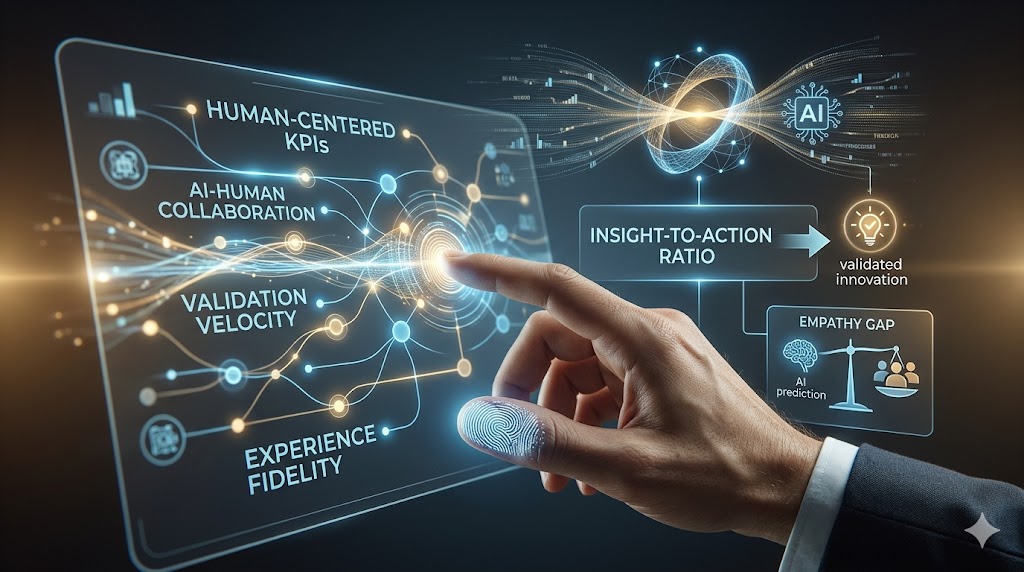
- Human-Centered Design (HCD) Metrics: As we rely more on synthetic users and AI-driven personas, we risk losing touch with reality. We need to track the “Empathy Gap” — the distance between what an AI predicts a human needs and what a human actually experiences.
The goal is to move from a “Supply-Side” view of innovation (what we produced) to a “Demand-Side” view (the value the customer actually unlocked).
III. New KPIs for the AI Era
To lead in an AI-augmented landscape, we must introduce specialized metrics that go beyond traditional business logic. These “New KPIs” focus on the intersection of data, ethics, and the unique synergy between human creativity and machine intelligence.
1. The Insight-to-Action Ratio
Data is only as valuable as the decisions it informs. This metric measures the temporal distance between an AI-detected market signal (a “weak signal”) and the deployment of a validated, human-vetted prototype. A high ratio suggests an organization that is data-rich but “action-poor.”
2. Data Liquidity & Literacy
Innovation thrives on the fluid movement of information. Data Liquidity tracks how effectively innovation-related insights move across departmental silos to train and refine internal AI models. Combined with Literacy, it measures the organization’s ability to turn raw data into a strategic asset.
3. Collaborative Intelligence (CQ)
The most successful future organizations won’t just have the best AI; they will have the best human-AI teams. The CQ metric evaluates how effectively humans are prompting, refining, and steering AI outputs to achieve results that neither could produce in isolation.
4. Ethical Innovation Index
In the age of AI, guardrails are not obstacles — they are essential KPIs. This index measures bias detection frequency, transparency scores in algorithmic decision-making, and the alignment of new solutions with long-term human agency and societal well-being.
By implementing these measures, we ensure that AI remains a tool for Human-Centered Change, rather than just a driver of automated mediocrity.
IV. Measuring the “Middle of the Funnel”
The “Middle of the Funnel” is traditionally where innovation goes to die — the messy transition from a promising idea to a scalable reality. In the AI era, this stage becomes a high-speed laboratory where Experience Level Measures (XLMs) take precedence over rigid operational quotas.
- Validation Velocity: We no longer need to wait months for physical market tests. By utilizing AI to simulate complex market conditions and consumer behaviors, we measure how quickly we can “kill” a bad idea. Success is defined by the speed at which we stop investing in the wrong things.
- Pivot Frequency: In a volatile landscape, staying the course is often a recipe for irrelevance. This KPI tracks the number of strategic shifts informed by real-time AI data analysis. It rewards teams for being agile enough to redirect resources toward higher-value opportunities as they emerge.
- Experience Fidelity: As we move through development, we must measure how closely the evolving product aligns with the intended Human Experience (HX). This involves using AI to audit journey maps and touchpoints, ensuring that the qualitative essence of the design isn’t lost in the technical execution.
By focusing on these middle-stage metrics, we transform the innovation process from a linear assembly line into a dynamic, iterative cycle of FutureHacking™.
V. Strategic Impact and Futurology
To truly future-proof an organization, Innovation KPIs must look beyond the current fiscal year. In the Age of AI, we must measure our ability to shape the future, not just react to it. This requires a shift toward Ecosystem Thinking and the valuation of intellectual capital.
- The Ecosystem Health Score: We are moving away from isolated “Product KPIs” toward measures of mutual value. This score evaluates how an innovation strengthens the entire network — including partners, customers, and the environment. In a connected world, an innovation that succeeds at the expense of its ecosystem is a long-term failure.
- Future-Proofing Index: This metric audits the innovation portfolio against the three horizons of growth. Specifically, it tracks the balance between Horizon 1 (incremental AI improvements to current products) and Horizon 3 (transformational AI applications that could disrupt our own business model).
- The Return on Intelligence (ROI 2.0): Traditional ROI focuses on immediate financial gains. ROI 2.0 measures the “Knowledge Equity” generated during the innovation process. Even a project that never reaches the market can yield a high ROI if it produces unique data, reusable AI models, or deep customer insights that fuel future breakthroughs.
By shifting our perspective toward these long-term signals, we ensure that our strategic investments are building a sustainable Experience Management Office (XMO) rather than just chasing the latest tech trend.
VI. Conclusion: The Leader’s New Compass
As we navigate the complexities of the Age of AI, our measurement systems must evolve from tools of control to tools of exploration. The metrics we choose to track do more than just report progress — they signal to our organizations what we truly value. If we measure only efficiency, we will get automation; if we measure meaning, we will get innovation.
- The Shift in Mindset: Modern Innovation KPIs should function like a GPS for exploration rather than a speedometer for production. Their purpose is to help us navigate uncertainty and re-calibrate our path toward long-term value.
- Empowering the Human Element: In an increasingly automated world, the ultimate differentiators remain human curiosity, intuition, and empathy. Leaders must protect the space for these qualities to flourish, using AI to handle the “predictable” so humans can focus on the “possible.”
- Final Thought: Innovation has always been about making the world better for people. AI is not the destination; it is the most powerful vehicle we’ve ever had to reach that goal. By aligning our KPIs with human-centered change, we ensure that our technological progress leads to genuine human advancement.
The future isn’t something that happens to us — it’s something we build, one measured step at a time.
Frequently Asked Questions
Will AI eventually replace the need for Innovation KPIs?
No. AI will automate the collection and analysis of data, but it cannot define what “value” looks like for your specific organization or customers. As we move toward Agentic AI, KPIs become even more critical as the steering mechanism that ensures autonomous systems remain aligned with human-centered goals.
How do Experience Level Measures (XLMs) differ from traditional SLAs in innovation?
While SLAs (Service Level Agreements) focus on technical performance and uptime, XLMs measure the qualitative impact of an innovation on the human experience. In the age of AI, technical success is the baseline; true innovation success is measured by how effectively a solution removes friction and empowers the user.
What is the most important “New KPI” for a leadership team to adopt first?
The Insight-to-Action Ratio is the most critical starting point. In an AI-driven landscape, the bottleneck is rarely a lack of insights; it is the organizational inertia that prevents those insights from becoming prototypes. Improving this ratio directly increases your organizational agility.
SPECIAL BONUS: Braden Kelley’s Problem Finding Canvas can be a super useful starting point for doing design thinking or human-centered design.
“The Problem Finding Canvas should help you investigate a handful of areas to explore, choose the one most important to you, extract all of the potential challenges and opportunities and choose one to prioritize.”
Image credit: Gemini
 Sign up here to get Human-Centered Change & Innovation Weekly delivered to your inbox every week.