Orchestrating the Human-Centered Future
LAST UPDATED: May 7, 2026 at 7:10 PM
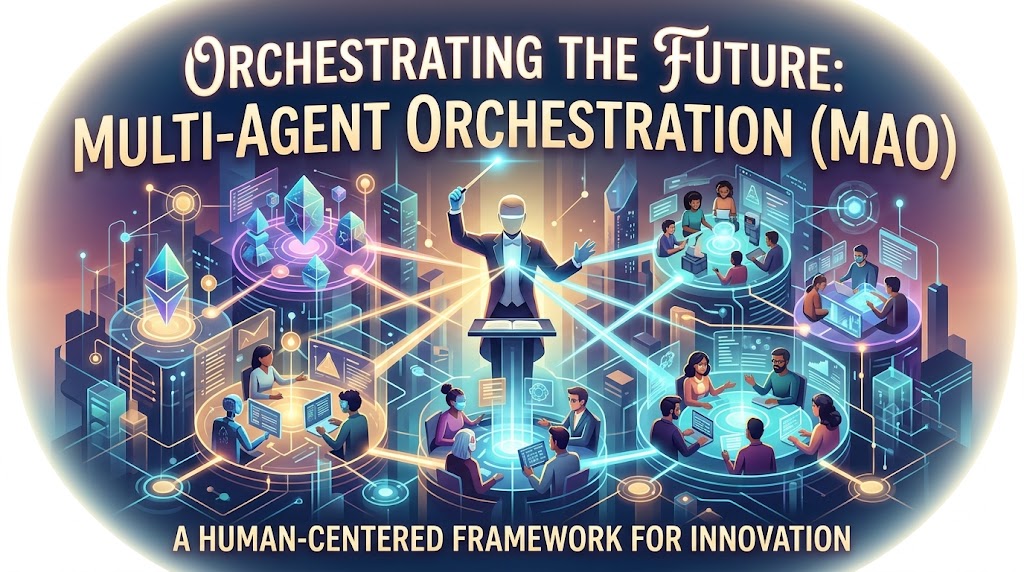
GUEST POST from Art Inteligencia
From Solitary Bots to Orchestrated Teams
The current innovation landscape is hitting a ceiling. While single-model AI has provided significant individual productivity gains, it often fails when faced with the multifaceted complexity of enterprise-scale digital transformation. We are witnessing the transition from isolated AI interactions to a paradigm of integrated digital ecosystems.
The Innovation Bottleneck
Relying on a single “jack-of-all-trades” model often leads to context collapse and a lack of depth. For true innovation to thrive, we need diverse perspectives and specialized expertise. Multi-Agent Orchestration (MAO) addresses this by moving us away from “chatting with AI” toward orchestrating outcomes through a coordinated digital workforce.
Defining the MAO Shift
MAO is the connective tissue that allows multiple AI agents — each with specific roles, tools, and personas — to collaborate on complex goals. It turns a series of prompts into a dynamic workflow, ensuring that the right “expert” agent is handling the right task at the right time, while maintaining a persistent thread of strategic intent.
The Human-Centered Lens
In this new era, the human role evolves rather than diminishes. An orchestrated framework still requires a conductor. Our focus remains on the human-centered design principles that ensure these agent swarms are aligned with real human needs, ethical guardrails, and the overarching vision of the organization.
The Anatomy of an Innovation-Ready MAO Framework
Building an orchestration framework for innovation requires more than just connecting APIs; it requires a structural design that mirrors high-performing human teams. To move beyond simple automation and toward true creative problem-solving, an MAO framework must balance three core pillars: specialization, communication, and persistence.
Specialization vs. Generalization
The era of the “Generalist Bot” is yielding to the Specialized Agent Swarm. In an innovation context, this means deploying distinct agents with narrow, deep mandates. You might have “The Researcher” scanning global patent databases, “The Devil’s Advocate” specifically programmed to find flaws in business models, and “The Rapid Prototyper” generating code or wireframes. This role-based approach prevents the cognitive dilution often seen in large, single-model prompts.
The Orchestration Layer: Solving “Context Collapse”
The true power of MAO lies in the orchestration layer — the “manager” that handles agent hand-offs. This layer uses standardized communication protocols to ensure that when a task moves from a researcher to a designer, the strategic intent isn’t lost. This solves the “broken telephone” problem, allowing for complex, multi-step innovation cycles that can run autonomously while remaining aligned with the initial human vision.
State Management and Shared Memory
Innovation is rarely linear; it is an iterative journey. A robust MAO framework utilizes persistent state management. By maintaining a “shared memory” across the swarm, agents can reference earlier pivots, discarded ideas, and customer feedback from previous sessions. This ensures the digital workforce isn’t just reacting to the latest prompt, but is learning and evolving alongside the project’s lifecycle.
Strategic Applications in the Innovation Lifecycle
Multi-Agent Orchestration (MAO) transforms innovation from a series of manual tasks into a scalable, high-velocity engine. By embedding intelligent agents across the innovation funnel, organizations can move from reactive problem-solving to proactive future-shaping.
FutureHacking and Trend Spotting
Traditional trend scanning is often limited by human bandwidth. Using MAO, we can deploy Agent Swarms to scan disparate data sources — from patent filings to social sentiment — simultaneously. These agents act as “Signal Pickers,” synthesizing weak signals into cohesive foresight scenarios. This allows leaders to “hack” the future by identifying emerging opportunities months or years before they become mainstream.
Rapid Concept Validation via “Digital Personas”
One of the most powerful applications of MAO is the ability to stress-test ideas before investing significant capital. We can create Synthetic Customer Personas — digital agents programmed with specific demographic data, behaviors, and pain points. These “synths” provide immediate, iterative feedback on new experience designs, ensuring that human-centered design principles are baked into the concept from the very first draft.
Closing the XLM Gap
While traditional metrics focus on system performance, Experience Level Measures (XLMs) focus on human outcomes. MAO frameworks can be configured to monitor these XLMs in real-time across digital and physical touchpoints. When friction is detected, agents don’t just alert a dashboard; they can autonomously propose friction-lessening interventions or prototype alternative workflows, ensuring the experience remains seamless and human-centric.
Managing the Change: The Human-Agent Work Collaboration
The successful integration of Multi-Agent Orchestration (MAO) isn’t just a technical deployment; it is a profound organizational shift. To leverage these frameworks effectively, we must redesign our workflows to treat AI agents as collaborative partners rather than just automated scripts.
The New Org Chart: Integrating Digital Agents
As we move toward hybrid teams, our organizational structures must evolve to include “digital coworkers.” This requires moving beyond traditional silos to create Human-AI Work Collaboration models. In this setup, digital agents are assigned specific roles — such as data synthesis or rapid iteration — allowing human team members to focus on high-level strategy, creative direction, and empathy-driven decision-making.
Avoiding the Trap of “Automated Austerity”
A critical challenge in the age of MAO is avoiding a race to the bottom. Organizations must resist the “Vicious Cycle of Automated Austerity,” where AI is used solely to cut costs and displace human labor. Instead, the focus should be on augmentation — using agent swarms to expand our capacity for innovation and to create new forms of value that were previously impossible to achieve.
Governance and “Escalation Gates”
Trust is the foundation of any collaborative system. To maintain this, MAO frameworks must include Escalation Gates — predefined points where autonomous processes must pause for human review. Whether it’s an ethical check, a brand alignment review, or a strategic pivot, these gates ensure that the “digital workforce” remains accountable to human leadership and organizational values.
The Skill Shift: From Prompting to Orchestration
The core competency for future leaders is shifting from “Prompt Engineering” to Orchestration Leadership. This involves the ability to design complex workflows, define agent personas, and manage the hand-offs between human and digital actors. It’s about being the conductor of the orchestra, ensuring every “player” is in sync to produce a harmonious and innovative outcome.
The Ecosystem: Leading Frameworks and Players to Watch
The shift toward Multi-Agent Orchestration (MAO) is supported by a rapidly maturing ecosystem of enterprise-grade platforms and agile, open-source frameworks. For innovation leaders, selecting the right stack is about balancing the need for governance with the requirement for creative flexibility.
The Infrastructure Giants: Enterprise-Grade Orchestration
The “Big Three” have moved beyond simple model hosting to provide full-lifecycle agent runtimes.
- Microsoft (Azure AI Foundry & Semantic Kernel): The primary choice for organizations heavily invested in the .NET and Microsoft 365 stacks. Azure AI Foundry (formerly AI Studio) provides hierarchical orchestration, allowing a “manager” agent to delegate tasks to role-specific sub-agents with built-in SOC 2 and HIPAA compliance.
- Google Cloud (Gemini Enterprise Agent Platform): Launched at Next ’26, this platform features a re-engineered Agent Runtime with sub-second cold starts and an Agent Memory Bank that allows agents to recall high-accuracy details for long-term project context.
- AWS Bedrock (AgentCore): A serverless powerhouse that excels in model diversity. Its AgentCore platform is designed for production-scale autonomous agents, offering a 25-30% cost-performance advantage for inference-heavy innovation workloads.
- IBM (watsonx Orchestrate): Remains the leader for highly regulated industries, focusing on sovereign AI and “hard” governance where every agentic action must be auditable and tied to legacy systems like SAP or Salesforce.
The Agile Frameworks: The Innovator’s Toolkit
For teams building bespoke innovation workflows, these frameworks offer the most granular control.
- LangGraph (by LangChain): The “gold standard” for stateful, controllable workflows. It treats agent interactions as directed cyclic graphs, making it the best choice when you need precise control over branching, retries, and human-in-the-loop “time travel” debugging.
- CrewAI: Known for its role-based paradigm. It is the most “human-centered” framework, allowing you to define a “crew” (e.g., Researcher, Writer, Reviewer) that mirrors real-world team dynamics. It is currently the fastest path from a conceptual “innovation roles” model to a working prototype.
- Pydantic AI: A newcomer that has gained rapid adoption for its focus on “Type-Safe” Python agents. It is essential for projects where data integrity is non-negotiable, such as financial modeling or technical engineering simulations.
Startups to Watch: The Next Wave of “Agentic” Innovation
These private companies are defining specialized niches within the orchestration space.
- Sierra: Led by Bret Taylor, Sierra is at the forefront of autonomous customer experience orchestration, moving beyond chatbots to agents that can actually execute complex transactions and resolutions.
- Decagon & Maven AGI: These players are transforming support and operations into “proactive experience management,” using multi-agent systems to anticipate friction before it occurs.
- XBOW: A critical player in the security and compliance layer, ensuring that as your agent swarms grow, they remain within legal and ethical guardrails.
- Cognition AI & Anysphere (Cursor): While focused on coding, their “agentic” approach to software development provides a blueprint for how AI can handle complex, multi-step creative projects from start to finish.
Conclusion: Stoking the Digital Bonfire
We stand at a pivotal moment in the evolution of work and creativity. Multi-Agent Orchestration is not merely a “tech stack” upgrade; it is the infrastructure for a new era of human-augmented intelligence. By moving away from siloed tools and toward an orchestrated digital workforce, we can finally overcome the bottlenecks that have long slowed the innovation lifecycle.
However, the technology is only as effective as the vision behind it. As we deploy these frameworks, our guiding principle must remain human-centered. We don’t build agent swarms to replace the “magic maker” or the “conscript”; we build them to amplify the impact of every role within the innovation team.
The Call to Action: Don’t just build a bot; build a capability. Start by identifying the “Experience Level Measures” that matter most to your customers, and then design an orchestration framework specifically to move those needles.
MAO is the connective tissue that allows human creativity to scale. By offloading the coordination, data synthesis, and rapid prototyping to an orchestrated framework, we free up human innovators to do what they do best: dream, empathize, and decide. It’s time to stop managing software and start conducting the future.
Frequently Asked Questions
1. What is the difference between an AI Agent and Multi-Agent Orchestration (MAO)?
A single AI agent is a tool designed to perform a specific task or conversation. Multi-Agent Orchestration (MAO) is the framework that manages a “team” of these agents, handling the hand-offs, memory, and strategy required to complete complex, multi-step innovation projects without manual human intervention at every step.
2. How does MAO improve the innovation process?
MAO accelerates the innovation lifecycle by automating the “busy work” of research, prototyping, and validation. By deploying specialized agents (like a digital “Devil’s Advocate” or “Trend Spotter”), teams can stress-test more ideas in less time, ensuring only the most viable, human-centered concepts move forward.
3. Is MAO intended to replace human innovation teams?
No. In a human-centered framework, MAO is designed for augmentation. It offloads data-heavy and repetitive tasks to digital agents so that humans can focus on high-value roles—providing strategic vision, ethical oversight, and the emotional intelligence necessary to create meaningful experiences.
Disclaimer: This article speculates on the potential future applications of cutting-edge scientific research. While based on current scientific understanding, the practical realization of these concepts may vary in timeline and feasibility and are subject to ongoing research and development.
Image credits: Gemini
 Sign up here to get Human-Centered Change & Innovation Weekly delivered to your inbox every week.