LAST UPDATED: March 9, 2026 at 10:35 PM
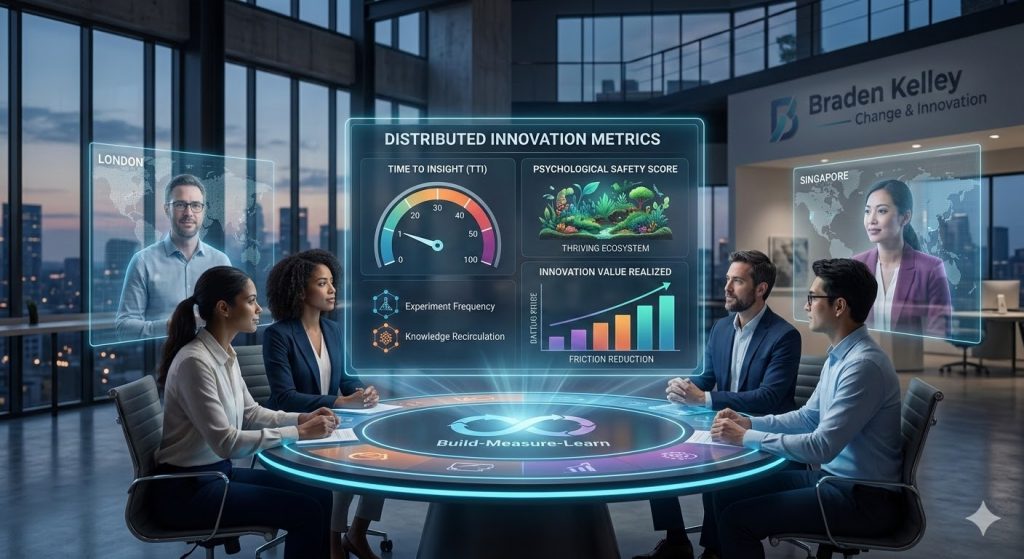
GUEST POST from Art Inteligencia
The Distributed Dilemma: Moving Beyond Activity to Impact
In the modern landscape of Human-Centered Innovation, the physical walls of the innovation lab have finally crumbled. We have successfully assembled global teams of brilliant minds, yet many leaders remain haunted by a lingering question: If we can’t see the innovation happening, how do we know it’s working?
The traditional “management by walking around” is dead. In a distributed environment, relying on physical cues to gauge momentum or engagement is a recipe for stagnation. When teams are spread across time zones and digital interfaces, there is a natural tendency for leadership to retreat into activity-based management — tracking Jira tickets, counting Slack messages, or monitoring hours logged. However, activity is not progress, and busyness is not innovation.
To lead a truly agile, distributed innovation engine, we must address the Visibility Gap. This gap isn’t just about seeing people at their desks; it’s about the lack of clarity regarding how individual contributions aggregate into collective value. We need a compass, not just a dashboard.
“Innovation in a distributed world requires us to become masters of measuring the impact of work through a human-centered lens, rather than the volume of work through a mechanical one.”
This article explores a shift toward Innovation Accounting. We will move away from vanity metrics that offer a false sense of security and toward a framework that measures the velocity of learning, the health of our collaborative culture, and the ultimate reduction of customer friction. By providing distributed teams with clear, meaningful metrics, we don’t just track their performance — we empower their autonomy.
The Velocity of Learning: Measuring Input Over Throughput
In a Human-Centered Innovation framework, the most valuable currency an innovation team possesses is not their code or their prototypes — it is their validated learning. For distributed teams, where communication can be asynchronous and fragmented, the speed at which we move from a “hunch” to a “fact” is the ultimate predictor of success.
If we treat innovation as a linear manufacturing process, we fail. Instead, we must measure the inputs that fuel the engine of discovery. This requires a shift from measuring output (how much did we build?) to velocity (how fast are we learning?).
[Image of Build-Measure-Learn feedback loop]
Experimentation Frequency
The first metric that matters is the Frequency of Hypothesis Testing. In a distributed environment, teams can easily fall into “perfection paralysis,” where they over-engineer a solution before showing it to a customer. We must track the number of distinct experiments — interviews, smoke tests, or paper prototypes — conducted per month. The goal is to lower the cost of failure so that the frequency of attempts can rise.
Diversity of Contribution
Innovation thrives on Cross-Pollination. In distributed teams, there is a constant risk of regional silos where the “London pod” and the “Singapore pod” solve problems in isolation. We measure diversity by tracking the number of functional areas or geographic regions contributing to a single project’s pivot or persevere decision. If our insights are coming from a single demographic or location, our innovation is inherently fragile.
Time to Insight (TTI)
Perhaps the most critical metric for organizational agility is Time to Insight. This measures the delta between identifying a potential customer friction point and the completion of a validation study. A high TTI usually indicates a “Bureaucracy Leak” — where digital hand-offs and approval layers are choking the team’s ability to react to market shifts.
“In the race to the future, the winner isn’t the one who works the most hours, but the one who cycles through the Build-Measure-Learn loop the fastest.”
By focusing on these learning inputs, we provide distributed teams with a clear mandate: your job is not to stay busy; your job is to reduce uncertainty. When we measure learning, we foster a culture of curiosity that transcends time zones.
Collaborative Cohesion: The Human Health of Distributed Innovation
Innovation is a team sport that thrives on high-bandwidth trust. In a distributed environment, we lose the “water cooler” moments and the non-verbal cues that build psychological safety. If we don’t measure the health of our collaboration, we risk building a group of isolated task-performers rather than a cohesive innovation engine.
We must look beyond participation rates in Zoom calls and instead measure the quality and safety of the digital space we’ve created.
The Synchronicity Ratio
One of the greatest tensions in distributed work is the balance between Deep Work and Collaborative Collisions. We track the Synchronicity Ratio to ensure teams aren’t being smothered by “meeting fatigue” while also avoiding the isolation of “siloed execution.” A healthy ratio allows for long blocks of asynchronous focus, punctuated by high-intensity, synchronous creative sessions. If this ratio tilts too far in either direction, innovation velocity stalls.
Psychological Safety Scores
In a physical room, you can feel the tension when an idea is shot down. Digitally, that silence is invisible. We utilize frequent, anonymous Pulse Surveys to measure the team’s “Safety to Fail.” We ask: “Do you feel comfortable proposing a ‘wild’ idea in our digital workspace?” and “When an experiment fails, is the focus on the lesson or the blame?” A declining safety score is a leading indicator of a future lack of breakthrough ideas.
Knowledge Recirculation
True Organizational Agility depends on how effectively insights move across the network. We measure Knowledge Recirculation by tracking how often a finding from one distributed pod (e.g., a “Customer Friction” insight from the Dublin team) is cited or utilized in the project documentation of another (e.g., the Seattle team). This measures the “connective tissue” of the organization — ensuring we aren’t solving the same problem twice.
“Distance should never be an excuse for disconnectedness. In innovation, the strongest bond is not a shared office, but a shared understanding and the safety to challenge the status quo.”
By making these “soft” elements visible through data, we treat the team culture as a product that requires constant iteration and optimization. When the human core is healthy, the innovation output follows naturally.
Value Realization: Bridging Innovation to the Bottom Line
The ultimate test of a distributed innovation team is not the elegance of their ideas, but the tangible value those ideas create for the organization and its customers. In high-performing cultures, we must move beyond “innovation theater” — the appearance of being creative — and focus on Innovation Accounting that tracks how we are plugging revenue leaks and capturing new market opportunities.
In a distributed environment, the distance between the “builder” and the “buyer” can grow dangerously wide. We use value realization metrics to ensure every digital sprint is anchored in commercial and human reality.
Innovation Risk vs. Revenue Leakage
Every organization suffers from Revenue Leakage — the gap between the value a product could provide and what the customer actually experiences. We measure the impact of our innovation projects by their ability to close these gaps. By utilizing Risk & Revenue Leakage Diagnostics, distributed teams can prioritize projects that address high-friction customer touchpoints. We track the “Projected Leakage Recovery” (PLR) to justify the investment in distributed experimentation.
Customer Friction Reduction (CFR)
Our primary benchmark for success is the Customer Experience (CX) Audit. We don’t just launch features; we measure the reduction in customer effort. For a distributed team, this metric serves as a unifying North Star. Whether a developer is in Port Orchard or Singapore, their success is measured by the same standard: Did this innovation make the customer’s life measurably easier? We track the delta in friction scores before and after a solution is deployed.
The Pivot-to-Persevere Ratio
One of the most dangerous traits in a distributed team is “sunk cost bias,” where remote pods continue working on a failing idea simply because they lack the high-bandwidth feedback to stop. We measure the Pivot Rate — the percentage of projects that are significantly redirected or halted based on data. A pivot is not a failure; it is a successful validation that a specific path was incorrect. A team that never pivots is likely ignoring the data.
“True innovation is the profitable implementation of creative ideas. If we aren’t measuring the reduction of friction and the recovery of revenue, we aren’t innovating — we’re just experimenting.”
By tying distributed efforts to these hard-hitting value metrics, we ensure that the “freedom to explore” is balanced with the “responsibility to deliver.” This alignment creates a culture where every team member understands exactly how their digital contributions move the needle for the entire enterprise.
Pitfalls to Avoid: When Metrics Become the Mission
Even the most well-intentioned Innovation Accounting system can backfire if it is implemented without a human-centered perspective. In distributed teams, where data often replaces dialogue, metrics can easily be misinterpreted or, worse, “gamed.” To maintain a healthy innovation culture, leaders must be vigilant against the unintended consequences of high-visibility tracking.
Measurement should be a flashlight, not a hammer. When we weaponize data, we don’t improve performance; we simply teach people how to hide the truth.
The “Green Dashboard” Trap
In a distributed environment, there is a natural desire to report “green” status updates to headquarters to prove productivity. This leads to the Green Dashboard Trap — where every KPI looks perfect on paper, yet the organization is failing to launch meaningful products. We must encourage “Red” and “Yellow” statuses as signs of honesty and opportunities for Human-Centered Innovation. If a dashboard is always green, the team isn’t taking enough risks.
Over-Measurement Fatigue
There is a diminishing return on data collection. If an innovation team spends 20% of their week updating tracking tools and filling out pulse surveys, they are spending 20% less time solving Customer Friction. We must ensure that our metrics are “low-friction” themselves — ideally captured through existing workflows rather than manual entry. The goal is to spend more time innovating and less time reporting on innovation.
Misalignment with the North Star
The most dangerous pitfall is Local Optimization — where a distributed pod optimizes for a metric that doesn’t actually drive the broader strategy. For example, a team might increase their “Experimentation Frequency” by running trivial tests that don’t move the needle on Revenue Leakage. Every metric must be explicitly mapped back to the organization’s strategic goals. If the team can’t explain why a metric matters to the customer, it probably doesn’t.
“When a measure becomes a target, it ceases to be a good measure. Our focus must remain on the human impact of our innovations, not just the numbers on the screen.”
By anticipating these pitfalls, we can build a measurement system that supports Organizational Agility rather than stifling it. We use metrics to inform our conversations, not to replace them.
Conclusion: Measuring for Empowerment
The ultimate goal of Innovation Accounting for distributed teams is not control; it is autonomy. In a high-performing organization, metrics are the guardrails that allow teams to move fast without asking for permission at every turn. When we provide a distributed team with a clear understanding of what “success” looks like through a human-centered lens, we grant them the freedom to execute with Organizational Agility.
By shifting our focus from tracking presence to measuring impact, we transition from a culture of surveillance to a culture of empowerment.
Autonomy Through Clarity
When a distributed pod knows their primary metric is the reduction of Customer Friction, they don’t need a manager in a different time zone to tell them which feature to prioritize. The data provides the mandate. This clarity reduces the “cognitive load” of remote work, allowing teams to spend their creative energy on solving problems rather than navigating internal hierarchies.
The Future of Strategic Foresight
Finally, these metrics allow us to move from reactive management to Strategic Foresight. By tracking the Velocity of Learning and Knowledge Recirculation, leadership can predict which teams are on the verge of a breakthrough and which are stalling before the crisis actually hits. We use these insights to reallocate resources dynamically, ensuring that the organization remains resilient in the face of constant change.
“The most powerful tool a distributed leader has is a shared set of Metrics That Matter. When the team owns the data, they own the outcome.”
As we continue to navigate the complexities of Human-Centered Innovation, let us remember that the numbers are merely a shadow of the human effort behind them. Our mission is to ensure that every distributed mind—no matter where they are located—is empowered to contribute to a future that is more innovative, more agile, and more human.
Frequently Asked Questions
Why are traditional productivity metrics failing distributed innovation teams?
Traditional metrics often focus on “activity” (hours logged, tickets closed) rather than “impact” (validated learning, friction reduction). In a distributed environment, this creates a surveillance culture that stifles the psychological safety necessary for breakthrough creative thinking.
How do you measure “soft” cultural elements like psychological safety remotely?
We utilize frequent, anonymous pulse surveys and track “Knowledge Recirculation” across digital platforms. By measuring how often ideas are challenged or shared across distributed pods, we gain a data-driven view of the team’s collaborative health without needing physical proximity.
What is the most critical metric for organizational agility in innovation?
The “Velocity of Learning” is paramount. Specifically, tracking the “Time to Insight” — the speed at which a team moves from identifying a customer friction point to validating a solution — is the best predictor of long-term success and revenue leakage recovery.
Image credit: Google Gemini
 Sign up here to get Human-Centered Change & Innovation Weekly delivered to your inbox every week.