GUEST POST from Art Inteligencia
What Is a Customer Journey Map? (Short Answer)
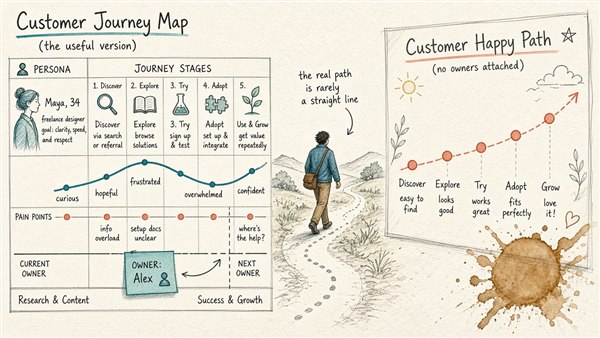
A customer journey map is a visual representation of a persona’s end-to-end path across stages and touchpoints — typically including actions, thoughts, emotions, pain points, and opportunities. It helps teams see the experience as a journey, not a pile of channels. It is not enough when it shows only the intended happy path, has no owner for the seams, or substitutes for walking and auditing the lived experience. Maps describe. Audits test whether reality matches the map.
A journey map without evidence and ownership is a poster of the experience you wish customers had.
Below: what belongs on a real map, when mapping helps, when it fails, and what to add when the wall is not enough. This definition aligns with the Experience Design Glossary. For the full practitioner how-to, see Customer Journey Mapping: The Complete Practitioner’s Guide.
What Belongs on a Customer Journey Map?
A useful map is built for a specific persona and a specific job — not “everyone” averaged into a false middle.
- Stages — the sequence from first need through use, support, renewal, or exit.
- Touchpoints and channels — where the person interacts: web, app, store, call, email, partner, frontline.
- Actions, thoughts, and emotions — what they do, what they believe is happening, and how confidence rises or falls.
- Goals and expectations — the job they are trying to finish at each stage. Without goals, you have a touchpoint list, not a journey map.
- Pain points, friction, and moments of truth — where effort, confusion, or stakes spike.
- Opportunities — specific improvements tied to loyalty, completion, or revenue — not vague “delight more” stickers.
That structure supports the broader definition of customer experience: perceptions formed across every interaction, before, during, and after purchase — not only the channel you happen to own.
If you cannot name whose journey and which job, you are decorating a process diagram.
When Is a Customer Journey Map Useful?
- To create shared sight. Cross-functional teams stop arguing from their silo’s screen and see the handoffs customers actually cross.
- To prioritize after contact. When the map is fed by interviews, observation, and operational data, pain points become investable — not anecdotal.
- To separate current state from future state. Current-state maps expose reality. Future-state maps propose redesign. Mixing them without saying so is how wishful thinking becomes “strategy.”
- To prepare a blueprint or audit. Journey maps focus on the person’s path. Service blueprints add backstage people, processes, and systems. Experience audits test whether the lived path matches either artifact.
Used this way, mapping is a core practice inside experience design — research, map, measure, improve — not a one-day workshop trophy.
When Is a Journey Map Not Enough?
Maps fail when teams treat the artifact as the finish line.
- Intended journey, not lived journey. Built from conference-room memory, the map shows how the process is supposed to work. Customers already pay for homework, wrong doors, retelling, and unowned waits the swimlane never captured. Those lags are inventoried in 12 Friction Points Customers Feel Before Your Journey Map Does.
- No seam owner. Beautiful stages with orphan handoffs. Design thinking misuse #4 is journey maps without owners — see 7 Ways Design Thinking Gets Misused.
- Happy path only. Recovery, exceptions, and “what if it breaks” never make the wall. Real loyalty is often decided in the mess.
- One generic map for every persona. Averaging hides the journeys that fail hardest.
- Scorekeeping costume. The map exists; nothing in the operating model moved. Channels still have local KPIs; nobody owns the cliff between them.
- Map as substitute for walking. Nobody has gone through the journey as a customer — retail, call, full sales cycle — with fresh eyes. Paper cannot replace that.
When the map is green and the journey is still red, you improved the workshop — not the experience.
What Should You Do When the Map Is Not Enough?
- Validate with contact evidence — interviews, observation, frontline input, and behavioral data — before you fund the future-state mural.
- Name owners for seams and moments of truth — not only for stages that already have a department.
- Map from the mess — include recovery, policy surprises, and powerless frontline moments.
- Add the backstage — when friction is produced by tools, incentives, or partner handoffs, move to a service blueprint mindset.
- Audit the lived experience — journey walking, triangulation of data and stories, competitive comparison, and a prioritized friction inventory. That is what an experience audit adds beyond an internal mapping session — see 10 Signs You Need a Customer Experience Audit and the Customer Experience Audit Checklist.
Keep the map. Add evidence, ownership, and a test of reality. That is when journey mapping earns its keep.
FAQ: Customer Journey Maps
What is a customer journey map in simple words?
A customer journey map is a picture of the steps a specific type of customer takes to get a job done with your organization — including touchpoints, emotions, and pain points — so teams can see the whole experience instead of only their own channel.
What is the difference between a journey map and an experience audit?
A journey map describes the experience — often the intended or internally believed path. An experience audit tests the actual experience through research, journey walking, data, and often competitive benchmarking to see where reality diverges from the map and where value is leaking.
What is the difference between a journey map and a service blueprint?
A journey map focuses on what the person does, thinks, and feels across stages and touchpoints. A service blueprint adds the frontstage and backstage people, processes, and systems that make those touchpoints possible — revealing where operations create or destroy the experience.
When is a customer journey map not enough?
When it is built without real customer contact, shows only the happy path, has no owners for handoffs, averages all personas into one map, or is never validated by walking the lived journey. In those cases it becomes a poster, not a design tool.
How do you make a journey map useful?
Build it for a named persona and job, ground it in evidence, include emotions and friction, name seam owners, separate current state from future state, and follow it with action — blueprint the backstage and audit whether reality changed.
SPECIAL BONUS: Braden Kelley’s Problem Finding Canvas can be a super useful starting point for doing design thinking or human-centered design.
“The Problem Finding Canvas should help you investigate a handful of areas to explore, choose the one most important to you, extract all of the potential challenges and opportunities and choose one to prioritize.”
Image credit: Cursor
 Sign up here to get Human-Centered Change & Innovation Weekly delivered to your inbox every week.