Why They Measure Different Things
by Braden Kelley and Art Inteligencia
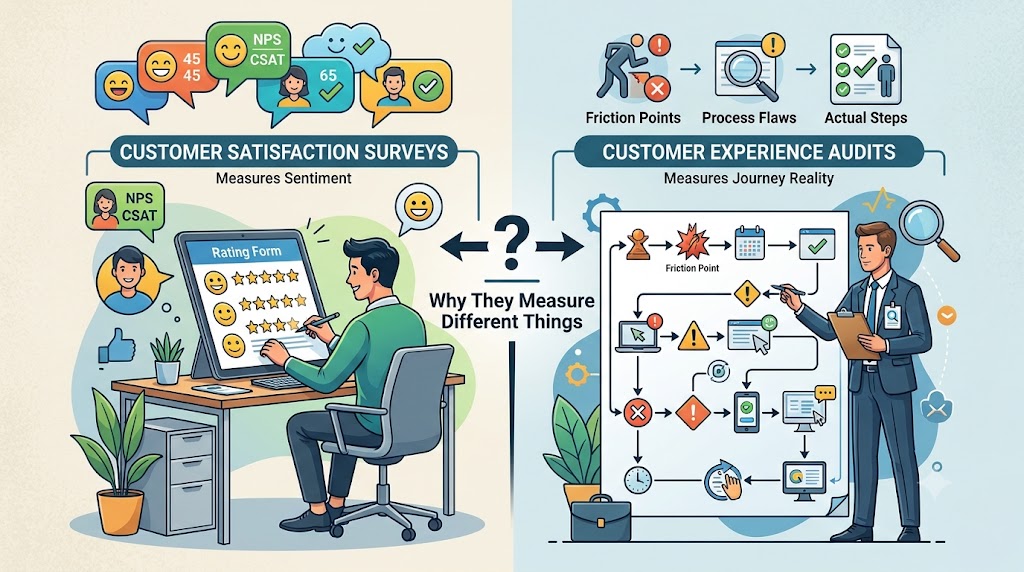
“We already survey our customers” is the single most common objection I hear when I raise the idea of an experience audit, and it’s a reasonable one on the surface — why pay for a second measurement of the same thing? The honest answer is that a survey and an audit aren’t measuring the same thing at all. They’re not even measuring in the same direction.
A survey measures what customers are willing to tell you
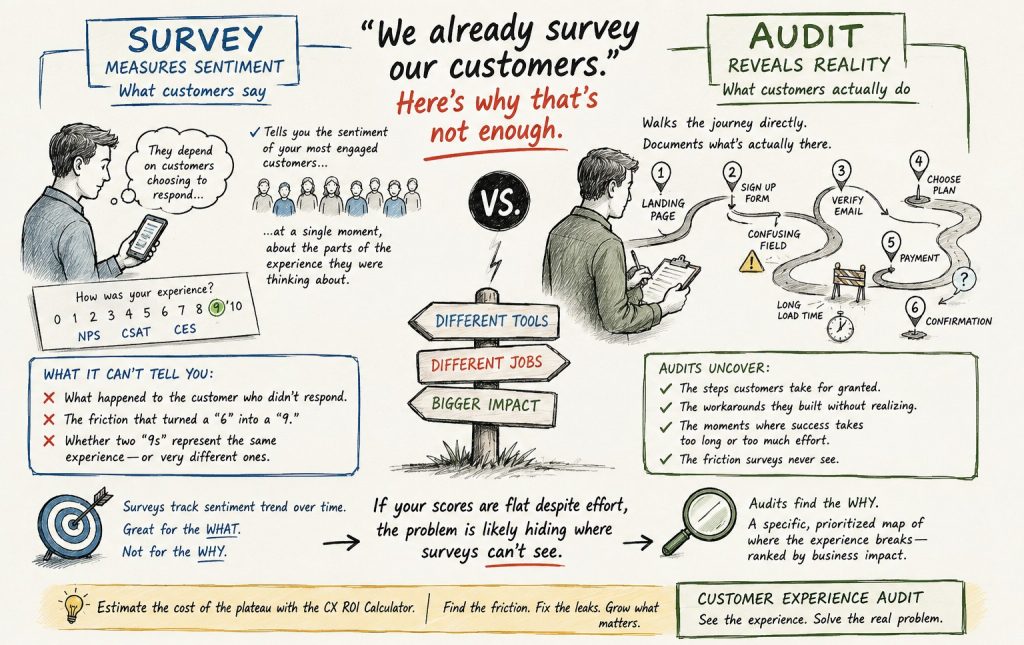
NPS, CSAT, and CES all share a structural feature: they depend entirely on a customer choosing to respond, and then choosing to be candid in that response. That’s not a flaw in the instrument — it’s simply what the instrument is. It tells you the sentiment of your most engaged customers (response rates skew toward people who feel strongly, in either direction) at a single moment, about the parts of the experience they happened to be thinking about when the survey arrived.
What it structurally cannot tell you: what happened to the customer who didn’t respond. What the friction actually looked like, step by step, that produced a “6” instead of a “9.” Whether a “9” from one customer and a “9” from another represent the same underlying experience, or two very different ones that both happened to land on the same number.
An audit measures what’s actually happening in the journey
An audit doesn’t ask customers to self-report — it walks the journey directly, the way a real customer experiences it, and documents what’s actually there. That distinction matters most exactly where surveys go quiet: the steps a customer takes for granted and never thinks to mention, the workaround they built without realizing it was a workaround, the moment where the process technically succeeded but took four times longer than it should have.
You can walk journeys for clients whose NPS had been flat, technically acceptable, for years — and find friction serious enough to explain real revenue loss, sitting in a step that had simply never come up in a survey response because no customer thought to complain about something they’d quietly adapted to.
Where each one actually earns its place
None of this makes the survey obsolete — it makes it a different tool for a different job. A survey is the right instrument for tracking sentiment trend over time, cheaply and continuously, across your whole customer base. It’s the wrong instrument for finding out why the trend is what it is, or for finding the friction nobody thought to mention.
An audit is the right instrument for that “why” — for producing a specific, prioritized map of where the experience actually breaks, ranked by business impact. It’s not something you run monthly; it’s something you run when the survey data has told you that something’s wrong without telling you what.
The tell that you need one, not the other
If your satisfaction scores have been flat — not declining, just plateaued — despite genuine effort to improve them, that’s usually the clearest signal that the problem lives somewhere the survey can’t see, and that more survey data won’t produce a different answer than the data you already have. That’s the specific situation an audit is built for.
If you want a rough sense of what that plateau might be costing before committing to a diagnosis, the CX ROI Calculator is a fast way to put a number on it. When you’re ready to find out exactly where the friction is living, that’s what a Customer Experience Audit is for.
Want to learn more about the value of having an independent Customer Experience Audit done? Or are you ready to invest in one?
Image Credit: Gemini, ChatGPT
Content Authenticity Statement: The topic area, key elements to focus on, etc. were decisions made by Braden Kelley, with a little help from Claude to clean up the article.
 Sign up here to get Human-Centered Change & Innovation Weekly delivered to your inbox every week.