by Braden Kelley and Chateau G Pato
Every few years, a technology industry that has been sprinting stops, looks around and discovers that someone needs to do the paperwork. Cloud had its moment. Mobile had its moment. Now AI is having it.
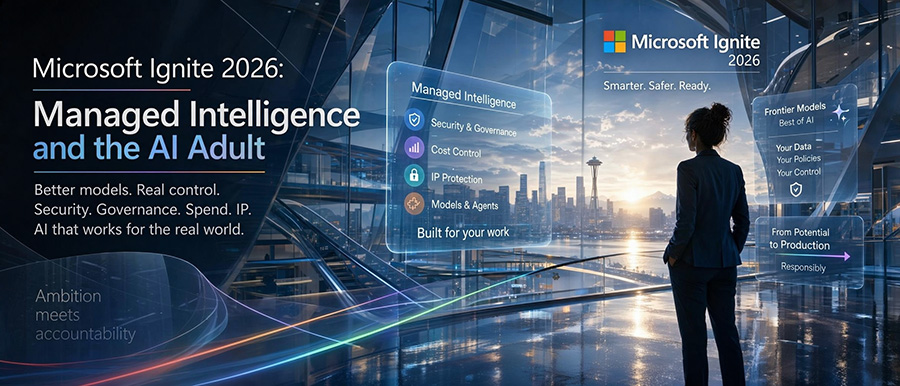
At Ignite this week, Microsoft made a play to be the company that does the paperwork. The pitch, as I read it, is a managed intelligence future: companies use the best frontier models and Microsoft’s own focused models, keep control of security and governance, watch their spend, protect their intellectual property, and tune models and agents to their own work. The tone was less “look what AI can do” and more “let’s be responsible about what we’ve started.” Call it the adult-in-the-room positioning. Whether Microsoft has earned that chair is the interesting question.
I read through Microsoft’s announcements, the analyst commentary and the competition. Here’s what’s new, where the next innovations are, who else is already building this, and where Microsoft looks strong or exposed.
The short answer
Microsoft has assembled the most complete packaged version of managed intelligence I’ve seen from one vendor: its own lower-cost models, a router that decides which model to use, tuning tools, an identity-based control plane for agents, security agents, and a cost dashboard. But much of it is preview, most of the performance claims are Microsoft’s own, and the tuning approach creates switching costs. Others, notably ServiceNow, Google and AWS, are building pieces of the same idea. Nobody I found matches the full stack from chips to cost dashboard.
What Microsoft announced
Smaller, focused models instead of one model for everything
This is the idea I like best, and it matches what I wrote in the hybrid intelligence piece: most work doesn’t need the biggest brain in the building.
- MAI Code 2 targets everyday enterprise coding. Microsoft says it reaches 98% of GPT-6.1 Sol’s quality at about 40% of the price, and 96% of Claude Opus 5.5’s quality at about 5% of the price, averaged across four coding benchmarks.
- MAI Cyber 2 Flash is a security model that Microsoft says scores 92.3% on a cybersecurity benchmark against 91.5% for a leading frontier model, at under 2% of the cost per task.
- Microsoft-Decision-1.1 is a routing model that sends each request to a larger model only when it’s needed. It’s generally available.
- Frontier models aren’t going away. GPT 6.2 and Meta’s latest models are coming to Foundry, and in Copilot, users can pick OpenAI or Anthropic models, subject to organizational policy.
Microsoft’s own tagline for the lineup: “Frontier performance. A fraction of today’s prices.” Hold that thought, because every one of those benchmark figures is vendor-reported.
A control plane for agents
Agent 365 is the center of the governance story. Microsoft says more than 50 million agents are already in it. Each agent gets its own Microsoft Entra identity, so IT can see it, limit it and block it. Autopilot, a persistent agent that works across Teams and Outlook, comes with its own agent ID and a named human manager, and its actions are logged under its own name for audit.
The most interesting piece is the money. Agent 365 Cost Management tracks consumption by user, service, agent and model, with limits, policies and alerts. Business Analytics measures value “in work completed, not simply tokens.” Satya Nadella called it an “ERP system for AI usage,” and I think that’s the right metaphor. AI spend is about to need the same discipline as any other enterprise resource. Both pieces are in preview or the Frontier program, with value insights expanding in December.
Security that’s agentic too
Microsoft Perception, now generally available, uses red (attack), blue (detection) and green (remediation) agent teams. Defender runtime protection for local AI agents is also generally available, and Constellation Research notes that Microsoft’s security coverage extends to AWS and Google Cloud. Azure confidential computing previews, including a Confidential Clean Room for multiparty analytics, speak directly to the IP-protection concern. Microsoft also announced an AI Transparency Initiative with 40 participating organizations and work alongside NIST’s agent standards effort.
Tuning, so the model learns your business
- Training in Foundry (preview) adapts supported models with an organization’s own data. Programmed Training (preview) lets engineers write their own training loops for supervised and reinforcement learning on open-weight models. The agent optimizer, which proposes and tests agent changes against evaluations, is generally available.
- Frontier Tuning, announced at Build in June and in private preview, uses reinforcement learning inside the customer’s compliance boundary to learn from process, not just examples. Microsoft’s reported results include an HR workflow going from 13% to 87% task completion and a tuned model at roughly one-tenth the cost for a McKinsey use case. Those are vendor-reported figures, with no methodology.
- MAI Licensed Weights would give trusted customers access to Microsoft’s model weights. No date has been given.
The context layer and the hardware
Microsoft IQ packages organizational context, drawing on Work IQ, Fabric IQ, Foundry IQ and Web IQ, with about 350 third-party connectors. Constellation’s summary of the strategy is that models are a commodity and the value is in the context. On the hardware side, Microsoft claims its Maia 300 chip delivers 40% more tokens per watt than leading GPU-based systems, and Cobalt 200 virtual machines are generally available. For customers who want the work closer to home, Foundry Local, Windows Server 2028 (preview) and Azure Local options address sovereignty and residency.
Why this matters
Three shifts here are worth naming, because they’re bigger than any single product:
- Routing is becoming a management function. Deciding which model handles which task, based on quality, speed and cost, is the AI equivalent of deciding who on your team should take a call. It’s an operating decision, not a technical one.
- Cost is finally a first-class metric. Measuring value in work completed rather than tokens consumed is the correct instinct. Counting tokens is like measuring a salesperson by miles driven.
- Control is moving from the model to the agent. Giving each agent an identity, a manager and an audit trail treats agents like a workforce, which is how people will need to think about them.
Where the next innovation is
This is the part I’d bet on. The announcements open gaps, and gaps are where innovators live.
- Portability of tuned intelligence. If a model has been tuned on how your company actually works, that asset is valuable. Whoever makes it portable, auditable and exit-friendly wins the trust of every skeptical CFO.
- Independent benchmarks of cost and quality. Today the buyer is comparing one vendor’s slides to another’s. A neutral, auditable cost-per-outcome standard would be worth real money.
- A cross-vendor control plane that’s actually neutral. Companies will run models from several providers. The control layer that works across all of them, without favoring its owner, is still up for grabs.
- Outcome accounting. Measuring “work completed” is hard. The first tools that tie agent activity to business results, not activity logs, will change how AI budgets get approved.
- The human side of an agent workforce. Nobody is yet systematically measuring how it feels for employees and customers when agents join the process. That’s an experience problem, and it’s why I believe experience audits will extend to the human-and-agent journey.
- Scenario planning for model prices. If specialized models cost a fraction of frontier ones, your 2027 budget assumptions may be wrong in either direction. That’s a signals-and-futures exercise, not a spreadsheet exercise.
Who else is doing this?
Yes, others are already building parts of it. The market is crowded, and its claims are often ahead of its evidence. Here’s what I found, with sources noted below. These are vendor descriptions unless I say otherwise.
| Vendor | What it offers | Where it looks strong | Where it looks exposed |
|---|---|---|---|
| ServiceNow (AI Control Tower) | Discover, observe, govern, secure and measure AI across systems, including AWS, Google Cloud, Azure, SAP, Oracle and Workday; cost and ROI dashboards; a “kill switch” | Governance that turns into real work: routing findings to owners, tracking remediation, keeping an audit trail | One analyst survey found 14 of 15 customers said runtime control was external, limited or unproven at scale; 12 of 15 raised cost concerns |
| Google (Gemini Enterprise Agent Platform) | Agent identity, registry, gateway, evaluation and observability; Model Armor; 200+ models in Model Garden; FinOps Explainability agent and project spend caps | Governance built into the platform, open at the edge and consolidated at the center, per Bain | Centered on Google Cloud; maturity of each component unclear; tuning wasn’t addressed in the coverage I read |
| AWS (Bedrock AgentCore) | Cedar-based policies that check tool calls, temporal policies for approvals and budgets, evaluations (GA March 2026); model customization including reinforcement fine-tuning for Nova | The closest to Microsoft’s full-stack idea: its own models, customization and agent policy in one provider | AWS is the control surface; policy covers traffic through its gateway; compliance mapping wasn’t documented |
| IBM (watsonx Orchestrate, Sovereign Core) | An agent control plane for multi-cloud and on-premises, with sovereignty controls | Strong on hybrid and regulated environments; Sovereign Core is generally available | The next-generation Orchestrate was in private preview as of May; cost controls and observability weren’t documented on its pages |
A few caveats. Much of the head-to-head comparison comes from a guide published by a vendor that sells a competing product, which it discloses, so I used it for feature facts and not for rankings. I didn’t dig into Salesforce, Databricks or the smaller governance specialists, so this table isn’t a market map. And no one else I found combines their own cheaper models, routing, tuning, governance and silicon the way Microsoft is pitching. AWS comes closest.
Microsoft’s strengths
- It already owns the identity layer. Governing agents through Entra, Purview and Defender builds on tools many enterprises already run. That’s a real distribution advantage.
- Full-stack cost control. Few competitors can say “our model, our router, our chip and our cost dashboard” in one sentence.
- Multi-model by design. Letting customers pick OpenAI or Anthropic models, subject to policy, reduces the “all eggs, one basket” objection.
- A credible narrative. Measuring value in work completed, and framing AI spend like an ERP discipline, speaks the language CFOs and boards already use.
Microsoft’s weaknesses
- Lock-in through tuning. One critique of Microsoft’s approach calls the “no vendor lock-in” claim “technically correct and commercially misleading at the same time.” Models tuned on your workflow traces become sticky, and leaving means retraining elsewhere. Microsoft says the knowledge stays yours, but the coverage doesn’t address portability of the tuning environment or skills.
- Unproven governance across mixed estates. Entra is mature for people. Governing agents across Azure, Google Cloud and on-premises systems is newer, and ServiceNow’s tool was designed from the start for agent governance.
- Marketing numbers. The cost-versus-quality comparisons are Microsoft’s, and its Copilot announcement cites a GigaOm report claiming Copilot is 84% cheaper than Claude for an everyday user, which I couldn’t verify independently. Parity today doesn’t mean parity in six months, as the releases keep coming.
- Licensing complexity. Insights for Microsoft services require at least one Microsoft 365 Copilot license in the tenant, and insights for non-Microsoft agents require an Agent 365 license. A third-party guide lists Agent 365 at $15 per user per month, best with E5. That’s a platform commitment, not a plug-in.
- Lots of preview. Cost Management, Frontier Tuning, Programmed Training and MAI Licensed Weights are preview, private preview or undated.
- Reliability. A global Microsoft 365 outage knocked out Outlook, Teams and OneDrive for nearly 24 hours last week, and the UK’s NHS lost email and Teams access for much of the day. Microsoft apologized, attributed it to a network change, and said it wasn’t related to AI or agents. Fair enough, but it’s hard to be the adult in the room while the lights are out.
- The IP promise. Microsoft has promised “enterprise grade, clean and commercially licensed data.” A June report from The Decoder said Microsoft’s own technical paper shows a significant portion of the MAI training corpus comes from Common Crawl, an openly available web scrape. I didn’t see a Microsoft response, and the report doesn’t give a proportion. Buyers who care about IP protection should ask for the training-data details in writing.
What I’d ask before signing anything
- Can I take my tuned model, skills and evaluations with me, and what does it cost to leave?
- Who verified the benchmarks, on whose workloads? Run your own tasks before you believe anyone’s price-performance chart.
- What does it cover outside this vendor’s walls? Ask to see agents from other platforms governed, blocked and logged in a live demonstration.
- What’s generally available today, and what’s a roadmap?
- How is value measured? If the answer is “tokens,” keep asking.
- What happens to my employees’ and customers’ experience? Measure it before and after.
My verdict
Innovation or Not? Innovation, mostly in the packaging, with proof still to come.
None of the individual ideas is brand new: model routing, agent identity, FinOps and fine-tuning all exist elsewhere. What’s new is a large vendor assembling them into a single story that a CIO, a CFO and a general counsel can all understand, and putting its weight behind the idea that AI needs management, not just momentum. That’s a meaningful shift, and it will force competitors to answer.
But being the adult in the room is something you demonstrate, not something you announce. The test will be portability, independent verification and keeping the lights on. If Microsoft passes those, managed intelligence becomes the default way large organizations buy AI. If it doesn’t, the opening goes to whoever builds the neutral control layer.
Either way, the question for leaders has changed. It’s no longer “should we use AI?” It’s “who is managing it, and how would we know?”
Sources
- Ignite 2026: Building the frontier ecosystem (Microsoft)
- Microsoft Ignite 2026 Book of News
- Copilot at Microsoft Ignite (Microsoft)
- Microsoft launches seven MAI models at Ignite 2026 (TestingCatalog)
- At Ignite 2026, Microsoft makes case to be your work operating system, intelligence layer (Constellation Research)
- Microsoft MAI models and Frontier Tuning (Data Science Dojo)
- Don’t Step Into The Platform Trap: What Microsoft Build 2026 Could Mean for Your Next AI Stack Decision (CustomerThink)
- Microsoft apologizes for major outage (Windows Central)
- Microsoft trained its MAI models on unlicensed web data (Pulse, citing The Decoder)
- ServiceNow expands AI Control Tower (ServiceNow)
- ServiceNow AI Control Tower: selling a penthouse while building the frame (SiliconANGLE)
- Google Cloud Next 2026: the agentic enterprise control plane comes into view (Bain)
- AWS adds, doubles down on customizing and fine-tuning AI models and agents (Constellation Research)
- IBM Think 2026: the blueprint for the AI operating model (IBM Newsroom)
- Top 5 AI Agent Control Planes in 2026: Compared (Traccia; the publisher sells a competing product)
Image Credits: Microsoft AI
Content Authenticity Statement: The topic area, key elements to focus on, etc. were decisions made by Braden Kelley, with a little help from Claude to clean up the article.
 Sign up here to get Human-Centered Change & Innovation Weekly delivered to your inbox every week.