by Braden Kelley and Art Inteligencia
What Is the Innovation Process? (Short Answer)
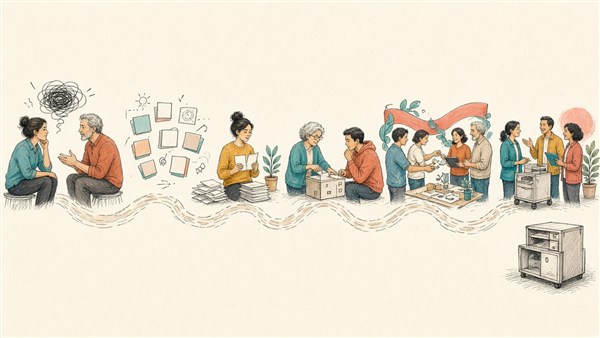
The innovation process is how an organization turns a human problem into a widely adopted solution. Six stages: (1) frame the problem from insight, (2) generate options, (3) choose what to pursue, (4) develop and test evidence, (5) design adoption into how work actually runs, and (6) scale what people use — then learn. Launch is not the finish line. Adoption is.
If your innovation process ends at launch, you built a project plan — not an innovation process.
Below you’ll find why most process diagrams stop too soon, what each stage is for, how this differs from stage-gate and design thinking, where the process usually breaks, and how to run it without bureaucracy. The point of the process is adopted value, not novelty — see What Is Innovation? A Clear Definition, With Examples.
Why Do Most Innovation Process Diagrams Stop Too Soon?
The diagram most teams inherit looks like this: idea, screen, develop, launch. It is tidy. It is also incomplete.
What’s usually missing is the customer’s job, evidence before a big commitment, fit with the operating model, a named owner who will run the new way after the project team leaves, and proof that people actually adopted it. A beautiful stage-gate with nobody accountable after go-live is a slideshow.
A process that cannot kill ideas, or cannot hand them to the people who must live with them, is not an innovation process.
What Are the Six Stages of the Innovation Process?
| Stage | Purpose | Done when |
|---|---|---|
| 1. Frame the problem from insight | Name who has the job and what is failing | The problem is specific enough to test |
| 2. Generate options | Create real alternatives, including recombination | You have more than one decorated concept |
| 3. Choose what to pursue | Fund a few bets and stop the rest | Kills and parks are explicit, not “still in the pipeline” |
| 4. Develop and test evidence | Learn whether behavior will change before you scale spend | You have evidence about use, not only applause |
| 5. Design adoption into the operating model | Make the new way survivable in real work | Jobs, incentives, handoffs, and an owner are in place |
| 6. Scale what is used — and learn | Expand where adoption and value hold | Behavior moves, the old path shrinks, and learning feeds the next cycle |
1. Frame the Problem from Insight
Purpose: Who has the job? What frustration or unmet need is real? Start from evidence, not a sponsor’s favorite idea.
Done when: The problem is specific enough that a test could prove you wrong.
Common skip: Jumping to a solution because someone important already picked one.
2. Generate Options
Purpose: Produce several ways to solve the framed problem, including recombination of things that already exist — not only “brand-new.”
Done when: You have genuine alternatives, not one concept and a brainstorm that rubber-stamps it.
Common skip: Treating ideation as the innovation.
3. Choose What to Pursue
Purpose: Apply criteria tied to strategy, customer value, and the organization’s capacity — including the courage to stop. Different types of bets deserve different patience; see What Are the Different Types of Innovation?.
Done when: A small set is funded and the rest are explicitly killed or parked.
Common skip: Everything stays “in the pipeline.”
4. Develop and Test Evidence
Purpose: Prototypes, pilots, and cheap tests that could falsify the bet before you scale spend.
Done when: You have evidence about behavior, not only applause in a demo.
Common skip: Building the full product “to see if it works.”
5. Design Adoption into the Operating Model
Purpose: Jobs, incentives, training, handoffs, the old path, and a named owner who will run this after the project team leaves.
Done when: The new way can survive contact with real work.
Common skip: “We’ll handle change later.” For the stages teams most often leap over between learning and scale, see 6 Stages Most Organizations Skip Between Insight and Scale.
6. Scale What Is Used — and Learn
Purpose: Expand only where adoption and value hold, and feed what you learned back into the next insight.
Done when: Behavior and outcomes move for the people you meant to serve, and the old path shrinks.
Common skip: Scaling a pilot because the deck was approved. For how to measure value beyond idea count, see 12 Metrics That Actually Measure Innovation Value.
How Is This Different From Stage-Gate or Design Thinking?
| Approach | What it’s strong at | Where it often stops short |
|---|---|---|
| Stage-gate | Go/kill discipline and investment control | Product-centric; “launch” treated as done |
| Design thinking | Empathy, problem framing, and prototyping | Operating-model adoption and scale left for “later” |
| This process | Human insight at the front; adoption and learning at the back; explicit kills in the middle | Becomes bureaucracy if every stage grows a committee |
A culture that cannot fund, forgive, and finish will stall any diagram — see How Do You Build a Culture of Innovation?
Use the methods. Don’t let the method replace the outcome.
Where Does the Innovation Process Usually Break?
- The problem was never framed. A solution is looking for a sponsor.
- The choice was never made. The pipeline is obese; nothing is stopped.
- Evidence was skipped. The team builds first and learns late.
- Adoption was unfunded. Launch day is the celebration and the end. That pattern is a form of innovation theater.
- Scale has no owner. The pilot runs forever because nobody in the business owns the new way.
How Do You Run the Innovation Process Without Bureaucracy?
- One page per stage: the question, the evidence required, the decision, and the owner.
- Same stages, different speed: incremental bets and radical bets share the path, but not the same evidence bar or patience.
- Kill criteria before affection: write what would stop the work before you fall in love with the idea.
- Name the adoption owner early: before development spend gets large.
- A quarterly learning review: what you stopped, what you scaled, and what you still don’t know.
A good innovation process is short enough to use and strict enough to stop the wrong work.
FAQ: The Innovation Process
What are the stages of the innovation process?
Six stages: frame the problem from insight, generate options, choose what to pursue, develop and test evidence, design adoption into the operating model, and scale what people actually use — then learn. Launch is a milestone inside the process, not the end of it.
What is the innovation process in simple terms?
The innovation process is how an organization turns a real human problem into a solution people widely adopt because they value it more than what they used before. It includes choosing, testing, adopting, and scaling — not only coming up with ideas.
What is the difference between the innovation process and stage-gate?
Stage-gate is a go/kill discipline that often treats product launch as the finish. This innovation process keeps human insight at the front and operating-model adoption and learning at the back, with explicit decisions to stop work in the middle.
Why do innovation processes fail?
They fail when the problem was never framed, nothing is ever killed, evidence is skipped, adoption is unfunded, or scale has no owner in the business. A diagram cannot compensate for those gaps.
When is an innovation process finished?
An innovation process is finished for a given bet when the people it was meant to serve have adopted it, outcomes have moved, the old path has shrunk, and what was learned has been fed back into the next cycle — not on launch day.
Image credits: Cursor
Content Authenticity Statement: The topic area, key elements to focus on, etc. were decisions made by Braden Kelley, with a little help from Google Gemini and M365 CoPilot to clean up the article, add images and create infographics.
 Sign up here to get Human-Centered Change & Innovation Weekly delivered to your inbox every week.