by Braden Kelley and Art Inteligencia
What Is Strategic Foresight? (Short Answer)
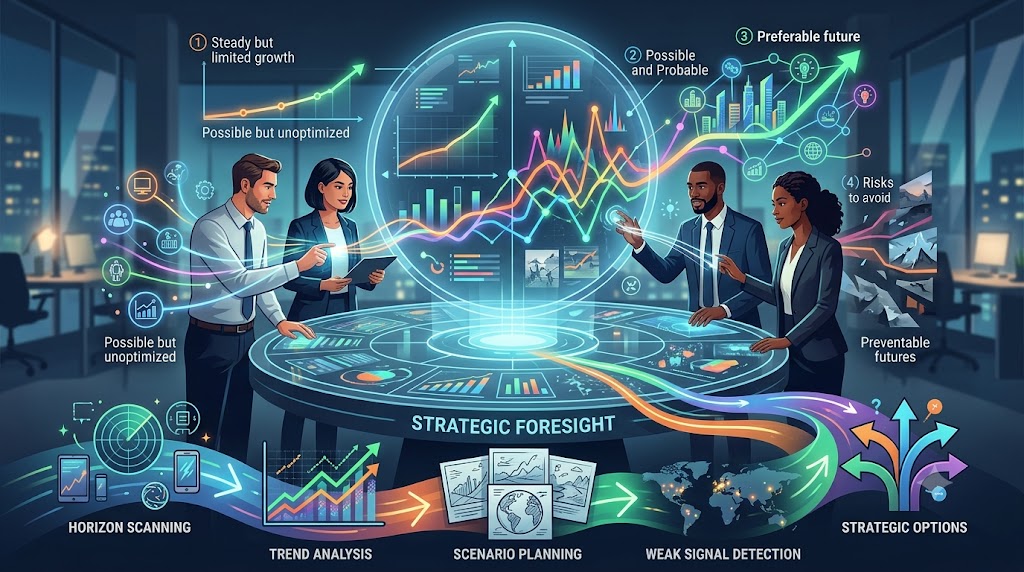
Strategic foresight is the practice of systematically exploring multiple possible futures so you can make better decisions and take more effective action in the present. It is not fortune-telling. It combines sensing weak signals, mapping how they might evolve, exploring possible, probable, and preferable futures, and translating insight into what to fund, stop, prepare for, or redesign now.
If foresight cannot change a decision, it is entertainment with better vocabulary.
Below you’ll find how foresight differs from planning and forecasting, what the work includes, what it is not, and how you know you are doing it. For the longer practitioner guide — methods, adjacent disciplines, and why organizations fail at this — see Strategic Foresight: A Practitioner’s Guide.
How Is Strategic Foresight Different from Planning and Forecasting?
These words get used interchangeably. They should not.
| Approach | Starting point | Output | Fails when… |
|---|---|---|---|
| Strategic planning | A mostly expected future | Roadmap from here to a defined there | “There” turns out to be the wrong place |
| Forecasting | Stable dynamics you can model | A predicted value or range | Discontinuities break the model |
| Scenario planning | A few high-uncertainty drivers | Multiple plausible future stories | Murals never gate the portfolio |
| Strategic foresight | Genuine uncertainty | Signals, futures, and present decisions | Treated as an annual costume, not a habit |
Scenario planning is a core tool inside foresight. Foresight is broader: scanning, weak signals, trend sense-making, scenarios, and strategic options that are robust across more than one future. Forecasting still matters for near-term numbers inside a stable frame. Foresight is what you need when the frame itself may move.
Planning answers how we get there. Foresight first asks where “there” might turn out to be — and which landing we are funding.
What Does Strategic Foresight Actually Include?
Strip away the jargon and the work has a simple arc. In FutureHacking™ I teach it as four steps anyone can run:
- Pick the signals that matter. Not every trend PDF. Weak signals from the floor — customers, employees, partners, technology, policy — filtered for relevance to your context.
- Map how those signals evolve. Inflection points, interactions, and what would accelerate or stall each one. Separate a headline from a structural shift.
- Explore possible, probable, and preferable futures. Possible expands the map. Probable is the baseline planners already love. Preferable is the future worth shaping — and preventable futures are the ones worth designing against.
- Make the preferable future more real. Roadmaps, guideposts, near-term actions, and trigger signals that tell you when to accelerate, pause, or stop.
That is the accessible path. The same discipline shows up in classic methods — horizon scanning, trend analysis, scenario development, weak-signal detection, strategic options — detailed in the practitioner’s guide. Lean habits that keep foresight from becoming buzzword bloat are in 6 Ways to Practice Strategic Foresight Without Buzzword Bloat.
Foresight without action is a mural. Action without foresight is extrapolation with confidence.
What Is Strategic Foresight Not?
- Not a prediction contest. Being “right” about one future is luck or marketing. Being prepared across several futures is the craft. A futurist’s job is preparation and shaping, not oracle status — see What Does a Futurist Do?
- Not a megatrends deck. Trends that never touch jobs, incentives, or capital allocation are wallpaper.
- Not only an offsite. One scenario weekend a year is an event. Capability is ongoing sensing and quarterly fund/stop consequences.
- Not a substitute for strategy. Foresight widens the landscape and stress-tests bets. Strategy still chooses. Foresight without strategy is entertainment. Strategy without foresight is extrapolation.
- Not reserved for specialists. Specialists help. Leadership teams can practice with visual, collaborative tools — which is why I built FutureHacking™.
How Do You Know Strategic Foresight Is Working?
- Can you name the signals you are watching — and which ones moved this quarter?
- Do you hold more than one plausible future for the bets that matter, with soft and hard landings in human terms?
- Is there a decision date when leadership must fund, stop, or redesign based on which signals moved?
- Have futures been translated into work — whose jobs change, what old paths die, who owns the new way?
- Did anything in the portfolio actually change — started, stopped, or redesigned — because of foresight?
If nothing in the portfolio moved, you ran a meeting. You did not practice foresight.
FAQ: What Is Strategic Foresight?
What is strategic foresight in simple words?
Strategic foresight is a structured way to explore several possible futures so you can decide what to do now. It uses signals, scenarios, and preferred futures — then ties them to actions such as what to fund, stop, prepare for, or redesign.
Is strategic foresight the same as predicting the future?
No. Prediction tries to name one future. Strategic foresight prepares you for multiple plausible futures and helps you shape a preferable one. Accuracy about a single forecast is not the goal. Better present decisions under uncertainty are.
What is the difference between strategic foresight and scenario planning?
Scenario planning builds multiple plausible future stories. Strategic foresight includes scenarios and also scanning for signals, mapping how they evolve, developing options that work across futures, and acting when trigger signals move. Scenarios ask what might happen. Foresight also asks what we do now.
How is strategic foresight different from strategic planning?
Strategic planning usually builds a roadmap toward an expected future. Strategic foresight explores several futures first — including uncomfortable ones — then informs what to plan for, hedge against, or actively shape. The best organizations use foresight to widen the landscape and planning to execute inside it.
How do you practice strategic foresight?
Pick relevant signals, map how they evolve, explore possible, probable, and preferable futures, and turn the preferred future into near-term actions with trigger signals and fund/stop decisions. Keep it tied to the portfolio — not to a one-time offsite mural.
Image credits: Gemini
Content Authenticity Statement: The topic area, key elements to focus on, etc. were decisions made by Braden Kelley, with a little help from Cursor to clean up the article, add images and create infographics.
 Sign up here to get Human-Centered Change & Innovation Weekly delivered to your inbox every week.