by Braden Kelley and Art Inteligencia
I. Introduction: The Industrialist in the Mud
For generations, the global imagination has romanticized agriculture. We cling to a nostalgic, cottage-industry myth of farming—one filled with rustic barns, predictable seasons, and manual labor. But as a futurist and innovation strategist, I look at the reality of our current global landscape and see a system under immense friction. Our traditional models of food production are increasingly vulnerable to climate volatility, geopolitical shifts, and severe supply chain disruptions.
Take the United Kingdom’s strawberry market as a prime case study. Historically, during the bleak winter months, the UK has been forced to import roughly 90% of its strawberries. This reliance creates a massive carbon footprint, accumulating thousands of unnecessary air miles just to place fresh fruit on supermarket shelves. It is a textbook example of a broken user experience within our food ecosystem.
The Agri-Tech Paradigm Shift
True innovation occurs when we challenge these deeply entrenched systemic flaws. This is precisely what unfolded when Sir James Dyson turned his attention to the British countryside. His entry into agriculture was not a billionaire’s eccentric hobby; it was a massive, calculated manufacturing scale operation. Today, Dyson Farming spans over 36,000 acres, fundamentally shifting the paradigm of what a modern farm can be.
By treating the field not as a scenic backdrop, but as an advanced production ecosystem, Dyson has proven that high-technology and ecology are entirely symbiotic. He recognized that solving our grandest challenges requires us to ditch nostalgia in favor of relentless, forward-thinking execution.
“Farming is not a cottage-industry, or something quaint and nostalgic; efficient, high-technology agriculture holds many of the keys to our future.”
— Sir James Dyson
II. The Genesis: From Airflow to Agriculture
To understand how a company world-renowned for cyclonic vacuums, digital motors, and hair care ends up producing millions of British strawberries, you have to look past the end product and examine the underlying mindset. True cross-industry innovation happens when we stop defining ourselves by what we make, and start defining ourselves by how we solve problems.
For Sir James Dyson, the connection to the land is deeply personal. Long before he was an industrialist, he grew up in an agricultural community in North Norfolk. His early winters were spent lifting wet potato sacks and hauling brussels sprouts—hard, manual labor that left a lasting impression of the sheer grit required to sustain farming. When he returned to agriculture decades later, he didn’t see a separate world; he saw an industry ripe for the same system optimization principles that drive advanced manufacturing.
The Universal Laws of Engineering
To a systems engineer, a factory floor and an agricultural field are fundamentally governed by the same variables: inputs, throughput, energy transfers, and waste mitigation. Whether you are guiding airflow through a bagless vacuum cleaner or orchestrating the micro-climate around a living organism, the goal is peak operational efficiency.
Dyson looked at traditional farming and spotted classic design friction points: unmitigated environmental dependency, unpredictable yields, high labor inefficiency, and the massive carbon cost of importing out-of-season fruit. It was a broken system screaming for a design thinking intervention.
“Growing things is rather like making things – I am a manufacturer, and I have approached farming from that point of view… A factory should be well designed, well-built and work most efficiently as a machine, using the latest technology for production. The same applies to farming.”
— Sir James Dyson
Solving What Doesn’t Work
The core ethos of Dyson has always been a relentless desire to fix things that are fundamentally broken or inefficient. By exporting core fluiddynamics, automated robotics, and thermodynamic expertise from the laboratory to the greenhouse, Dyson Farming bypassed incremental adjustments. Instead, they designed a predictable, localized agricultural machine capable of operating 365 days a year.
III. The 26-Acre Glasshouse: Bringing Systems Thinking to the Strawberry
In Carrington, Lincolnshire, sits a 26-acre glasshouse that serves as the physical manifestation of Dyson’s systems-led philosophy. This facility is far from a passive greenhouse; it functions as a highly automated, data-driven food laboratory containing upwards of 1.2 million strawberry plants. By controlling every variable—from ambient temperature and humidity to root nutrition and light wavelengths—Dyson has removed the unpredictability of traditional farming, turning strawberry cultivation into a precise, scalable process.
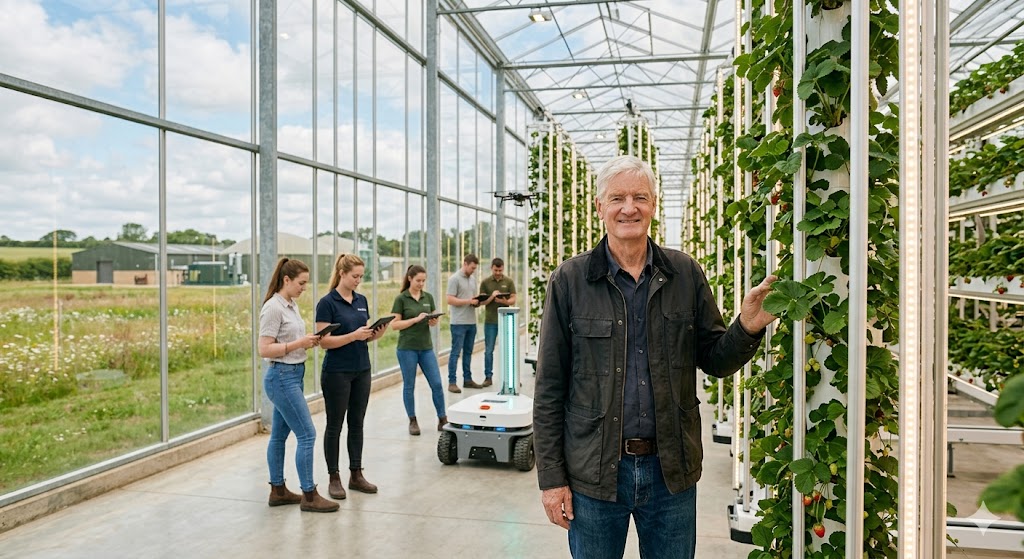
Central to this facility is the implementation of a Hybrid Vertical Growing System (HVGS). Rather than planting traditionally in the ground, rows of strawberries are suspended on advanced, dynamic aluminum rigs that maximize vertical space. These massive structures operate like slow-moving Ferris wheels, rotating the plants to ensure they receive uniform exposure to natural sunlight. By optimizing the three-dimensional footprint of the glasshouse, Dyson Farming generates a 250% increase in yield per square meter compared to traditional flat-field farming methods.
The Integration of Robotics and Automation
Managing over a million plants across a 26-acre footprint requires an entirely new operational framework. Dyson engineers have bridged the gap between agriculture and advanced manufacturing by introducing proprietary automation suites directly to the gutters. Intelligent vision-sensing robots navigate the rows, using machine learning algorithms to calculate the exact color profile and ripeness of individual berries before picking them with absolute precision.
Furthermore, the facility mitigates disease without relying on standard chemical interventions. At night, autonomous rail-guided vehicles traverse the dark aisles, passing targeted ultraviolet (UV-C) light over the foliage to neutralize powdery mildew and mold spores before they can take root. When pests like aphids do emerge, the engineering team deploys biological controls, programmatically releasing predatory insects to establish a natural balance within the micro-climate.
Data-Driven Climate Architecture
Every element of the glasshouse acts as an interconnected sensor node. Advanced climate software dynamically adjusts the glasshouse’s roof vents, internal shading screens, and massive LED growth lamps based on real-time meteorological data. By treating the physical structure as a macro-machine designed to cater to the physiological needs of the plant, Dyson has managed to extend the British strawberry season to a full 12 months, delivering fresh fruit to local markets even in the depths of winter.
IV. The Closed-Loop Ecosystem: The Ultimate Circular Economy
True innovation within complex systems requires us to look beyond immediate outputs and design for industrial symbiosis. A standalone high-tech glasshouse is an engineering achievement; however, if it relies on fossil fuels to maintain its tropical winter temperatures, it fails the test of sustainable experience design. Dyson Farming resolved this challenge by implementing a highly integrated, closed-loop circular economy framework at their Carrington site.
The 26-acre strawberry glasshouse does not burden the local energy grid. Instead, it operates adjacent to a massive, industrial-scale Anaerobic Digestion (AD) plant. This facility processes organic matter—primarily energy crops grown on the surrounding farm alongside organic crop waste from the glasshouse itself—breaking it down using specialized bacteria to produce biogas. This gas is then captured and utilized to drive massive turbines, generating enough clean electricity to power more than 10,000 homes.
The Thermodynamic Cascade
In a standard power plant, the massive amount of heat generated by electricity production is lost to the atmosphere as waste. Dyson’s engineering team viewed this thermal loss as an untapped input. They designed a closed system of insulated subterranean piping to capture this surplus heat from the AD plant’s generators, channeling it directly into the glasshouse structure. This steady, recycled thermal energy maintains the internal climate at an optimal 18–20°C even when outdoor temperatures drop below freezing.
The circularity extends deep into the byproduct architecture of the process:
- Renewable Heat: The thermal energy from the generator cooling systems replaces fossil-fuel heating, mitigating thousands of tons of carbon emissions.
- Nutrient Digestion: The solid and liquid organic residue left over after anaerobic digestion—known as digestate—is treated and used as a nutrient-dense organic fertilizer across Dyson’s 36,000 acres of open-field farming, eliminating the need for synthetic, petroleum-derived fertilizers.
- Carbon Capture: Carbon dioxide emissions from the gas engines are cleaned, cooled, and pumped directly into the glasshouse to accelerate plant photosynthesis during daylight hours.
- Hydrological Security: The glasshouse roof acts as a massive rain catchment system, funneling water into a 50-million-gallon local lagoon to supply the precise, closed-loop drip irrigation network.
“It might seem odd for an industrialist who makes vacuum cleaners, hairdryers and robotics to be interested in farming but I see it as an extension of that. This is all about machinery, mechanics and science improving things, it’s regenerative and it’s the right way to farm.”
— Sir James Dyson
Designing Out the Concept of Waste
By connecting these disparate operational layers—thermodynamics, microbiology, mechanical engineering, and botany—Dyson Farming has created a highly resilient agricultural machine. This ecosystem model proves that the future of sustainability doesn’t lie in reducing our output, but in optimizing the interconnected loops between our inputs, resources, and environments.
V. Futurology & The Human Element: The Future of the Agronomist
When analyzing the future of labor and automation, my strategic foresight research often highlights a concept I call the AI Soft Landing—the intentional transition where automation doesn’t displace the human workforce, but rather elevates it to perform higher-value, more rewarding roles. Agriculture is on the absolute frontline of this shift. Globally, the farming sector faces a profound demographic crisis; in the UK, the average age of an agricultural worker hovers around 59 years old. By shifting the paradigm from manual labor to high-technology operations, Dyson Farming has effectively dropped their average workforce age to 40, turning farming into a highly attractive destination for the next generation of talent.
The employee experience at a modern agri-tech facility looks completely different than it did a generation ago. The workforce is no longer composed solely of manual pickers working under unpredictable skies; instead, the glasshouse is managed by data analysts, drone operators, software engineers, and advanced agronomists. Humans work alongside machine intelligence, using data dashboards to monitor sap flow, track nutrient profiles, and optimize robotic picking schedules. We are witnessing the birth of a new professional class: the tech-driven land steward.
Biodiversity as an Engineering KPI
A true human-centered innovation framework recognizes that humanity cannot thrive unless the surrounding natural ecosystem thrives with it. In a traditional industrial farming setup, maximizing yield often comes at the direct expense of local biodiversity. Dyson’s systems-engineering approach treats the surrounding environment not as an external variable, but as a critical part of the macro-machine that must be carefully maintained.
Across their expansive holdings, biodiversity metrics are tracked with the same rigor as manufacturing outputs. The operation actively manages over 400 kilometers of native hedgerows, establishes extensive wildflower margins to support wild pollinators, and constructs dedicated nesting boxes for barn owls and birds of prey. By utilizing automated data collection and drone surveying, the engineering teams treat soil health, water purity, and wildlife populations as vital key performance indicators (KPIs) of the farm’s long-term commercial sustainability.
“Dyson Farming is developing new approaches to efficient, high-technology agriculture, which we hope will lead to a commercially sustainable future… Sustainable food production, food security and the environment are vital to the nation’s health and the nation’s economy.”
— Sir James Dyson
The Legacy of Participatory Ecosystems
Ultimately, this model proves that top-down design is obsolete in complex ecological and economic systems. By inviting engineers, biologists, and local communities to co-create a localized food production system, Dyson Farming demonstrates how strategic foresight can be grounded in practical, scalable realities. They are redefining what it means to be a custodian of the land in the twenty-first century.
VI. Conclusion: The Blueprint for Cross-Disciplinary Innovation
The transformation of Dyson Farming from an experimental project into a high-yielding, circular agricultural powerhouse offers a profound lesson for leadership across all sectors: true breakthrough innovation rarely happens by staying safely inside your comfort zone. It occurs at the intersection of disciplines, when a proven methodology from one industry is boldly exported to completely rewrite the rules of another.
Sir James Dyson did not attempt to alter the fundamental biological mechanics of how a strawberry grows. Instead, he and his engineering teams used systems thinking and human-centered experience design to re-engineer the entire macro-environment surrounding the plant. By connecting thermodynamics, robotics, and microbiology into a cohesive, closed-loop engine, they transformed a volatile, seasonal gamble into a predictable, localized, and commercially viable reality.
The Takeaway for Tomorrow’s Leaders
As we look to the future, the grand challenges of our era—whether in food security, healthcare, or energy infrastructure—will not be solved by siloed thinking. They require an expansive, ecosystem-wide view that treats waste as an unutilized input and views automation as a tool to elevate the human workforce. Dyson Farming serves as a brilliant blueprint for this exact ethos. It proves that when you possess a relentless desire to fix what is broken, bring manufacturing precision to the natural world, and design with the wider ecosystem in mind, you can build a sustainable, resilient future—one system, and one harvest, at a time.
Frequently Asked Questions: Systems Thinking in Agriculture
How does an engineering company like Dyson transition successfully into commercial farming?
Dyson approached agriculture not as a traditional farming operation, but as an advanced manufacturing and systems engineering challenge. By treating a greenhouse or a field exactly like a factory floor, they mapped their existing core competencies—such as fluid dynamics, thermal management, automation, and robotics—directly onto agricultural friction points. This systemic mindset allowed them to optimize inputs, design out waste, and create a highly predictable, climate-resilient growing process.
What exactly makes Dyson Farming’s strawberry greenhouse a “closed-loop” ecosystem?
The 26-acre glasshouse achieved circular sustainability by integrating directly with an adjacent Anaerobic Digestion (AD) plant. The AD plant processes energy crops and organic waste to generate clean electricity for the local grid. Dyson engineers capture the natural by-products of this process: the waste heat is piped back to warm the glasshouse in winter, the captured carbon dioxide is used to accelerate plant photosynthesis, and the nutrient-dense digestate residue replaces synthetic chemicals as an organic fertilizer for the open fields.
How does advanced agricultural automation impact the human workforce and employment?
Instead of completely displacing human workers, advanced automation elevates the employee experience and shifts workforce demographics. By integrating automated vision-sensing picking robots and autonomous UV-C disease-control rovers, Dyson Farming eliminates grueling, repetitive manual labor. This transforms the traditional agricultural role into high-value career paths, attracting a younger generation of data analysts, software developers, drone pilots, and tech-driven agronomists.
Image credits: Gemini
Content Authenticity Statement: The topic area, key elements to focus on, etc. were decisions made by Braden Kelley, with a little help from Google Gemini to clean up the article, add images and create infographics.
 Sign up here to get Human-Centered Change & Innovation Weekly delivered to your inbox every week.