Why the Great American Contraction is leading to a crisis of demand and a re-imagining of the American Social Contract.
LAST UPDATED: April 17, 2026 at 3:58 PM
GUEST POST from Art Inteligencia
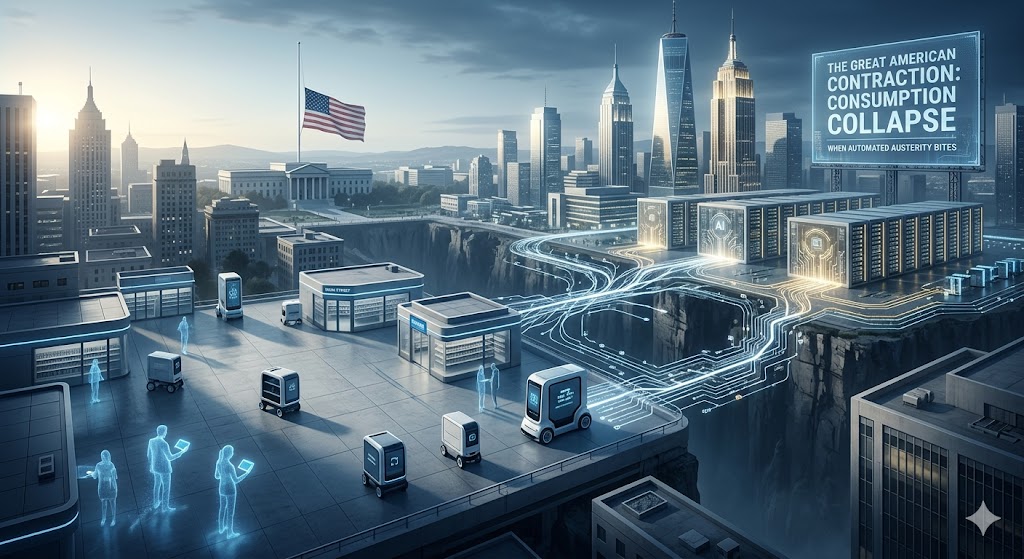
The Ghost in the Shopping Mall
In our previous exploration, “The Great American Contraction,” we identified a fundamental shift in the American story. For the first time in our history, the foundational assumption of “more” — more people, more labor, and more expansion — has been inverted. We discussed how the exponential rise of AI and robotics is dismantling the traditional value chain of human labor, moving us from a nation of “doers” to a necessary, albeit smaller, elite class of “architects.”
However, as we move closer to the two-year horizon of the next United States Presidential election, a more insidious shadow is beginning to fall across the landscape. It is no longer just a crisis of employment; it has evolved into a crisis of consumption. This is the “Feedback Loop of Irrelevance.”
The logic is as cold as the algorithms driving it: As increasing numbers of knowledge workers and service providers are displaced by autonomous agents, their disposable income evaporates. When people lose their financial footing, they spend less. When they spend less, the revenue of the very companies that automated them begins to shrink. To protect their margins in a declining market, these companies are forced to cut back even further — often doubling down on automation to reduce costs — which in turn removes more consumers from the marketplace.
We are witnessing the birth of a deflationary death spiral where corporate efficiency threatens to cannibalize the very markets it was designed to serve. Over the next 24 months, this cycle will redefine the American psyche and set the stage for an election year unlike any we have ever seen.
It is time to look beyond the immediate shock of job loss and examine the structural integrity of our economic operating system. If the “Old Equation” of labor-for-income is a sinking ship, we must decide what happens to the passengers before we reach the horizon of 2028.
The Vicious Cycle of Automated Austerity
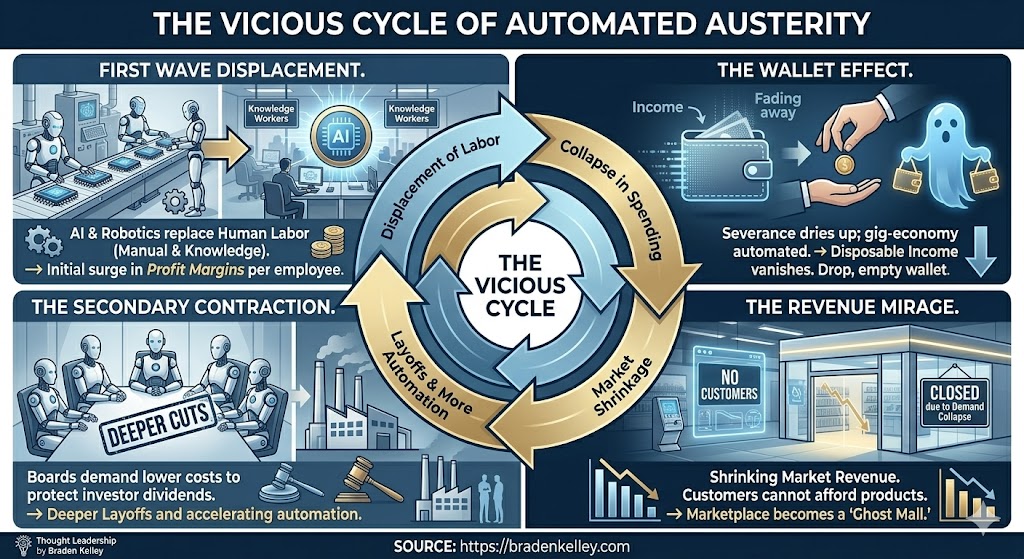
The transition from a growth-based economy to a Great Contraction is not a linear event; it is a recursive loop. As AI adoption accelerates, we are witnessing a phenomenon I call “Automated Austerity.” This is the process where short-term corporate gains from labor reduction lead directly to long-term market erosion. The cycle progresses through four distinct, overlapping phases:
Phase 1: The First Wave Displacement
We are currently seeing the replacement of both low-skilled physical labor and high-skilled knowledge work by autonomous systems. This isn’t just about factory floors; it’s about the “Architect” roles we once thought were safe. As companies replace $150k-a-year analysts with $15-a-month compute tokens, the immediate impact is a massive surge in corporate profit margins.
Phase 2: The Wallet Effect
The friction begins here. Displaced workers initially rely on savings or severance, but as those dry up, the “gig economy” safety net is nowhere to be found — because AI is already performing the freelance writing, coding, and administrative tasks that used to provide a bridge. Disposable income doesn’t just dip; for a significant percentage of the population, it vanishes. This causes a sharp contraction in discretionary spending.
Phase 3: The Revenue Mirage
This is the trap. Companies that automated to save money suddenly find their top-line revenue shrinking because their customers (the former workers) can no longer afford their products. The efficiency gains are real, but the market size is artificial. We are entering a period where companies may be 100% efficient at producing goods that 0% of the displaced population can buy.
Phase 4: The Secondary Contraction
Faced with shrinking revenues, boards of directors demand even deeper cost-cutting to protect investor dividends. This leads to a second, more desperate wave of layoffs, further reducing the tax base and consumer spending power. This feedback loop creates a Deflationary Death Spiral that traditional monetary policy is ill-equipped to handle.
“When you automate the consumer out of a job, you eventually automate the business out of a customer.” — Braden Kelley
Over the next two years, this cycle will move from the periphery of Silicon Valley to the heart of every American household, forcing a radical re-evaluation of how we distribute the abundance that AI creates.
The Two-Year Horizon: 2026–2028
As we navigate the next twenty-four months, the gap between traditional economic indicators and the lived reality of American citizens will become a canyon. We are entering a period of Economic Bifurcation, where the distance between those who own the “compute” and those who formerly provided the “labor” creates a new social stratification.
The Rise of the ‘Hollow’ Recovery
Expect to hear the term “efficiency-led growth” frequently in the coming months. Wall Street may remain buoyant as AI-integrated corporations report record-breaking margins per employee. However, this is a hollow success. While the stock market reflects corporate optimization, our Alternative Economic Health Measures—like the Genuine Progress Indicator (GPI) — will likely show a steep decline. We are becoming a nation that is technically “wealthier” while the average citizen’s ability to participate in that wealth is structurally dismantled.
The Shift from ‘Doer’ to ‘Architect’ Burnout
The “Great American Contraction” is not just about those losing roles; it is about the immense pressure on those who remain. The survivors — the Architect Class — are tasked with managing sprawling AI ecosystems. This creates a new kind of cognitive load. By 2027, I predict we will see a peak in “Technological Burnout,” where the speed of AI-driven change outpaces the human capacity to design for it. This is where Human-Centered Innovation becomes a survival skill rather than a corporate luxury.
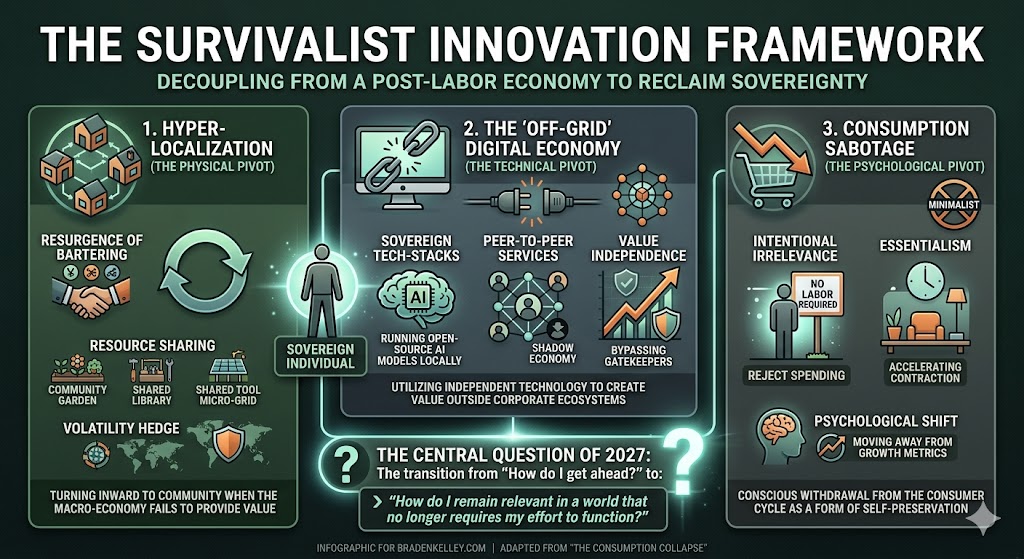
The Mindset of Survivalist Innovation
As the feedback loop of shrinking revenue intensifies, we will see American citizens taking radical actions to decouple from a failing labor market. This includes:
- Hyper-Localization: A resurgence in local bartering and community-based resource sharing as a hedge against the volatility of the automated economy.
- The ‘Off-Grid’ Digital Economy: Individuals utilizing open-source AI models to create value outside of the traditional corporate gatekeepers, leading to a “shadow economy” of peer-to-peer services.
- Consumption Sabotage: A psychological shift where citizens, feeling irrelevant to the economy, consciously reduce their consumption to the bare essentials, further accelerating the contraction.
This period will be defined by a search for meaning in a post-labor world. The American citizen of 2027 is no longer asking “How do I get ahead?” but rather “How do I remain relevant in a world that no longer requires my effort to function?”
Beyond GDP: New Vitals for a Contracting Economy
As the “Old Equation” fails, the metrics we use to measure national success are becoming dangerously obsolete. In a world where AI can drive productivity while simultaneously hollowing out the consumer class, GDP is no longer a compass; it is a rearview mirror. To navigate the next two years, we must shift our focus to alternative economic health measures that prioritize human vitality over transactional velocity.
1. The Genuine Progress Indicator (GPI)
Unlike GDP, which counts the “cost of cleaning up a disaster” as a positive, the GPI factors in income inequality and the social costs of underemployment. As we move toward 2028, we must demand a GPI-centered view of the economy. If AI-driven efficiency creates wealth but destroys the social capital of our communities, the GPI will show we are regressing, providing a much-needed reality check to “hollow” stock market gains.
2. The U-7 ‘Utility’ Rate
Standard unemployment figures (U-3) are increasingly irrelevant. We need a U-7 ‘Utility’ Rate to track those who are “technologically displaced”—individuals whose roles have been absorbed by algorithms or whose wages have been suppressed to the point of working poverty. This metric will highlight the Architect Gap: the growing number of people who have the capacity for high-value human contribution but lack access to the compute resources required to compete.
3. The Social Progress Index (SPI)
The goal of an automated economy should be to improve the human condition. The SPI measures outcomes that actually matter: Access to advanced education, personal freedom, and environmental quality. By 2027, the SPI will be the most honest indicator of whether the Great Contraction is a managed transition to a better life or a chaotic collapse of the middle class.
4. Value of Organizational Learning Technologies (VOLT)
We must begin measuring the “Agility Score” of our nation. VOLT measures how effectively we are using AI to solve complex problems rather than just replacing workers. A high VOLT score paired with a low SPI suggests we are building a “learning machine” that has forgotten its purpose: to serve the humans who created it.
“A high-GDP nation with a crashing Social Progress Index(SPI) is merely a failed state in a gold tuxedo.”
The political battleground of the next two years will be defined by a new set of metrics similar to these (but likely different). The 2028 election will not just be a choice between candidates, but a choice between maintaining the illusion of growth or designing a system of sovereignty for the American citizen.
The Sovereign Tech-Stack & The Localized Pivot
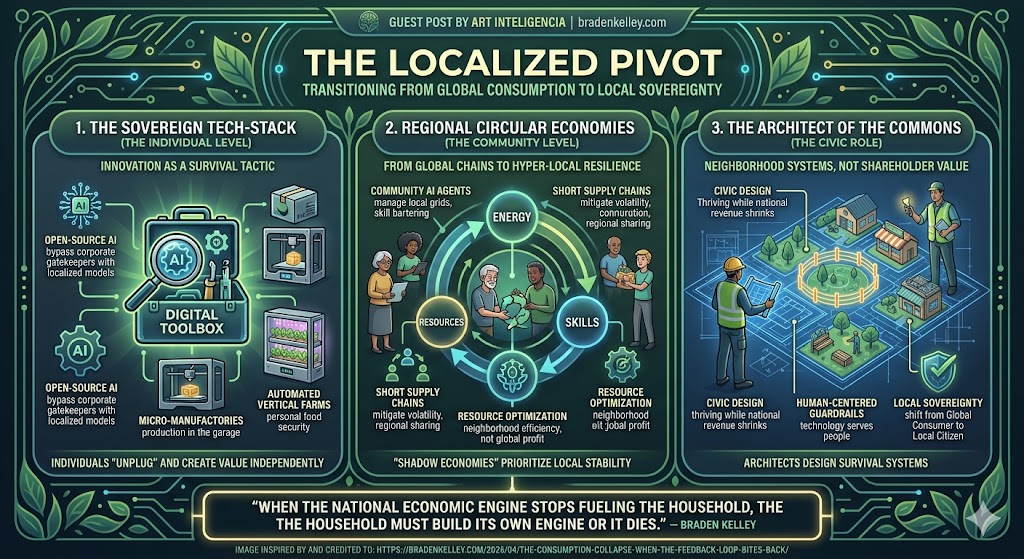
As the “Feedback Loop of Irrelevance” continues to shrink traditional income, we are witnessing a radical grassroots response: The Localized Pivot. When the macro-economy fails to provide value to the individual, the individual stops providing value to the macro-economy and turns inward to their community.
The Rise of the ‘Personal AI’ Infrastructure
By 2027, the barrier to entry for sophisticated production will vanish. We will see a surge in “Sovereign Tech-Stacks” — individuals and small collectives using localized, open-source AI models to run micro-manufactories, automated vertical farms, and peer-to-peer service networks. This is Innovation as a Survival Tactic. These citizens are essentially “unplugging” from the hollowed-out corporate ecosystem and creating a shadow economy that traditional GDP cannot track.
From Global Chains to Hyper-Local Resilience
The contraction of consumer spending will lead to the death of the “long supply chain” for many goods. In its place, we will see the rise of Regional Circular Economies. AI will be used not to maximize global profit, but to optimize local resource sharing. Imagine community AI agents that manage local energy grids or coordinate the bartering of skills — human-centered design at its most fundamental level.
The ‘Architect’ of the Commons
In this phase, the “Architect” role I’ve discussed previously becomes a civic one. These are the individuals who design the systems that keep their communities thriving while the national revenue shrinks. They are the ones building the Human-Centered Guardrails that ensure technology serves the neighborhood, not the shareholder. This shift represents a move from Global Consumerism to Local Sovereignty.
“When the national economic engine stops fueling the household, the household must build its own engine, or it dies.” — Braden Kelley
This localized movement will be the wild card of 2028. It creates a class of “Un-Architected” citizens who are no longer dependent on the federal government or major corporations, creating a profound tension for any political candidate trying to promise a return to the ‘Old Equation’.
The Road to 2028: The Politics of Human Relevance
As we approach the next Presidential election, the political discourse will undergo a seismic shift. The traditional “Left vs. Right” battle lines over tax rates and social issues will be superseded by a more existential debate: The Individual vs. The Algorithm. The 2028 election will likely be the first in history centered entirely on the consequences of a post-labor economy.
The ‘Humanity First’ Tax and Sovereign Solvency
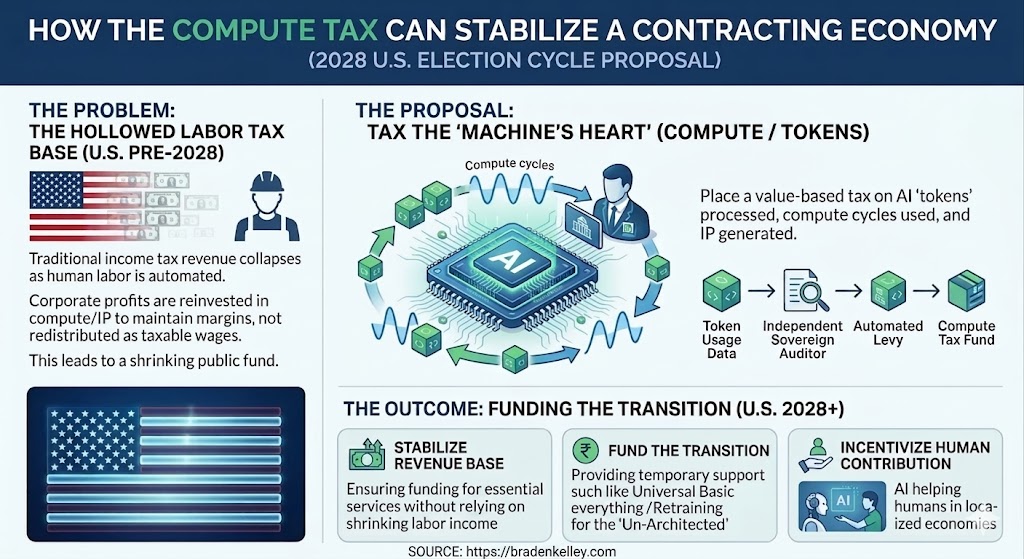
The most contentious issue will be how to fund a shrinking state as the labor-based tax system collapses. We will see the rise of the “Compute Tax” — a proposal to tax AI tokens and robotic output rather than human hours. This isn’t just about revenue; it’s about sovereign solvency. When companies reinvest profits into compute rather than wages, the “Economic OS” crashes. Expect candidates to run on a platform of Universal Basic Everything (UBE) — providing the results of automation (healthcare, housing, and energy) directly to the people as the tax base from labor vanishes.
The Death of Traditional Immigration Debates
As I noted in our initial look at the Contraction, the old argument about immigrants “taking jobs” or “filling gaps” is dead. In 2028, the focus will shift to “Strategic Talent Acquisition.” The debate will center on how to attract the world’s few remaining irreplaceable “Architect” minds while managing a domestic population that is increasingly surplus to the needs of capital. This will create a strange political alliance between protectionists and humanists, both seeking to shield human value from digital devaluation.
Mindset and Likely Actions of the Citizenry
By the time voters head to the polls, the American mindset will have shifted from aspiration to preservation. We are likely to see:
- The Rise of ‘Neo-Luddite’ Activism: Not a rejection of technology, but a demand for “Human-Centered Guardrails” that prevent AI from cannibalizing the last remaining sectors of human connection.
- The Search for Non-Monetary Meaning: A surge in candidates who focus on “Quality of Life” metrics rather than fiscal growth, appealing to a class of people who no longer derive their identity from their “job.”
- Algorithmic Populism: Politicians using AI to personalize fear and hope at scale, creating a feedback loop where the technology used to displace the worker is also used to win their vote.
The central question of the 2028 election will be simple but devastating: “What is a country for, if not to support the thriving of its people — even when those people are no longer ‘productive’ in a traditional sense?” The winner will be the one who can design a new social contract for a smaller, more resilient, and truly innovative nation.
Conclusion: Designing a Thrivable Contraction
The Great American Contraction is no longer a theoretical “what-if” for futurists to debate; it is an active restructuring of our reality. As the feedback loop of automated austerity begins to bite, we are discovering that a country built on the relentless pursuit of “more” is fundamentally ill-equipped to handle the arrival of “enough.”
The next two years will be a period of intense friction as our legacy systems — our tax codes, our education models, and our social safety nets — grind against the frictionless efficiency of the AI era. We will see traditional economic metrics fail to capture the quiet struggle of the consumer, and we will watch as the 2028 election turns into a referendum on the value of a human being in a post-labor world.
But contraction does not have to mean collapse. If we shift our focus from transactional velocity to human vitality, we have the opportunity to design a new version of the American Dream. This new dream isn’t about the quantity of jobs we can protect from the machines, but the quality of the lives we can build with the abundance those machines create. It is about moving from a nation of “doers” who are exhausted by the grind to a nation of “architects” who are inspired by the possible.
“The goal of innovation was never to replace the human; it was to release the human. We are finally being forced to decide what we want to be released to do.” — Braden Kelley
The road to 2028 will be defined by whether we choose to cling to the wreckage of the growth-based model or whether we have the courage to embrace a smaller, smarter, and more human-centered future. The contraction is inevitable, but the outcome is ours to design.
STAY TUNED: On Tuesday my friend Braden Kelley (with a little help from me) is publishing an article featuring one hypothesis for what an AI SOFT LANDING might look like.
Image credits: Google Gemini
 Sign up here to get Human-Centered Change & Innovation Weekly delivered to your inbox every week.