GUEST POST from Chateau G Pato
The Hook: The Planning Illusion (Why Gantt Charts Fail in Exponential Times)
Ask a room of executive leaders a simple, uncomfortable question: How much of your current annual strategic plan was rendered obsolete within 90 days of being approved? In most organizations, the room goes quiet.
The Trap of Predictability
Traditional strategic planning is built on an inherited industrial assumption: that the future is a linear, predictable extrapolation of the past. We spend months huddled in boardrooms crafting immaculate five-year forecasts, locking resources into static Gantt charts, and treating deviations from the plan as operational failures. But in an era of exponential technological, social, and market shifts, over-investing in rigid plans doesn’t create security—it creates blind spots. It wastes an organization’s scarcest, non-renewable resource: time.
The Diagnosis Error
When disruption hits, the typical leadership reflex is to double down on execution. Leaders commit a fundamental diagnosis error: they treat all change the same. They apply slow, sequential, top-down “planned change” playbooks to sudden, volatile, and complex external shifts. They try to manage a chaotic reality with a toolset designed for a clockwork universe.
The Shift
Winning organizations understand that the future cannot be predicted; it must be navigated. The competitive advantage no longer belongs to those who craft the most detailed map of a static world, but to those who can pivot the fastest when the terrain changes. It requires a fundamental shift: moving away from Plan-and-Execute and toward Sense-Learn-Adapt—building the continuous organizational reflexes required to get to the future first.
The Velocity of Organizational Learning: Three Core Pillars
To learn faster than you plan, learning cannot remain trapped inside a siloed HR portal or a once-a-year innovation bootcamp. High-velocity learning must be architected directly into how daily work gets done. Organizations that consistently out-adapt their competitors build this capability across three human-centered pillars:
1. Sensing the Future Before It Arrives (Foresight over Forecasting)
Traditional forecasting relies on historical data—meaning leaders are trying to drive forward while staring exclusively into the rearview mirror. By the time a trend shows up in a quarterly financial report, the window to lead it has already closed.
- Building a Global Sensing Network: Your sharpest early-warning system isn’t an external analyst report; it is the people working at the edges of your organization. By empowering frontline employees—especially your natural Customer Champions—to act as active radar systems, you capture weak signals, shifting behaviors, and emerging friction points in real time.
- Applying FutureHacking™: Passive trend-watching isn’t enough. Through FutureHacking™, teams actively explore multiple plausible future scenarios and backcast from those possibilities to identify what the organization must test and learn today to shape the future rather than merely react to it.
2. Designing for Human Adoption, Not Just Technical Delivery
Roughly 70% of change and transformation initiatives fail, and the root cause is rarely technical. Organizations obsess over what to build—new software, new workflows, new strategies—while ignoring the human dynamics of who has to adopt it.
- The Critical Diagnostic Question: Whenever you introduce a shift, ask one question before writing a single project milestone: Does this change require people to learn something new, or does it ask them to give something up? Learning a new skill is a training challenge; giving up status, familiar habits, identity, or organizational turf is a deeply human change challenge that no Gantt chart can solve.
- Replacing Slide Decks with Visual Thinking: Dense, 80-page strategy decks create the illusion of alignment while hiding blind spots. Replacing linear documents with collaborative visual tools—such as the Change Planning Canvas™—allows cross-functional teams to see the entire system on one page, surface hidden resistance early, and co-create the path forward together.
3. Balancing Exploration and Execution Through Human Strengths
Organizational learning stalls when leaders either ask everyone to think the exact same way or over-index on brainstorming without a disciplined path to execution. True agility requires orchestrating diverse cognitive strengths.
- Leveraging the Nine Innovation Roles: High-learning teams intentionally balance Revolutionaries and Artists—who challenge sacred cows and generate fresh possibilities—with Customer Champions, Troubleshooters, and Connectors who test assumptions against reality, clear operational roadblocks, and scale validated learning across silos.
- The Value Innovation Equation: An insight or prototype only becomes true innovation when it satisfies three multiplied variables: Innovation = Value Creation × Value Access × Value Translation. Because they are multiplied, a zero in any category zeroes out the entire effort. Organizational learning doesn’t count until customers and employees can actually access and clearly understand the new value you have created.
Experience Design as a Continuous Feedback Loop
Too many organizations still treat Customer Experience (CX) and Employee Experience (EX) as backward-looking report cards—something measured once a year through Net Promoter Scores or engagement surveys, discussed in a quarterly review, and promptly filed away. When you are trying to learn faster than you plan, annual scorecards are post-mortems, not steering wheels.
Every Touchpoint is a Learning Experiment
In an adaptive, human-centered enterprise, experience design is not a cosmetic layer applied at the end of a project; it is your primary sensing and learning mechanism. Every interaction a customer or employee has with your brand, product, or workflow is a live experiment generating real-time feedback on whether your assumptions match human reality.
Walking the Moments That Matter
To turn experience into organizational velocity, leaders must move beyond static journey maps gathering dust on a wall and commit to continuous Customer Experience Audits. By regularly walking the end-to-end journey through the eyes of the customer, teams can compare actual operational reality head-to-head against rapidly shifting expectations. Every point of friction, confusion, or workaround isn’t merely a service failure to patch—it is a flashing neon sign pointing directly toward an unmet need and your next innovation opportunity.
Closing the EX-CX Loop
You cannot deliver an agile, human-centered customer experience on the outside if your people are trapped inside rigid, bureaucratic workflows on the inside. Employee Experience and Customer Experience are two halves of the same continuous learning loop. When frontline teams are bogged down by legacy approval chains or penalized for surfacing bad news, learning stops at the edge of the organization. By designing internal systems for psychological safety, visual clarity, and rapid iteration, you empower the people closest to the customer to turn daily insights into immediate improvements.
From One-Off Projects to Continuous Capability (The Playbook)
Recognizing that learning beats planning is one thing; rewiring how an organization actually allocates time, money, and attention is another. Leaders don’t need another sweeping reorganization to start building higher learning velocity. Instead, they can embed a practical, four-step operating cadence into their existing teams:
-
Audit Your Change & Innovation Maturity
Before launching another transformation initiative, diagnose the system you already have. Identify where legacy governance, risk aversion, or missing cognitive strengths—like a shortage of Connectors or Troubleshooters—are quietly bottlenecking how fast insights move from the edges of the business to decision-makers.
-
Shift from Project Charters to Learning Charters
Traditional project charters lock teams into premature promises around fixed deliverables, timelines, and ROI before a single assumption has been tested in the real world. Require every major initiative to begin with a Learning Charter that explicitly names its riskiest human and market assumptions alongside the fastest, lowest-cost experiments required to validate or invalidate them before unlocking full-scale funding.
-
Institutionalize Visual Alignment
Strategy dies in translation between the boardroom and the front lines. Replace static status reports and siloed spreadsheets with shared visual canvases—such as the Change Planning Canvas™—so cross-functional teams can see customer friction, change impacts, and active experiments on a single shared surface, turning alignment into a living conversation rather than a quarterly readout.
-
Reward Validated Learning, Not Just Plan Adherence
People repeat what gets recognized and funded. If leaders only celebrate hitting predetermined milestones, teams will hide inconvenient customer truths to protect their budgets. Rebalance leadership incentives so that surfacing a critical market shift early—or killing a flawed assumption before millions are wasted—is celebrated just as visibly as hitting a quarterly target.
Conclusion: Getting to the Future First
Static plans begin decaying the very moment they make contact with human reality, whereas organizational learning compounds. Every weak signal captured at the edge, every assumption tested early, and every visual conversation that aligns people around real customer friction builds a durable capability that no competitor can easily copy from a slide deck.
A Final Challenge for Leaders
The next time you sit down to review strategy with your leadership team, resist the urge to polish the timeline or debate the third decimal place on a five-year forecast. Stop asking, “Is our plan airtight?” Instead, ask the question that will actually determine whether your organization thrives in the decade ahead:
“How fast can we sense a shift, test an assumption, and align our people around what we just learned?”
Because in a world that refuses to sit still, the ultimate competitive advantage isn’t having the best plan—it’s being the fastest learner in the room.
Frequently Asked Questions
Why do traditional strategic plans fail in fast-changing environments?
Traditional strategic plans assume the future is a linear, predictable extension of the past. In exponential, volatile markets, static five-year forecasts and rigid Gantt charts quickly lose contact with reality—creating blind spots, slowing down organizational reflexes, and wasting an organization’s scarcest resource: time.
What does it mean for an organization to learn faster than it can plan?
Learning faster than you plan means shifting from a rigid Plan-and-Execute model to a continuous Sense-Learn-Adapt operating rhythm. Instead of relying on annual forecasts, organizations empower frontline employees to spot weak signals early, use visual thinking tools to align cross-functional teams, and run rapid, low-cost experiments to validate assumptions before scaling.
How can leaders start replacing rigid planning with continuous learning?
Leaders can start with four practical shifts: auditing their organization’s change and innovation maturity, replacing fixed project charters with assumption-testing Learning Charters, using shared visual canvases to eliminate strategy translation loss, and rewarding teams for validated learning—including killing flawed assumptions early—rather than solely rewarding adherence to a static plan.
Bottom line: Futurology is not fortune telling. Futurists use a scientific approach to create their deliverables, but a methodology and tools like those in FutureHacking™ can empower anyone to engage in futurology themselves.
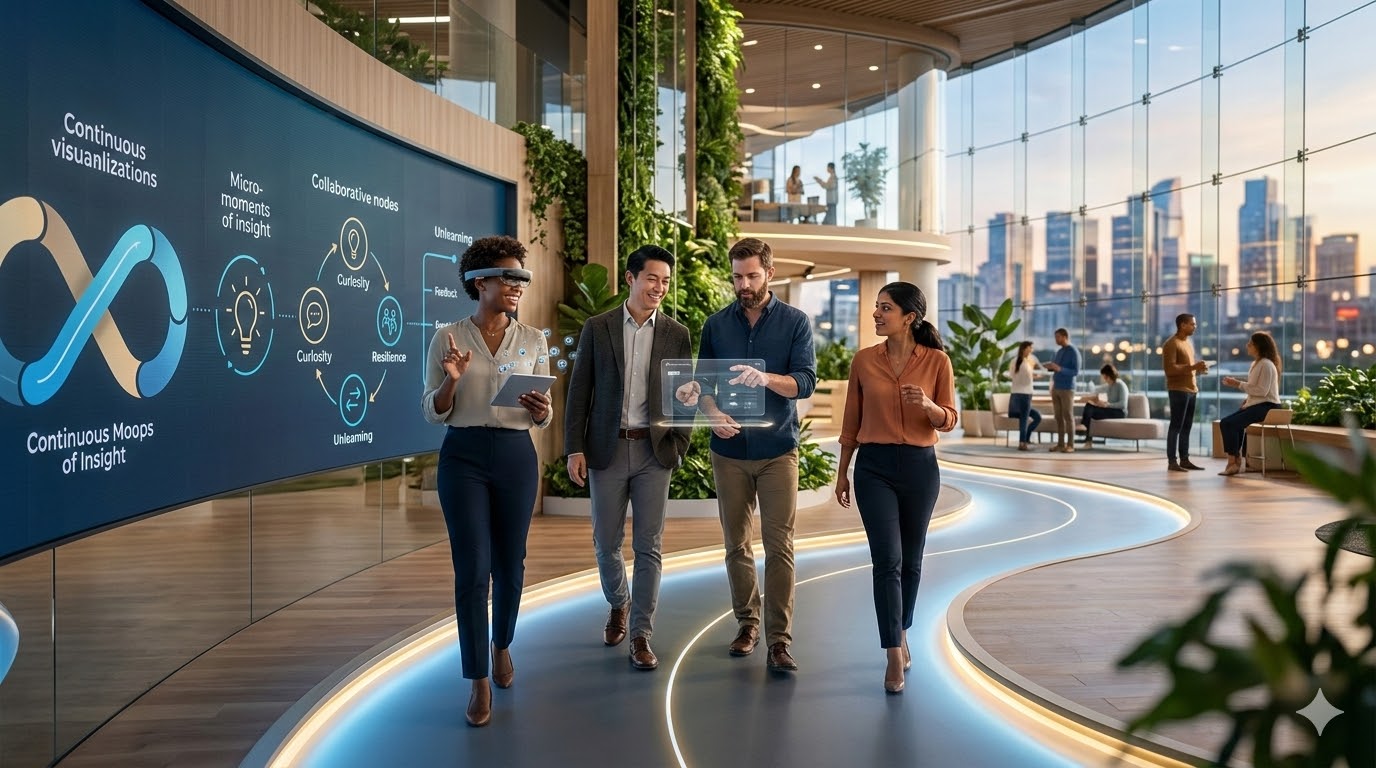
Image credit: Gemini
 Sign up here to get Human-Centered Change & Innovation Weekly delivered to your inbox every week.