GUEST POST from Chateau G Pato
I. Hook & Core Premise
The Shift from Tool to Terrain
For decades, technology existed as a suite of tools—discrete applications designed to execute specific tasks at the command of human operators. Today, we are witnessing a fundamental paradigm shift: artificial intelligence is no longer merely a tool we deploy, but the underlying terrain on which modern society operates. Intelligence is transitioning into foundational infrastructure, as essential and ubiquitous as electricity, clean water, or physical transit networks. As organizational workflows, decision-making systems, and value creation models are woven directly into algorithmic fabrics, we cease to simply use AI; we inhabit its ecosystem.
The Neo-Feudal Metaphor
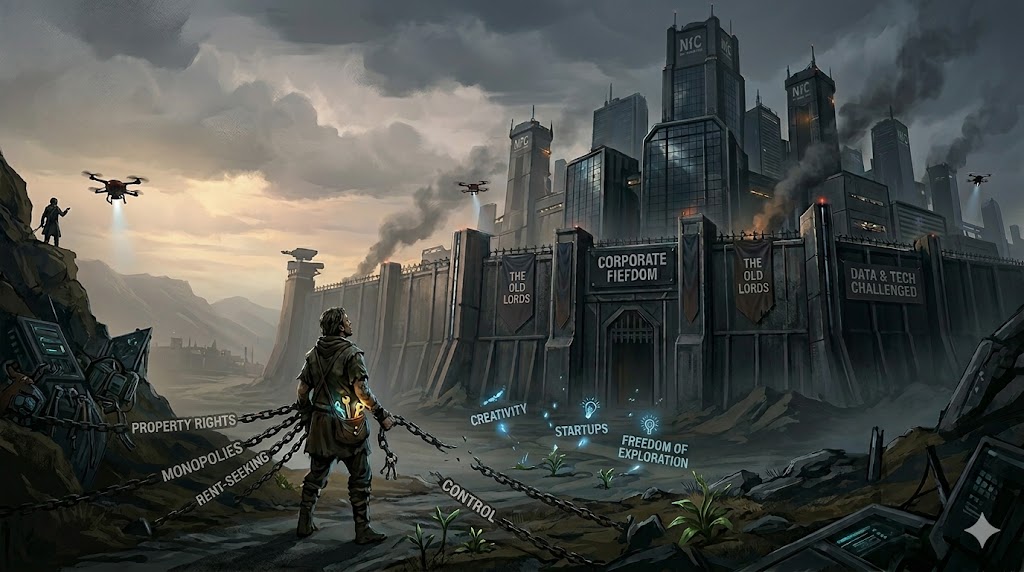
This structural evolution brings a striking historical parallel into focus: the emergence of a Neo-Feudal AI Economy. In this emerging landscape:
- Digital Lords: A small group of hyperscale platform monopolies control the essential raw materials—massive GPU clusters, energy resources, proprietary datasets, and foundational models.
- Digital Fiefdoms: Walled ecosystems dictating the terms of access, compute distribution, and algorithmic reach.
- Digital Serfs: Knowledge workers, creative professionals, and enterprises who build their livelihoods on top of these proprietary models, perpetually dependent on platforms they neither own nor control.
The Central Thesis
When intelligence becomes infrastructure, power inevitably concentrates among those who own and govern that infrastructure. Left unchecked, this concentration risks creating systemic economic disenfranchisement and eroding human agency. However, technology is not destiny. By intentionally applying human-centered design, open innovation frameworks, and proactive change leadership, we can transform intelligence from a consolidated gatekeeping mechanism into an empowering public utility—one that amplifies human ingenuity rather than replacing it.
II. The Four Pillars of the Neo-Feudal AI Architecture
To understand how power consolidates within an economy powered by synthetic intelligence, we must analyze the structural mechanics of its architecture. Much like medieval feudalism rested on land ownership, lord-vassal contracts, and agrarian rents, the Neo-Feudal AI Economy is built upon four foundational pillars that dictate how value, leverage, and agency are distributed.
1. Compute & Data as the New Land (The Digital Estates)
In this new paradigm, compute capacity and frontier data are the primary assets of economic production. The capital expenditures required to build, power, and maintain gigawatt-scale data centers create immense barriers to entry. Hyperscalers and platform sovereigns effectively own the modern equivalent of prime arable land:
- Infrastructure Enclosure: Access to cutting-edge silicon clusters, cooling infrastructure, and power grids is concentrated among a handful of tech monopolies.
- Data Enclosure: Raw human culture, intellectual property, and institutional knowledge have been harvested into proprietary training corpuses, transforming public information into privatized intelligence platforms.
2. Algorithmic Rent-Seeking (Tolls on the Knowledge Superhighway)
The traditional software business model—purchasing licenses or building in-house capability—is giving way to perpetual cognitive rent. As artificial reasoning becomes embedded in every business process, organizations must pay a continuous toll to access foundational intelligence:
- API Rents & Model Dependencies: Companies pay per token or per agent interaction, shifting operational budgets toward foundational platform owners.
- The Platform Paradox: Businesses build solutions on top of third-party platforms, only to see their margins squeezed as platform lords adjust pricing, usage terms, or capabilities at will.
3. The Erosion of Middle-Tier Innovation
In a standard market, mid-sized enterprises and specialized software vendors serve as engines of competition and job growth. In a Neo-Feudal AI Economy, these middle-tier players face severe structural vulnerability:
- Tenant Farmer Dynamics: Mid-tier innovators become tenant farmers, cultivating niche applications on land owned by platform lords.
- Sherlocking & Platform Absorption: When a tenant develops a lucrative application or workflow, the underlying platform lord can natively integrate the feature, rendering the tenant’s business model obsolete overnight.
4. The Frictionless Dislocation of Human Capital
The most critical human-centered impact of this architectural shift is the rapid commoditization of cognitive labor. When foundational intelligence becomes an abundant commodity, traditional knowledge-work career ladders dissolve:
- Skills Obsolescence Velocity: Cognitive tasks—from coding and synthesis to analysis and design—are automated faster than traditional educational or organizational systems can adapt.
- Erosion of Autonomy: Knowledge workers are increasingly managed by, or forced to conform to, algorithmic systems, reducing human experts to mere supervisors of platform-driven workflows.
III. Experience Design in a Gated Intelligence World
As intelligence becomes embedded infrastructure, the practice of experience design reaches a pivotal crossroads. For decades, human-centered design has focused on reducing friction, optimizing usability, and fostering delight. However, when every interface, service touchpoint, and operational workflow is mediated by proprietary AI models, experience design must evolve to confront deeper systemic challenges: the preservation of human agency, qualitative nuance, and authentic empathy.
Customer & Employee Experience (CX/EX) Under Algorithmic Sovereignty
When organizations rely on standardized, off-the-shelf foundation models to drive customer service, onboarding, internal communications, and decision support, a subtle homogenizing effect takes hold. The experience layer risks becoming flattened into a uniform, algorithmically optimized grayness:
- Homogenization of Brand Identity: As AI agents handle end-to-end interactions using shared base models, brands lose their unique voice, cultural resonance, and distinct human character.
- Algorithmic Bureaucracy in Employee Experience: Internal workflows dictated by prescriptive AI managers can reduce workers to execution units, stripping away autonomy, personal craftsmanship, and intrinsic motivation.
The Threat to Human Agency
Modern experience architecture too often prioritizes hyper-convenience over human empowerment. By delegating cognitive choice, critical reflection, and creative synthesis entirely to background algorithms, design patterns risk inducing cognitive passivity:
- Illusion of Choice: Users and employees are presented with algorithmically curated options that direct outcomes toward platform-preferred paths rather than genuine human intent.
- Atrophy of Critical Thinking: Over-reliance on predictive suggestions creates a “deskilling feedback loop,” where human operators gradually lose the capacity to question, validate, or override automated outputs.
Designing for Intentional Friction
To counter the passive drift of gated intelligence, experience designers must champion “intentional friction”—deliberate design interventions that pause the automated flow to invite reflection, human judgment, and moral reasoning:
- Human-in-the-Loop Architecture: Designing explicit checkpoints where human intuition, ethical assessment, and qualitative context are required before high-stakes decisions are finalized.
- Designing for Co-Creation over Automation: Shifting the design paradigm from passive task-completion engines to active cognitive scaffolds that augment, challenge, and elevate human capability rather than replacing it.
IV. Human-Centered Change Leadership for the AI Era
Navigating the transition into an economy anchored by intelligent infrastructure requires a fundamental reset in how we approach organizational transformation. Technocratic approaches to change management treat technology adoption as an end in itself—forcing human systems to bend around software architectures. In a world of exponential platform shifts, true leadership demands a human-centered change framework that prioritizes human dignity, organizational agility, and strategic resilience.
Moving Beyond Technological Determinism
Technological determinism suggests that the trajectory of artificial intelligence is fixed and unyielding—that society and organizations must passively adapt to whatever AI platforms dictate. Human-centered change leaders reject this premise:
- Agency Over Automation: Technology defines what is technically possible, but human leadership, policy, and design determine what is desirable, ethical, and valuable.
- Intentional Adoption: Leaders must evaluate AI capabilities not through the lens of cost-cutting alone, but through how well they strengthen core organizational values, customer trust, and long-term capability.
Reframing Change Management for Accelerated Shifts
Linear, episodic change models (e.g., Unfreeze-Change-Refreeze) are woefully inadequate for an era defined by continuous model updates, autonomous agentic systems, and rapid platform evolution. Organizations require a persistent capability for continuous adaptation:
- Continuous Change Capability: Transitioning from viewing change as a disruption to viewing change capacity as a core operational muscle and competitive advantage.
- Adaptive Organizational Architecture: Building flexible team structures, modular workflows, and psychological safety nets that allow employees to experiment, iterate, and pivot alongside evolving tools.
Preserving Human Dignity and Purpose
When cognitive tasks are automated at scale, the primary risk to organizations is not just skill gap dislocation, but a crisis of human purpose and engagement. Leadership must consciously orchestrate the repositioning of human talent:
- Elevating Humans to Choreographers: Shifting worker identity from task executioners to strategic choreographers—guiding AI output, injecting qualitative context, and applying ethical judgment.
- Value Creation Through Uniquely Human Qualities: Doubling down on human-centric traits that algorithms cannot replicate: empathy, contextual curiosity, moral reasoning, and cross-disciplinary innovation.
V. A Manifesto for Open Innovation & Distributed Intelligence
If the current trajectory of centralized AI infrastructure goes unchecked, the concentration of economic power will inevitably yield a modern digital feudalism. Reclaiming human agency and economic dynamism requires an intentional strategy: counterbalancing gated platforms with open, decentralized, and human-centered innovation models. Below is a framework for resisting algorithmic enclosure and building a more resilient, distributed intelligence ecosystem.
Neo-Feudal Risks vs. Human-Centered Innovation Countermeasures
| Neo-Feudal Risk | Human-Centered Innovation Countermeasure |
|---|---|
| Monopolization of Reasoning: Power concentrated in proprietary, black-box foundational models. | Open-Source & Decentralized AI: Investing in open weights, localized compute networks, and open-source foundation models to democratize access to reasoning. |
| Algorithmic Dependency: Complete reliance on third-party platform rules, APIs, and shifting pricing models. | Data Sovereignty & Custom Architectures: Curating proprietary domain data assets and deploying fine-tuned, owned agent architectures. |
| Worker Displacement: Commoditization and elimination of human knowledge roles. | Continuous Capability Mapping: Building co-creative human-AI workflows that treat synthetic intelligence as an augmentative capability, not a substitute for human ingenuity. |
| Homogenized Output: Bland, standardized customer and employee experiences driven by generic models. | Differentiated Experience Design: Double down on human empathy, craft, contextual nuance, and distinct brand character. |
Fostering Public & Open-Source Intelligence Assets
Just as physical infrastructure—highways, water systems, and communication grids—relies on public oversight to prevent monopoly exploitation, foundational cognitive infrastructure must be treated as a public good:
- Digital Commons & Shared Datasets: Establishing public digital trusts and open-data repositories that ensure equitable access to non-proprietary training data.
- Democratized Compute Utilities: Supporting public compute initiatives, open-source frameworks, and edge-device processing to reduce total reliance on hyperscale monopolies.
Ecosystem Co-Creation
Challenger enterprises, mid-tier companies, and independent innovators cannot compete against tech sovereigns in isolation. Resilience lies in collaborative networks:
- Open Innovation Ecosystems: Pooling industry-specific expertise, data, and specialized agents across organizations to create shared value networks rather than walled gardens.
- Interoperable Standards: Championing open standards for AI agent communication, data portability, and model evaluation to ensure enterprise mobility and prevent platform lock-in.
VI. Conclusion & Call to Action
We stand at a critical inflection point in the history of human enterprise. The transformation of artificial intelligence from discrete software applications into foundational infrastructure is not merely a technological shift; it is a profound economic and social restructuring. Left to default market forces and hyper-concentrated capital, this transition will naturally gravitate toward digital feudalism—a world where a small oligarchy of platform sovereigns extracts rent on human thought while workers and organizations operate as precarious digital tenants.
The Choice Ahead
However, the outcome of this transformation is not predetermined. Technology reflects the values, structures, and choices of those who design and deploy it. We face a defining fork in the road:
- The Passive Path: Allowing intelligence to become a gated, consolidated monopoly that homogenizes human experience, erodes agency, and accelerates economic inequality.
- The Intentional Path: Harnessing intelligence as an empowering, accessible utility—a cognitive scaffold designed to expand human potential, foster open innovation, and democratize economic opportunity.
The Leader’s Imperative
Transforming intelligence infrastructure into a force for broad-based human empowerment requires immediate, proactive leadership across every discipline:
- Executive Leaders: Resist total algorithmic reliance. Invest in proprietary domain assets, build adaptive organizational architectures, and champion business models that share created value across your human ecosystem.
- Innovators & Strategists: Build beyond the walled gardens. Engage in open ecosystems, leverage decentralized models, and reject zero-sum competition in favor of co-created industry value networks.
- Experience Designers & Change Leaders: Champion the human element. Design for intentional friction, preserve critical human reflection, and construct workflows that elevate knowledge workers into strategic choreographers of synthetic intelligence.
As intelligence becomes the infrastructure of our world, our highest mandate is clear: we must ensure that human ingenuity, dignity, and agency remain the ultimate purpose of that infrastructure.
Frequently Asked Questions
What is the Neo-Feudal AI Economy?
The Neo-Feudal AI Economy refers to an economic model where artificial intelligence transitions from a standalone tool into foundational infrastructure. In this system, power and capital concentrate among a small group of platform monopolies (“Digital Lords”) who control compute, energy, proprietary datasets, and foundation models, while businesses and knowledge workers operate as dependent tenants (“Digital Serfs”) paying ongoing cognitive rent.
Why is AI considered an infrastructure rather than just software?
AI is becoming infrastructure because modern workflows, business logic, customer interactions, and decision-making systems are being built directly on top of foundational models and compute grids. Like electricity or water utilities, access to artificial intelligence is becoming essential for basic participation in the modern digital economy.
How can leaders prevent algorithmic enclosure and protect human agency?
Leaders can counter algorithmic enclosure by adopting human-centered change leadership, investing in open-source foundation models and decentralized compute, maintaining proprietary data sovereignty, and designing experiences that preserve intentional friction and human-in-the-loop decision-making.
SPECIAL BONUS: Braden Kelley’s Problem Finding Canvas can be a super useful starting point for doing design thinking or human-centered design.
“The Problem Finding Canvas should help you investigate a handful of areas to explore, choose the one most important to you, extract all of the potential challenges and opportunities and choose one to prioritize.”
Image credit: Gemini
 Sign up here to get Human-Centered Change & Innovation Weekly delivered to your inbox every week.