GUEST POST from Chateau G Pato
I. Introduction: The Fallacy of the Technological Silver Bullet
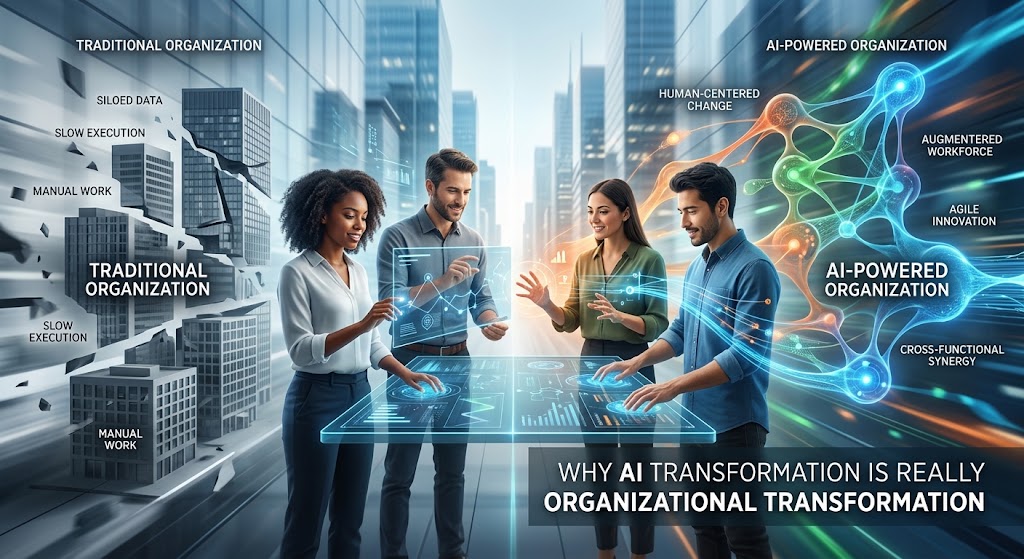
Organizations around the globe are rushing to integrate Artificial Intelligence into their operations, pouring massive budgets into enterprise licenses, algorithmic models, and pilot projects. Yet, despite the unprecedented speed of AI adoption, a troubling pattern has emerged: the vast majority of these initiatives stall out, failing to deliver measurable, sustainable business value. The fundamental reason for this breakdown is not technical inefficiency—it is a perspective flaw. Leaders are attempting to solve an organizational challenge using a software deployment playbook.
Treating AI as a simple IT upgrade traps enterprises in “pilot purgatory.” When technology is deployed in isolation, without addressing the underlying organizational dynamics, it generates isolated experiments rather than scalable capability. Algorithms do not create enterprise value on their own; value is realized only when human beings adapt their habits, decisions, and workflows around new possibilities. True transformation requires moving past the silver-bullet mindset to recognize that technology is merely the catalyst—the real work lies in organizational redesign.
At its core, AI transformation is a human enterprise. Shifting from incremental automation to genuine strategic advantage demands a focus on culture, mindset, and cross-functional alignment. To unleash the full potential of AI, leadership must look beyond the toolset and anchor their strategy in Human-Centered Change™, ensuring that as machines evolve, the organization’s human capacity evolves alongside them.
II. Re-Anchoring AI in Value Creation, Translation, and Access
The core failure of many AI initiatives stems from a fundamental misunderstanding of value dynamics. Organizations routinely collect disjointed AI use cases—a customer service chatbot here, an automated summarization tool there—confusing random activity with strategic progress. Collecting tools without a unifying framework is merely procrastination dressed up as progress. To drive meaningful organizational transformation, AI deployments must be anchored directly into how an enterprise creates, translates, and accesses value.
1. Value Creation: Solving Core Strategic Challenges
Value creation begins by asking the right business questions rather than searching for problems to fit a newly purchased algorithm. Instead of aiming for incremental speedups in low-impact tasks, organizations must deploy AI to unlock new market opportunities, solve previously intractable operational bottlenecks, and enhance core offerings. True AI-driven value creation fundamentally expands what the enterprise is capable of delivering to its customers and stakeholders.
2. Value Translation: Connecting Capability to Workflow
Possessing advanced AI models offers zero strategic advantage if frontline teams cannot translate that algorithmic intelligence into daily action. Value translation bridges the gap between raw technological output and operational decisions. It requires articulating precisely how AI tools integrate into existing job roles, workflows, and decision-making governance. Without deliberate translation, high-potential AI tools become complex, unused novelties that fail to alter the trajectory of the business.
3. Value Access: Removing Organizational Friction
Finally, value access focuses on democratizing intelligence across cross-functional teams while maintaining proper governance. Organizational silos, legacy permissions, and fragmented data architectures frequently prevent teams from accessing and scaling AI outcomes. Transforming an organization with AI means removing the structural, cultural, and technical friction that prevents workforce members from seamlessly leveraging insights, collaborating across functions, and scaling proven solutions enterprise-wide.
III. The Human-Centered Change™ Imperative
Technology alone never changes an organization; human beings adapting their daily behavior do. If employees view Artificial Intelligence as an existential threat or a convoluted burden imposed by leadership, even the most sophisticated systems will produce resistance rather than results. Navigating an AI transformation requires a deliberate pivot toward Human-Centered Change™—focusing on workforce fluency, psychological safety, and clear, visual change frameworks.
1. Mindset over Toolset: Developing AI Fluency
Adopting AI is less like installing software and more like learning a new language. Realizing its promise requires moving past basic digital literacy into true AI fluency—building the confidence, critical thinking, and prompt intuition necessary to collaborate with intelligent systems. Organizations must foster psychological safety, actively shifting employee mindsets from fear of replacement to an appreciation for human augmentation, where AI handles routine complexity so humans can focus on empathy, judgment, and strategic ingenuity.
2. Breaking AI Inertia: Visualizing “Learn Fast” Frameworks
The traditional silicon valley mantra of “fail fast” often breeds anxiety and inertia within established corporate cultures. To build momentum, leaders need collaborative, visual frameworks that replace fear with structured curiosity. Utilizing visual tools—such as the Change Planning Canvas™ and Experiment Canvas—helps cross-functional teams explicitly map out hypothesis testing, risks, and learning loops, transforming abstract AI concepts into clear, shared visual action plans.
3. The 5 Keys to AI Change Continuity
For AI capability to truly stick, change cannot be treated as a one-time project event. It demands an integrated, continuous discipline across five foundational dimensions:
- Change Planning: Co-creating visual roadmaps with frontline stakeholders to design realistic pathways for adoption.
- Change Leadership: Cultivating active executive champions who model AI fluency and articulate a clear vision for human-machine synergy.
- Change Management: Providing continuous enablement, training, and clear communication to guide teams through operational shifts.
- Change Maintenance: Establishing feedback loops and ongoing support to reinforce new behaviors and prevent teams from slipping back into legacy habits.
- Change Portfolio Management: Aligning and sequencing multiple AI initiatives to prevent change fatigue and ensure optimal resource allocation across the enterprise.
IV. Redesigning Work Architecture & Experience Design
To realize the full potential of Artificial Intelligence, organizations must look beyond isolated task automation and reimagine the fundamental architecture of work. Integrating machine intelligence into an enterprise requires designing entirely new collaboration models between humans and algorithms, balancing immediate operational efficiencies with long-term strategic exploration, and dismantling the structural silos that restrict cross-functional agility.
1. The Human + Machine Coexistence: Elevating Experience Design
The true power of AI lies in augmentation, not mere headcount reduction. Architecting a successful AI-enabled workplace requires applying intentional experience design principles to both the Customer Experience (CX) and the Employee Experience (EX). Roles must be thoughtfully redesigned to assign repetitive, data-intensive tasks to automated systems while reallocating human capacity toward high-value activities—such as strategic problem-solving, creative synthesis, ethical oversight, and empathetic relationship building.
2. Balancing Exploration vs. Exploitation
A central challenge in organizational transformation is managing the dual imperative of operational execution and future-oriented innovation. Organizations must structure their work architecture so that short-term efficiency gains (exploiting current capabilities through AI-driven optimization) do not consume all available resources or stifle radical innovation (exploring new, AI-enabled business models). Leadership must create deliberate space and governance for continuous experimentation without disrupting current core performance.
3. Cross-Functional Synergy and Structural Alignment
AI does not respect traditional departmental boundaries; its insights and workflows naturally span end-to-end value streams. Continuing to operate within rigid functional silos—where IT owns the technology, HR owns talent, and business units own strategy—creates friction and dilutes impact. Achieving operational transformation requires aligning these functions under shared strategic accountability, co-created visual governance frameworks, and unified measures of success that reflect integrated value delivery across the enterprise.
V. Conclusion & Actionable Call to Leadership
The imperative for modern enterprise leaders could not be clearer: Artificial Intelligence is fundamentally an organizational change discipline disguised as a technological breakthrough. Organizations that continue to treat AI as a mere IT upgrade will remain stuck in pilot purgatory, accumulating expensive digital novelties while failing to shift the needle on performance, agility, or competitive advantage.
1. The Essential Mindset Shift for Executives
Unlocking the full potential of AI requires moving beyond the transactional question, “What tasks can this technology automate?” Instead, leaders must confront the transformational question: “What must our organization become to thrive in an AI-augmented world?” This shift elevates AI strategy from a cost-reduction exercise to a catalyst for organizational capability, workforce empowerment, and sustained value creation.
2. The Executive Change Roadmap
Navigating this transition demands active Change Leadership rather than passive management oversight. To build a resilient, AI-ready enterprise, leaders must immediately focus on three core actions:
- Invest in Human Capability First: prioritize workforce AI fluency, psychological safety, and continuous learning over short-term software acquisition.
- Implement Visual Governance & Tools: replace abstract strategies with co-created, visual frameworks—such as the Change Planning Canvas™—that foster cross-functional alignment and rapid, transparent decision-making.
- Commit to Human-Centered Change™: design work architectures that elevate both employee and customer experiences, ensuring that technological adoption serves human ingenuity and strategic purpose.
The future belongs not to the organizations with the most sophisticated algorithms, but to those that excel at integrating machine intelligence with human capability. By re-anchoring AI strategy in organizational transformation, leadership can move past the hype and build an adaptable, high-performing enterprise built for the future.
Frequently Asked Questions
- Why do most AI transformation efforts fail?
- Most AI initiatives stall in “pilot purgatory” because organizations treat AI as a technical software rollout rather than an organizational change effort. Success requires focusing on human adoption, mindset shifts, and workflow redesign rather than just deploying technology.
- How does Human-Centered Change™ apply to AI adoption?
- Human-Centered Change™ focuses on building AI fluency, ensuring psychological safety, and using collaborative visual frameworks. It shifts the workforce mindset from fearing job replacement to leveraging AI for human capability augmentation.
- What is the difference between AI tool adoption and AI organizational transformation?
- AI tool adoption simply automates isolated tasks or introduces standalone software. AI organizational transformation redefines how an enterprise creates, translates, and accesses value by redesigning work architecture, cross-functional synergy, and employee experiences.
Bottom line: Futurology is not fortune telling. Futurists use a scientific approach to create their deliverables, but a methodology and tools like those in FutureHacking™ can empower anyone to engage in futurology themselves.
Image credit: Gemini
 Sign up here to get Human-Centered Change & Innovation Weekly delivered to your inbox every week.