Structuring Teams to Take Ideas from Conception to Scale
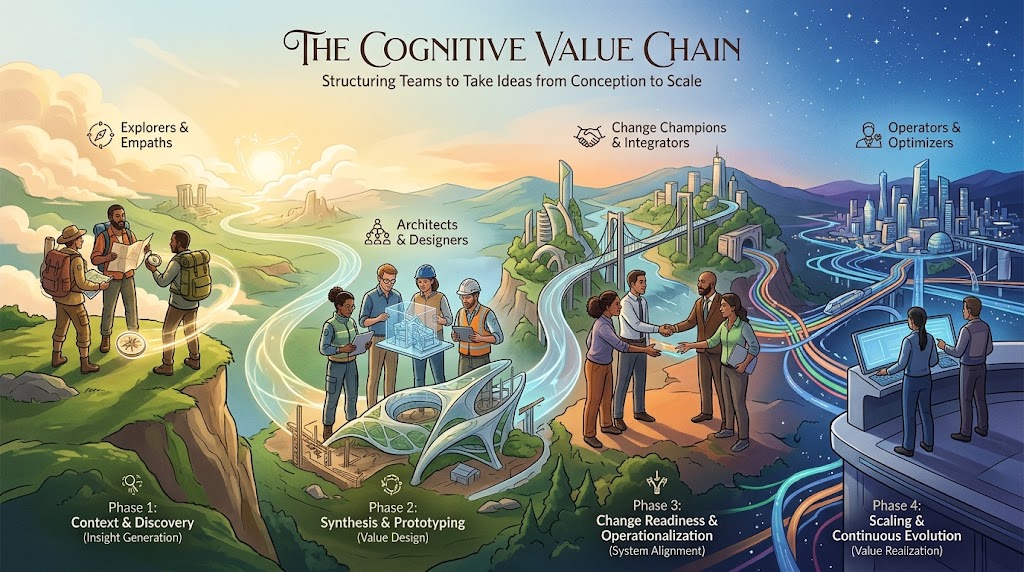
GUEST POST from Art Inteligencia
Executive Summary: The Cognitive Value Chain
Most organizations do not suffer from a shortage of great ideas—they suffer from a systemic inability to move those ideas from initial spark to sustained, enterprise-scale impact.
Traditional innovation approaches treat ideation and execution as binary states. The Cognitive Value Chain redefines innovation as a continuous, human-centered assembly line of distinct cognitive modes. By aligning specific mindsets, team structures, and experience design principles to distinct phases of value creation, leaders can bridge the execution gap and turn friction into momentum.
Core Thesis
Scaling innovation is fundamentally a human-centered change challenge. Success requires intentionally orchestrating four cognitive transitions: shifting from Explorers identifying human needs, to Architects prototyping value, to Integrators building organizational readiness, and finally to Optimizers realizing value at scale.
Key Strategic Takeaways
- Eliminate the Handoff Friction: Great ideas die in the seams between teams. Structuring early integration loops prevents the “Not Invented Here” syndrome before scaling begins.
- Align Mindset to Stage: Assigning execution-oriented mindsets too early stifles discovery, while keeping exploratory mindsets too late prevents operationalization.
- Human-Centered Integration: Change management and experience design cannot be downstream afterthoughts—they must be woven into the fabric of product and service architecture from Day 1.
Phase 1: Context & Discovery (Insight Generation)
Every scalable innovation begins not with a solution, but with deep curiosity and a relentless commitment to understanding human needs and market shifts.
Phase 1 lays the foundation of the Cognitive Value Chain by framing the right problems before jumping to answers. Instead of brainstorming in a vacuum, teams engage in Human-Centered Sensing—evaluating the broader landscape through the dual lenses of customer and employee experience design to uncover latent friction, unarticulated desires, and strategic opportunities.
Phase Blueprint
- Primary Objective: Uncover high-value insights and establish strategic problem-solution fit.
- Cognitive Mode: Divergent, inquisitive, empathetic, and challenge-driven.
- Key Deliverable: Formulated problem statements and customer experience gap analyses.
Team Dynamic: Explorers & Empaths
To succeed in this initial phase, team structures must prioritize cognitive diversity that thrives on ambiguity. The ideal team composition combines:
- Explorers: Individuals who scan horizon trends, challenge long-held organizational assumptions, and connect disparate dots across industries.
- Empaths: Experience design practitioners who listen deeply to users, mapping emotional journeys and uncovering hidden behavioral pain points.
Tooling & Methodology
Insight generation relies on structured inquiry rather than ad-hoc ideation. Teams leverage problem-framing canvases, contextual inquiry, and experience mapping to align organizational strategy directly with authentic market demands. By establishing a rigorous foundation here, organizations ensure that downstream investments are built on validated human value rather than internal guesswork.
Phase 2: Synthesis & Prototyping (Value Design)
Raw insights hold little enterprise value until they are translated into tangible, testable architectures designed for both human desirability and operational viability.
Phase 2 pivots the Cognitive Value Chain from open-ended exploration to purposeful convergence. Here, teams synthesize raw customer and employee insights into initial service models, experience blueprints, and business concepts. Through continuous feedback loops, early designs are de-risked long before capital-intensive deployment begins.
Phase Blueprint
- Primary Objective: Convert raw insights into validated, low-fidelity prototypes and scalable experience architectures.
- Cognitive Mode: Convergent, constructive, analytical, and iterative.
- Key Deliverable: Tested prototypes, experience blueprints, and initial business model hypotheses.
Team Dynamic: Architects & Designers
This phase requires a transition in cognitive posture—moving from open inquiry to systemic construction. The team structure centers on:
- Architects: Strategic thinkers who evaluate technical feasibility, value proposition sustainability, and broader ecosystem integration.
- Designers: Experience specialists who craft user interfaces, touchpoints, and interaction flows to ensure intuitive adoption.
Tooling & Methodology
Rapid experimentation is the cornerstone of value design. Teams utilize experience prototyping, visual charters, and experiment canvases to stress-test assumptions. By measuring real human reactions to early concepts, organizations identify potential friction points and refine the solution while the cost of modification remains low.
Phase 3: Change Readiness & Operationalization (System Alignment)
The greatest threat to a brilliant innovation is not market rejection—it is internal organizational inertia and systemic resistance to change.
Phase 3 bridges the critical chasm between a validated prototype and an enterprise-wide rollout. Instead of treating change management as a late-stage announcement, the Cognitive Value Chain integrates human-centered change design directly into operational planning. This ensures that organizational culture, incentives, governance, and capabilities are aligned long before scaling begins.
Phase Blueprint
- Primary Objective: Overcome organizational friction, build institutional capability, and prepare systems for enterprise adoption.
- Cognitive Mode: Relational, integrative, strategic, and capability-focused.
- Key Deliverable: Change architecture plans, stakeholder engagement roadmaps, and operational transition frameworks.
Team Dynamic: Change Champions & Integrators
Navigating the organizational handoff demands mindsets skilled in empathy, negotiation, and systems thinking. Primary roles include:
- Change Champions: Influencers and leaders across departments who build cross-functional coalition, communicate purpose, and drive cultural buy-in.
- Integrators: Operations and systems experts who reconfigure workflows, update governance structures, and align IT/process architectures with the new experience.
Tooling & Methodology
Success in this phase relies on structured change planning tools, organizational agility frameworks, and stakeholder impact mapping. By proactively diagnosing risk and addressing the human element of change early, teams dismantle the “Not Invented Here” bias and establish frictionless pathways for enterprise scaling.
Phase 4: Scaling & Continuous Evolution (Value Realization)
Innovation reaches its full potential only when scalable delivery is paired with an ongoing commitment to continuous experience refinement.
Phase 4 represents the destination of the Cognitive Value Chain—embedding the innovation seamlessly into the core operating engine of the enterprise. True value realization requires industrializing delivery without losing the human-centered spirit that sparked the original vision. By establishing tight feedback loops, operational teams maintain delivery excellence while constantly feeding fresh signals back into Phase 1 for perpetual learning.
Phase Blueprint
- Primary Objective: Achieve sustained enterprise scale, measure real-world impact, and institutionalize continuous feedback loops.
- Cognitive Mode: Disciplined, analytical, systematic, and optimization-oriented.
- Key Deliverable: Scaled operating models, experience level metrics, and ongoing continuous improvement cycles.
Team Dynamic: Operators & Optimizers
Scaling requires transition to execution-minded cognitive styles focused on consistency, efficiency, and governance. Key capabilities include:
- Operators: Process and delivery leaders who manage day-to-day execution, maintain quality standards, and ensure operational resilience across all channels.
- Optimizers: Data and analytics specialists who track adoption metrics, measure experience level outcomes, and fine-tune system performance.
Tooling & Methodology
Long-term success depends on robust measurement frameworks, experience management oversight, and operational governance dashboards. By continuously monitoring key performance and experience indicators, organizations ensure the value proposition remains vibrant and adaptable to evolving market forces over time.
Conclusion & Strategic Imperative
Innovation is not a solitary lightning strike—it is an orchestrated, human-centered journey from early insight to enterprise realization.
By mastering The Cognitive Value Chain, organizations move past the trap of random ideation and build a resilient capability for sustained value creation. The true bottleneck in modern business is rarely a lack of vision; it is the structural friction between how teams think, collaborate, and adapt across transitions.
The Leadership Call to Action
Leaders must step back from simply managing project outcomes and focus instead on designing the cognitive environment. Audit your organization to identify where your value chain leaks potential: Are you expecting Explorers to drive operational scale, or asking Optimizers to discover breakthrough insights?
Aligning the right cognitive modes, human-centered design practices, and change management principles to each stage of the journey ensures your best ideas don’t just survive the organization—they transform it.
Frequently Asked Questions
What is the primary difference between traditional innovation models and The Cognitive Value Chain?
Traditional models treat ideation and execution as binary steps, often leading to severe handoff friction. The Cognitive Value Chain redefines innovation as a continuous, four-stage human-centered assembly line, systematically aligning specific cognitive mindsets—Explorers, Architects, Integrators, and Optimizers—to each phase of value creation.
Why do great concepts usually fail during Phase 3 (Change Readiness & Operationalization)?
Most concepts stall during operationalization due to internal organizational inertia and the “Not Invented Here” syndrome. Phase 3 addresses this by integrating human-centered change design, organizational agility, and stakeholder alignment into the process before enterprise scaling begins, rather than treating change management as a late-stage afterthought.
How can leaders apply The Cognitive Value Chain to existing teams?
Leaders should conduct a cognitive audit of their innovation process to identify operational bottlenecks. Rather than expecting one team to manage the entire lifecycle, leaders must structure cross-functional transitions that match individuals’ natural cognitive strengths (discovery, architectural design, change integration, or operational optimization) to the appropriate stage of the innovation journey.
EDITOR’S NOTE: Braden Kelley’s Problem Finding Canvas can be a super useful starting point for doing design thinking or human-centered design.
“The Problem Finding Canvas should help you investigate a handful of areas to explore, choose the one most important to you, extract all of the potential challenges and opportunities and choose one to prioritize.”
Image credit: Gemini
 Sign up here to get Human-Centered Change & Innovation Weekly delivered to your inbox every week.