Rethinking Change, Innovation, and Human Potential
GUEST POST from Art Inteligencia
The Fallacy of Automation vs. The Promise of Apprenticeship
The dominant conversation surrounding Artificial Intelligence remains stubbornly stuck in a false binary: either AI will systematically replace human talent across every knowledge domain, or it is merely a glorified backend automation utility. Both perspectives miss the true strategic shift happening right beneath our feet.
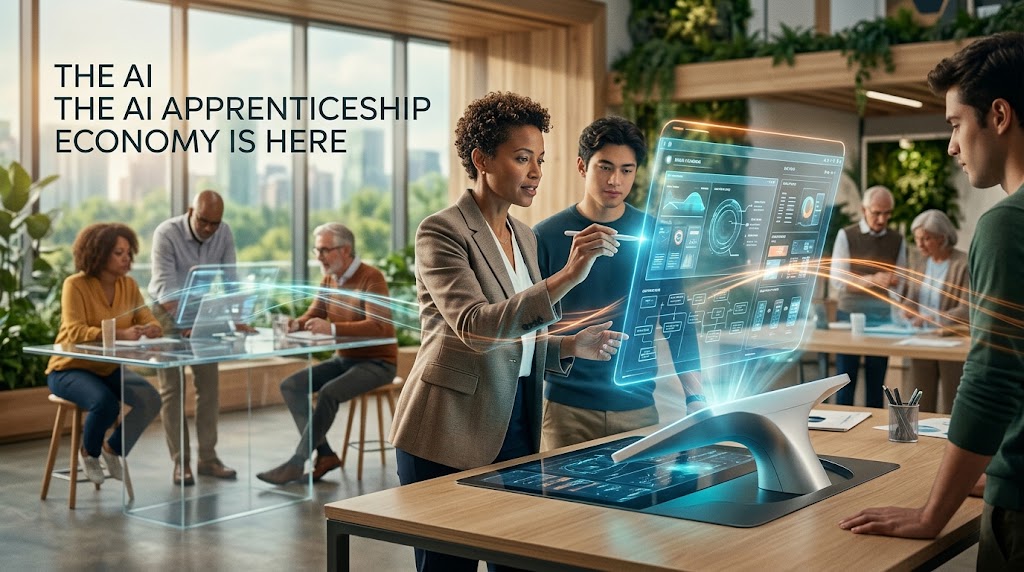
We are entering The AI Apprenticeship Economy. In this new paradigm, AI should not be viewed as an autonomous replacement for human expertise, nor as a static tool. Instead, it functions as a digital apprentice—an eager, extraordinarily fast assistant capable of processing massive volumes of data, but one that inherently lacks context, empathy, strategic nuance, and lived experience.
Just as a master craftsperson guides, curates, and shapes the output of an apprentice, human workers must step into the role of strategic orchestrators. When we reframe AI as a dynamic partner in skill-building and experience design, we unlock unprecedented organizational agility. The leaders and organizations that thrive in this decade won’t be those who use AI to cut headcount, but those who design superior human-centered ecosystems where humans and digital apprentices elevate each other’s potential.
The Core Pillars of the AI Apprenticeship Economy
To successfully integrate digital apprentices into an organization, leaders must move beyond superficial efficiency metrics and rethink how value is generated. The AI Apprenticeship Economy rests on three fundamental structural pillars:
Bidirectional Mentorship
Traditional software training is one-way: humans learn how to operate the system. In an apprenticeship model, the learning loop runs both ways. Human experts continuously train AI agents on tacit domain knowledge, organizational nuance, brand voice, and customer context. In return, AI provides humans with rapid synthesis, real-time pattern recognition, and non-obvious cross-industry insights, accelerating human skill development and decision-making.
Human-Centered Control Loops
An apprentice is never left without supervision on mission-critical work. Designing robust human-in-the-loop and human-on-the-loop architectures ensures that strategic intuition, ethical oversight, and emotional intelligence remain firmly anchored by human judgment. Control loops must be designed not as bureaucratic roadblocks, but as seamless experience touchpoints that allow human experts to easily review, refine, and approve apprentice output.
Accelerated Value-to-Market
When multidisciplinary teams are paired with specialized AI apprentices, the path from idea to validated prototype shrinks from months to days. By treating AI agents as dedicated research, design, and analysis pods, organizations can radically increase their experimentation capacity. This speed enables teams to test more hypotheses, iterate on experience designs faster, and bring high-value innovations to market with significantly reduced risk.
Redesigning Change Management for AI-Human Synergies
Technology alone never transforms an enterprise; culture and experience design do. Scaling the AI Apprenticeship Economy requires a fundamental shift in how we approach organizational change, moving away from top-down mandates toward human-centered enablement.
Overcoming Resistance Through Agency
Fear of obsolescence is the primary driver of resistance to new technologies. When AI is framed as a cost-cutting replacement tool, employees naturally respond with hesitation or passive resistance. By reframing the narrative around agency and mentorship—positioning the employee as the “master” directing a digital apprentice—we shift the dynamic from displacement to empowerment. Workers retain ownership over their domain while delegating low-leverage friction tasks.
Updating Experience Design (EX/UX)
The success of human-AI collaboration hinges on friction-free interface design. Employee Experience (EX) teams must rethink workplace workflows to ensure human-AI handoffs are intuitive and transparent. This means building user experiences where feedback loops are clear, confidence scores are visible, and taking control back from an AI agent requires zero administrative overhead. When interaction models are designed around human cognitive needs, adoption follows naturally.
Building Cultural Infrastructure for Experimentation
In an environment where digital apprentices compress production cycles, innovation becomes a function of psychological safety. Leaders must cultivate a culture that encourages rapid, decentralized experimentation. This involves establishing clear guardrails—so teams know where they have total freedom to test apprentice-assisted ideas—and actively celebrating “smart failures” that yield strategic insights. Without strong cultural permission to experiment, the full value of AI apprenticeships will remain untapped.
A Framework for Innovation Managers
To move from strategic vision to execution, innovation leaders need a practical roadmap for integrating digital apprentices into everyday operational workflows. This three-step framework ensures AI adoption drives measurable business value while keeping human experience at the center.
Step 1: Map the Apprentice Touchpoints
Begin by conducting a workflow audit across your teams to separate high-value strategic thinking from routine operational friction. Identify low-leverage, contextual tasks—such as initial data synthesis, preliminary research summaries, scenario modeling draft generation, or basic prototype coding—that can be safely delegated to digital apprentices. Mapping these touchpoints creates clear boundary lines where human oversight begins and automated assistance ends.
Step 2: Establish Quality Controls & Ethics
An apprentice is only as effective as the governance surrounding its work. Establish clear human-in-the-loop validation checkpoints before any apprentice-generated asset touches customers or critical internal systems. Define robust ethical guidelines, algorithmic bias checks, data privacy standards, and brand alignment rubrics to ensure all outputs meet organizational standards without introducing hidden liabilities or experience drift.
Step 3: Measure Beyond Efficiency
Traditional IT implementations measure success purely by cost reduction or hours saved. In the AI Apprenticeship Economy, efficiency is merely the baseline. Innovation managers must track higher-order value metrics, including:
- Creative Bandwidth: The increase in time employees spend on high-level strategic problem solving and customer experience design.
- Innovation Velocity: The speed at which teams move from initial concept to validated market experiment.
- Experience Level Measures (XLMs): Improvements in internal employee satisfaction, team engagement, and external customer sentiment across AI-augmented touchpoints.
Conclusion: The Future Belongs to the Master Craftsman
The dawn of the AI Apprenticeship Economy represents far more than an incremental upgrade in enterprise software—it demands a fundamental transformation in organizational culture, leadership mindset, and experience design. Leaders who view AI merely as a mechanism for headcount reduction are playing a short-sighted game that risks stripping their organizations of tacit knowledge, domain mastery, and distinct brand value.
The true competitive advantage in this era will belong to organizations that cultivate master craftspeople—leaders and teams capable of setting vision, asking better questions, exercising strategic judgment, and expertly directing fleets of digital apprentices. AI brings the raw compute, processing speed, and scale, but humans bring the cause, empathy, purpose, and creative direction.
By designing human-centered workflows where digital apprentices elevate human potential rather than diminish it, we build resilient organizations capable of navigating perpetual market chaos. The tools are ready; the challenge now is designing the human experience to match.
Frequently Asked Questions
How does the AI Apprenticeship model differ from traditional automation?
Traditional automation seeks to replace human tasks with static, rules-based software to cut costs. The AI Apprenticeship model treats AI as a dynamic partner requiring human direction, context, and ethical curation, aiming to elevate human creative bandwidth and innovation velocity rather than simply reduce headcount.
How do organizations prevent loss of human domain expertise when delegating tasks to AI?
By establishing bidirectional mentorship loops and human-centered control loops. Employees maintain ownership over strategic decision-making and quality governance, positioning the worker as the “master craftsperson” who reviews, refines, and directs the apprentice’s raw output.
What key metrics should leaders track to measure AI Apprenticeship success?
Instead of relying solely on hours saved or immediate cost reduction, leaders should track creative bandwidth (time spent on strategic problem solving), innovation velocity (concept-to-experiment speed), and Experience Level Measures (XLMs) across both employee engagement and customer sentiment.
EDITOR’S NOTE: Braden Kelley’s Problem Finding Canvas can be a super useful starting point for doing design thinking or human-centered design.
“The Problem Finding Canvas should help you investigate a handful of areas to explore, choose the one most important to you, extract all of the potential challenges and opportunities and choose one to prioritize.”
Image credit: Gemini
 Sign up here to get Human-Centered Change & Innovation Weekly delivered to your inbox every week.