Building the Invisible Interfaces of the Symbiotic Workplace
GUEST POST from Art Inteligencia
The Death of the “Input/Output” Era
For the past few years, the narrative of the AI revolution has been dominated by a singular, seductive skill: prompt engineering. We have spent an immense amount of cognitive energy learning how to speak “machine,” refining our syntax, and treating LLMs like high-speed interns that require constant, explicit instruction. But this is a transitory phase, a necessary friction as we navigate the shift from digital tools to digital collaborators.
The problem with the current paradigm is that it keeps us trapped in a “mechanic” mindset. Every time we must pause our creative flow to draft a prompt, we break the cognitive loop required for true innovation. We are focusing on how to *use* the tool, rather than how to *work with* the system.
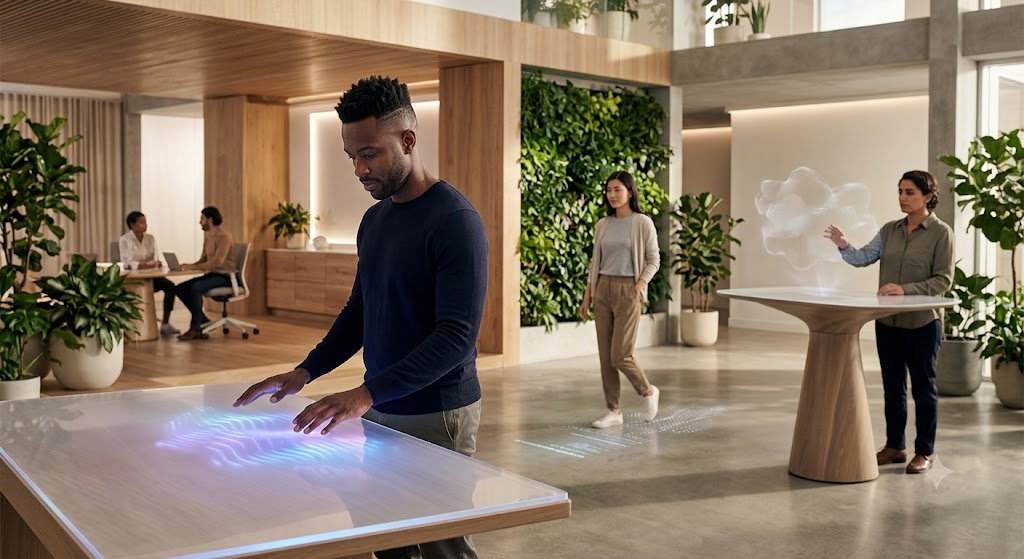
The future of productivity lies in the total dissolution of the interface. We are transitioning toward the “Symbiotic Workplace” — an environment where human intent and machine execution merge so seamlessly that the technology becomes invisible. In this model, the goal is no longer to get a better answer from a chatbot; it is to create an ecosystem that understands our objectives, knows our history, and executes on our behalf before we even think to ask.
From Explicit Commands to Contextual Awareness
The conversational UI (CUI), for all its current popularity, is merely a bridge — not the final destination. Relying on chat interfaces requires us to constantly switch contexts, effectively putting the human in the role of a project manager rather than a creator. True progress demands that we move beyond asking machines to do things and toward systems that understand the “why” behind our work.
True contextual intelligence represents a fundamental shift in how work happens. Instead of waiting for a prompt, the next generation of enterprise systems will anticipate needs by synthesizing data across disparate streams: active calendars, email threads, historical project outcomes, and real-time behavioral signals. By understanding the context of a project, the system can proactively offer the next logical step, draft the necessary components, or flag potential risks before they materialize.
This transition represents a profound change in the human role: moving from “Doing” — the manual, repetitive assembly of outputs — to “Directing” — the high-value work of curating, refining, and approving. In this symbiotic model, the AI stops being a tool we reach for, and starts being an intelligent layer that sits beneath the workflow itself, ensuring that human effort is always applied where it provides the most strategic value.
The Architecture of Invisible Interfaces
To move beyond the conversational interface, we must shift our focus toward ambient computing in the enterprise. This requires moving away from discrete, siloed applications and toward a unified ecosystem where sensors, ambient data streams, and predictive modeling render the “command line” obsolete.
Building truly invisible interfaces requires adherence to three core design principles:
- Proactivity: The system should function as an intuitive partner, suggesting pathways and solutions rather than waiting to be prompted.
- Persistence: Institutional knowledge must be fluid, moving across the enterprise ecosystem automatically without the need for manual logging or status updates.
- Frictionless Handoffs: The objective is to eliminate the “translation layer.” Work should flow between human and machine through shared intent, not through the labor-intensive crafting of prompts.
Central to this architecture is the development of synthetic personas — intelligent interfaces that do not just provide generic responses, but act as extensions of the team’s culture and organizational values. By embedding these personas directly into the fabric of the workspace, we stop treating AI as an external service and begin integrating it as a persistent, evolving member of the collective workforce.
The Human Experience (HX): Designing for Empowerment, Not Obsolescence
As we design for invisibility, the most significant danger we face is losing sight of the human at the center of the process. As manual labor is offloaded to increasingly autonomous systems, the human burden naturally shifts toward higher-order tasks: nuanced judgment, ethical framing, and long-term strategic synthesis. The challenge is not just technical; it is a design imperative to ensure that the removal of friction does not result in the removal of human agency.
Maintaining agency means that “invisible” must never mean “opaque.” While the system handles the heavy lifting of execution, the underlying logic, decision pathways, and data sources must remain auditable and clear. We must guard against the “black box” syndrome where convenience compromises transparency, ensuring that humans remain the architects of the outcomes, even when they are not the authors of the individual tasks.
Furthermore, we must intentionally design for serendipity. Algorithmic efficiency is a double-edged sword; while it optimizes for known paths, it can inadvertently prune the unstructured interactions and “happy accidents” that drive true innovation. In a symbiotic workplace, the goal of our interfaces should be to provide a scaffolding for excellence while leaving ample space for human intuition, debate, and the messy, creative friction that defines exceptional work.
Strategic Imperatives for the Futurist Leader
The transition to a symbiotic workplace requires a fundamental rethink of leadership and organizational development. We must move beyond the current obsession with technical upskilling—specifically “prompt engineering”—and pivot toward cultivating a workforce capable of high-level orchestration.
To prepare for this shift, leaders must focus on three strategic pillars:
- From Prompting to Orchestrating: We need to stop training employees on how to “talk” to AI and start training them to manage ecosystems. Success will be defined by the ability to align autonomous agents with business objectives and oversee the quality of their outputs.
- Managing the Cultural Shift: Automation anxiety is real, but it is often rooted in a fear of obsolescence. Leaders must reframe the narrative, positioning AI as a vehicle for offloading low-value labor so that staff can refocus their energy on high-value human problems—innovation, empathy, and strategy.
- Infrastructure Modernization: The era of centralized, rigid IT stacks is coming to an end. Organizations must pivot toward decentralized, AI-integrated workflows that allow data and intent to flow fluidly between humans and machines, breaking down the silos that prevent true collaboration.
In this new landscape, the leader’s role is not to manage the work itself, but to manage the conditions under which work happens. By focusing on orchestrating these symbiotic relationships, you empower your team to focus on the problems that machines cannot solve.
The Symbiotic Future
The trajectory of the modern workplace is clear: the most powerful interface is the one that disappears. We have spent years treating technology as a tool to be wielded; we are now entering an era where technology is a partner to be integrated. By moving beyond the limitations of prompt engineering, we unlock the potential for a truly symbiotic enterprise — one where friction is reduced, agility is amplified, and the human spirit is freed to pursue higher-order creative work.
This is a call to action for every leader, architect, and strategist: stop asking how to get your AI to do what you want, and start asking what your organization can achieve when the friction of technology is finally removed. We must shift our focus from optimizing the machine to optimizing the *partnership* between human intent and artificial capability.
True innovation does not happen when we build better tools for people; it happens when we build systems that grow with them. The symbiotic workplace is not a distant vision — it is an architectural choice we make today. Let us design not for the commands of the past, but for the invisible, powerful, and seamless possibilities of the future.
Frequently Asked Questions
What is the symbiotic workplace?
The symbiotic workplace is an organizational environment where human intent and machine execution merge seamlessly. It moves beyond manual interactions like prompt engineering toward an ambient, intelligent ecosystem that anticipates needs and aligns technology with business objectives.
Why is “invisible interface” design important?
Invisible interfaces remove the cognitive friction of manual inputs, allowing workers to focus on high-level strategy and creative problem-solving rather than managing technical tools. This shifts the focus from “doing” work to “directing” outcomes.
How should leaders prepare for the transition to AI-integrated workflows?
Leaders should shift their focus from training employees on technical prompting to fostering skills in orchestration, ethical decision-making, and strategic alignment, while moving toward decentralized IT infrastructures that support fluid human-machine collaboration.
Bottom line: Futurists are not fortune tellers. They use a formal approach to achieve their outcomes, but a methodology and tools like those in FutureHacking™ can empower anyone to be their own futurist.
Image credit: Gemini
 Sign up here to get Human-Centered Change & Innovation Weekly delivered to your inbox every week.